• KGS/USD = 0.01143 -0%
  • KZT/USD = 0.00198 -0%
  • TJS/USD = 0.10899 0.65%
  • UZS/USD = 0.00008 -0%
  • TMT/USD = 0.28490 -0.28%
  • KGS/USD = 0.01143 -0%
  • KZT/USD = 0.00198 -0%
  • TJS/USD = 0.10899 0.65%
  • UZS/USD = 0.00008 -0%
  • TMT/USD = 0.28490 -0.28%
  • KGS/USD = 0.01143 -0%
  • KZT/USD = 0.00198 -0%
  • TJS/USD = 0.10899 0.65%
  • UZS/USD = 0.00008 -0%
  • TMT/USD = 0.28490 -0.28%
  • KGS/USD = 0.01143 -0%
  • KZT/USD = 0.00198 -0%
  • TJS/USD = 0.10899 0.65%
  • UZS/USD = 0.00008 -0%
  • TMT/USD = 0.28490 -0.28%
  • KGS/USD = 0.01143 -0%
  • KZT/USD = 0.00198 -0%
  • TJS/USD = 0.10899 0.65%
  • UZS/USD = 0.00008 -0%
  • TMT/USD = 0.28490 -0.28%
  • KGS/USD = 0.01143 -0%
  • KZT/USD = 0.00198 -0%
  • TJS/USD = 0.10899 0.65%
  • UZS/USD = 0.00008 -0%
  • TMT/USD = 0.28490 -0.28%
  • KGS/USD = 0.01143 -0%
  • KZT/USD = 0.00198 -0%
  • TJS/USD = 0.10899 0.65%
  • UZS/USD = 0.00008 -0%
  • TMT/USD = 0.28490 -0.28%
  • KGS/USD = 0.01143 -0%
  • KZT/USD = 0.00198 -0%
  • TJS/USD = 0.10899 0.65%
  • UZS/USD = 0.00008 -0%
  • TMT/USD = 0.28490 -0.28%
07 December 2025

Viewing results 1621 - 1626 of 2282

The C5+1 Concept: The Idea Behind This Week’s B5+1 Forum in Almaty

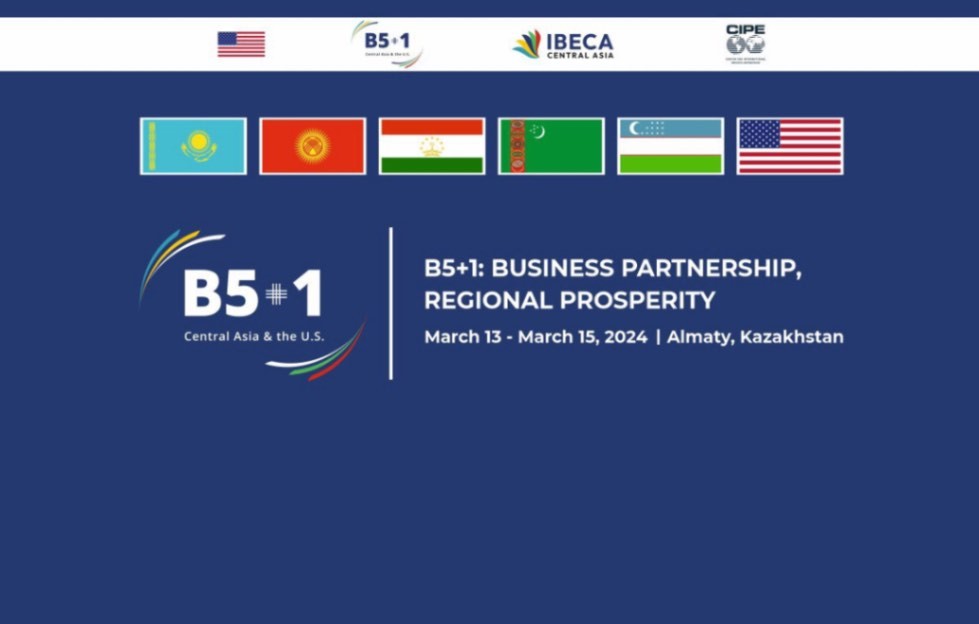
Recognizing that the Central Asia region could benefit more from initiatives in global security, business and trade if its countries strengthened their cooperation in key areas, the Center for International Private Enterprise (CIPE) created the ‘C5+1’ platform last year for just this purpose. The Center’s 5+1 group features the governments of the five Central Asian republics – Kazakhstan, Uzbekistan, Kyrgyzstan, Tajikistan and Turkmenistan – plus the United States, whose State Department and international chambers of commerce are central to the platform’s work. An inaugural C5+1 Summit was held in September 2023, on the sidelines of the 78th session of the UN General Assembly in New York. At this high-level meeting, the presidents of each of the Central Asian nations joined US president Joe Biden in dialog on enhancing the region’s stability and prosperity through economic, energy, and security partnerships within the C5+1 framework.  Building on this start made by C5+1, CIPE is now launching the ‘B5+1’ format, focused on cooperation in the global business context. The inaugural B5+1 Forum will take place this week in Kazakhstan’s business capital of Almaty, and will include presentations and panel discussions with policy makers from the United States, Central Asia and several other countries. On 14 and 15 March leaders from the public sector will discuss Central Asia’s economic integration, international trade and investment alongside dozens of influential private companies.  The B5+1 Forum will pick up where the C5+1 Summit left off in exploring opportunities for American companies in Central Asia. This potential lies in key sectors such as critical minerals, renewable energy and manufacturing. The Almaty event will also continue the conversation on enhancing regional connectivity via the Trans-Caspian International Transport Route, also known as the Trans-Caspian Corridor. At a time of geopolitical upheaval and disruption of existing supply chains, international investment in this trade route is being sought through the Partnership for Global Infrastructure and Investment. The B5+1 Forum forms part of CIPE’s program called “Improving the Business Environment in Central Asia” (IBECA). CIPE themselves are affiliated to the US Chamber of Commerce – the catalyst behind the B7 and B20 platforms – and receive funding from the US Department of State.  The establishment of B5+1 is closely aligned with commitments made during the C5+1 Summit last September, and outlined in a document called the New York Declaration. The upcoming Forum aims to deliver on two key commitments in the declaration.   The Times of Central Asia will be in attendance at the B5+1 Forum on 14-15 March, and will be publishing insight and analysis from the event.

Letting Women Lead: Bridging the Finance Gap for Women-Led Businesses

Opinion by Hela Cheikhrouhou, IFC Regional Vice President, Middle East, Central Asia, Türkiye, Afghanistan, and Pakistan I get to meet many courageous women in my work for IFC in Southwest and Central Asia. [1] I’ve witnessed the seemingly insurmountable challenges they encounter every day. I’ve seen the unyielding resolve of rural women in Tattha, Pakistan in the face of climate change-induced severe floods, and the stunting of their children due to a lack of potable water. I’ve heard the heartening stories of female leaders shattering the glass ceiling in Kuwait. I’ve had passionate discussions with women entrepreneurs who are struggling to secure financing in a region where very few formal enterprises are majority owned by women. In Kazakhstan, that proportion is just 23.8 percent. In Jordan, it’s 8.1, in Lebanon, 4.7. Closing the economic gender gap is even more urgent due to the region’s poor performance in the World Bank's Women, Business and Law 2023 score: Nearly half its countries ranked lowest on the index. Their struggles remain largely invisible to the world. But, with entrenched economic challenges and escalating fragility and conflict, we can no longer afford to avert our eyes from the issues faced by half of the global population. The numbers reveal a disturbing gender disparity. In 2022, female labor force participation in the Middle East, Central Asia, Afghanistan, Pakistan, and Türkiye (MCT) stood at 26 percent of women at working age, compared to 75 percent for men. This isn’t just a matter of equity—failing to bridge economic gender gaps in these countries casts a dark shadow on the region's annual GDP. The valiant voices I've encountered have shone a light on the key challenges preventing women from thriving in, or even entering the work force: the lack of flexible working arrangements, robust measures to combat harassment, safe transportation, affordable childcare, and better access to a quality education. Showcasing female role models would also help inspire girls and young women to pursue a career. In the entrepreneurial landscape, the uneven playing field makes survival and growth an uphill battle for women-led businesses. The dearth of funding directed towards women entrepreneurs is another key obstacle—a mere 7 percent of private equity and venture capital in emerging markets is invested in women-founded startups. Many factors contribute to women’s limited access to startup capital. One reason is this staggering statistic: only about 15% of all VC 'cheque-writers' are women. This glaring absence of a female perspective in the venture capital space invites unconscious biases. A lack of collateral, due to limitations on women’s access to asset ownership, further exacerbates women entrepreneurs' lack of access to funding. But the challenges go far beyond finance. Social and cultural norms act as significant barriers to women's entrepreneurship. For example, cultural expectations see childcare responsibilities placed mainly on women—preventing them from excelling in the entrepreneurship space. Yet hidden behind these challenges are outsized opportunities. The potential benefits of financing women-led businesses are substantial for both banks and investors. Research consistently shows that a gender-balanced portfolio...

Land Cleared for Tourism next to Old Bukhara; UNESCO Urges Pause

Despite UNESCO’s concerns, Uzbekistan is pushing ahead with plans for a big tourist complex next to the historical center of Bukhara, a jewel of medieval architecture in Central Asia. Workers are already clearing areas for “Eternal Bukhara,” a tourist facility that will boast a museum, teahouses and restaurants offering national cuisine, craft stalls and workshops for gold and blacksmithing, embroidery, wood carving, pottery, and painting. The design intends to evoke the urban layout of past centuries, with traditional drainage systems and ponds. All this construction would happen in part of the buffer zone surrounding the old city, potentially increasing the flow of tourists, but also putting more pressure on the integrity of the ancient site. Bukhara, a destination on the Silk Route that is more than 2,000 years old, contains the tomb of the ruler Ismail Samani, an emblem of 10th century Muslim architecture, as well as many ancient madrasas, or Islamic schools, according to UNESCO. [caption id="attachment_15561" align="aligncenter" width="843"] Traveler Veronika Karobitskaya looks toward the Kalyan Mosque in the ancient city of Bukhara, Uzbekistan. Karobitskaya, a Russian citizen, visited Bukhara in September 2022 and said she was “completely fascinated” by the city’s heritage. Photograph: Veronika Karobitskaya[/caption] [caption id="attachment_15562" align="aligncenter" width="960"] A view of the Kalon Minaret, a major landmark in Bukhara. Photograph: Veronika Karobitskaya[/caption] The historical center of Bukhara, registered on the world heritage list of the U.N. cultural agency in 1993, comprises 216 hectares and its buffer zone comprises 339 hectares. Some demolition has begun on the 32.6 hectares earmarked for the tourist complex, including at a sports stadium. Last year, some Bukharan residents appealed to the government not to dismantle the stadium, saying 1,200 children and 50 coaches use the stadium every day. A total of 29 buildings and facilities are slated for demolition. They include the Bukhara government building, designed by Uzbek architect Richard Blaise and built in 1980, as well as secondary and music schools, and social centers. Local authorities have tried to reassure residents who say they wish the tourist complex could be built further from the historical center. “It should be noted that on the basis of this project, it is planned to create a green park for residents and guests of Bukhara to walk in two-thirds of the area planned. In this regard, the trees in the area established earlier in accordance with the ´Green Bukhara´ program in the project area will be fully preserved and will be enriched as a new garden landscape,” the regional administration said in a report. According to UNESCO, however, there are laws and urban planning codes that “provide protection of monuments of cultural heritage and their buffer zones.” Sara Noshadi, director of UNESCO’s office in Uzbekistan, said on X, formerly Twitter, on March 2 that the U.N. agency is closely monitoring the Bukhara’s ancient site and was aware of local concerns about “potential construction plans” in the buffer zone. [caption id="attachment_15563" align="aligncenter" width="843"] Russian tourist Veronika Karobitskaya, who visited Bukhara in 2022, stands next to the...

Religion in the Cities of Kazakhstan – Opinion by Gulmira Ileuova

The research discussed in this article was conducted in July-August 2023 by the Strategy Center for Sociological and Political Studies Public Foundation in collaboration with the office of the Rosa Luxemburg Foundation in Central Asia. A total of 1,604 people were surveyed in six cities. Since the goal of the project was to study atheism and atheistic views, the choice of where to conduct the survey was made based on the latest census data, according to which the following regions/cities had the highest proportions of nonbelievers: Kostanay Region (4.84%), Mangystau Region (4.38%), Almaty (4.32%) and Shymkent (3.65%), versus an average across the whole country of 2.25%. Table 1. Religion of the population of Kazakhstan (%; census data)   Muslim Orthodox Refused to answer Nonbeliever Kazakhstan overall 69.31 17.04 11.01 2.25 In cities 64.45 20.45 11.84 2.81   Of course, the term “nonbeliever” is not necessarily equivalent to the concept of “atheist,” but nevertheless we decided to start with these statistics with the goal of understanding the religious identities of city residents in the given areas and identifying the reasons contributing to the increased share of nonbelievers, including atheists. This study was conducted in cities at three administrative-territorial levels: so-called “cities of republic significance” (Almaty and Shymkent); regional capitals (Kostanay and Aktau); small towns (Rudny and Zhanaozen). The survey in these six cities showed that 72% considered themselves Muslim, 10% Orthodox and 4% atheist (Rudny 5.6%, Almaty 4.7%, Zhanaozen 4.5%, Kostanay 3.0%), while about 1% named other denominations (“protestant movements,” “Baptists,” “Jehovah’s Witnesses,” “New Life”). Twelve percent refused to answer the question, while 1% could not answer. Analyzing the responses to this question by age, we see that there are more atheists in the youngest age group of 18-24 years old at almost 5%, while in this same cohort, as well as in the 31-49 age group there is a higher proportion of Muslims (77% each, versus 65% in the 50+ group). A higher share of people over 50 are Orthodox Christians, while in this oldest group more people also refused to the question (17%). Thus, 87% of city dwellers who took part in the survey reported that they were followers of one religion or another. However, if we use the Dawkins spectrum (of theistic probability) – which we slightly modified for the purposes of this study – we see that among those surveyed only 77% were believers. Overall, only 48% were strong theists, absolutely convinced that God exists. Another 29% were uncertain that God exists but still assume so. Twenty percent classified themselves as agnostics – lacking a clear position on whether God exists or not – while 3% are atheists, strong or uncertain.   Table 2. Which statement best reflects your position? (% of total respondents) Statement Share, % Decided theist (I am convinced that God exists) 47.9 Uncertain theist (I do not know for sure that God exists, but the probability is high, so I believe that he does) 29.4 Agnostic (I do not know whether God exists...

Great Women in the History of the Kyrgyz Republic

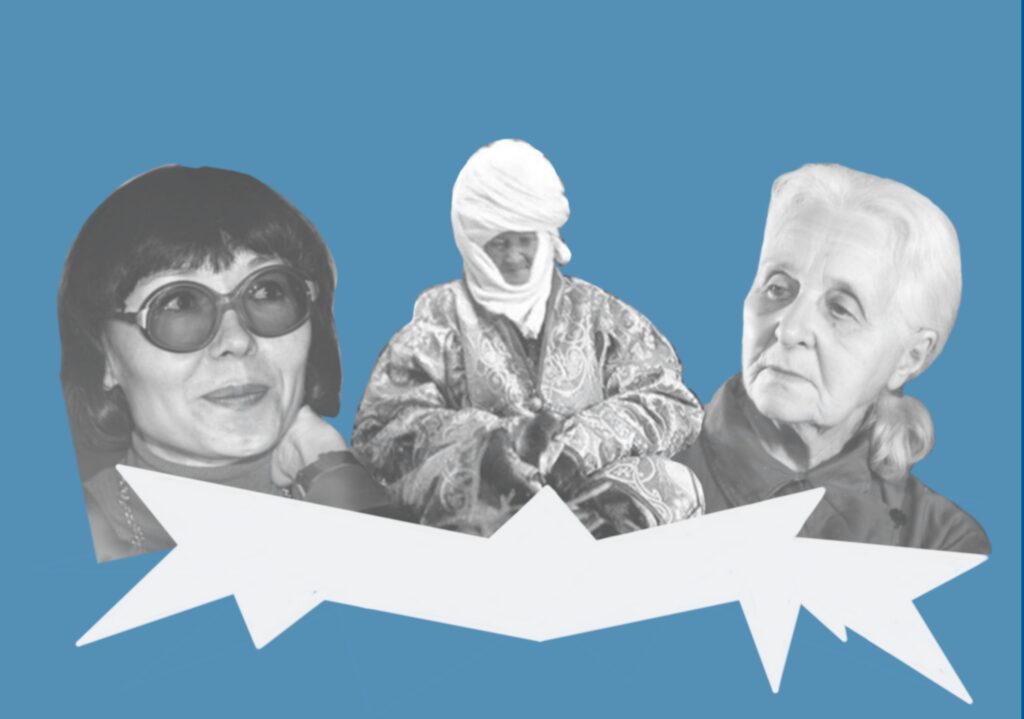
Nestled in the heart of Central Asia, Kyrgyzstan boasts a rich tapestry of history woven by extraordinary women who have played pivotal roles in shaping the nation. From political pioneers to cultural icons, these women have left an indelible mark on the nation. To mark International Women’s Day, we remember some great women in the history of Kyrgyzstan, acknowledging their contribution and enduring impact.  Kurmanjan Datka[/vc_column_text][vc_single_image image="15382" img_size="full" el_class="scond-image" parallax_scroll="no" woodmart_inline="no"][vc_column_text woodmart_inline="no" text_larger="no"]Photo: Carl Gustav Mannerheim Known as the "Queen of the South," Kurmanjan Datka, the “Tsaritsa of Alai” was a courageous and noble woman who was not afraid to break with tradition. An important politician, in the second half of the eighteen century Kurmanjan ruled over the region wisely. Seeking both compromise and fighting for the rights of her people, she played a crucial role in unifying the Kyrgyz tribes during a tumultuous period, when her leadership and diplomacy skills were instrumental in maintaining peace. Aside from Kurmanjan, no other woman has ever been honored with the title "Datka" - meaning "general" - in the history of Kyrgyzstan. Kurmanjan was the only woman to rule over the Kyrgyz nation. Recognized as the "mother of the nation," 2011 was declared the year of Kurmanjan Datka in the Republic, where her face adorns banknotes. Olga Manuilova[/vc_column_text][vc_single_image image="15302" img_size="full" el_class="scond-image" parallax_scroll="no" woodmart_inline="no"][vc_column_text woodmart_inline="no" text_larger="no"]Photo: ilgeri.kg Olga Manuilova's contributions were valued highly by the Government of the Kyrgyz SSR, which in 1954 recognized her with the prestigious title, People's Artist of the Kyrgyz SSR. In acknowledgment of her outstanding work, she was also honored with many other awards, including the Order of the Red Banner of Labor, the Badge of Honor, and the medal For Valorous Labor. Additionally, Manuilova received commendations in the form of diplomas from the Supreme Soviet of the Republic. Among her notable creations were artistic masterpieces such as "Builders of the Great Chui Canal," "In Aid of the Front" from 1942, and a monument to General Panfilov, which entwined her work with the fate of the nation. These remarkable works earned Manuilova the distinguished title of "Honored Art Worker of the Kyrgyz SSR." This recognition underscored the significant impact of her artistic endeavors and highlighted her exceptional role in contributing to the cultural and artistic heritage of Kyrgyzstan. In 1973, a main belt asteroid was named after her. Urkuya Salieva[/vc_column_text][vc_single_image image="15305" img_size="full" el_class="scond-image" parallax_scroll="no" woodmart_inline="no"][vc_column_text woodmart_inline="no" text_larger="no"]Illustration: limon.kg At the age of just seventeen, in 1927 Salieva became the secretary of her local Komsomol cell in the Osh Oblast, indicating her early inclination towards political activism. The following year, she defied societal expectations by assuming the role of chairperson for the council of her birth village of Murkut. Displaying exceptional leadership, Salieva was elected chairperson of the Kyzyl-Asker collective farm despite opposition from affluent individuals who underestimated her ability to navigate the challenges of this role. Showing devotion to her people, Salieva worked tirelessly to surpass all expectations, securing a seat on the Central Executive Committee of the Kyrgyz...

Great Women in the History of Kazakhstan

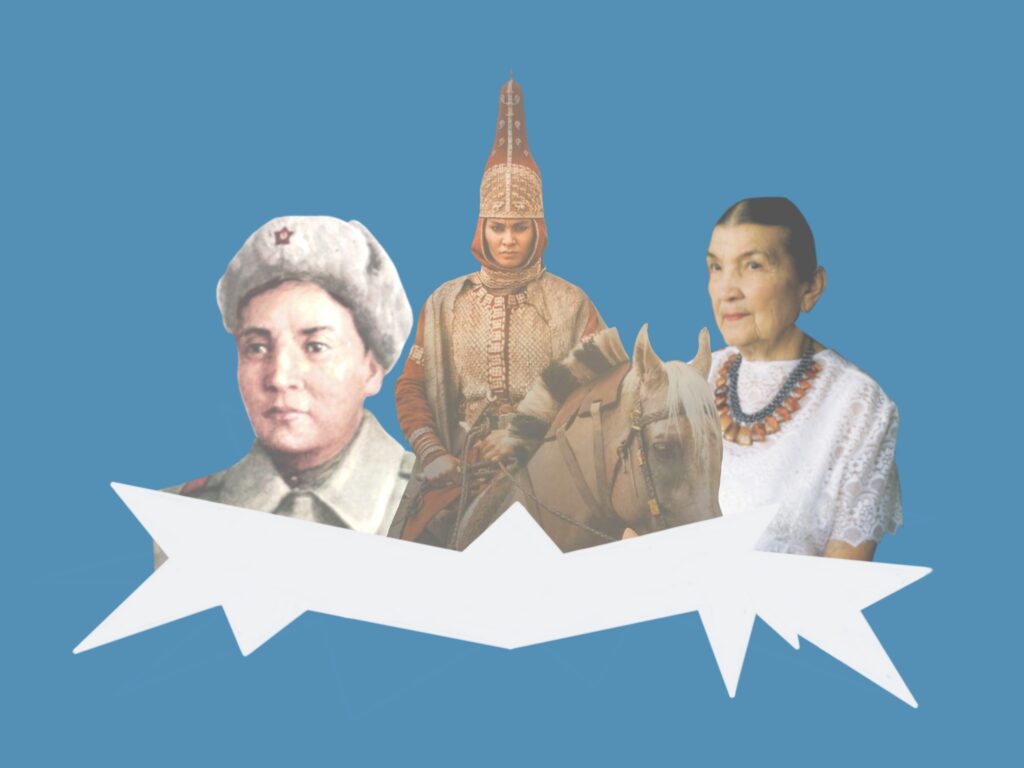
Women have played an important role in the history of Kazakhstan, making a significant contribution to the development of the country. They have shown courage, determination and talent in various walks of life, from politics and education to culture. Today, their role is being recognized, and women in Kazakhstan are becoming more aware of their actions than ever before. "I have always been inspired by our women, the women of the great steppe," Karina from Taraz told TCA, "especially in the field of culture, because at that time, such professions were considered solely for men. Thanks to them, we now have the opportunity not only to work in such professions, but also to become respected individuals." "Because of them, I have the opportunity to become whatever I want to be," Alina from Astana told TCA. "Their talent and drive has given freedom to the next generation." Today, on International Women's Day, we take a look at some of the outstanding women whose lives have had a fundamental impact on the course of the nation's history. Tomyris[/vc_column_text][vc_single_image image="15001" img_size="full" el_class="scond-image" parallax_scroll="no" woodmart_inline="no"][vc_column_text woodmart_inline="no" text_larger="no"]A still from the movie, "Tomyris" The name of Tomyris, the Queen of the Massagetes, is well-known in the culture of Kazakhstan, and is a source of pride and inspiration for Kazakhstani women. Queen Tomyris fought the mighty Persian king, Cyrus the Great, demonstrating her military prowess and intransigence. Tomyris won the battle, in which most of the Persian Army was destroyed. According to a legend, she placed Cyrus’ head in a wine fur filled with blood, saying: "You thirsted for blood, king of the Persians, so drink it now to your heart's content." Thus, Tomyris brought peace to her people. Nazipa Kul zhanova[/vc_column_text][vc_single_image image="15002" img_size="full" el_class="scond-image" parallax_scroll="no" woodmart_inline="no"][vc_column_text woodmart_inline="no" text_larger="no"]Photo: kaznu.kz Nazipa Kul zhanova was the first accredited female teacher in Kazakhstan and the first female journalist on the editorial staff of Yenbekshi Kazakh (Working Kazakh). An educator, ethnographer and translator, she became the preeminent specialist in the preparation of the Kazakh alphabet. Among other things, her philosophical articles addressed the role of a woman's place in public life and in the family. A proponent of the importance of education and the active participation of women in the progress and development society, Kulzhanova stated that "A woman is the mother of the people. Only an educated, skillful, free woman is able to raise her people to the level of advanced nations." Nagima Arykova[/vc_column_text][vc_single_image image="15003" img_size="full" el_class="scond-image" parallax_scroll="no" woodmart_inline="no"][vc_column_text woodmart_inline="no" text_larger="no"]Photo: Rate.kz Nagima Arykova was an outstanding woman stateswoman and one of the leading lights of the women's movement in Kazakhstan. She was the author of "The Role of a Woman Commissioner" and "The Struggle for the Rights of Working Women in Kazakhstan." Arykova was the editor of the newspaper Kazakh capital, and was the first woman to become a leading member of the government of Kazakhstan. Manshuk Mametova[/vc_column_text][vc_single_image image="15004" img_size="full" el_class="scond-image" parallax_scroll="no" woodmart_inline="no"][vc_column_text woodmart_inline="no" text_larger="no"]Photo: pochta-polevaya.ru Manshuk Mametova was a machine-gunner during the Second World War and...