• KGS/USD = 0.01143 -0%
  • KZT/USD = 0.00198 -0%
  • TJS/USD = 0.10899 0.65%
  • UZS/USD = 0.00008 -0%
  • TMT/USD = 0.28490 -0.28%
  • KGS/USD = 0.01143 -0%
  • KZT/USD = 0.00198 -0%
  • TJS/USD = 0.10899 0.65%
  • UZS/USD = 0.00008 -0%
  • TMT/USD = 0.28490 -0.28%
  • KGS/USD = 0.01143 -0%
  • KZT/USD = 0.00198 -0%
  • TJS/USD = 0.10899 0.65%
  • UZS/USD = 0.00008 -0%
  • TMT/USD = 0.28490 -0.28%
  • KGS/USD = 0.01143 -0%
  • KZT/USD = 0.00198 -0%
  • TJS/USD = 0.10899 0.65%
  • UZS/USD = 0.00008 -0%
  • TMT/USD = 0.28490 -0.28%
  • KGS/USD = 0.01143 -0%
  • KZT/USD = 0.00198 -0%
  • TJS/USD = 0.10899 0.65%
  • UZS/USD = 0.00008 -0%
  • TMT/USD = 0.28490 -0.28%
  • KGS/USD = 0.01143 -0%
  • KZT/USD = 0.00198 -0%
  • TJS/USD = 0.10899 0.65%
  • UZS/USD = 0.00008 -0%
  • TMT/USD = 0.28490 -0.28%
  • KGS/USD = 0.01143 -0%
  • KZT/USD = 0.00198 -0%
  • TJS/USD = 0.10899 0.65%
  • UZS/USD = 0.00008 -0%
  • TMT/USD = 0.28490 -0.28%
  • KGS/USD = 0.01143 -0%
  • KZT/USD = 0.00198 -0%
  • TJS/USD = 0.10899 0.65%
  • UZS/USD = 0.00008 -0%
  • TMT/USD = 0.28490 -0.28%
07 December 2025

Viewing results 811 - 816 of 1312

Unveiling the Magic: Behind the Scenes of “Baikonur”

Space continues to capture our imagination and inspire our stories, as we try to make sense of this vast final frontier. In the last part of our series on Baikonur, we explore its depiction within cinema. In 2011, German filmmaker, Veit Helmer released Baikonur, a story about space, scavenging and misguided love that was shot within the region. TCA spoke to him about filming in this heavily restricted landscape.   TCA: What was the inspiration behind your film, Baikonur? What drew you to this subject matter? Helmer: I was fascinated by the actual place, or what I knew about it; a hidden city with such a glorious past. Whilst researching, I found out about the scavengers who collect the pieces which fall on the steppe when the rockets are heading to space. To tell both stories at the same time intrigued me: space exploration and hunting for scrap metal. TCA: Given you also directed Absurdistan and Tuvalu, would it be fair to say you’re drawn to far-flung places? Helmer: Yes, I love to explore and find locations which haven’t been filmed before. But compared to the locations of my previous films - Tuvalu, which was shot in Bulgaria, and Absurdistan, which was shot in Azerbaijan - to travel to Baikonur was a much longer journey. [caption id="attachment_21684" align="aligncenter" width="2560"] Still from the film, "Baikonur," Alexander Asochakov as "Gagarin" leaving, villagers standing near yurt; image: Veit Helmer[/caption]   TCA: As stated in the tagline of your film, “Whatever falls from heaven, you may keep. So goes the unwritten law of the Kazakh seppe. A law avidly adhered to by the inhabitants of a small village, who collect the space debris that falls downrange from the nearby Baikonur space station.” The village scavengers portrayed in your film are based in reality; how did you find out about them, and what was your experience with them? Helmer: It was very funny reading the first review from Kazakhstan, where a young journalist wrote that the film is based on the old Kazakh law “Whatever falls from heaven, you may keep,” which in reality was an invention by my screenwriter, Sergey Ashkenazy. But as this fable seems to feel so real, I never tried to dispel that myth. When writing the screenplay, Sergey and me went to Zheskaskan and the surrounding steppe, talking to the hunters of the scrap metal. It was not an ideal moment, because Roscosmos started to collect the debris themselves and the local villagers’ activity became illegal. The new reality was not villages against each other, but villagers against Roscosmos. [caption id="attachment_21685" align="aligncenter" width="2560"] Still from the film, "Baikonur," Alexander Asochakov as "Gagarin" (center) cleaning assembly hall in Baikonur ; image: Veit Helmer[/caption]   TCA: As a Western filmmaker you were granted a unique opportunity to film within Baikonur - what did you observe of the landscape? What were the highlights of this experience? Helmer: There was a saying among the early cosmonauts that the Central Asian steppe was for them...


Balancing Regional Integration Amid Global Rivalries

Central Asia has become a focal point for world and regional powers such as China, Russia, the European Union, the United States, and Turkey. Amid geopolitical uncertainty and a shifting global order, regional cooperation seems to be a top priority for Kazakhstan, Kyrgyzstan, Uzbekistan, Turkmenistan, and Tajikistan in their foreign policy. The problem, however, is that the absence of a unified regional identity among Central Asian nations poses a major obstacle to their ambitions to strengthen regional integrations. They have different views on their regional identity due to their unique cultures, histories, politics, and economies. But in spite of that, on June 9, in the Kazakh capital of Astana, leaders of the five Central Asian countries gathered to discuss closer economic cooperation, stability and security in the region. They sought to expand ties in trade, industry, transport and logistics, energy, agriculture, as well as in the water management. As a result of the summit, regional leaders signed several key agreements, including the Roadmap for development of regional cooperation for 2025-2027, as well as the Conceptual framework of development of regional cooperation Central Asia 2040. These documents indicate that the regional integration will be a long-term process that will last for decades. In the meantime, Central Asian states will almost certainly continue strengthening bilateral ties. The Consultative Meetings of the leaders of Central Asian countries gave Kazakhstan and Uzbekistan another opportunity to deepen cooperation in various fields. The two nations, who signed an agreement on allied relations in 2022, announced their plans to adopt a strategic partnership program until 2034, and also to jointly launch several big economic and energy project. Prior to the meeting in Astana, presidents of Kazakhstan, Kyrgyzstan, Uzbekistan, Turkmenistan, and Tajikistan held talks with Azerbaijani leader Ilham Aliyev. They were also scheduled to meet with Japanese Prime Minister Kishida Fumio, but he canceled his visit to Astana after the Japan Meteorological Agency issued a warning of a potential earthquake in the Nankai Trough. Unlike him, Josep Borrell, Vice-President of the European Commission and High Representative of the European Union for Foreign Affairs and Security Policy, visited Central Asia in early August. He traveled to Kazakhstan and neighboring Kyrgyzstan– a country that signed the Enhanced Partnership and Cooperation Agreement with the European Union on June 25. Although both nations are members of the Russian-led Eurasian Economic Union (EAEU), and the Collective Security Treaty Organization (CSTO) Moscow’s preoccupation with the war in Ukraine has allowed other actors, including the European Union, to strengthen its presence in the strategically important region. While the EU’s goals in Central Asia are mainly related to energy, Japan’s plans to expand cooperation with the five regional countries serve as Tokyo’s strategic tool to counterbalance China's growing influence in the region. Azerbaijan, on the other hand, seeks to create a strategic energy bridge linking Central Asia and Europe via the South Caucasus. That is why Baku’s collaboration with Central Asian countries in the energy sector has become more crucial than ever. It is no surprise...

Blast off to Baikonur: A Space Tourist’s Odyssey

Space tourism is a growing industry, with visitors to Baikonur attending launches, especially missions to the International Space Station. The town is a leased Russian enclave ensconced within Kazakhstan, including the cosmodrome which is controlled by Roscosmos, the Russian space agency. After NASA ended its Space Shuttle program in 2011, Baikonur became the only launch site to the International Space Station (ISS) until 2020. Now, 60 years after space travel began, it still remains an important gateway to the stars. As described by Megan Eaves, “Baikonur is in many ways a perfect relic of the Soviet 1960s. Stoic mosaics depicting muscular comrades heralding a new era of space still decorate entrance gates and the walls of the town's functional, Brutalist apartment blocks, which once housed construction workers, aerospace engineers and space families. Inside the cosmodrome, crumbling hangars stand side-by-side next to the original, minimalist cottages where Yuri Gagarin and the early cosmonauts slept.” [caption id="attachment_21654" align="aligncenter" width="800"] Statue of Yuri Gagarin in the town of Baikonur, Kazakhstan; image: Ric Gazarian[/caption]   Near a hotel where visitors stay is Cosmonaut’s Alley, a path in a wooded area surrounded by trees planted by all those who launched into space from Baikonur. The first tree that greets visitors is Yuri Gagarin’s from 1961. Continuing our coverage of Baikonur, TCA spoke to renowned travel blogger, Ric Gazarian, who in 2018 witnessed the MS-08 launch which sent three men on the 55th expedition to the ISS. TCA: Your blogs about your experience at Baikonur contain a lot of history on the Russian space program; where and when did you find out about Baikonur and the space program? Was there anything in particular that piqued your interest? Gazarian: There wasn’t a specific moment, but I’ve been intrigued by space travel since I was a kid. NASA is exceedingly cool and fascinating, and so is Roscosmos, but with the addition of the exoticness from a Western perspective. The history and rivalry between the U.S. and the Soviet Union’s space program is so rich. So, when I found out about the opportunity to visit Baikonur and witness a space launch, it was immediately added to my bucketlist. It was this unique opportunity to witness firsthand Soviet/Russian space traditions. The added bonus is so few people make the effort to visit. [caption id="attachment_21619" align="aligncenter" width="2560"] Museum in the Chelomey International Space School, Baikonur, Kazakhstan; image: Ric Gazarian[/caption]   TCA: You stated that “This was not your typical tourist trip to Paris…This was a group of space geeks and Soviet fan boys.” Which one are you? Gazarian: A little bit of both. One experience we had was watching the cosmonauts leave their quarantine hotel and board the bus to take them for their final preparations before the launch. A crowd of a couple of hundred people had circled their bus; it was a rock star moment. To know these guys were soon to be launched into space touches you emotionally. And yes, this is a dream come true for Soviet...

Comic Con Astana 24: Mixed Impressions from Delight to Disappointment

Comic Conventions, known as Comic Con, began back in1970 when a group of enthusiasts gathered in San Diego, California to exchange comics. Since then, international festivals promoting comics, pop culture, sci-fi, video games, anime and related films and TV series have soared in popularity, attracting thousands of fans to venues across the globe. Now an annual event, Kazakhstan’s Comic Con was first staged in 2019, and Comic Con Astana '24, running from 25-28 July at the city’s Expo International Exhibition Center, was one of the most eagerly anticipated events in the world of pop culture. Tickets were available online from 15 April as well as at the door. Quick to sell out, the four-day festival attracted over 53,000 visitors from 30 countries. [caption id="attachment_21630" align="alignnone" width="720"] photo TCA : Center stage[/caption] Comprising a comprehensive program representing all aspects of the international comics industry, Astana’s festival included appearances by numerous superstars such as Russian actors Ruzil Minekaev and Anton Lapenko, and Danish actor Mads Mikkelsen renowned for his leading role in the TV series ‘Hannibal’ and as Cliff Unger in Hideo Kojima’s video game ‘Death Standing.’ Representing the home front, presentations were made by over 100 Kazakh authors of graphic novels. In addition to having a unique opportunity to meet their heroes, actors and authors, visitors were able to actively participate in various themed events, masterclasses, autograph sessions, and exhibitions. Professionals and attendees alike, injected great flair to the event by dressing as their favorite heroes to compete for prizes totaling US$ 27,000 in a Cosplay contest. [caption id="attachment_21629" align="alignnone" width="540"] photo: TCA: Cosplay participants[/caption] Response to the organizers’ delivery of a dynamic, wide-spanning program was generally positive, with visitors reporting that the event had met their expectations. Many however, commented that their overall impression was significantly marred by the considerable discomfort caused by lengthy, bottleneck queues of up to three hours to either enter the building or access popular events. [video width="480" height="848" mp4="https://timesca.com/wp-content/uploads/2024/08/WhatsApp-Video-2024-08-13-at-17.49.23_d55b7dfb.mp4"][/video] "The program was great, especially meeting our favorite actors,” a guest named Altair, told TCA. “But the queues were simply unbearable. We spent almost half of the day just waiting, and it greatly affected our enjoyment.” Nastya, another guest, also expressed her dissatisfaction over the control of the flow of visitors: "The festival was cool, but the crush, which led to some visitors fainting, made our stay not as comfortable as we would have liked. I hope that in the future, Comic Con will take this into account and improve the organization.” Aruzhan, the third visitor interviewed by TCA, added, "I liked everything, it was especially cool to see stars from all over the world, but I think they should have sold fewer tickets so that everyone was comfortable in the building.” On the other side of the fence, blogger Anastasiz and a guest headliner of the Comic Con, was similarly upset by administrative oversights and in a video post, condemned the fact that because the queues were not closed, hundreds of people, standing in tight...

Greek Reports: Captain of Boat Carrying Kazakhs Says Hydra Fire Was His Fault

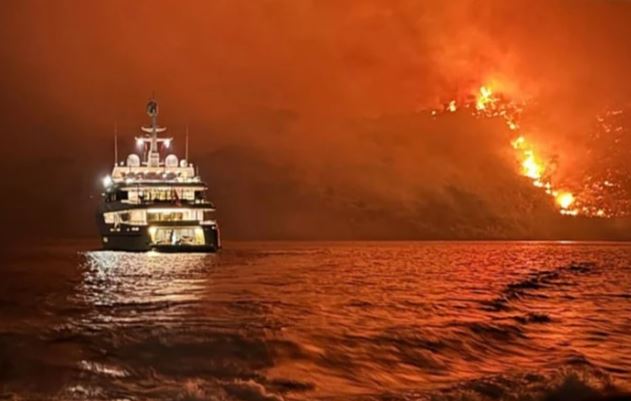
The captain of a luxury boat that was carrying Kazakh tourists when it was linked to a forest fire on the Greek tourist island of Hydra in June has taken responsibility for the blaze, according to Greek media. While some circumstances surrounding the fire remain unclear, the statement by the captain undercuts suspicion that initially fell on the group of tourists including Daniyar Abulgazin, who has shares in multiple Kazakh companies and is one of Kazakhstan’s wealthiest business executives. Abulgazin, who rented the boat, had denied wrongdoing in connection with the fire and said he had left Greece as previously scheduled on June 22 after speaking with “representatives of the Greek authorities.” The captain, who is in detention and faces arson charges, said he launched fireworks, one of which landed in the forest and started the wildfire, protothema.gr reported last week. The acknowledgement reversed his earlier account that no fireworks were set off from the vessel. The Greek media outlet did not identify the captain. A dozen other crewmembers were arrested after the fire. Most were released on bail. Prosecutors also filed charges of complicity in arson against the Kazakh passengers, Greek media have said. But the captain’s new testimony, delivered early this month, exonerates “the other crew members and the foreign multimillionaire charterers of the yacht,” ekathimerini.com reported. Abulgazin had referred to “incorrect and misleading” media reports, expressing regret about the fire and promising to cooperate with the Greek investigation.

Baikonur: An Alternative Journey Into Space

The moon landing is imprinted on the Western collective psyche, but Baikonur is not. Like most children growing up in the U.S., I watched William Shatner on Star Trek, and when we think of space, we think of Neil Armstrong and NASA, not Kazakhstan. However, on April 12, 1961, the first man in space, Yuri Gagarin, took off from the Baikonur Cosmodrome in what is now Kazakhstan. Like WWII, however, space is the subject of parallel narratives, and the “Space Race” was an integral part of the Cold War.   Baikonur Is a Place of Firsts Baikonur is a place of firsts - the first artificial satellite, Sputnik 1, the first dog, Laika, the first higher living organisms to survive a journey to outer space, Belka and Strelka, the first man, Yuri Gagarin, and the first woman, Valentina Tereshkova, all took off from Baikonur. Originally constructed during the Cold War as a missile test site, the area was chosen for several reasons; it’s isolation from densely populated areas and proximity to the equator made it easier to launch rockets, and the flat landscape ensured radio signals would not be disrupted. The battle for control over space between the U.S. and the Soviet Union was both ideological and military in nature. Baikonur was baptized in Cold War misinformation tactics. Located thirty kilometers south of the launch facilities, the closest town was originally known as Tyuratam. In 1961, Soviet officials swapped its name with a town located some 350 kilometers away, “Baikonur,” to misdirect Western intelligence. A fake spaceport constructed from plywood was erected in the “real” Baikonur to deceive enemy spy planes. In the early 1960s, the Soviet Union's covert actions allowed it to advance its space program faster than the United States, which faced public and media scrutiny. While U.S. space missions were broadcast live, exposing any failings, the USSR could operate clandestinely, protecting its missile technology and maintaining a strategic edge. A key example is the R7 rocket used to launch Yuri Gagarin into space; the largest intercontinental ballistic missile of its time, its details were closely guarded. [caption id="attachment_21512" align="aligncenter" width="1622"] Fifty year commemorative stamp of the first woman in space, Kazakhstan, 2013[/caption]   “Space Race” Propaganda Another tool of Cold War propaganda was the flight of Valentina Tereshkova, the “First Lady of Space.” Prior to her journey to the stars in June 1963, Tereshkova had worked on an assembly line in a textiles factory. Her parachuting experience with a local paramilitary flying club proved crucial in her selection. In her three-day flight, the every-woman clocked up more space hours than all American astronauts up to that time combined. Tereshkova may have been a propaganda tool dispatched for Western audiences as proof of gender equality in the USSR, but it would be a nineteen year wait for the next female cosmonaut. In 2007, at the age of seventy, Tereshkova volunteered for a one-way mission to Mars. Having turned to politics as her primary concern following her spaceflight, in...