• KGS/USD = 0.01143 -0%
  • KZT/USD = 0.00198 -0%
  • TJS/USD = 0.10899 0.65%
  • UZS/USD = 0.00008 -0%
  • TMT/USD = 0.28490 -0.28%
  • KGS/USD = 0.01143 -0%
  • KZT/USD = 0.00198 -0%
  • TJS/USD = 0.10899 0.65%
  • UZS/USD = 0.00008 -0%
  • TMT/USD = 0.28490 -0.28%
  • KGS/USD = 0.01143 -0%
  • KZT/USD = 0.00198 -0%
  • TJS/USD = 0.10899 0.65%
  • UZS/USD = 0.00008 -0%
  • TMT/USD = 0.28490 -0.28%
  • KGS/USD = 0.01143 -0%
  • KZT/USD = 0.00198 -0%
  • TJS/USD = 0.10899 0.65%
  • UZS/USD = 0.00008 -0%
  • TMT/USD = 0.28490 -0.28%
  • KGS/USD = 0.01143 -0%
  • KZT/USD = 0.00198 -0%
  • TJS/USD = 0.10899 0.65%
  • UZS/USD = 0.00008 -0%
  • TMT/USD = 0.28490 -0.28%
  • KGS/USD = 0.01143 -0%
  • KZT/USD = 0.00198 -0%
  • TJS/USD = 0.10899 0.65%
  • UZS/USD = 0.00008 -0%
  • TMT/USD = 0.28490 -0.28%
  • KGS/USD = 0.01143 -0%
  • KZT/USD = 0.00198 -0%
  • TJS/USD = 0.10899 0.65%
  • UZS/USD = 0.00008 -0%
  • TMT/USD = 0.28490 -0.28%
  • KGS/USD = 0.01143 -0%
  • KZT/USD = 0.00198 -0%
  • TJS/USD = 0.10899 0.65%
  • UZS/USD = 0.00008 -0%
  • TMT/USD = 0.28490 -0.28%
07 December 2025

Viewing results 265 - 270 of 489

Why Does Energy-Rich Kazakhstan Want Tajikistan’s Uranium?

Despite having significant uranium resources, Tajikistan does not plan to build a nuclear plant anytime soon, if it all. Quite aware of that, Kazakhstan – Dushanbe’s ally in the Russian-dominated Collective Security Treaty Organization (CSTO) – is reportedly eyeing Tajikistan’s uranium. But why? "I would rather earn a profit from the resources of others than my own," John D. Rockefeller, a prominent industrialist, is often paraphrased as saying. Policymakers in Astana could soon begin implementing such a strategy in regard to uranium. Kazakhstan is the largest producer of natural uranium worldwide. In 2022, the energy-rich nation produced the largest share of uranium from mines (43% of world supply), followed by Canada (15%) and Namibia (11%) (ref). In spite of that, Astana could eventually start purchasing the radioactive element from Tajikistan. On August 22, following Kazakh President Kassym-Jomart Tokayev’s visit to Dushanbe, the Tajik Rare-Earth Metals Company, TajRedMet, and Kazakhstan’s national atomic company, Kazatomprom, signed a memorandum of understanding and cooperation in the extraction and processing of uranium and rare-earth metals. Signing such a protocol aligns with Astana’s ambitions to build a nuclear power plant in the country. In that context, Kazatomprom – the world's largest uranium producer – is likely seeking to play an active role in producing uranium fuel for the proposed nuclear plant. Given the global resurgence of nuclear energy and the ensuing “race for uranium,” Kazatomprom is keen to assess the current status of Tajikistan's uranium reserves, and, if feasible, expand its resource base. Uranium is considered one of the main natural resources of Tajikistan. It is believed that the first atomic bomb developed by the Soviet Union contained raw materials from Tajikistan. But after the collapse of the USSR, uranium mining was curtailed in the mountainous country. According to various estimates, 14% of the world's reserves of uranium are located on the territory of the landlocked country of around 10 million people. But compared to other nations, Tajikistan does not have significant uranium mining operations, meaning its uranium deposits remain underdeveloped. However, the fact that Russian companies are interested in exploration and mining of uranium in the Tajikistan suggests that Kazatomprom might have serious competition. It is entirely possible that other foreign corporations will also eventually join the “race for uranium” in Tajikistan. Meanwhile, Kazakhstan will almost certainly be inclined to consolidate its own uranium market. In terms of uranium production in the largest Central Asian state, the Russian State Nuclear Energy Corporation Rosatom is the leader due to its shares in five enterprises operating in Kazakhstan. Since Astana aims to develop closer ties with the West, it is no surprise that France is looking to strengthen its position in the energy-rich country, particularly in its nuclear and uranium sectors. Russia and China are unlikely to give up easily on their ambitions to preserve their influence in the Central Asian nation, however. In 2022, Kazakhstan exported around half of its uranium to China. From January to October 2023, Astana shipped uranium worth $922.7 million to the...

U.S. Decision to Give Military Aircraft to Uzbekistan Upsets Taliban

Ownership of 46 U.S. military aircraft that have sat on the tarmac in Uzbekistan’s southern city of Termez for more than three years has finally been established. Most of those planes and helicopters are going to Uzbekistan, and south of the Uzbek border in Afghanistan, the Taliban are not pleased with this decision.   Escape from Afghanistan On August 15, 2021, Taliban forces freely entered Kabul and reestablished themselves in power. The rapid advances of Taliban militants across Afghanistan earlier that month came as the last foreign forces were departing from the country. Panic broke out throughout the nation. On the day the Taliban entered Kabul, dozens of Afghan Army aircraft carrying government officials and soldiers left their bases and flew north, some to Tajikistan, most to Uzbekistan. In Uzbekistan, the Afghans were deported to U.S. custody and taken to the United Arab Emirates, where they were eventually given U.S. visas and sent to live in the United States. However, the 22 planes and 24 helicopters they flew aboard to Uzbekistan have remained at Termez. The aircraft belonged to the United States. They were loaned for use by the U.S.-backed government forces in Afghanistan. The Taliban assert that all the weapons used by troops of the ousted Afghan government belong to the Afghan people, meaning to the Taliban. On January 4, 2022, Taliban Defense Ministry representative, Inomulla Samagani, said a request for the return of the aircraft had been made to Uzbekistan and Tajikistan. Days later, the Taliban’s acting Defense Minister, Mawlawi Mohammad Yaqoob, son of Taliban founder Mullah Omar, demanded their return. “Our planes that you have, that are in Tajikistan and Uzbekistan, must be returned to us,” Yaqoob said, warning both countries, “not to test our patience and not to force us to take possible retaliatory steps to [reclaim the aircraft].” As economic relations have grown between Taliban-ruled Afghanistan and Uzbekistan since late 2021, the Taliban’s language has softened, but their claim to the planes and helicopters has been repeated several times. On August 24, 2024, Uzbekistan’s kun.uz news agency reported that U.S. Ambassador to Uzbekistan Johnathan Henick had stated that most of the U.S. aircraft in Uzbekistan would be handed over to the Uzbek government. “Yes, it is already official,” Henick said. “The military equipment will remain in Uzbekistan, this is already settled.” Unsurprisingly, the Taliban Defense Ministry responded to Henick’s remarks. “Any agreement regarding the fate of Afghan helicopters and planes in Uzbekistan is unacceptable,” a Taliban Defense Ministry statement stated. Taliban Defense Ministry spokesman, Emayatullah Khwarazmi, said in an audio statement released on August 27 that the “government of Uzbekistan is expected to refrain from any dealings in this regard, to consider good neighborly relations, and to make a wise decision by cooperating in the return of Afghanistan's air force aircraft." U.S. officials have made it clear since 2021 that under no circumstance would the aircraft be given to Afghanistan. During a visit to Dushanbe in June 2022, Commander of the U.S. Central Command, General...

Ecological Limit: Five Year Countdown to Water Scarcity in Central Asia

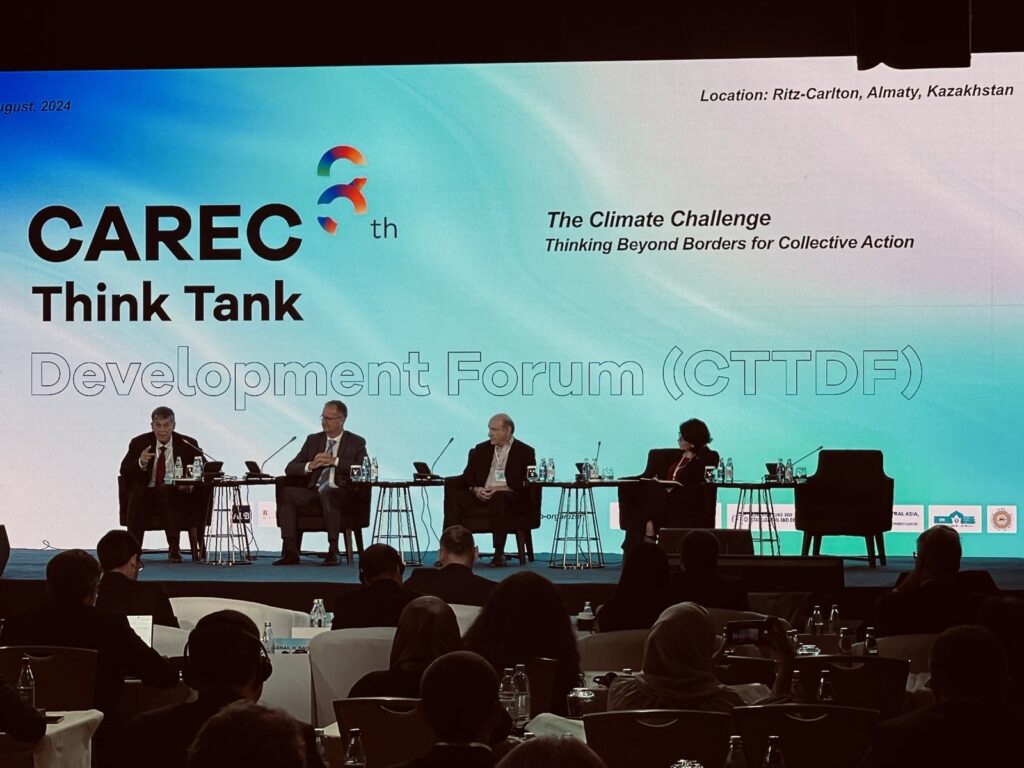
Combating climate change requires collective action by all or a sufficient majority of the world's players supporting global initiatives. Otherwise, it may soon be too late to take any action. To address the issue, the Eurasian Development Bank, the CAREC Think Tank, and the Asian Development Bank organized a two-day forum entitled “The Climate Challenge: Thinking Beyond Borders for Collective Action,” in Almaty, Kazakhstan. Focusing on means of achieving genuine regional cooperation on Asian climate action, the eighth CAREC Think Tank Development Forum was attended by policymakers, experts, and opinion leaders from more than 30 countries. The extensive two-day dialog, consisting of eight sessions, opened with a discussion on the effectiveness of current global initiatives related to climate change: the Paris Agreement, the Global Environment Facility, and the Green Climate Fund. Attention then turned to deepening cooperation among as many stakeholders as possible through multilateral platforms such as the UN Framework Convention on Climate Change. Asia's role in the global fight against climate change, and the difficult balancing act between economic growth and decarbonization efforts were discussed at length. Simply put, the rapid growth of the Asian economy is inevitably accompanied by an increasing consumption of energy, the generation of which leads to increased emissions and pollution. Climate damage due to human impact can be halted and even reversed. However, because this can only be achieved with technological intervention, it poses problems for developing economies unable to afford advanced technologies. Hence, establishing a framework and mechanisms for global technology transfer were key to discussions. Water and finance were also high on the agenda and the subject of a paper presented by Arman Ahunbaev, Head of the Center for Infrastructure and Industrial Research of the Eurasian Development Bank on “Ways to close the investment gap in the drinking water supply and wastewater sector in Central Asia." Ahunbaev reported that 10 million people, or 14% of the population in Central Asia, do not have access to safe drinking water and warned that without intervention, the situation would reach the point of no return in the coming years. To prevent this from happening, he stressed the urgent need for solutions to four problems. The first problem is a twofold increase in the volume of water intake for municipal and domestic needs, based on past figures which showed a growth from 4.2 cubic kilometers in 1994 to 8.6 cubic kilometers in 2020. The second problem is the severe deterioration of water supply infrastructure and treatment equipment, and the third, technological and commercial water losses in distribution networks. The fourth problem is related to the demographic boom and, consequently, the rapid urbanization of Central Asia's population. Cities are expanding and  their infrastructure needs to develop accordingly. According to experts, in 2023, urbanization in Central Asian countries will reach 49%, and by 2050, 61%. By 2030, the urban population will exceed that in rural areas. Ahunbaev noted the need for improvement in financing the water supply and sanitation sector in Central Asia since according to rough...

Tajikistan Promises Toil and Trouble for Witchcraft Clients

Tajikistan is widening the war on warlocks. The Tajik government has previously announced hard labor, heavy fines and other tough penalties for people convicted of fortune-telling, sorcery and witchcraft. Now it is targeting their customers. Legal measures are being taken against more than 150 people suspected of paying soothsayers to commit “criminal acts,” the Ministry of Internal Affairs said on Wednesday. The ministry did not provide details about the legal action, but said it will collect the data and photographs of people who go to fortune-tellers and sorcerers. For years, Tajikistan has warned that fortune-tellers and the like are fraudsters seeking to bilk customers out of their money. There appear to be deeper concerns that deeply rooted beliefs revolving around the supernatural are a threat to stability. Alarming human rights groups, the government has also banned clothing deemed to be foreign to Tajik culture, a purported reference to Islamic clothing such as the hijab. Tajikistan´s efforts to regulate religious expression are part of a bigger campaign against extremism, though critics fear such controls could end up pushing some people toward radicalism.

With the Russian Language Waning in Central Asia, Will Other Languages Replace It?

Russian is still the most widespread foreign language in Kazakhstan, though its role is declining there, and across Central Asia in general. At the same time, the people of the region have been slow to learn other languages, in part due to economic factors such as slowing globalization, according to the Kazakhstani political analyst Zamir Karazhanov, who is head of the Kemel Arna Public Foundation.   The language of cities Since declaring independence in 1991, all the counties of Central Asia have made promoting their national languages a priority. But foreign languages, which link the region with the rest of the world, have also historically been seen as critical. In practice, however, the study and use of foreign languages other than Russian is not widespread. The Russian language is losing its prominence in Kazakhstan as the number of ethnic Russians declines. According to official statistics, as of January 1, 2024, Russians made up 14.89% of the country’s population, down from close to 40% in 1989. Nevertheless, thanks to the education system and Kazakhstan’s proximity to Russia, the level of proficiency in Russian remains high. In Kazakhstan and Kyrgyzstan, Russian is a second official language. In Tajikistan, it is called the “language of interethnic communication”. In Uzbekistan and Turkmenistan, however, it does not have an official status. More than 90% of Kazakhstanis know Russian to some degree, while 20% of the population considers it their native language. Meanwhile, those figures for Turkmenistan are 40% and 12% respectively. In Kyrgyzstan, about 44% know Russian and 5% consider it their native language; in Uzbekistan, it is about 50% and 2.7%; and in Tajikistan, 55% and 0.3%. Kazakhstan's President Kassym-Jomart Tokayev has repeatedly spoken about the need to preserve the Russian language in Kazakhstan, and the unacceptability of language-based discrimination. Last year, he unveiled the International Russian Language Organization, established by the CIS Heads of State Council. “The new organization is open to all countries and, of course, very relevant from the point of view of global humanitarian cooperation,” explained Tokayev, while underlining that measures to promote the Russian language in the Eurasia region and elsewhere are congruous with the trend of strengthening national identities. “Kazakhstan will continue the policy of bolstering the status of the state language of Kazakh,” Tokayev said at the time. Today, Kazakhstan has many Russian-language media, while Russian remains the lingua franca at meetings among post-Soviet countries. Even though Russian is concentrated in big cities, all Kazakhstanis receive a significant amount of western and other foreign news from Russian sources. “Russian is spoken in most of Kazakhstan. In the biggest city, Almaty, communicating in Russian is not a problem. But, if you move 30-50 km outside the city, it gets harder to speak it. Russian is the language of cities and the language of interethnic interaction,” the political analyst Karazhanov told The Times of Central Asia. “Of course, the number of native speakers of the Kazakh language is growing, and the number of Russian speakers is declining, but Kazakh...

Deadly Attacks in Russia Spark Fears of Extremism Amid Ethnic Tensions

On August 23 2024, four prison employees were killed after several prisoners staged a revolt in the remote IK-19 Surovikino penal colony in the southwestern Volgograd region of Russia. Special forces stormed the facility and “neutralized” the attackers, whom the Russian media named as Temur Khusinov, 29, and Ramzidin Toshev, 28, from Uzbekistan, and Nazirchon Toshov, 28, and Rustamchon Navruzi, 23, from Tajikistan. In a mobile phone video released by the perpetrators, the attackers identified themselves as members of Islamic State, claiming their actions were fueled by a desire to avenge the mistreatment of Muslims. The footage starkly depicted prison officials lying in pools of blood, while other clips showed the attackers moving freely through the prison courtyard. With the twentieth anniversary of the Beslan school massacre - perpetrated by members of a Chechen separatist group called the Riyad as-Saliheen Martyrs’ Brigade - drawing near, tensions in Russia are running high, with the perceived threat from extremism leading to a wave of xenophobia. The Crocus City Hall attack, which allegedly involved Tajiks, served to stoke ethnic tensions in Russia, leading to backlash by nationalists. Faced with such conditions and prejudice, an exodus of migrant workers during a time of war has left Russia with a dearth of human capital. Through the Collective Security Treaty Organization (CSTO), Russia is working with the C5 to detect and combat violent extremists, some of whom are illegally entering Central Asia before traveling to Russia. The Central Asian states, which are secular, are meanwhile trying to balance rights to religious freedom with blocking the malinfluence of oppressive and potentially violent ideologies. Three Central Asian countries border Afghanistan, and both the U.S. and the UNODC are working with Tajikistan to counter terrorism and violent extremism. While some extremist groups see Central Asia as a fertile recruiting ground, a UN report from 2023 noted that “Regional Member States estimated current ISIL-K strength at between 1,000 and 3,000 fighters, of whom approximately 200 were of Central Asian origin.” Despite these low numbers, however, the fact that some observers continue to link Islamic State Khorasan Province to the countries of Central Asia - even though the terrorist organization has purely Afghan roots - means that Central Asia once again finds itself at the center of a nexus of international security challenges.