• KGS/USD = 0.01144 0%
  • KZT/USD = 0.00196 -0%
  • TJS/USD = 0.10896 -0%
  • UZS/USD = 0.00008 0%
  • TMT/USD = 0.28571 0.28%
  • KGS/USD = 0.01144 0%
  • KZT/USD = 0.00196 -0%
  • TJS/USD = 0.10896 -0%
  • UZS/USD = 0.00008 0%
  • TMT/USD = 0.28571 0.28%
  • KGS/USD = 0.01144 0%
  • KZT/USD = 0.00196 -0%
  • TJS/USD = 0.10896 -0%
  • UZS/USD = 0.00008 0%
  • TMT/USD = 0.28571 0.28%
  • KGS/USD = 0.01144 0%
  • KZT/USD = 0.00196 -0%
  • TJS/USD = 0.10896 -0%
  • UZS/USD = 0.00008 0%
  • TMT/USD = 0.28571 0.28%
  • KGS/USD = 0.01144 0%
  • KZT/USD = 0.00196 -0%
  • TJS/USD = 0.10896 -0%
  • UZS/USD = 0.00008 0%
  • TMT/USD = 0.28571 0.28%
  • KGS/USD = 0.01144 0%
  • KZT/USD = 0.00196 -0%
  • TJS/USD = 0.10896 -0%
  • UZS/USD = 0.00008 0%
  • TMT/USD = 0.28571 0.28%
  • KGS/USD = 0.01144 0%
  • KZT/USD = 0.00196 -0%
  • TJS/USD = 0.10896 -0%
  • UZS/USD = 0.00008 0%
  • TMT/USD = 0.28571 0.28%
  • KGS/USD = 0.01144 0%
  • KZT/USD = 0.00196 -0%
  • TJS/USD = 0.10896 -0%
  • UZS/USD = 0.00008 0%
  • TMT/USD = 0.28571 0.28%
09 December 2025

Uzbekistan Halves Child Poverty in Four Years

Uzbekistan has achieved a significant reduction in child poverty over the past four years. According to UNICEF Representative Regina Maria Castillo, the child poverty rate dropped from 21.5% in 2021 to just 11.4% in 2024, effectively cutting the figure in half. Speaking at an international forum in Namangan, Castillo credited deliberate government policy for the 10-percentage-point decline.

She emphasized that government-funded social benefits, including child allowances and pensions, played a critical role in lifting families out of poverty. Without these support mechanisms, she noted, child poverty could have sharply increased during the same period. Castillo also highlighted the importance of universal state-provided services, such as education, healthcare, and child protection, as essential pillars for developing human capital. She stressed that prioritizing child poverty reduction within broader socio-economic policy is vital, adding that UNICEF stands ready to support the Uzbek government through a multi-sectoral approach.

Reducing poverty has become a central national priority in Uzbekistan. President Shavkat Mirziyoyev has set an ambitious target: to lower the national poverty rate to 6% by the end of 2025 and to eradicate absolute poverty entirely by 2030. These goals build on substantial progress already achieved. According to official figures, approximately 7.5 million people have been lifted out of poverty in recent years. The national poverty rate declined to 8.9% in 2024, down from around 23% a few years prior. The World Bank estimates that poverty in Uzbekistan has halved since 2015, a rate of decline faster than the regional average.

At the Namangan forum, Mirziyoyev announced that as of mid-2025, the poverty level had dropped further to 6.8%, placing the country on track to meet its 6% year-end target. “Thanks to consistent reforms, 7.5 million people have been lifted out of poverty… The objective is to reduce this to 6% by year-end,” he said. “By 2030, Uzbekistan has every opportunity to completely eradicate absolute poverty and we will definitely achieve this.”

Several key drivers underpin the country’s progress. Rising household incomes account for roughly 60% of the recent poverty reduction, according to the World Bank. With the economy nearly doubling in size over the past eight years, economic growth has translated into higher wages and job creation, lifting many families above the poverty line.

Another major contributor has been the expansion and modernization of social benefit programs. Increased spending on pensions and direct aid has protected millions from falling into extreme hardship. Notably, during the COVID-19 pandemic, Uzbekistan mobilized $8 billion for free medical supplies and direct payments, which prevented an estimated 5.2 million people from falling into the “poverty trap.”

Looking ahead, sustaining these gains will hinge on job creation and human-capital improvements, sharper targeting in social protection, and stronger climate resilience – especially in rural regions. UNICEF’s 2024 situation analysis likewise flags regional disparities in child poverty and stresses better services for large, low-income households. The World Bank’s climate assessments, meanwhile, warn that rising temperatures and mounting water stress could push vulnerable rural families back into poverty without quicker adaptation in agriculture and water management. Together, these risks define the to-do list for keeping child-poverty declines on track.

Chinese Man Jailed in Tashkent for Pouring Boiling Water on Cat

A Chinese citizen in Tashkent has been sentenced to five days in detention after being found guilty of torturing a cat by repeatedly pouring boiling water on it, according to the animal protection organization “Mehr va Oqibat” (Kindness and Compassion).

The incident occurred during the night of September 16-17, when a local resident contacted the group’s hotline after hearing the sound of a cat crying. Looking outside, the witness saw her neighbor, identified as Y.Z., a Chinese national, pouring boiling water onto the animal, which he had confined in a container to prevent it from escaping.

Mehr va Oqibat promptly reported the case to the Ministry of Internal Affairs, the Ministry of Foreign Affairs, and the Chinese Embassy in Uzbekistan, urging legal action under Uzbek law and calling for the offender’s deportation.

On September 18, the Yakkasaroy District Criminal Court sentenced Y.Z. to five days of administrative detention. His legal team appealed the decision, requesting a reduced penalty in the form of a fine. However, on September 20, the Tashkent City Criminal Court rejected the appeal and upheld the original sentence.

In a statement, Mehr va Oqibat thanked its attorney, Dilshodbek Asadullayev, for representing the case in court, and expressed appreciation for the witness who reported the abuse. The organization reiterated its intention to pursue Y.Z.’s deportation.

Founded in 2010, Mehr va Oqibat has been at the forefront of promoting humane treatment of animals in Uzbekistan. In 2019, the group launched the “Mushukkent” initiative, which established cat shelters in Tashkent police stations. In 2023, with the support of local residents, it built a three-story cat shelter in the Uchtepa district to provide refuge for stray animals during the winter. The project, supported by the Tashkent city administration and the National Guard, also serves as an educational tool to encourage compassion among children.

The organization emphasized that preventing animal cruelty and fostering kindness are essential not only for animal welfare, but also for nurturing a more humane and just society.

Kazakhstan Recognizes Course Certificates as Equivalent to University Diplomas

Kazakhstan’s National Council for Professional Qualifications, in collaboration with industry experts, has approved a new National Qualifications Framework (NQF) that officially recognizes certificates from professional and advanced training courses as valid proof of education for employment purposes.

Previously, only diplomas from universities, colleges, and technical schools were accepted. According to the Ministry of Labor and Social Protection of the Population, the revised system now also includes non-formal and informal learning, skills and knowledge acquired outside traditional educational institutions over a person’s lifetime. The reform is based on the European Qualifications Framework and tailored to meet the evolving demands of Kazakhstan’s labor market.

“The updated NQF was developed in line with Kazakhstan’s labor and education legislation and incorporates international practices. It is based on transparency and comparability, which ensures recognition of competencies acquired in different sectors and facilitates labor mobility. The framework supports lifelong learning and is tailored to the real needs of the economy,” said First Vice Minister of Labor and Social Protection Askarbek Yertayev.

The framework consists of eight levels, ranked by increasing complexity of tasks, responsibility, and knowledge intensity. Under the new system, not only are diplomas and work experience recognized, but certificates from short-term courses and qualifications verified via the Career Enbek portal are now considered official evidence of skills.

The Ministry also clarified labor code provisions regarding multiple employment. Citizens are permitted to work for more than one employer, provided the total working time does not exceed 12 hours per day, up to eight hours at the primary job and four hours in secondary employment. However, minors under 18 and employees in hazardous occupations, excluding healthcare workers, are prohibited from holding multiple jobs. Civil servants may not take on secondary employment, except in teaching, research, or creative roles.

As previously reported by The Times of Central Asia, authorities have recently increased pressure on employers who pay “gray wages”, salaries paid off the books without tax or social contributions.

Insider’s View: Uzbekistan–U.S. – A New Era of Environmentally Friendly and Energy-Efficient Investment

Today, environmentally friendly and energy-efficient projects are no longer just a fashionable trend but a factor of global competitiveness. Uzbekistan, once regarded as a country with a resource-based energy system and limited opportunities for the adoption of modern technologies, is now becoming a hub for “green” investment and innovation. A strategic partnership with the United States plays a special role in this process, encompassing key areas ranging from energy and ecology to finance, education, and culture. Clean and innovative projects are becoming the hallmark of Uzbek-American relations, shaping a new model of cooperation in the 21st century.

Green Energy and Strategic Partnership

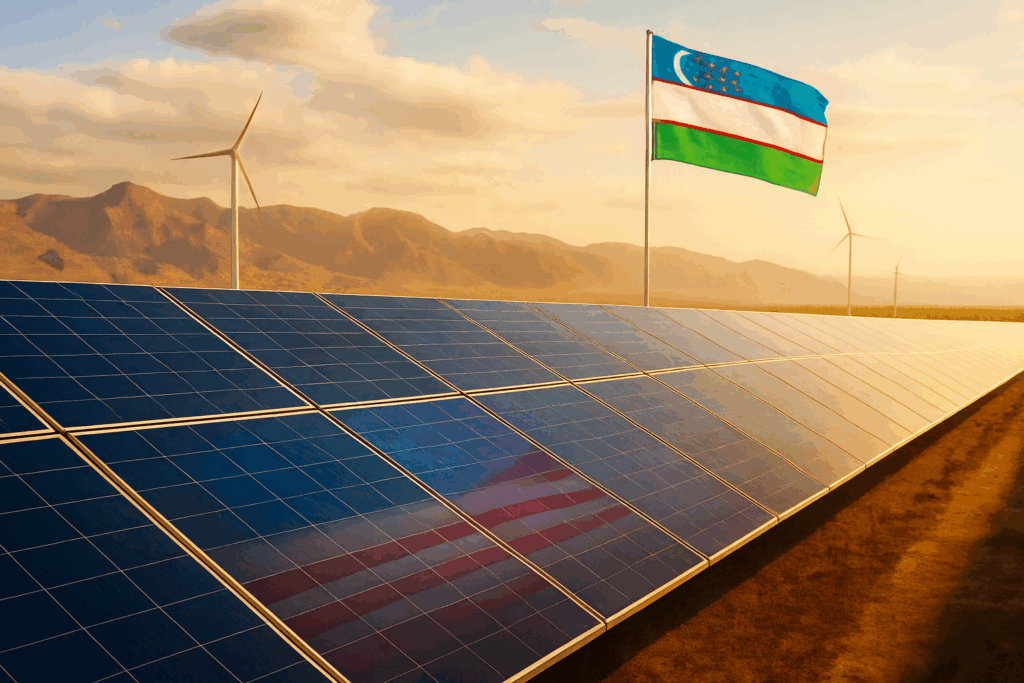
Uzbekistan is moving confidently toward a “green” future. While in 2018 renewable energy sources accounted for less than one percent of electricity generation, from January to July 2025, renewables already provided 20.3% of the country’s total electricity. More than 11 billion kWh of “green” energy were produced, including 6.4 billion kWh from solar power plants and 3.6 billion kWh from wind farms. This volume saved 3.6 billion cubic meters of natural gas and prevented over 2.2 million tons of harmful emissions. Every day, renewables now generate about 26.7 million kWh – enough to cover the needs of 7.28 million households for half a year, or 3.64 million homes for an entire year. Currently, 10 solar and 4 wind plants with a combined capacity of more than 4.5 GW operate across 10 regions of the country.

A key focus of Uzbek-American cooperation has become “green” energy. In 2025, Allied Green Ammonia (AGA), together with the U.S. company Plug Power, announced a major project for the production of sustainable aviation fuel, green diesel, and urea. The plan includes the supply of electrolyzers with a capacity of up to 2 GW for the future complex. A final investment decision is expected by the end of 2025, and the project has already been recognized as one of the flagship initiatives for Central Asia.

Air Products – A Flagship of American Presence

Air Products, a global leader in industrial gases and hydrogen energy, occupies a special place in Uzbek-American cooperation. In the Kashkadarya region, the company participates in a large-scale gas-to-liquids (GTL) project worth around $1 billion. The complex is designed to produce about 1.5 million tons of synthetic fuels per year, including diesel, jet kerosene, and naphtha. Its structure includes air separation units, autothermal reformers, and hydrogen production facilities. This project has become a landmark example of how U.S. technologies are transforming Uzbekistan’s energy sector.

In addition to GTL, Air Products is actively developing industrial gas production in Uzbekistan. The company participates in oxygen, nitrogen, and hydrogen production projects, introduces the latest PSA units, as well as freezing and storage technologies that reduce food losses and enhance economic resilience. Furthermore, the company has implemented a “green financing” system that links investments to sustainability principles. These projects not only strengthen the country’s industrial potential but also pave the way for positioning Uzbekistan as a regional hub for “green” energy.

The company’s future plans are equally ambitious: production of aviation fuel, CO₂ capture and storage, and coal gasification. Investment volumes exceed several billion dollars, including the construction of a methanol plant with an annual capacity of 1.34 million tons in Bukhara. This transforms Uzbekistan into a future center of high-tech energy in Central Asia, while Air Products becomes a symbol of Uzbek-American partnership.

Investments and Finance

The environmental agenda is closely linked to finance. The Uzbekistan National Investment Fund (UzNIF), with assets worth $1.7 billion, has been entrusted to the management of the U.S. company Franklin Templeton. For the first time in the country’s history, the fund is preparing for an international listing – a symbol of trust in American financial institutions and a new resource for investment in “green” projects.

Agriculture and Ecology: New Horizons of Partnership

Agriculture is one of the key areas of the Uzbek-American partnership, and a striking example is the Silverleafe Agrocluster in the Jizzakh region. This project has become a symbol of the modernization of the country’s agro-industrial complex. U.S. investments have enabled the introduction of precision farming technologies, modern irrigation systems, and innovative John Deere equipment, taking cotton and related crop production to a qualitatively new level.

The cluster has become a model for the transition from outdated practices to a modern agribusiness management system. It applies a track & trace system, allowing products to be monitored from the field to the consumer, significantly increasing transparency and trust in international markets. The adoption of international quality standards and certification has opened access to new export markets and reduced dependence on outdated farming methods.

The project is closely connected with the Agribusiness Development Activity (ADA) and Agricultural Value Chains (AVC) programs. These help farmers expand fruit and vegetable exports, implement quality standards and certifications, and develop greenhouse complexes and intensive orchards. A major result has been a reduction in post-harvest losses and an increase in farm profitability. Thus, the Silverleafe Agrocluster has not only become a catalyst for technological transformation in agriculture but also demonstrated that U.S. investments can deliver tangible effects in sustainable development and the “green” economy.

An equally important area of Uzbek-American cooperation is ecology and waste recycling. A vivid example is the activity of the U.S. company Sayar LLC, which is implementing a large-scale project for medical waste utilization with subsequent thermal energy generation.

Launched in 2024, the project already covers Tashkent, Samarkand, and Bukhara in its first stage, processing up to 6,000 tons of medical waste annually. The generated energy is used to supply hospitals with heating, hot water, and equipment operation. This increases the energy efficiency of social infrastructure while ensuring safe disposal of hazardous waste.

Future plans are even more ambitious: by 2030, recycling capacity will be expanded to 90,000 tons per year, with thermal energy generation reaching 300 GWh annually. The company’s total investment in the project is estimated at around $115 million.

The initiative is unique in that it combines environmental and social dimensions: waste recycling reduces the environmental burden and prevents the spread of infections, while the generated energy provides medical institutions with affordable and eco-friendly resources. Thus, Sayar LLC has become one of the first U.S. companies to demonstrate that waste recycling in Uzbekistan can be not only environmentally justified but also economically viable.

Social Initiatives

The All Children Succeeding (ACS) project, worth $25 million, is aimed at developing inclusive primary education. Healthcare programs include tuberculosis prevention and the One Health initiative, which integrates human, animal, and environmental health. These projects are directly linked to sustainable development, as education and public health form the foundation for introducing innovative “green” initiatives.

Education and Entrepreneurship

The Fulbright and FLEX programs, research initiatives, as well as Ambassador’s Fund for Cultural Preservation (AFCP) projects, help prepare a new generation of specialists capable of meeting the challenges of the “green” economy.

January 2025 marked an important milestone for fintech development: the U.S. Embassy in Tashkent and OSON Holding (Brio Group) signed a memorandum to launch the Academy for Women Entrepreneurs (AWE). Funding has been allocated to train 25 women entrepreneurs at the Thunderbird School of Global Management at Arizona State University. The program covers regions across the country, supporting small and medium-sized businesses in energy, science, and technology. This is already the embassy’s second public-private partnership initiative: in 2024, a memorandum with Air Products was signed to establish a Makerspace in Karshi.

Political and Economic Dialogue

In September 2025, the leaders of Uzbekistan and the United States reaffirmed their commitment to expand the strategic partnership in critical areas – from energy and infrastructure to digitalization and education. Clean investments and innovative projects remain at the heart of this agenda, underscoring that the future of relations is built on the principles of sustainable development.

Conclusion: A Green Future as the Foundation of Strategic Partnership

Uzbekistan and the United States demonstrate that cooperation can cover diverse fields – from “green” energy and industry to education, healthcare, culture, and fintech. Companies such as Air Products, Plug Power, Franklin Templeton, and OSON play a central role in raising bilateral relations to a global level. Together, they are laying the foundation for a new stage of the Uzbek-American partnership – one based on clean energy, the digital economy, and the technologies of the future.


The views expressed in this article are those of the author and do not necessarily reflect the official policy or position of the publication, its affiliates, or any other organizations mentioned.

Tokayev at the UN Underscores Kazakhstan’s New Diplomacy

Kazakhstan’s international visibility is reaching a peak this late summer and early autumn of 2025. In August, UN Secretary-General António Guterres visited Astana, praising the country’s role as a stabilizing influence in Central Asia and a supporter of multilateral institutions.

In a few days, President Kassym-Jomart Tokayev will address the UN General Assembly in New York, presenting Kazakhstan as a reliable partner in peacekeeping, sustainable development, and nonproliferation. This upcoming UN speech marks a departure from past appearances, signaling Astana’s intent not only to balance powers but also to set global agendas. Together, these events signify the country’s ascent as a state no longer defined solely by the art of survival between great powers, but one that now seeks to set agendas, convene adversaries, and project norms beyond its borders.

This dual UN moment illustrates the broader transformation of Kazakhstan’s foreign policy over the past year: the shift from multi-vector balancing, an inheritance of the Nazarbayev era, toward a more assertive mode of multi-actor entrepreneurship. Framed through the UN stage, Kazakhstan’s diplomacy now aspires to translate regional initiatives into a global narrative. Rather than oscillating between Moscow, Beijing, Brussels, and Washington, Astana has begun to use its accumulated diplomatic capital to initiate, mediate, and institutionalize regional and global frameworks.

From Balance to Initiative

For three decades after independence, Kazakhstan’s “multi-vector” foreign policy served as a model of survival in a region shaped by the clash of external rivalries. The doctrine emphasized equidistance between Russia, China, and the West, with an overlay of pragmatic economic engagement.

In practice, this often meant leveraging one relationship to offset pressure from another while securing steady inflows of trade and investment. Today, however, the war in Ukraine, the erosion of European security, and the sharper contest between Beijing and Washington have undermined the viability of simple balancing.

In response, Tokayev’s government has shifted its approach, seeking to overlay a more agenda-setting dynamic on multi-vectorism by positioning Kazakhstan as a regional hub for diplomacy and connectivity. At the UN, this shift might be presented as Kazakhstan’s evolution from passive survival to a more proactive approach to international diplomacy. Astana’s task is to transform such declarations into a durable strategy.

Central Asia and the South Caucasus

The clearest evidence of Kazakhstan’s new role comes from Central Asia itself. Relations with Uzbekistan, once characterized by rivalry, have been recast as a cornerstone of functional regionalism. Over the past twelve months, Astana and Tashkent have concluded demarcation agreements, expanded electricity grid interconnections, and coordinated positions on water resource management.

The consultative meetings of Central Asian leaders, which Kazakhstan has championed, now serve as regularized platforms for joint initiatives, from infrastructure to practical economic integration, with attempts to reduce Russian and Chinese influence. At the UN, this shift may be framed as Kazakhstan’s evolution from mere survival to actively pioneering new approaches in international diplomacy. For Kazakhstan, the partnership with Uzbekistan provides buffering against external pressure and multiplies regional influence. Astana has also made use of the UN Regional Centre for Preventive Diplomacy for Central Asia (UNRCCA), grounding its convening authority in both international law and practical problem-solving.

The past year also saw Kazakhstan deepen its engagement in the South Caucasus. Economic ties with Azerbaijan have grown rapidly, with bilateral trade surpassing $330 million in the first half of 2025 alone. Transport and logistics have been at the core of this cooperation.

In August, Almaty served as one of the trusted platforms for discussions leading to the U.S.-backed Armenia–Azerbaijan declaration. By hosting these talks, Astana demonstrated its capacity to act as an intermediary in one of Eurasia’s most contentious disputes. These mediation efforts will bolster Tokayev’s UN narrative of Kazakhstan as a neutral broker capable of contributing to peace beyond Central Asia.

The European Union and the United States

Kazakhstan’s outreach to the European Union has combined commercial pragmatism with strategic signaling. In 2024, EU–Kazakhstan trade approached $50 billion, making Astana the EU’s leading oil supplier and a pivotal partner in critical raw materials. Less visible were discussions on renewable energy and regulatory standards, where Kazakhstan pressed to move beyond transactional deals. European counterparts welcomed the ambition but voiced caution about Astana’s capacity to implement, just as they did with Uzbekistan and other Central Asian states at the Samarkand summit.

Calls for a new EU–Central Asia summit and participation in the bloc’s green hydrogen initiative highlight aspirations, but realization is far from guaranteed. Tokayev is expected to reference these initiatives at the UN as part of Kazakhstan’s contribution to global climate and energy agendas. Cooperation with the United States represents a complementary vector. Through the C5+1 dialogue and expanding trade – now surpassing $4 billion annually – Washington and Astana have pursued supply chain and critical mineral projects. The Middle Corridor, advanced through the Trans-Caspian Trade and Transit Partnership (TRIPP), has become central to this agenda, while Kazakhstan’s role in brokering the Armenia–Azerbaijan declaration has opened discussion of a new Armenia corridor – still tentative, but reinforcing Astana’s image as both mediator and connector. Together, the European Union and the United States are also Kazakhstan’s largest cumulative foreign investors, accounting for well over 40% of total FDI – far outweighing contributions from Russia and China.

American officials have tied this relationship to explicit support for Kazakh sovereignty, particularly in light of the Ukraine war. Tokayev’s government has courted these ties while keeping one eye on the turbulence of U.S. domestic politics. How far this engagement can withstand shifting U.S. priorities remains an open question. At the UN, however, Astana will likely frame U.S. and EU partnerships as part of its multilateral credentials, linking bilateral gains to global governance priorities.

Russia and China

Russia and China remain the delicate fulcrum of Kazakhstan’s foreign policy. Relations with Moscow have grown more complicated as Astana, emphasizing territorial integrity, has refused to recognize Russia’s annexation of Ukrainian territories. Yet economic dependence on Russian transit remains entrenched, and Kazakhstan cannot easily disentangle itself from inherited supply chains. Defense integration is discouraged even as the national economy stays deeply exposed to Russian markets, a vulnerability that hardens structural limits on autonomy.

China has meanwhile become Kazakhstan’s largest trading partner. Infrastructure, energy, and manufacturing dominate the bilateral agenda, with railroad connectivity under the Belt and Road remaining a backbone of the corridor. Astana has welcomed Chinese investment while insisting on sovereign decision-making. Official Chinese sources frame the relationship in sweeping terms, while Kazakh policymakers present it more cautiously. Beijing is accepted as a necessary partner, but concerns over dependency linger. By stressing peace in Ukraine and UN reform, Tokayev is signaling that his UN speech will present Kazakhstan not just as a regional balancer between Moscow and Beijing, but as a middle power anchoring its diplomacy in sovereignty and international law.

Kazakhstan, Central Asia, and the UN Stage

From the vantage point of 2025, Kazakhstan’s foreign policy no longer resembles a defensive maneuver, as multi-vectorism once did. Its current diplomacy is closer to an entrepreneurial project, improvised in parts yet directed toward shaping outcomes across Eurasia. In the South Caucasus, Astana has mediated talks; in Central Asia, it has convened neighbors; with the European Union, it has pressed for frameworks as well as trade. This initiative, while uneven in implementation, signals a shift in posture from survival through balance to influence through engagement, and it reflects Tokayev’s effort to project Kazakhstan as a professionalized “middle power” with a distinct diplomatic identity that links domestic reform to external strategy.

The strategy is ambitious, but its foundations remain fragile. Moscow may tighten pressure if Astana is perceived as drifting too far from Russian security structures; the domestic reform process may stall under bureaucratic resistance or political hesitation; commodity markets may again swing violently, exposing vulnerabilities in the national economy. Yet the initiative is taking root in agency, network-building, and institutional reform. The Bertelsmann Transformation Index estimates that this new diplomatic dynamism positions Kazakhstan to do more than merely survive among larger powers, though the actualization of this potential will depend on consolidating reforms at home and carefully managing external pressures.

Kazakhstan’s activism has raised Central Asia’s profile in the United Nations. Guterres’s August visit underlined the region’s role in preventive diplomacy, while Astana’s initiatives are now shaping how the UN views Central Asia: not as peripheral, but as a zone of governance experiments with global resonance. Tokayev wants the world to see Kazakhstan not as a passive buffer, but as a rising middle power. By convening Central Asia’s leaders, mediating in the South Caucasus, and championing new corridors to Europe, he has already begun to redefine his country’s role. His UNGA address now offers the chance to show that Kazakhstan is no longer surviving between powers, but stepping forward to give Central Asia a voice with global resonance.

Central Asian Presidents at UNGA-80: All Five Confirmed

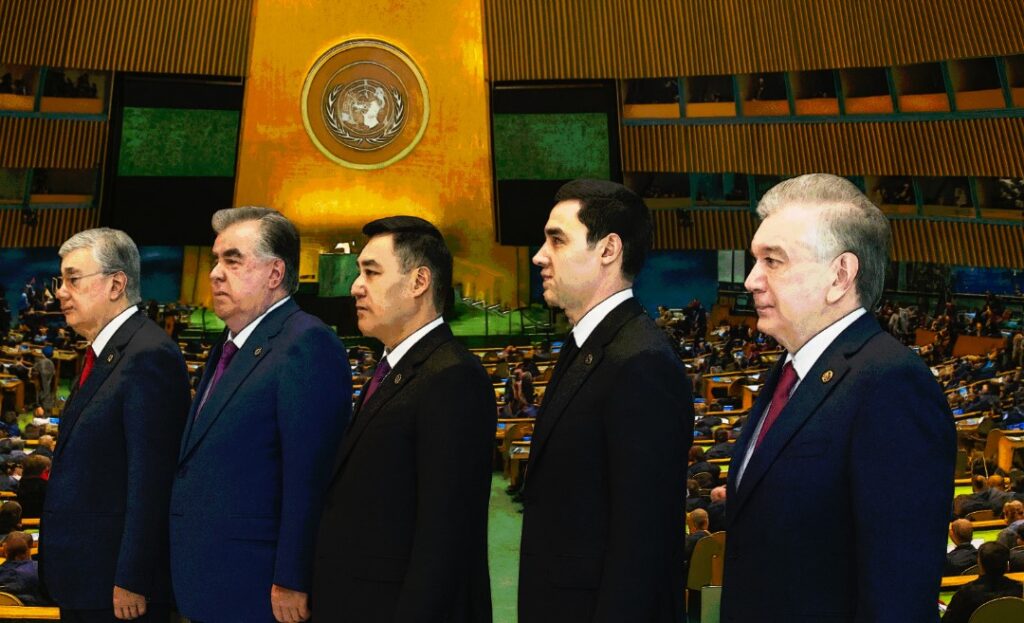
New York, Sept 22, 2025 – Central Asia will have a strong presence at the 80th United Nations General Assembly (UNGA-80), with four of the region’s presidents confirmed to attend in person. One leader’s participation, however, remains unannounced.

From Kazakhstan, President Kassym-Jomart Tokayev is scheduled to be in New York from September 21 to 23. The Kazakh presidency confirmed that he will deliver his country’s national statement and meet with other heads of state on the sidelines of the high-level week.

Kyrgyzstan’s President Sadyr Japarov is officially confirmed to be in New York from September 22 to September 25, where he is scheduled to deliver a speech in the General Debate. Japarov will also join a UN Security Council discussion on AI and a high-level climate event, while holding bilateral meetings with Secretary-General António Guterres and leaders from multiple regions.

In Tajikistan, the presidential press service announced on September 21 that President Emomali Rahmon departed Dushanbe for New York to attend UNGA-80. He is accompanied by senior officials and is expected to speak during the General Debate.

From Turkmenistan, President Serdar Berdimuhamedov left Ashgabat on September 21 for a working trip to New York. Turkmen state media confirmed his participation in UNGA-80, marking his direct representation of the country at the session.

Uzbekistan’s President Shavkat Mirziyoyev arrived in New York on September 20 for a visit lasting through September 24. His agenda includes addressing the General Debate on its opening day and holding bilateral meetings with UN Secretary-General António Guterres and other world leaders.

With the General Debate opening on September 23, Central Asia is set to be represented at the highest level by all five of its nations: Kazakhstan, Kyrgyzstan, Tajikistan, Turkmenistan, and Uzbekistan.