• KGS/USD = 0.01144 0%
  • KZT/USD = 0.00194 -0%
  • TJS/USD = 0.10844 -0.46%
  • UZS/USD = 0.00008 0%
  • TMT/USD = 0.28571 0.28%
  • KGS/USD = 0.01144 0%
  • KZT/USD = 0.00194 -0%
  • TJS/USD = 0.10844 -0.46%
  • UZS/USD = 0.00008 0%
  • TMT/USD = 0.28571 0.28%
  • KGS/USD = 0.01144 0%
  • KZT/USD = 0.00194 -0%
  • TJS/USD = 0.10844 -0.46%
  • UZS/USD = 0.00008 0%
  • TMT/USD = 0.28571 0.28%
  • KGS/USD = 0.01144 0%
  • KZT/USD = 0.00194 -0%
  • TJS/USD = 0.10844 -0.46%
  • UZS/USD = 0.00008 0%
  • TMT/USD = 0.28571 0.28%
  • KGS/USD = 0.01144 0%
  • KZT/USD = 0.00194 -0%
  • TJS/USD = 0.10844 -0.46%
  • UZS/USD = 0.00008 0%
  • TMT/USD = 0.28571 0.28%
  • KGS/USD = 0.01144 0%
  • KZT/USD = 0.00194 -0%
  • TJS/USD = 0.10844 -0.46%
  • UZS/USD = 0.00008 0%
  • TMT/USD = 0.28571 0.28%
  • KGS/USD = 0.01144 0%
  • KZT/USD = 0.00194 -0%
  • TJS/USD = 0.10844 -0.46%
  • UZS/USD = 0.00008 0%
  • TMT/USD = 0.28571 0.28%
  • KGS/USD = 0.01144 0%
  • KZT/USD = 0.00194 -0%
  • TJS/USD = 0.10844 -0.46%
  • UZS/USD = 0.00008 0%
  • TMT/USD = 0.28571 0.28%
09 December 2025

Tajikistan: turning pigs into sheep, and other plagiarism adventures

DUSHANBE (TCA) — A new scandal reveals the poor state of scholarship in Tajikistan, marked with widespread plagiarism and academic fraud. We are republishing this article on the issue, originally published by Eurasianet:

It was like something out of a fairytale. Nazrulo Amirov turned pigs into sheep. Sort of.

When Amirov, the now-former rector at the agricultural economics institute of Tajikistan’s Academy of Science, came to assembling a scholarly thesis in 2014 on “The Development of Meat Livestock Breeding in Tajikistan,” he took a shortcut. In some parts, he simply copied sections out of an earlier work by a Russian scholar and substituted “pig” for “sheep.”

Amirov is one of dozens of senior and respected figures in Tajikistan to have been busted for academic plagiarism in the last few weeks. The detective work was done by Dissernet, a volunteer community in Russia which has delighted since 2013 in uncovering similar feats of scholarly theft by officials in that country.

Among the alleged Tajik offenders are First Deputy Prime Minister Davlatali Said, the governor of the Khatlon region, Davlatsho Gulmahmadzaoda, and an advisor to the president, Abdullo Rahmon.

The propensity among officials to try and climb through the hierarchy of academic ranks — and cheat all the while — stems from an unspoken rule that the title Doctor of Sciences, or something close, is a must for anybody hoping to achieve high office. As in many countries, a jumble of letters after one’s name on a business card is also often deemed a point of pride for high-ranking civil servants in Tajikistan.

It was only in 2014 that Tajikistan created its own analogue of Russia’s Higher Attestation Commission, or VAK, a government body responsible for overseeing the process of evaluating advanced academic theses. According to Tajikistan’s Academy of Sciences, more than 1,200 Tajiks successfully submitted academic works to VAK between 2013 and 2017; many others submitted in the years before.

That has given Dissernet co-founder Andrei Zayakin a lot to work with. As Zayakin notes, the plagiarism is sometimes almost too crude to be believed.

The case of Rahmon, the advisor to President Emomali Rahmon (no relation), was among the more egregious. His work, submitted in 2007, was titled “The Features of the Formation of Civil Society in Tajikistan.”

As in other similar acts of purloining, Rahmon allegedly lifted chunks of text from other people’s work, but gave it a local flavor by switching “church” to “mosque” and “Russia” to “Tajikistan.” Elsewhere, he changed VCIOM, a respected Russian polling and sociological research outfit, into the Center of Strategic Studies, a think tank attached to the Tajik presidential administration.

When charting the history of his native country, Rahmon cites a 1998 law on religious freedom. Except that Tajikistan had no such law that year. Russia did adopt such legislation in 1997. Tajikistan’s law on religion was approved in 2009, two years after Rahmon had his thesis approved by VAK.

Perhaps the most striking aspect of Rahmon’s work is the amount of criticism it levels at Tajik authorities and its references to public distrust in the government.

“Analyzing this dissertation, our expert committee was pleasantly surprised by the wide dissemination among the Tajik population of such Western concepts as freedom of speech, free elections [and the] transition of power,” Dissernet noted sarcastically in its caustic commentary on the thesis.

Dissernet makes the exercise of comparing and contrasting the plagiarists’ work with the original easy by creating side-by-side tables of the copied sections and the source. Rahmon’s interest in democracy, as this tool shows, is seemingly far from being his own.

While only around one-third of Rahmon’s work is copied, in the case of Said, the deputy prime minister, that figure reaches around 70 percent. He borrowed mostly from fellow Tajiks, however, meaning he was able to do without switching out words betraying a non-Tajik context.

Dissernet believes that the plagiarism is often not even committed by the purported authors, but that the offenders simply order the works from academic freelancers.
Zayakin said it may be employees of VAK itself that are embroiled in this business.

“The expert council at VAK have become confederates of the mafia racket writing the theses. Moreover, the attestation commission is forced to defend plagiarists since it has received not inconsiderable amounts of money for being awarded academic titles,” he said.

By Zayakin’s estimates, buying a thesis can cost anywhere from $10,000 to $25,000, depending on the rank of the title being pursued.

VAK has typically blustered through such accusations. Of the Tajik officials caught in the act, only Amirov, of pigs-into-sheep fame, has owned up and pledged to write a fresh thesis.

Tajik authorities, meanwhile, have unleashed whispering and state-media campaigns against Dissernet to paper over the embarrassment.

Defenders of the accused officials on social media have suggested the Russian group was hired to carry out the hatchet job. Among the possible suspects named in such speculation are Iran, Tajikistan’s political opposition and mysterious “third forces,” a reliable standby for the region’s conspiracy theorists.

On the official front, representatives from several ministries and government departments assembled for a roundtable on April 26 to make a public statement about the unfolding scandal. In a statement posted on the website of Khovar state news agency, the roundtable concluded that Dissernet’s reports were a threat to Tajikistan’s “information security” and that the group was taking money to undermine the government and the country’s values.

“We should give a proper response to these information attacks that are being devised abroad. Ensuring information security during this tense situation in the world is a component of national security,” the statement noted.

Hafiz Boboyorov, a Tajik researcher at the Berlin-based Alexander von Humboldt Foundation, lamented in remarks to Eurasianet that the authorities had taken a combative stance instead of soliciting assistance in rooting out academic fraud.

“If you cooperate with groups like Dissernet and submit materials for inspection before publication, this would serve the interests of scholarship. This way, fewer random people would get into academia and there would be only truly committed people working for the public good,” Boboyorov said.

Boboyorov, who formerly worked at the Academy of Sciences in Dushanbe, noted that Tajikistan’s own dissertation attestation commission has only been going for three years and that it would take a long time — no less than 10 years — to build up its own digital database to help prevent plagiarism.

That state of affairs promises little good for the state of scholarship in the country.

Until then, said Boboyorov, the emphasis will remain with simply “pursuing the existence of an scholarly title, instead ensuring its quality.”
IMF commends economic reforms in Uzbekistan

TASHKENT (TCA) — The Executive Board of the International Monetary Fund (IMF) has concluded consultations with the government of Uzbekistan and welcomed that Uzbekistan has initiated a comprehensive reform program to open and liberalize the economy, stimulate job creation, and promote inclusive growth.

Continue reading

Canadian company to invest $1.3 billion to build solar power plant in Uzbekistan

TASHKENT (TCA) — Toronto-based SkyPower, the global leader in sustainability and utility-scale solar production, has announced an estimated $1.3 billion foreign direct investment in Uzbekistan to build 1,000 MW of solar energy generation capacity throughout the country.

This project will bring the largest foreign direct investment in Uzbekistan’s history, the Canadian company said. Uzbekistan and SkyPower also signed the first Power Purchase Agreement (PPA) in the country’s history, whereby the government will be purchasing power from an international and private company. Uzbekistan’s President Shavkat Mirziyoyev has signed a decree signifying the government’s full support of the project and sovereign guarantees. SkyPower will be the first independent power producer in the history of Uzbekistan, working closely with state-owned utility company Uzbekenergo. This project is also the first public-private partnership between Uzbekistan and a North American company.

François-Philippe Champagne, Minister of International Trade for the Government of Canada, remarked, “Growing Canada’s cleantech and renewable sectors and encouraging the export of locally developed ideas and solutions that benefit the world is a priority for our government. I am pleased to see industry leaders like SkyPower Global help us towards that goal. This historic partnership with UzbekEnergo and the government of Uzbekistan will bolster growth in the region and help establish Canadian expertise in this fast-growing sector.”

SkyPower Chief Executive Officer Kerry Adler said that, “This is a historic partnership that will benefit both the Government of Uzbekistan and SkyPower, and we are happy to be building Uzbekistan’s first solar power installation. President Mirziyoyev’s forward-thinking vision for Uzbekistan, along with the commitment of the Deputy Prime Ministers and the leadership of the National Project Management Office in concert with Uzbekenergo leadership, together have really helped move this project forward. Uzbekistan is a country that holds tremendous opportunities for foreign investors under the vision for growth and expansion of President Mirziyoyev.”

The project will contribute an estimated $2.9 billion to Uzbekistan’s gross domestic product and create thousands of jobs. This will ultimately bring Uzbekistan to about 10 percent of its total renewable generation capacity, helping Uzbekistan reach its 2030 Paris Climate commitments while bringing power to the people of Uzbekistan.

Uzbekistan’s president to visit US

TASHKENT (TCA) — President of Uzbekistan Shavkat Mirziyoyev, at the invitation of the President of the United States of America Donald Trump, will pay the first official visit to the US on May 15-17, Uzbekistan’s official Jahon Information Agency reports.

Continue reading

Turkmenistan’s new Turkmenbashi international seaport another link in expanding Eurasian trade

ASHGABAT (TCA) — Turkmenistan’s new Caspian Sea port will give its landlocked neighbors — Afghanistan, Uzbekistan, and Kyrgyzstan — a vital maritime transport link to Western markets. We are republishing this article on the issue, written by John C. K. Daly, originally published by The Jamestown Foundation’s Eurasia Daily Monitor:

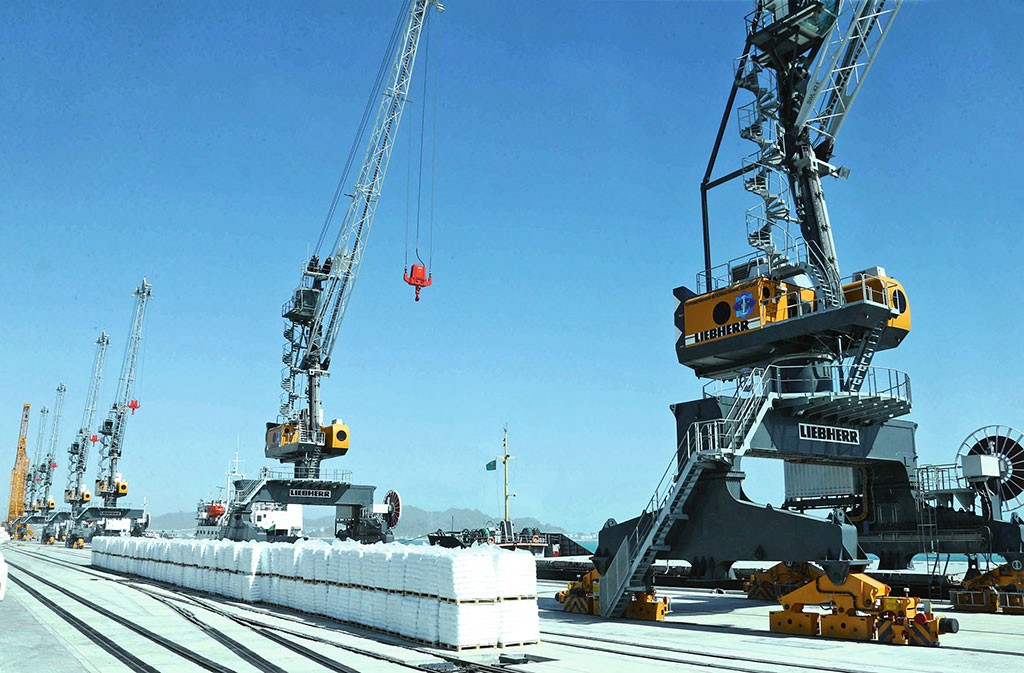
Turkmenistan’s President Gurbanguly Berdimuhamedov visited the Caspian shore, on May 2, to inaugurate the Turkmenbashi International Seaport. The new $1.5 billion facility, Berdimuhamedov told attendees, is important not only for Turkmenistan but the wider region as well. It promises to become an important link in the formation of a modern system of maritime transport across the Caspian. He added that his government is offering use of the port to neighboring countries, including the other Central Asian republics (Regnum, May 3).

Designs for the port’s expansion were drawn up five years ago, before record-low prices for natural gas decimated Turkmenistan’s primary source of export revenue. According to the Ministry of Foreign Affairs, construction of the Turkmenbashi International Seaport began in August 2013. The new port covers an area of about 375 acres and includes ferry, passenger and cargo terminals, with 1.1 miles of berths designed to serve 17 vessels at once (Mir24, May 2).

The Turkmenbashi International Seaport’s projected throughput capacity is considerable: the government states that the new facility will be able to service 300,000 passengers, 75,000 trailer trucks, and 400,000 twenty-foot equivalent unit (TEU) containers a year (Mfa.gov.tm, May 2). The projected annual total throughput capacity of the new port is 17–18 million tons of cargo; the ship-to-shore berths (STS) will operate with a capacity of 25 TEUs per hour (Turkmenportal.com, May 3).

Another important component in the expanded Turkmenbashi port is the “Balkan” shipbuilding and ship-repair plant. The enterprise, built by the Turkish company Gap Inşat, under a May 2014 contract with the Turkmenistan State Service of Sea and River Transport, has the capacity to process 12,000 tons of steel per year. The facility will be able to construct 4–6 vessels annually while providing maintenance facilities for another 20–30 ships per year, allowing for repair works to be carried out on civilian vessels such as tankers, dry cargo vessels and tugboats (Arzuw News, May 3). In addition, Turkmenbashi, formerly Krasnovodsk, is the home port of the modest Turkmenistani Navy (Military-az.com, July 27, 2012).

The Turkmenbashi International Seaport’s potential is already being recognized across the Caspian region. Speaking at Turkmenistan’s “Great Silk Road—To New Development Milestones” international forum, held to commemorate the port’s opening, Russian Astrakhan region Governor Aleksandr Zhilkin told participants, “The port opening in Turkmenbashi will also work in the interests of the Astrakhan region,” referring to the resumption in the near future of shipping between Turkmenbashi and Russia’s Caspian port of Olya. Zhilkin added that Astrakhan “has been developing closer relations with all the countries of the Caspian region for a long time, and with Turkmenistan in particular” (Kaspyinfo.ru, May 3).

Kyrgyzstan, the easternmost of the former Soviet Central Asian states, has also expressed interest in utilizing the new seaport. Kurmanbek Akyshev, the director of Kyrgyzstan’s Civil Aviation Agency, who also attended the forum at the head of a delegation, told reporters, “…it is very important that the International Sea Port was put into operation on the Turkmen coast of the Caspian Sea. As you know, Kyrgyzstan has no access to the sea… [T]he new port will significantly reduce the distance and travel time for large-scale cargo flows, bringing to a qualitative new level economic and trade cooperation between Asia and Europe” (Turkmenportal.com, May 3).

Beyond individual countries, at the forum Berdimuhamedov stated that his government is also exploring the possibility of international organizations utilizing the new port facility, including the Shanghai Cooperation Organization (SCO), the Commonwealth of Independent States (CIS) and the Organization for Economic Cooperation and Development (OECD) (Turkmenistan.gov.tm, May 2).

For many hundreds of years, up to the beginning of the 20th century, the Caspian developed as one of the key points of the transcontinental Great Silk Road because of coordination between interested parties from China to Europe. The imposition of Communism in the former Russian Empire, between 1917 and 1991, largely severed these connections; and today, the Caspian’s sole maritime access to the ocean remains the sovereign Russian internal Volga-Don Canal (see EDM, May 5, 2014). Since 1991, growing interest in the Caspian’s hydrocarbon resources has produced tension between the five states with a Caspian shoreline (see EDM, April 5, 2018). Even as these issues remain unresolved between the four new former Soviet states and Iran, the new Turkmenbashi International Seaport has the potential to benefit not only them but countries further afield from, East Asia to Europe. The new facility’s estimated annual throughput of 18 million tons of cargo, if utilized, will make it the Caspian’s largest port.

Turkmenistan’s “transport diplomacy,” accordingly, has the potential to increase the prosperity not only of Turkmenistan but its landlocked eastern neighbors, from Uzbekistan to Afghanistan to Kyrgyzstan, by providing a vital maritime transport link for their products to reach Western markets. While China remains the primary impetus behind the development of Eurasian transport networks, for Russia the route provides yet another export vector, with the added attraction of not transiting any North Atlantic Treaty Organization (NATO) countries, with whom relations are deteriorating.

Given the two Eurasian superpowers’ guaranteed interest in promoting international trade, combined with the Turkmenistani government’s outreach to the SCO, CIS and OECD, it seems probable that Ashgabat has made a wise investment.