• KGS/USD = 0.01144 0%
  • KZT/USD = 0.00195 -0%
  • TJS/USD = 0.10896 -0%
  • UZS/USD = 0.00008 0%
  • TMT/USD = 0.28571 0.28%
  • KGS/USD = 0.01144 0%
  • KZT/USD = 0.00195 -0%
  • TJS/USD = 0.10896 -0%
  • UZS/USD = 0.00008 0%
  • TMT/USD = 0.28571 0.28%
  • KGS/USD = 0.01144 0%
  • KZT/USD = 0.00195 -0%
  • TJS/USD = 0.10896 -0%
  • UZS/USD = 0.00008 0%
  • TMT/USD = 0.28571 0.28%
  • KGS/USD = 0.01144 0%
  • KZT/USD = 0.00195 -0%
  • TJS/USD = 0.10896 -0%
  • UZS/USD = 0.00008 0%
  • TMT/USD = 0.28571 0.28%
  • KGS/USD = 0.01144 0%
  • KZT/USD = 0.00195 -0%
  • TJS/USD = 0.10896 -0%
  • UZS/USD = 0.00008 0%
  • TMT/USD = 0.28571 0.28%
  • KGS/USD = 0.01144 0%
  • KZT/USD = 0.00195 -0%
  • TJS/USD = 0.10896 -0%
  • UZS/USD = 0.00008 0%
  • TMT/USD = 0.28571 0.28%
  • KGS/USD = 0.01144 0%
  • KZT/USD = 0.00195 -0%
  • TJS/USD = 0.10896 -0%
  • UZS/USD = 0.00008 0%
  • TMT/USD = 0.28571 0.28%
  • KGS/USD = 0.01144 0%
  • KZT/USD = 0.00195 -0%
  • TJS/USD = 0.10896 -0%
  • UZS/USD = 0.00008 0%
  • TMT/USD = 0.28571 0.28%
09 December 2025

Kazakhstan Expands AI-Powered Video Surveillance Network

Kazakhstan has installed more than 19,000 street surveillance cameras equipped with artificial intelligence (AI), enhancing law enforcement’s ability to respond swiftly to incidents, the Ministry of Internal Affairs has announced.

The ministry stated that the country continues to expand its digital security infrastructure. The AI-enabled cameras are capable of facial recognition, detecting abandoned objects, and analyzing traffic patterns. “The integration of these systems with Operational Management Centers allows us to respond to incidents in real time,” it noted.

Police officers have also been equipped with tablets and smart tokens to improve mobility. For the public, reporting tools have been introduced through the 102 mobile app and the “Law and Order” service, accessible via eGovMobile and banking applications. Since the start of 2025, over 8,300 reports have been submitted through these digital platforms.

However, the digital transition has coincided with a rise in cybercrime, particularly online fraud. In response, the internal ministry has implemented early detection systems and mechanisms to block suspicious calls and transactions. “In recent months alone, we have prevented the theft of more than 2.6 billion tenge, confiscated over 88,000 SIM cards used by fraudsters, and blocked more than 67 million fraudulent international calls,” the ministry reported.

Despite the uptick in cybercrime, traditional crime rates have declined. Since the beginning of the year, more than 10,000 criminal cases have been solved, and nearly 10 million administrative offenses have been prevented. “Thanks to preventive measures, the overall crime rate has dropped by 13%, that’s 9,000 fewer cases compared to last year. We’ve seen decreases in murders, robberies, acts of hooliganism, theft, and livestock rustling. Crimes involving weapons, committed in public places, or by previously convicted individuals have also gone down,” said Minister of Internal Affairs Yerzhan Sadenov.

In the area of narcotics enforcement, more than 4,600 drug-related offenses were recorded between January and July 2025. Authorities dismantled 13 organized groups and seized over 11 tons of drugs and 23 tons of chemicals. The ministry also reported 44 extremist-related criminal offenses during the same period, 23 of which have been forwarded to the courts.

Addressing domestic violence, the ministry established a dedicated department at the beginning of 2025. In the first seven months, more than 8,000 criminal cases were registered, over 56,000 protective court orders issued, and more than 19,000 offenders detained.

As previously reported by The Times of Central Asia, the adoption of a new domestic violence law has led to a decline in crimes against women and children, though challenges remain.

Real Madrid to Play Kairat in Almaty in UEFA Champions League

Almaty’s Kairat will face European giants, including 15-time champions Real Madrid, in the UEFA Champions League group stage, marking a historic milestone for the Kazakh club.

Kairat has never before reached this phase of the competition. Earlier this summer, the club became only the second team from Kazakhstan, after Astana, to qualify for the group stage by overcoming four rounds of qualifiers. Prior to the August 28 draw, head coach Rafael Urazbakhtin expressed a wish to be grouped with Real Madrid, Barcelona, or Liverpool.

The draw delivered on one of those wishes: Kairat will now face Real Madrid, the most decorated club in European football history. Also in their group are Inter Milan, three-time Champions League winners, and Arsenal, a top English club with 13 domestic league titles but still seeking their first Champions League crown.

Kairat’s group stage schedule includes away matches against Sporting Lisbon and Copenhagen, while they will host Belgium’s Club Brugge, Greece’s Olympiacos, and Cyprus’s Pafos in Almaty. The group stage will be played between late September 2025 and the end of January 2026.

“We are delighted to be playing Real Madrid. It’s not often that such a club comes to Kazakhstan,” said Urazbakhtin. He acknowledged the disparity in skill levels but emphasized the importance of home support and maximizing their advantage in Almaty.

A total of 36 clubs are competing in this season’s group stage. Each team plays eight matches, four home and four away, against different opponents. The top eight teams overall will advance directly to the playoffs, while clubs ranked 9th to 24th will enter a playoff round in February 2026 to fight for the remaining spots in the round of 16.

As previously reported by The Times of Central Asia, Kairat earned their Champions League berth after a dramatic penalty shootout win over Celtic, with reserve goalkeeper Temirlan Anarbekov playing a decisive role in the victory.

Tokyo Steps Up: Iwaya’s Central Asia Tour Signals Japan’s Long-Term Commitment

Japanese Foreign Minister Takeshi Iwaya made a landmark trip to Central Asia from August 24–28, 2025, holding talks in Kazakhstan and Uzbekistan. Tokyo framed the visit as a bid to deepen bilateral ties and revive the Central Asia plus Japan leaders’ summits. The visit fulfilled commitments made by then-Prime Minister Kishida, who had planned a similar tour in 2024 before cancelling at the last minute due to a domestic earthquake alert.

Strategic Engagement

Iwaya’s visit reflects Tokyo’s long-standing, multifaceted approach to Central Asia. Analysts emphasized to The Times of Central Asia that Japan is pursuing “trust-building diplomacy” in the region, focusing on human capital, infrastructure, and governance rather than quick geopolitical wins. Tokyo inaugurated the Central Asia plus Japan Dialogue format in 2004, making it the first outside power to group all five Central Asian republics within a single framework. As Professor Timur Dadabaev of Tsukuba University told The Times of Central Asia, Tokyo is seen “not as a competing hegemon, but as a partner that invests in the region’s human capital, infrastructure, and governance in ways that reinforce independence.” This approach contrasts with what has been characterized as the transactional models of other powers.

On August 25, Iwaya met with Kazakhstan’s Deputy Prime Minister and Foreign Minister Murat Nurtleu in Astana, marking his first official visit to the country. The talks underscored both sides’ commitment to strengthening ties as strategic partners and in upholding a “free and open international order based on the rule of law.” The ministers welcomed active exchanges and pledged to expand cooperation in trade, investment, mineral resources, disaster prevention, and nuclear non-proliferation. They also announced plans to accelerate preparations for the long-delayed Central Asia plus Japan summit.

Japanese Foreign Minister Iwaya with Kazakh Foreign Minister Nurtleu in Astana after their meeting on August 25, 2025; image Japan MOFA

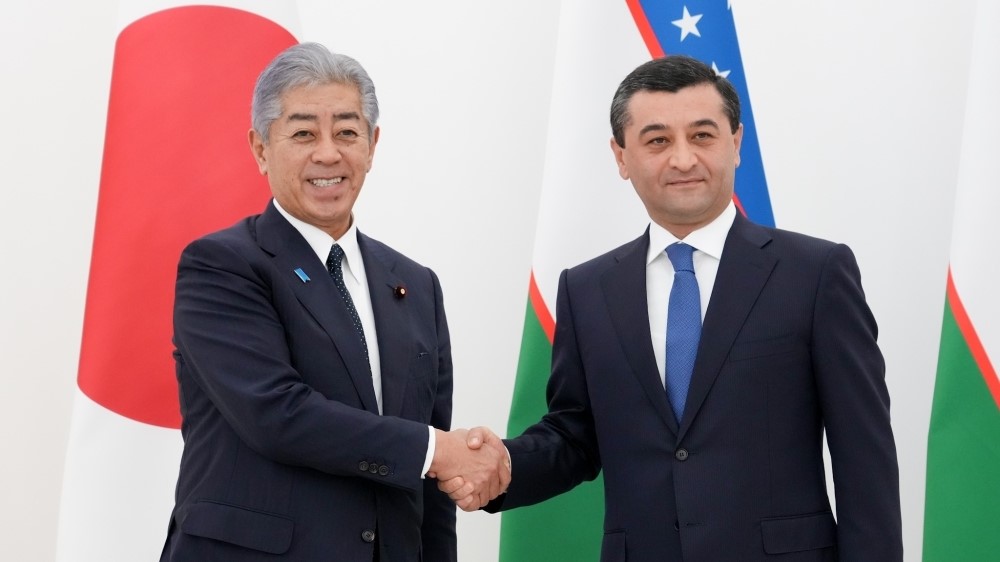
In Tashkent, Iwaya echoed this message, calling Uzbekistan “an important strategic partner,” and highlighting the first-ever foreign ministers’ strategic dialogue held there.

Japanese officials also stressed their policy does not aim to pressure Central Asian partners on sensitive issues. Characterizing Japan as a “catalyst to promote interconnectivity and inter-regional cooperation,” Foreign Ministry spokesman Toshihiro Kitamura stated that Tokyo does not see a zero-sum “competition between Japan and other countries. We would like to see Central Asian countries work together with other parts of the world.”

In Tashkent, Kitamura explicitly noted that while Japan condemns Russia’s invasion of Ukraine, it will not pressure Uzbekistan or others to take the same stance. “The relationship between Russia and the Central Asian countries is a very delicate issue. Each country should take into account the relations it establishes with other countries. Even if it is with Russia, such relations do not affect the relations of other countries with Japan,” Kitamura stated.

Bilateral Agreements

In Kazakhstan, Iwaya held high-level talks with President Kassym-Jomart Tokayev and Foreign Minister Nurtleu. Tokayev welcomed Japan as a “reliable and close partner in Asia” and said ties are “developing dynamically.” The sides agreed to arrange a Central Asia plus Japan summit as soon as possible, exchanged notes on Japanese grant aid for medical equipment for victims of nuclear testing, and announced a direct Tokyo–Almaty flight starting in March 2026. Kazakhstan also invited greater Japanese participation in energy and transit. “Kazakhstan already accounts for about 80% of overland freight traffic between Asia and Europe. We are ready to cooperate on the development of the Trans-Caspian International Transport Route and the introduction of digital technologies, including artificial intelligence, with the involvement of Japanese investors,” said Nurtleu.

In Tashkent, Iwaya and Uzbek Foreign Minister Bakhtiyor Saidov held the first Japan–Uzbekistan Foreign Ministers’ Strategic Dialogue, signed a joint communiqué, and showcased two grant projects: the Project for Human Resource Development Scholarship and an economic initiative for vulnerable groups, including Afghan returnees. The two sides agreed to hold the dialogue biennially and to schedule the Japan–Central Asia leaders’ summit at an early date, while expanding cooperation on economic security and supply chains.

Regional Implications

Iwaya’s August 2025 trip underscored Japan’s intent to remain a steady partner in Central Asia, balancing economic opportunity with respect for regional sensitivities. By advancing grant aid in Kazakhstan, launching new scholarship and development projects in Uzbekistan, and pledging to revive the Central Asia plus Japan summit, Tokyo is positioning itself as a constructive actor focused on connectivity, resilience, and trust-building. This “bridges not blocs” strategy comes backed by official statements from the Japanese Foreign Ministry highlighting a commitment to long-term partnerships. With strategic dialogue in Tashkent and new agreements in Astana, Japan has signaled that its presence in Central Asia is not episodic but a durable part of the region’s evolving geopolitical landscape.

Insider’s View: Uzbekistan’s Competitiveness and Advantages in the SCO Tourism Market

In recent years, Uzbekistan has strengthened its position in the international tourism market, particularly in the region of the Shanghai Cooperation Organization (SCO). From January to June 2025, the country welcomed over 5.3 million international tourists, more than double the figure of the previous year, while tourism service exports rose to $2.4 billion, marking a 164% increase.

For the SCO member states, tourism serves as a driver of economic growth and an important tool for cultural exchange and diplomatic rapprochement. Uzbekistan stands out within the Organization thanks to its rich cultural heritage, modern infrastructure, and liberal visa policy.

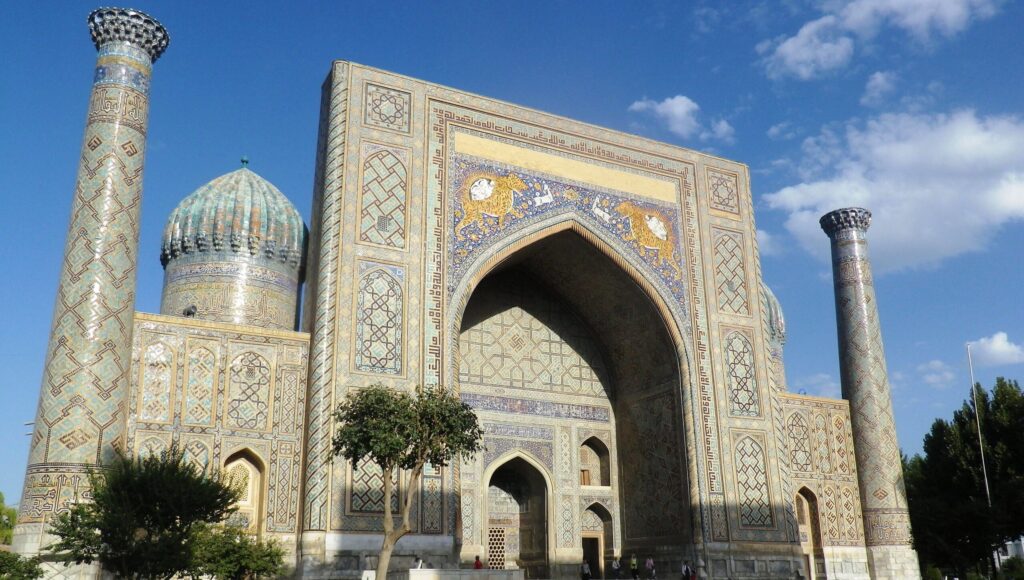
Uzbekistan’s historical landmarks provide the country with a significant competitive advantage within the SCO region. Cities such as Samarkand, Bukhara, and Khiva – all included on the UNESCO World Heritage List – have become major cultural magnets for tourists. These cities are home to hundreds of architectural monuments, mosques and madrasahs, traditional markets, and craft centers, offering travelers a truly unique experience.

Building on this heritage, Uzbekistan has also expanded its hospitality sector. In the first half of 2025, Uzbekistan established 60 new hotels, 287 family guest houses, 146 hostels, and 24 other accommodation facilities – a total of 517 new establishments offering 12,800 additional beds. As a result, the total number of accommodation facilities reached 6,448, with overall capacity exceeding 170,000 beds.

In recent years, Uzbekistan has actively cooperated with global hotel brands, with international chains such as Hilton, Intercontinental, Bentley, Bill Wyndham & Co., and Azimut implementing investment projects across various regions of the country. This has had a positive impact on both the quality of service and the level of trust from the international community.

Additionally, 368 new tourism companies and travel agencies were established in the country, bringing the total number of tour operators to 4,052. Across the republic, 3,415 tour guides are currently active, with 215 new specialists trained in just the first half of this year. These developments have improved the quality of tourism services and significantly enhanced conditions for visitors to the country.

Uzbekistan’s visa policy is also one of the most progressive in the region. Today, citizens of more than 90 countries can enter the country visa-free, while an additional 56 countries have access to an electronic visa system. This has become a key factor in the growth of tourist arrivals.

All of these measures have contributed to a significant increase in the number of tourists visiting Uzbekistan. In the first six months of 2025 alone, more than 4.3 million tourists from SCO member states visited the country, accounting for over 80% of all international visitors.

Uzbekistan is also actively promoting its tourism image on the international stage. Cooperation is underway with global media companies such as World Media Group, Blue Sky, Sky One, Wanderlust, Euronews, the BBC, National Geographic, CNN, Travel Tomorrow, Warner Bros. Discovery, Saga Travel Group, as well as with online platforms like Ctrip.com, Holiday Factory, Voyage Privé, and others.

In 2024, Uzbekistan participated in 22 international tourism exhibitions held in 19 leading countries worldwide, presenting its national pavilion. A number of large-scale initiatives are also being implemented within the SCO region. In particular, as part of the Year of Tourism of Uzbekistan in China, presentations were held in more than 20 provinces, alongside participation in tourism exhibitions and over 500 B2B meetings. As a result of these events, 44 agreements were signed to facilitate the arrival of Chinese tourists to Uzbekistan.

From an economic perspective, tourism plays a key role in Uzbekistan’s economy. In 2024, 591 projects were implemented with a total investment of $2.8 billion, creating 19,428 new jobs. For 2025, the government has set even more ambitious targets: attracting 11 million foreign tourists, generating tourism revenues of $3.8 billion, and creating 50,000 new jobs.

Furthermore, the country is implementing the “Tourism-2040” strategy aimed at the long-term development of the industry. This strategy includes focus areas such as sustainable tourism development, eco-friendly travel, involvement of local communities, infrastructure expansion, and the adoption of digital technologies.

In conclusion, Uzbekistan’s competitiveness in the SCO tourism market is ensured by a range of factors: a rich historical and cultural heritage, modern infrastructure, an active international marketing strategy, favorable visa policies, and a stable economic strategy. Taken together, these make the country an important regional player and a significant global actor in the tourism market.


The views expressed in this article are those of the author and do not necessarily reflect the official policy or position of the publication, its affiliates, or any other organizations mentioned.

Rails Through the Mountains: Kyrgyzstan Expanding Network in All Directions

On August 25, in the remote village of Kosh-Dobo in central Kyrgyzstan, construction finally started on Kyrgyzstan’s section of a railway that will connect the country to China and Uzbekistan.

It is one of the most important projects in Kyrgyzstan’s 34 years of independence. And it is not the only railway project in Kyrgyzstan, as the country is at last moving to better connect by rail, both internally and with its neighbors.

Three Dormant Decades

For the first 30 years of independence, no new railway tracks were laid in Kyrgyzstan, but that is now changing. Kyrgyzstan is about 90% mountainous. When Kyrgyzstan became independent in late 1991 after the collapse of the Soviet Union, there were two railways leading into Kyrgyzstan. Both came from Uzbekistan to the west.

A northern line connected Uzbekistan’s capital, Tashkent, through southern Kazakhstan to Kyrgyzstan’s capital, Bishkek, and from there continued eastward to Issyk-Kul, a large lake and tourist area in the northeastern corner of the country. The other railway extended only a few dozen kilometers from the Uzbek border to Osh in southern Kyrgyzstan. The length of the two railways combined amounted to some 320 kilometers.

Work started on the 186-kilometer Balykchy-Kochkor-Kara-Keche railway at the end of March 2022. Balykchy is located at the western tip of Issyk-Kul. Since Soviet times, it has been the last stop on the train that originates in Uzbekistan and travels through Bishkek.

Kochkor is a village in Naryn Province, about 63 kilometers southwest of Balykchy. Some 120 kilometers further to the southwest is Kara-Keche, one of Kyrgyzstan’s primary coal-mining sites and the source of much of the coal used in the thermal power plant that supplies heat and electricity to Bishkek.

Chairman of Kyrgyzstan’s Cabinet of Ministers Adylbek Ksaymaliyev said in May 2025 that there are already plans to connect this railway line to the China-Kyrgyzstan-China line being built through southern Naryn Province.

The Eurasian Development Bank recently agreed to fund a feasibility study for extending the railway from Balykchy to the town of Cholpon-Ata, the main tourist town on the north shore of Issyk-Kul, with a stop at the Issyk-Kul airport at Tamchy. As it stands now, people headed to Cholpon-Ata by rail must switch from the train to car or bus at Balykchy to travel the remaining 80 kilometers to Cholpon-Ata.

In May 2024, President Sadyr Japarov called for that railway line to eventually reach the town of Karakol, at the eastern end of Issyk-Kul, some 140 kilometers from Cholpon-Ata.

Naryn is the biggest province in Kyrgyzstan in terms of territory, but its connections to the rest of the country are tenuous, particularly in the northeastern part of the province where Kochkor and Kara-Keche are located.

Kosh-Dobo is in the southern part of Naryn Province, near the borders of the Jalal-Abad and Osh provinces. The village is located on the route of the long-awaited China-Kyrgyzstan-Uzbekistan (CKU) railway that will run from Kashgar in China’s Xinjiang region to Andijan, Uzbekistan.

The project was first proposed some 30 years ago, but remained in the discussion stages until recently. Eastern and southeastern Kyrgyzstan are covered by the high mountains, the Tien-Shan and Pamir mountains, respectively. That has restricted Kyrgyzstan’s trade routes to Kazakhstan, in the north, and Uzbekistan, in the west.

The 486-kilometer CKU railway will be the first significant eastern route for Kyrgyzstan (there are two roads connecting to China). Ultimately, the railway puts Kyrgyzstan on a China-Europe route that should bring Kyrgyzstan substantial revenue from transit fees, as well as allowing Kyrgyzstan to develop mining sites with critical minerals in hitherto remote areas that will be near the 312 kilometers of the railway line that passes through Kyrgyzstan and transport them to processing plants and markets.

The Kyrgyz section of the railway offers some formidable challenges as it requires the construction of 46 bridges with a combined length of some 120 kilometers, as well as 27 tunnels. China is helping with construction and loaning Kyrgyzstan some $2.35 billion to help with costs for its section of the railway.

In March this year, Kyrgyzstan announced plans to build a railway from the southern city of Batken, some 60 kilometers northeast to Kokand in Uzbekistan. Kokand has links to other cities in Uzbekistan’s section of the Ferghana Valley, as well as to the Uzbek capital, Tashkent.

Riding the Rails

Kyrgyzstan’s government plans to have all these new routes operating by 2030. These lines would add more than 700 kilometers of new railway.

Timing is everything, and the geopolitical situation in Central Asia, in general, and in Kyrgyzstan in particular, has changed in the last decade. For most of the first 25 years of independence, Kyrgyzstan had poor ties with Uzbekistan, limiting the use of existing railways connecting the two countries and precluding any possibility of building new rail links, including the CKU.

Uzbek-Kyrgyz relations have grown much warmer since Shavkat Mirziyoyev became Uzbekistan’s president in 2016. The Kyrgyz-Uzbek border was finally demarcated, and Uzbekistan is participating in projects inside Kyrgyzstan, such as the construction of the Kambarata-1 Hydropower Plant.

When Russia launched its full-scale war on Ukraine, China’s trade with Europe was hampered by EU sanctions on goods transiting Russian territory, which led China to expand the Middle Corridor through Central Asia. Beijing’s decision to finally move forward with the CKU railway after all these years was no doubt prompted by the restrictions on moving goods through Russia.

Development of the domestic railway network was long overdue. Outside cities and towns, most of the roads are gravel or dirt.

Kyrgyzstan’s wealth lies in the mining industry, and the expansion of railways will help the country open and take advantage of mineral deposits. Remote communities in eastern Kyrgyzstan will benefit from being on or near the railways, as they should have better access to food and other goods.

Kyrgyzstan Begins Building Strategic Highway to China’s Xinjiang

Kyrgyzstan has begun construction on the Barskoon-Bedel highway, a key section of the future Barskoon-Uchturfan-Aksu corridor that will link the Issyk-Kul region with China’s Aksu prefecture in Xinjiang via the Bedel Pass.

The new road is expected to shorten the distance between Aksu and Kyrgyzstan by 500 kilometers, saving at least 12 hours of travel time for freight carriers.

Route and Infrastructure

The highway will cross the Barskoon and Soek passes, the Kara-Sai valley, and the Ashuu-Suu pass. To ensure year-round use, the project includes construction of a 5.5 km tunnel under the Soek pass and a 3.8 km tunnel beneath the Ashuu-Suu pass, both areas prone to heavy winter closures.

Timeline and Contractor

Construction is being carried out by China Road and Bridge Corporation (CRBC). The main roadworks are scheduled for completion in September 2029, with full commissioning of the highway and supporting facilities expected by September 2030.

The Bedel checkpoint, first opened under a simplified regime in September 2024, lies in a remote mountain zone roughly equidistant from Karakol in Kyrgyzstan and Aksu in China. Its full-scale development with international-standard infrastructure is slated for completion by 2027.

Trade and Regional Connectivity

Once finished, the Barskoon-Bedel corridor will become Kyrgyzstan’s third road crossing with China, alongside the Irkeshtam (Osh region) and Torugart (Naryn region) passes. Unlike the older routes, which are frequently closed during winter, the new corridor is designed to provide a more reliable and time-efficient link.

The project is expected to strengthen Kyrgyzstan’s role as a transit hub for Chinese goods heading to third-country markets. Bilateral trade between Kyrgyzstan and China reached $23 billion in 2024, an eightfold increase in recent years.

Chinese Support

Speaking at the ceremony, Chinese Ambassador Liu Jiangping said the new highway is part of a wider set of strategic projects advancing between the two countries, aimed at accelerating cargo flows and expanding trade, investment, and economic cooperation.