• KGS/USD = 0.01144 0%
  • KZT/USD = 0.00194 -0%
  • TJS/USD = 0.10844 -0.46%
  • UZS/USD = 0.00008 0%
  • TMT/USD = 0.28571 0.28%
  • KGS/USD = 0.01144 0%
  • KZT/USD = 0.00194 -0%
  • TJS/USD = 0.10844 -0.46%
  • UZS/USD = 0.00008 0%
  • TMT/USD = 0.28571 0.28%
  • KGS/USD = 0.01144 0%
  • KZT/USD = 0.00194 -0%
  • TJS/USD = 0.10844 -0.46%
  • UZS/USD = 0.00008 0%
  • TMT/USD = 0.28571 0.28%
  • KGS/USD = 0.01144 0%
  • KZT/USD = 0.00194 -0%
  • TJS/USD = 0.10844 -0.46%
  • UZS/USD = 0.00008 0%
  • TMT/USD = 0.28571 0.28%
  • KGS/USD = 0.01144 0%
  • KZT/USD = 0.00194 -0%
  • TJS/USD = 0.10844 -0.46%
  • UZS/USD = 0.00008 0%
  • TMT/USD = 0.28571 0.28%
  • KGS/USD = 0.01144 0%
  • KZT/USD = 0.00194 -0%
  • TJS/USD = 0.10844 -0.46%
  • UZS/USD = 0.00008 0%
  • TMT/USD = 0.28571 0.28%
  • KGS/USD = 0.01144 0%
  • KZT/USD = 0.00194 -0%
  • TJS/USD = 0.10844 -0.46%
  • UZS/USD = 0.00008 0%
  • TMT/USD = 0.28571 0.28%
  • KGS/USD = 0.01144 0%
  • KZT/USD = 0.00194 -0%
  • TJS/USD = 0.10844 -0.46%
  • UZS/USD = 0.00008 0%
  • TMT/USD = 0.28571 0.28%
09 December 2025

Electric Vehicles in Kazakhstan: Growth, Gaps, and the Road Ahead

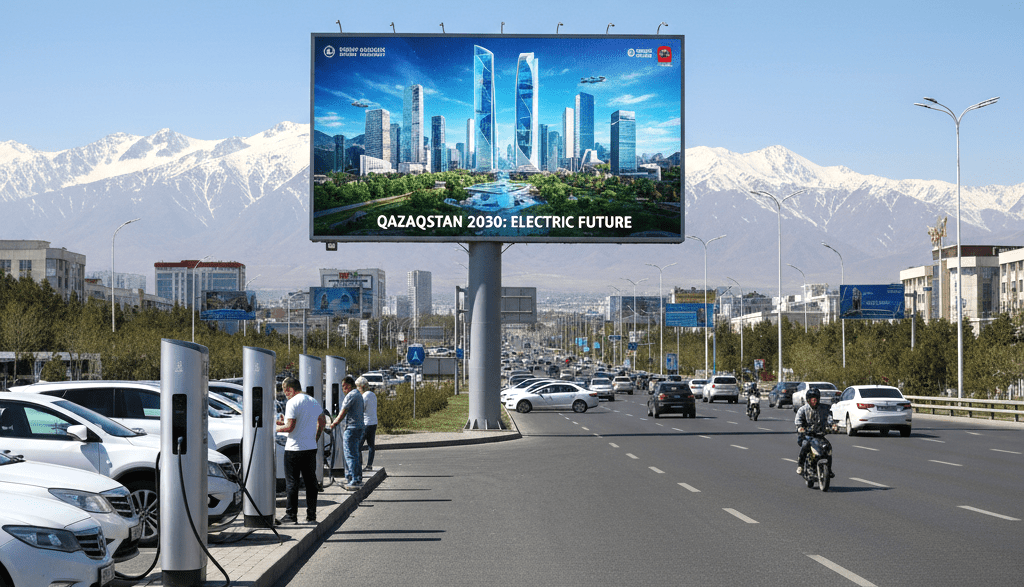
Despite growing interest in environmentally friendly transport, the share of electric vehicles (EVs) in Kazakhstan remains modest. This is due to their relatively late entry into the domestic market, persistent public skepticism, and an underdeveloped charging infrastructure. Nevertheless, electric mobility is already seen as a crucial component of Kazakhstan’s future transport strategy and its broader sustainable development agenda.

These are among the conclusions of a new study analyzing the state of the EV fleet in Kazakhstan and proposing measures to develop urban electric transport infrastructure.

According to official registration data, more than 19,000 electric cars and motorcycles were registered in Kazakhstan in the first half of 2025, a figure that reflects steadily rising interest in EV adoption.

More EVs, Fewer Charging Stations

If current trends continue, the EV fleet in Kazakhstan could increase more than tenfold by 2030, says Seydulla Abdullaev, Doctor of Technical Sciences and Head of the School of Transport Engineering and Logistics at the Satbayev Kazakh National Research Technical University. However, the pace of charging infrastructure development continues to lag.

“Even with the current ratio of 25 electric vehicles per charging station, Kazakhstan will need between 4,000 and 8,000 charging points by 2030. This will require significant investment, an updated regulatory framework, and more active participation from the private sector,” Abdullaev told The Times of Central Asia.

By comparison, in China, the global leader in EV production and charging infrastructure, one station serves an average of ten electric vehicles, a level considered high by industry standards. In Europe, EV charging stations are installed along highways at intervals of roughly 50 km. In contrast, only 23 such stations are currently operational on Kazakh highways.

International best practices highlight the value of equipping residential complexes and parking lots with courtyard chargers, especially when backed by state subsidies.

In Kazakhstan, a roadmap adopted in 2023 mandates that necessary EV infrastructure be established in all major cities by 2029. However, progress has been slow. In Almaty, which accounts for approximately 60% of the nation’s EV fleet, only 23 of the 40 planned charging stations were completed by 2024.

“Our analysis shows that the key barriers to electric transport development include inadequate infrastructure, a limited service base, and underdeveloped technical documentation. Moving forward, progress will largely depend on political decisions, particularly in areas such as EV production subsidies, charging station expansion, and buyer incentives,” Abdullaev noted.

Incentive Cuts Threaten Market Growth

Kazakhstan’s EV market has increasingly aligned with global trends, particularly the dominance of Chinese manufacturers. Today, around 70% of EVs in the country are made in China, followed by about 20% from the U.S., and the rest from Germany, Belgium, Austria, and Japan. According to Natalya Tokmurzina-Kobernyak, Associate Professor at the School of Transport Engineering and Logistics at Satbayev KazNITU, this technological diversity demands a broad and well-supported service infrastructure.

The global EV fleet, which stood at 58 million in 2020, had nearly quintupled by the end of 2024, according to the International Energy Agency. That figure is expected to reach 400 million by 2030. Two-thirds of these vehicles are battery electric, with hybrids making up the remainder.

In Kazakhstan, however, legislation only classifies battery electric vehicles as EVs. Hybrids are excluded under the Law “On Road Traffic.”

Researchers warn that the cancellation of import privileges could hurt EV adoption. The current exemption from customs duties was limited to 15,000 vehicles, a quota that has already been filled. Starting January 1, 2026, individual buyers will be required to pay 16% VAT, although the zero rate for transport and disposal taxes will remain. This is expected to raise EV prices by 30-40%.

EV charging network operators, who had anticipated a growth in demand, are now tempering their expectations. Bulat Pultambekov, a representative of the EVS charging station network, says the company is revising its business forecasts amid concerns about longer payback periods and tighter financing conditions.

Globally, governments offer extensive EV incentives. In the UK, subsidies reach $7,800; in France, up to 30% of a car’s value. Other common incentives include tax exemptions, free parking, use of public transport lanes, toll-free road access, zero VAT, and customs duty waivers.

The study modeled three development scenarios for EV mobility in Kazakhstan through 2030. Under the optimistic scenario, with continued state support, the EV fleet could grow to 120,000 units. A realistic projection puts the number at 78,000 (approximately 12% of the national vehicle fleet), while an inertial scenario, assuming limited policy support, projects growth to just 42,000 units.

“With the removal of import subsidies in 2025, we expect slower growth, even if the overall upward trend continues. As a result, the EV share will remain at 12-16%,” the study notes.

Who is Responsible for the Transition?

Kazakhstan has already adopted a basic legislative framework for EV regulation, including 17 national and 8 interstate standards for vehicles and chargers. Separate documents outline energy usage rules, and electrical safety is addressed in fire and installation regulations.

Yet, according to Tokmurzina-Kobernyak, the regulatory environment remains fragmented.

“We don’t have a dedicated law ‘On Electric Vehicle Transport’ that would consolidate all the disparate regulations,” she said, adding that Kazakhstan also lacks a single state body responsible for coordinating EV policy.

To fill these gaps, she recommends passing a specialized EV law, amending the Urban Planning Code, and introducing unified technical standards for charging station installation, adjusted for climatic differences across regions.

“Without systemic action, we cannot achieve zero harmful emissions,” she stressed.

One unresolved challenge is battery disposal. With an average lifespan of 5-7 years, the growing number of batteries will soon become an environmental concern. Safety is another issue: lithium-ion batteries can suffer from thermal runaway, leading to fire or explosion.

Though the technology is still emerging, several countries are already testing rapid heat-suppression systems. Kazakhstan’s fire services are also exploring new battery fire-extinguishing techniques. According to the research group, Kazakhstan has recorded three EV-related fires in the past four years. Future regulations for EV charging station placement are expected to include stricter fire and electrical safety requirements.

Experts agree that without active state involvement, further development of Kazakhstan’s EV sector is unlikely. A promising step is the roadmap for 2025-2035 being drafted by the International Finance Corporation (IFC), a World Bank entity. The plan will draw on global best practices, propose financial incentives, and identify pilot projects.

Competing with global leaders like China and the U.S., who enjoy large-scale production and technological advantages, will be a challenge. Therefore, researchers argue, Kazakhstan must leverage advanced technologies and alternative fuels while capitalizing on its domestic resource base.


Number of Tajik Citizens on Russia’s “Controlled Persons” List Surpasses 150,000

The number of Tajik nationals included in Russia’s registry of “controlled persons” has risen sharply, according to new figures released by the Representative Office of Tajikistan’s Ministry of Labor, Migration and Employment in Russia. Citing the latest update, Asia-Plus reports that more than 150,000 Tajik citizens were listed as of November, an increase of approximately 30,000 since the last official count.

The previous figures, published in October 2024, placed the number at over 120,000. Since then, the Tajik authorities have repeatedly urged migrants in Russia to legalize their status and take steps to be removed from the so-called “blacklist.” However, no updated statistics had been released until now.

Russia’s controlled persons registry, which came into force on February 5, 2025, encompasses individuals accused of various administrative violations. These range from minor offenses such as unpaid utility bills and traffic infractions to failure to appear at state agencies despite repeated summonses. Russian authorities gave migrants until September 10 to regularize their documents and avoid inclusion in the system.

In September, Russia’s Interior Ministry announced that around 770,000 people were registered nationwide, one-third of them women and children. Foreign nationals on the list face wide-ranging restrictions, including bans on changing their place of residence without permission, leaving their region, operating vehicles, purchasing property, or conducting specific financial transactions.

Since the registry’s introduction, numerous migrants have reported being added to the list in error. Many only discovered their status after receiving bank notifications about frozen accounts or blocked transactions.

Tajikistan’s migration office in Russia continues to advise citizens to verify their status through the Russian Interior Ministry’s online platform. Migrants whose names appear on the list are encouraged to contact local migration offices for assistance. Those unable to resolve their situation are urged to leave Russia within the legally mandated timeframe.

Earlier this year, The Times of Central Asia reported that the Tajik authorities had called on labor migrants in Russia to renew their documents before the deadline when Russia’s updated migration regulations came into effect. The Tajik Interior Ministry has reminded citizens that maintaining legal residency is essential for continued employment in the country.

IMF: Uzbekistan’s Economy Strong but Reforms Needed to Sustain Momentum

Uzbekistan’s economy remains robust, supported by strong domestic demand, high gold prices, and rising investment, according to the International Monetary Fund (IMF). The assessment was released in an end-of-mission statement following an IMF staff visit to Tashkent from November 17 to 25, led by Yasser Abdih.

The IMF reported that real GDP grew by 7.6% year-on-year in the first nine months of 2025, driven by buoyant household consumption and increased investment. Despite sustained demand, inflation has moderated. Headline inflation fell to 7.8% in October, while core inflation eased to 6.6%. This slowdown, the IMF noted, reflects the diminishing impact of last year’s administrative energy price adjustments, a firmer exchange rate, and continued tight monetary policy.

Household lending grew rapidly, up 23% in September, though business lending rose more modestly. The external current account deficit narrowed significantly in the first half of 2025, bolstered by high global gold prices, a strong performance in non-gold exports, and steady remittance inflows. International reserves remain “ample,” covering roughly 12 months of projected imports.

The IMF forecasts GDP growth to exceed 7% in 2025, tapering to around 6% in 2026. Inflation is expected to gradually decline toward the Central Bank of Uzbekistan’s 5% target by the end of 2027. Overall, the economic outlook is “broadly positive,” with risks described as “largely balanced.”

However, the IMF cautioned that stronger-than-expected revenues, particularly from gold exports, could lead to excessive government spending. To avoid overheating the economy, it advised limiting new expenditures, curbing real exchange rate appreciation, and reducing exposure to gold price volatility. The Uzbek government has reaffirmed its commitment to keeping the fiscal deficit below 3% of GDP in both 2025 and 2026.

The mission urged authorities to broaden the tax base and raise the tax-to-GDP ratio. It welcomed the government’s planned medium-term revenue strategy and ongoing reforms to reduce the shadow economy and modernize the Tax Committee. Key recommendations include restricting new tax incentives, enhancing audit systems, and publishing annual tax expenditure reports to improve transparency.

On monetary policy, the IMF stressed the need to maintain a tight stance to drive inflation down. The Central Bank of Uzbekistan has held its policy rate at 14% since March. The IMF welcomed the country’s move toward greater exchange rate flexibility, introduced in April.

The Fund also called for acceleration of financial sector reforms, including phasing out directed and preferential lending programs. It urged the finalization of a comprehensive roadmap to implement the 2025 Financial Sector Assessment Program recommendations.

Structural reforms remain critical to sustaining long-term growth. The IMF emphasized the need to continue privatizing and restructuring major state-owned enterprises, improve governance, strengthen market competition, and prepare for World Trade Organization accession, targeted for March 2026.

The IMF concluded the mission by thanking Uzbek authorities for their cooperation, noting that the visit will not result in a formal Board discussion.

A year earlier, the IMF delivered similarly upbeat projections for Uzbekistan, citing 6.4% GDP growth in the first half of 2024, rising remittances, and solid reserves. However, it also warned of inflationary pressures from energy price reforms and underscored the need for continued structural reforms to shield the economy from external shocks.

EU Supports Connectivity Improvements in Kazakhstan, Kyrgyzstan, and Uzbekistan as Part of Trans-Caspian Transport Corridor

On November 27, Tashkent hosted the Trans-Caspian Transport Corridor (TCTC) and Connectivity Investors Forum, where representatives of the European Union, Central Asian and South Caucasus states, Türkiye, and international development banks reaffirmed the strategic importance of the TCTC as a fast and reliable route linking Europe and Asia.

The TCTC is the EU’s designation for the Trans-Caspian International Transport Route (TITR), also known as the Middle Corridor. This multimodal route connects China and Southeast Asia to Europe via Central Asia, the Caspian Sea, Azerbaijan, Georgia, and Türkiye in no more than 15 days, offering an alternative to the northern route through Russia.

Participants discussed efforts to modernize both hard infrastructure, roads, railways, ports, and logistics hubs and soft connectivity, including digitalization, regulatory alignment, and trade facilitation.

According to the EU Delegation in Uzbekistan, the forum, attended by European Commissioner for International Partnerships Jozef Síkela and European Commissioner for Enlargement Marta Kos, produced several new agreements to enhance multimodal connectivity in Central Asia.

The EU has committed EUR 10.4 million within an EBRD loan of EUR 35 million to modernize Aktau Port in Kazakhstan, a key logistics hub on the Caspian Sea. The project will expand berths, introduce energy-efficient cranes, and increase container-handling capacity, strengthening the Middle Corridor’s competitiveness.

An envisaged EIB loan of EUR 150 million, backed by an EU guarantee of EUR 8.8 million, will support road rehabilitation in Kazakhstan. The financing for national operator KazAvtoZhol aims to improve sustainable transport infrastructure linked to the TCTC.

The EU will contribute EUR 15.46 million within an EBRD loan of EUR 35 million for the modernization of the Karabalta-Chaldovar road in Kyrgyzstan. Upgrading the 31.7-kilometer section will enhance connectivity between Kyrgyzstan and Kazakhstan, reduce travel time and costs, and improve road safety.

In Uzbekistan, an anticipated EIB loan of up to EUR 100 million, supported by an EU guarantee of EUR 6 million, will finance the Nukus Highway Development Project. The upgrade of 87 kilometers of the A380 highway, one of the country’s main transport arteries, is expected to strengthen regional trade and streamline transport flows with neighboring states.

Speaking at the forum, Commissioner Marta Kos stressed the geopolitical and economic value of reliable east-west transport links: “All of us have learnt the hard way that excessive dependencies make us vulnerable,” she said. “Investments in transport infrastructure, digital and energy connectivity create more options and less risk of blackmail. We need credible, long-term alternatives to the Northern Corridor. Cargo along the Middle Corridor has grown four-fold between 2022 and today. By 2030 it could again triple, if the right investments are made to increase capacity and close gaps.”

Kazakh Archaeologists Contribute to Landmark Discovery on the Origins of Dog Domestication

A groundbreaking study co-authored by Kazakh archaeologists has challenged long-held assumptions about the history of dog domestication. The research, titled “Wide Diversity of Dogs Thousands of Years Before Modern Breeding Methods,” was published in Science, the oldest scientific journal in the U.S.

The study was led by researchers from the University of Exeter (UK) and France’s National Center for Scientific Research and included contributions from 40 institutions worldwide. Kazakh scientists V.K. Merz and I.V. Merz of Toraygyrov University, along with E.R. Usmanova and V.V. Varfolomeev of the E.A. Buketov Karaganda National Research University, were among the co-authors.

The international team conducted a comprehensive comparative analysis of 643 dog and wolf skulls spanning the last 50,000 years from the Pleistocene to the present day. Using high-resolution 3D scanning, they analyzed over 600 specimens, revealing that dogs already displayed significant morphological diversity during the early Holocene epoch.

This diversity, previously believed to be the result of 19th-century selective breeding, was shown to have originated far earlier. The analysis traced the emergence of distinct dog types, including variations in size and skull structure, as early as 11,000 years ago. By the Mesolithic and Neolithic periods, dogs had already begun to differ in form, likely reflecting specialized roles such as hunting, guarding, and herding within human societies.

The researchers concluded that functional differentiation was a key driver in the development of what would eventually become distinct breeds. Their findings refute the common belief that modern breed variation is a relatively recent phenomenon. In fact, many differences in skull shape and size long predate the advent of formal breeding practices.

Kazakhstan’s archaeological collections and local expertise played a significant role in the project, underscoring the country’s growing contributions to global archaeozoological research.

Kazakhstan’s Broader Scientific Advances

In addition to this landmark discovery, Kazakh scientists continue to make technological strides across disciplines.

Researchers at the Institute of Combustion Problems have developed a device capable of converting hydrocarbon gases into 98.9% pure hydrogen and technical carbon in a single stage. Operating at plasma temperatures of up to 2,700°C, the unit requires no catalysts and consumes less energy than traditional methods. It also produces giant nanotubes with diameters reaching 100 nanometres.

Meanwhile, scientists at Al-Farabi Kazakh National University have introduced a mobile preservation unit capable of drying and storing a wide range of food products from fruit to fish for up to 10 to 50 years using specialized packaging.

These developments signal Kazakhstan’s expanding role in cutting-edge research and innovation across multiple scientific domains.

Tajikistan to Repay Over $500 Million to Foreign Creditors in 2026

Tajikistan plans to allocate $548 million to repay its principal external debt in 2026, according to the country’s draft state budget. This would be one of the largest annual external debt payments in recent years for the republic.

Most of the repayment will be covered directly from the national budget. A portion will also come from state-owned companies and enterprises that previously received sub-loans backed by government guarantees. These entities are now participating in the repayment process.

In addition to external debt, Tajikistan’s domestic obligations in 2026 are projected at more than $51 million. Of that amount, $16 million will be serviced from the budget, while the remaining $34.5 million will be financed through the Ministry of Finance’s deposits at the National Bank of Tajikistan, as well as revenue from the sale and lease of assets belonging to the now-liquidated Agroinvestbank and Tajiksodirotbank, both of which have been transferred to state ownership.

Despite these substantial repayments, Dushanbe plans to continue attracting foreign financing for development purposes. More than $678 million is earmarked for state investment projects in 2026, with funding to be directed toward the energy, infrastructure, and social sectors.

According to the Ministry of Finance, as of October 1, Tajikistan’s total external debt stood at $3.037 billion, down $151 million, or 4.7%, from the beginning of the year. The figures indicate a gradual reduction in the country’s debt burden.

The vast majority of the debt, 95.5%, or nearly $2.9 billion, is classified as direct government debt. Debt secured by state guarantees amounts to slightly over $138 million.

China remains Tajikistan’s largest creditor, with over $700 million in outstanding loans. Other major lenders include the World Bank, the Asian Development Bank, the Islamic Development Bank, and the European Bank for Reconstruction and Development.