• KGS/USD = 0.01144 0%
  • KZT/USD = 0.00194 -0%
  • TJS/USD = 0.10844 -0.46%
  • UZS/USD = 0.00008 0%
  • TMT/USD = 0.28571 0.28%
  • KGS/USD = 0.01144 0%
  • KZT/USD = 0.00194 -0%
  • TJS/USD = 0.10844 -0.46%
  • UZS/USD = 0.00008 0%
  • TMT/USD = 0.28571 0.28%
  • KGS/USD = 0.01144 0%
  • KZT/USD = 0.00194 -0%
  • TJS/USD = 0.10844 -0.46%
  • UZS/USD = 0.00008 0%
  • TMT/USD = 0.28571 0.28%
  • KGS/USD = 0.01144 0%
  • KZT/USD = 0.00194 -0%
  • TJS/USD = 0.10844 -0.46%
  • UZS/USD = 0.00008 0%
  • TMT/USD = 0.28571 0.28%
  • KGS/USD = 0.01144 0%
  • KZT/USD = 0.00194 -0%
  • TJS/USD = 0.10844 -0.46%
  • UZS/USD = 0.00008 0%
  • TMT/USD = 0.28571 0.28%
  • KGS/USD = 0.01144 0%
  • KZT/USD = 0.00194 -0%
  • TJS/USD = 0.10844 -0.46%
  • UZS/USD = 0.00008 0%
  • TMT/USD = 0.28571 0.28%
  • KGS/USD = 0.01144 0%
  • KZT/USD = 0.00194 -0%
  • TJS/USD = 0.10844 -0.46%
  • UZS/USD = 0.00008 0%
  • TMT/USD = 0.28571 0.28%
  • KGS/USD = 0.01144 0%
  • KZT/USD = 0.00194 -0%
  • TJS/USD = 0.10844 -0.46%
  • UZS/USD = 0.00008 0%
  • TMT/USD = 0.28571 0.28%
09 December 2025

Kyrgyzstan Proposes Controversial Criminal Code Changes Targeting Recidivism, Limiting Official Liability

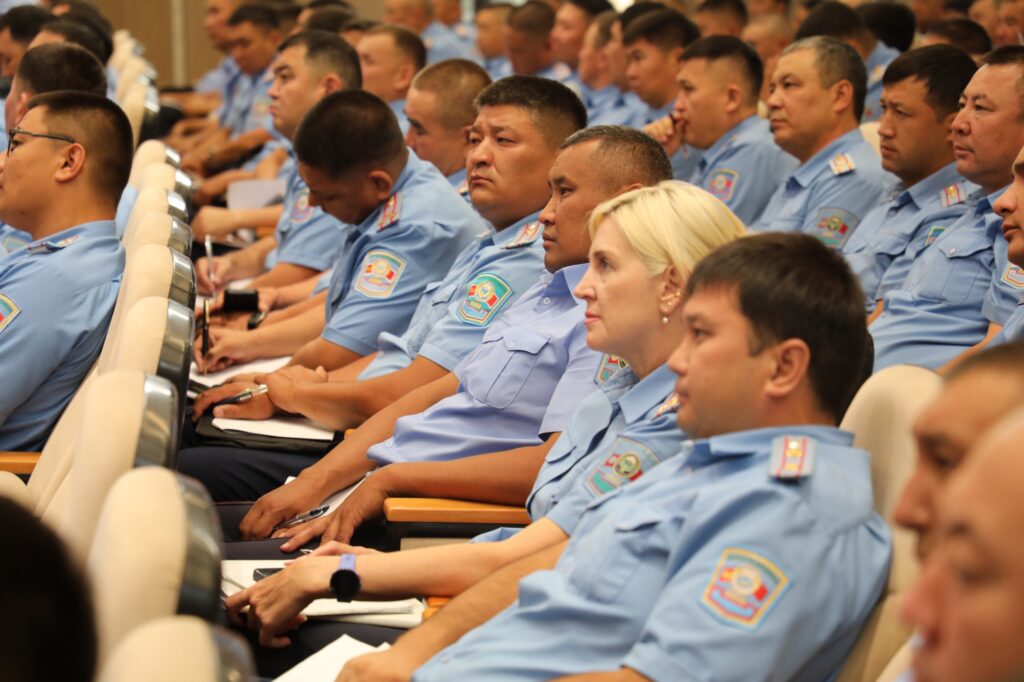
Kyrgyzstan’s Interior Ministry has submitted a bill aimed at restoring the concept of recidivism to the Criminal Code and limiting the liability of civil servants if their actions are deemed to protect national security. The proposal has sparked heated debate in both parliament and the public.

Proposed Changes

The draft law would reintroduce harsher penalties for repeat offenders. Recidivism, abolished in 2019 to ensure fairer treatment of convicted criminals, would once again become a legal category. According to the explanatory note, the earlier reform failed to yield the desired outcomes.

“The abolition of the concept of recidivism did not have the expected effect,” the note states. “Excluding harsher liability for members of organized criminal groups, who are often repeat offenders, has enabled them to consolidate and expand their influence.”

According to the bill’s proponents, nearly 90% of inmates in Kyrgyzstan have prior convictions. They argue that current parole and probation policies treat repeat offenders too leniently.

Combating organized crime has been a major priority in recent years. Dozens of so-called ‘thieves-in-law’ have been detained or neutralized, and suspects are now publicly compelled to renounce their criminal status. President Sadyr Japarov has already signed a law criminalizing the support or financing of criminal organizations.

“Organized crime poses a serious threat to national security and affects virtually all sectors of society,” the Cabinet said.

Under the proposed legislation, penalties for recidivism would be no less than half the maximum sentence for a given crime. In cases of “particularly dangerous recidivism,” the minimum would be two-thirds. Moreover, reconciliation between victim and perpetrator would no longer be grounds for dismissal of charges.

Authorities claim the measures will deter crime and diminish the appeal of criminal subcultures, particularly among young people.

Public Criticism

The most controversial element of the bill, however, is a provision that would exempt individuals from criminal liability if their actions were taken in defense of national sovereignty, the constitutional order, or environmental, economic, informational, or other forms of security.

Former MP Felix Kulov criticized the vague language of the proposal on social media, warning it could lead to legal abuse. He cited a hypothetical case in which an environmental activist seriously injures or kills a litterer, arguing the act could be wrongly justified as “defending environmental security.”

“Such additions clearly do not belong in Article 18 of the Criminal Code,” Kulov wrote. “The code already includes provisions for exceeding the limits of necessary defense and abuse of authority, and these new clauses would contradict them.”

Current MP Dastan Bekeshev reacted more bluntly: “This is crazy. If the law is passed, what is the point of justice at all?”

The draft law is now under review in the parliament. If adopted, it would represent one of the most significant overhauls of Kyrgyzstan’s criminal legislation in recent years.

Kazakhstani Opera Talent Aigerim Altynbek Wins Contest in Italy

Kazakhstani soprano Aigerim Altynbek believes “greater heights” await after she came first in an international opera singing competition in Italy.

Altynbek was among singers from 50 countries competing in the Concorso Lirico Internazionale di Portofino (CLIP) in the scenic harbor village of Portofino. The competition, which began in 2015, aims to support young talents and many of its winners and finalists have embarked on successful careers.

“I want to share some incredibly joyful news with you!” Altynbek posted on Instagram after she was awarded first prize on Sunday. “This was a truly special experience for me – and I believe even greater heights lie ahead.”

President Kassym-Jomart Tokayev congratulated Altynbek.

“This achievement, which has made our country’s culture known to the world and has been recognized by international experts, is of great significance,” Tokayev said. “You have made our state proud and brought our native art to the forefront of the world.”

Altynbek performed a duet last month with Italian tenor Andrea Bocelli at Pompeii, days after an appearance with Spanish tenor José Carreras in Astana. She has already received a number of accolades, including first prize in the Città di Arcore – Giacomo Puccini opera singing competition in Italy last year. She has been studying in Italy after graduating from the Kazakh National University of Arts.


Opinion: Ghosts of the Gulag: Kazakhstan’s Uneasy Dance With Memory and Moscow

In May 2025, the authorities in Moscow unveiled a life-size bas‑relief sculpture of Josef Stalin in the Taganskaya metro station. The next month, a statue of Lenin was pulled down in Osh, Kyrgyzstan. Between these two symbolic acts lies Kazakhstan, caught in a tug-of-war over the memory of Soviet-era repression.

Between 1920 and 1960, millions of prisoners were deported to more than fifty labor camps across what was later to become the Republic of Kazakhstan. Those who weren’t executed on the spot — political opponents, intellectuals, artists — were forced to work in mines, construction sites, or collective farms feeding Soviet industrial expansion. The death toll remains unknown but is believed to be in the millions.

Today, this dark past draws in history buffs and thrill-seekers. But darktourism.com, the go-to website on the topic, warns them: forgotten cemeteries, ghost villages, crumbling camps — this gulag archipelago is well hidden in the steppes. No sign points the way to the Museum of Political Repression in Dolinka, housed in the former headquarters of Karlag, one of the largest camps of the Soviet Gulag system.

The only other gulag transformed into a museum is ALZHIR, built on the ruins of the Akmola camp near Astana. It commemorates the 18,000 women imprisoned between 1939 and 1953 for being the wives of “traitors to the motherland.” These two museums now stand as official symbols of Soviet repression in Kazakhstan, and, more subtly, as frontline sites in a broader memory war across the former Soviet Union.

Selective Memory

When the museums were nationalized in the 2000s, their message became tightly controlled. Portraits and quotes from former president Nursultan Nazarbayev began to cover the walls. Guillaume Tiberghien, a specialist in dark tourism at the University of Glasgow, calls it a “selective interpretation of history.” The goal? To unify the country’s 160 ethnic groups under a shared narrative of collective suffering. At both Karlag and ALZHIR, guides emphasize acts of solidarity between Kazakh villagers and deportees — hospitality, compassion, bits of cheese tossed over barbed wire fences to feed the starving.

Execution scene recreated at the Karlag museum; image: Manon Madec.

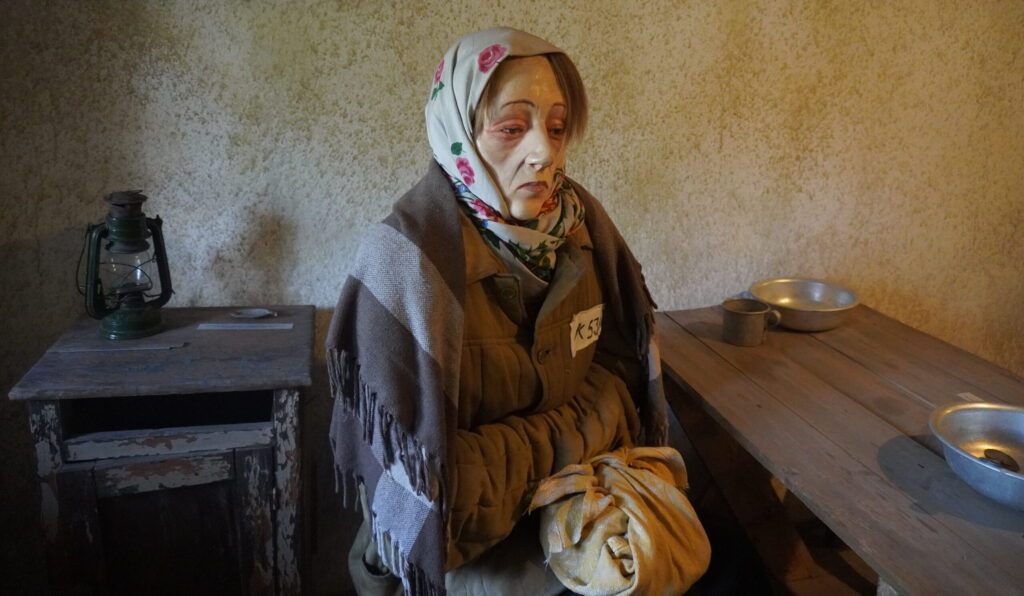
The past is staged. Between wax statues with sunken faces, sound effects mimicking heartbeats, and torture room reconstructions, the visitor is drawn into a visceral experience, sometimes at the cost of accuracy. “You wonder if the museum overdoes it to trigger emotion,” Tiberghien remarks. Margaret Comer, a memory studies expert at the University of Warsaw, explains: “It’s sometimes easier to mourn victims than to identify perpetrators.”

Execution scene and fake blood, reconstructed in the Dolinka museum; image: Manon Madec.

The complicity of local Kazakhs is never addressed. Russian responsibility is blurred behind vague terms like “NKVD” or “Stalinist repression.” At ALZHIR, visitors learn only about Sergey Barinov — a Russian commandant described as cultured, discreet, and caring toward the women detained. The other two camp directors are never mentioned.

In other former Soviet republics — Ukraine, the Baltics, Georgia — such neutrality would be unthinkable. “There, any figure linked to the Soviet regime is fiercely contested,” Comer notes.

Memory Wars

Tensions have sharpened since the war in Ukraine. In the background, Putin has accelerated the rehabilitation of Stalin, architect of the gulag archipelago. His busts are reappearing across Russia. Volgograd’s airport has been renamed “Stalingrad.” In occupied Melitopol, a new statue of the dictator was erected. “We’re witnessing a broad return of repressive memory politics in Russia,” says Tiberghien.

Former Soviet republics have taken note. “In Eastern Europe, especially the Baltics, every commemoration now includes a warning about today’s Russian threat,” Comer explains. Even in Central Asia — typically cautious — the decolonial narrative is gaining ground. In Kazakhstan, “some people now fear that Russia might one day cross the border,” she adds.

“The country is walking a tightrope,” Tiberghien explains. “It wants to keep things calm, to avoid upsetting Russia.” This balancing act was evident in President Tokayev’s speech on May 31, the official Day of Remembrance for Victims of Political Repression. While calling for the rehabilitation of victims and better access to archives, he also condemned the “instrumentalization” of history and urged the nation to look forward.

Museums mirror this caution. At ALZHIR, the May 31 commemorations are now held indoors, away from public view. A guide quietly admits she’s not allowed to comment on the closure of Russian memorial museums: “It might offend Russian tourists.” At Karlag, between two torture exhibits, visitors learn about inmate-led innovations: giant sunflowers, new cattle breeds, the Chizhevsky chandelier. “There’s an emphasis on what the prison system ‘contributed’ to the nation,” Comer notes. In this anniversary year of the Great Patriotic War, “the focus is more on Karlag’s role in victory than on mourning the victims,” adds Tiberghien.

Collective Amnesia

Why this insistence on what the gulag ‘contributed’? “There are conflicts of interest and truths people would rather not face. What tourists see is a compromise — one that works for the state and local communities,” Tiberghien emphasizes.

As a result, much of the Soviet legacy remains buried. Literally. “Around ALZHIR and in the Karaganda region, there are mass graves everywhere,” Tiberghien notes. The Mamochkino cemetery, near Karlag, is one of the few memorial sites dedicated to women and children who perished in the camps. It, too, lies neglected. Tiberghien speaks of a “collective amnesia” that obstructs historical reckoning.

The Mamochkino cemetery, left abandoned near the Karlag museum; image: Manon Madec

In Karaganda, Dimitry Kalmykov, director of the local Ecological Museum, sees an unspoken deal: “The state doesn’t want to reopen the file, and the Kazakhs aren’t demanding it.” The fear of speaking out, he says, has been passed down across generations. Kalmikov himself learned little about the USSR at school. What he knows, he read on his own.

But resources are fading. The archives are sealed by Russia. “The question isn’t when we’ll get access, but whether we ever will,” says one museum historian.

Gulags are not the only legacy at risk of being forgotten. The Soviet nuclear past is quietly vanishing too. “The Kurchatov museum has been closed to the public since 2023,” says Tiberghien. There, deformed animals preserved in jars bore witness to radiation damage. In Semipalatinsk, visits are increasingly rare, bogged down in bureaucracy. “Even the website listing radiation data has disappeared,” confirms Kalmykov.

In Karaganda, Lenin’s statue, stripped of its name, still stands; image: Manon Madec

What path will Kazakhstan choose? The future of its memory may lie in the hands of researchers, citizens, and akimats — those determined not to repeat the past. For now, the statue of Lenin still stands watch over Karaganda. But for how much longer?

Potential Mass Expulsion of Migrants Looms in Russia

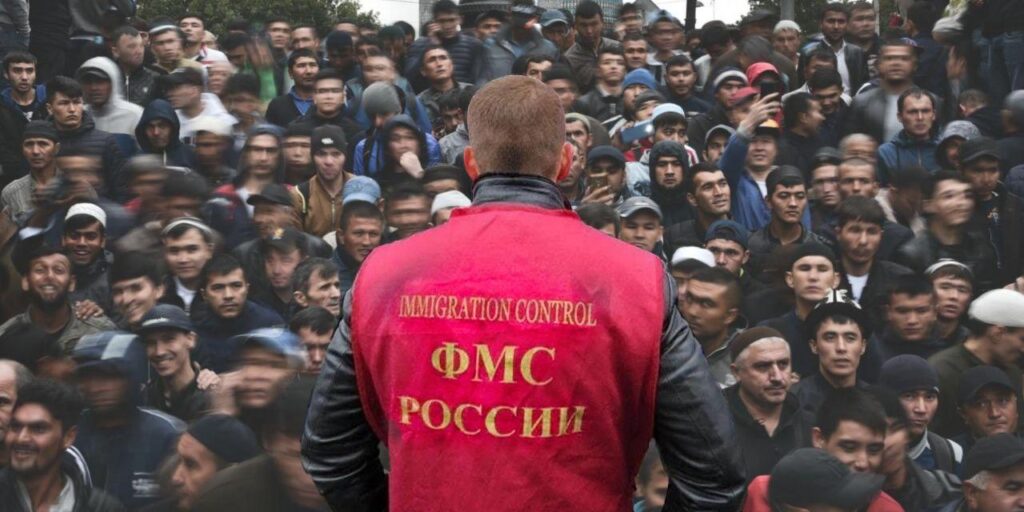
Russia introduced new regulations for foreign citizens in the country on February 5, and started keeping a list at the Interior Ministry of foreigners who are living or staying in Russia without proper documentation, the “controlled persons registry.” The rules are aimed at migrant laborers working in Russia, many of whom come from Central Asian countries.

Russia has set a September 10 deadline for foreigners in the country to clear up all their paperwork with the authorities or face expulsion with a ban on re-entry. Judging by recent comments from Kyrgyzstan’s ambassador to Russia, Kubanychbek Bokontayev, many might not make that September 10 deadline.

Needed but Not Desired

Over the course of the last two decades, millions of citizens from Central Asian countries have worked in Russia. Most are from Kyrgyzstan, Tajikistan, and Uzbekistan.

The remittances they send home have grown to the point where this money now accounts for nearly 40% of the GDP in Tajikistan, 24% in Kyrgyzstan, and 14% in Uzbekistan. Most of these remittances come from Russia.

Russia badly needs the extra workers, and, until recently, the arrangement seemed to suit all parties. But the March 2024 terrorist attack on Moscow’s Crocus City Hall changed the situation.

The Russian authorities detained and charged a group of Tajik nationals for the attack, and the always simmering xenophobia in Russia, particularly toward Central Asians, boiled over.

New rules and restrictions have been imposed on migrant workers.

Those that came into force in February this year were only the latest in a series of changes that already included mandatory fingerprinting and photographs upon entry to Russia, a reduction in the term of stay from 180 to 90 days, and an increasing list of infractions that provide grounds for deportation.

In 2024, Russia expelled some 157,000 migrants who were in the country illegally, which, according to Russian Interior Minister Vladimir Kolokoltsev, was an increase of some 50% over 2023.

The Clock Is Ticking

At the start of February, just before the latest regulations came into effect, Russia’s Deputy Interior Minister Aleksandr Gorovoi said there were some 670,000 foreigners living illegally in Russia. Gorovoi added that more than half were women and children, “those who entered, but we do not see that they received a patent registered with the migration service… [or] that an employment agreement was concluded with them.”

On July 24, Kyrgyz media outlet AKIpress published an interview with the Kyrgyz Ambassador to Russia, Bokontayev, in which he said that at the start of July, there were some 113,000 Kyrgyz citizens on the controlled persons registry, which he referred to as the “gray list.” He also said there were some 80,000 Kyrgyz citizens on the “black list” of people barred from entering Russia.

In a separate interview with Radio Free Europe/Radio Liberty’s Kyrgyz Service published on July 25, Kyrgyzstan’s General Consul in Russia, Bakyt Asanaliyev, said that about 30% of the Kyrgyz citizens on the gray list are children. Ambassador Bokontayev said Kyrgyzstan’s embassy is working to make sure those currently on the gray list do not end up on the black list.

Citizens on the gray list have additional restrictions placed upon them until they clear up their status. Among these are prohibitions on driving, marrying, traveling within Russia, changing their place of residency, opening a bank account, or spending more than 30,000 rubles (about $351) per month from existing Russian bank accounts.

Bokontayev noted that from February to the end of April, only some 4,000 Kyrgyz citizens on the gray list had legalized their status, and by the start of July, the figure was more than 7,000.

The pace could be quickening.

Asanaliyev said the number dropped from 113,000 at the start of July to 103,000 a little more than three weeks into July, though Bokontayev pointed out that it is difficult to give exact numbers as Russia’s Interior Ministry updates the controlled persons registry every six hours. Those who have successfully completed their registration are removed, while those recently caught without all the necessary documents are added.

With only some 17,000 Kyrgyz citizens having made themselves legal in Russia since February, it seems unlikely that all the remaining Kyrgyz citizens on the gray list will clear up their living or working status by September 10. Bokontayev noted there are long lines at Russia’s facilities for registering migrants, and the process of filling out paperwork and other requirements is time-consuming.

Easier for the Kyrgyz Than Others

The number of Central Asian migrant laborers has been declining in recent years due to tightening restrictions, increased xenophobia, and the fear, among males, of being pressured or forced into joining the Russian military and sent to fight in Ukraine.

In May 2023, Kyrgyzstan’s Labor Ministry reported that the number of Kyrgyz citizens working as migrant laborers in 2022 was more than 1.5 million, of which 1.063 million were in Russia.

In January 2025, Kyrgyzstan’s Foreign Ministry said the number of Kyrgyz citizens living and working in Russia dropped to some 650,000 in 2023 and to some 350,000 in 2024. Ambassador Bokontayev cited figures from Russia’s Interior Ministry that showed the number of Kyrgyz citizens in Russia in the first quarter of 2025 was some 352,000.

Kyrgyzstan is a member of the Russian-led Eurasian Economic Union (EAEU), a group that also includes Armenia, Belarus, and Kazakhstan. As an EAEU member, Kyrgyzstan’s citizens, including migrant laborers, are given easier access to other member countries and enjoy social benefits, such as healthcare, not given to people from non-member countries.

Citizens from Tajikistan and Uzbekistan staying or working in Russia face greater challenges than Kyrgyz in entering Russia and obtaining all the needed official approvals. There are far more Tajik and Uzbek migrant laborers in Russia than Kyrgyz. It is unclear how many Tajik and Uzbek citizens are on the gray list, but almost certainly it is more than Kyrgyz. If citizens from Kyrgyzstan, an EAEU member, are having such a hard time legally registering themselves in Russia, it is likely more difficult for Tajik and Uzbek citizens.

Kyrgyz President Sadyr Japarov visited Russia at the start of July and met with his Russian counterpart, Vladimir Putin. Japarov asked for Russian assistance in getting Kyrgyz citizens legally registered in Russia before September 10. The Tajik and Uzbek governments are likely also working with the Russian authorities to ensure as many of their citizens as possible meet the looming deadline.

The sudden return from Russia of even tens of thousands of Central Asian citizens to their home countries, where most would join the ranks of the unemployed, is not something the Central Asian leaders want to see. Such a scenario could spark social tensions.

Russia, too, would prefer to keep at least most of the migrant workforce, though Russian officials have already made it clear that they do not want wives and children accompanying Central Asian migrant laborers to Russia.

Some sort of compromise seems likely, but the Russian authorities might start mass expulsions after the deadline just to demonstrate that they are serious about having migrants in the country working and legally registered.

KTZ Secures $540 Million Loan to Upgrade Trans-Kazakhstan Railway Corridor

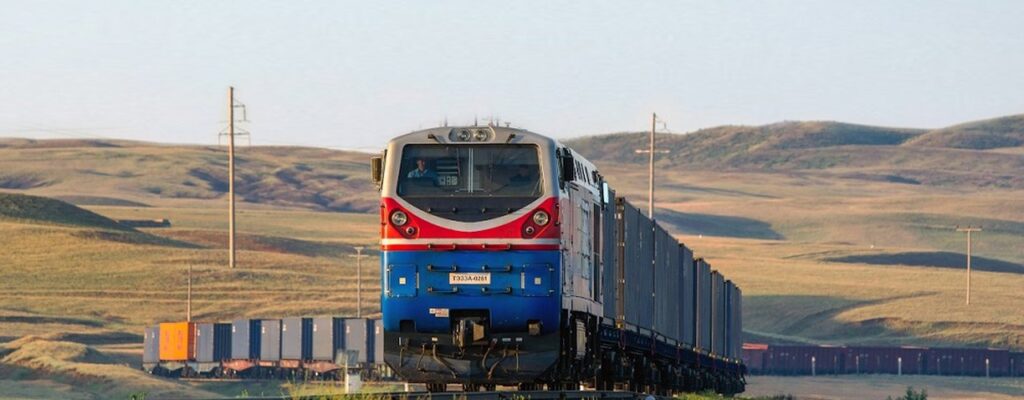
Kazakhstan Temir Zholy (KTZ), the national railway operator, has secured a syndicated loan of up to 480 million Swiss francs (approximately $540 million) for a three-year term. Arranged through Abu Dhabi Commercial Bank and Deutsche Bank, the financing will support key infrastructure projects along the Trans-Kazakhstan Railway Corridor.

According to KTZ, the loan will fund construction of the Moiynty-Kyzylzhar section, upgrades to congested segments of the national rail network, and the refinancing of existing debt.

The Trans-Kazakhstan Railway Corridor is central to Kazakhstan’s strategy to solidify its role as a major overland transit hub connecting China and Europe. Infrastructure improvements are expected to reduce delivery times, lower logistics costs, create jobs, and diversify international trade routes, enhancing both the resilience of Kazakhstan’s economy and the competitiveness of its transport sector.

Currently, more than 80% of overland freight from China to Europe passes through Kazakhstan via the Trans-Caspian International Transport Route (TITR), also known as the Middle Corridor. This route circumvents Russia and connects China to Europe through Central Asia and the Caspian Sea.

In 2024, freight volumes along the TITR surged by 60%, reaching 4.5 million tons. Kazakhstan aims to more than double that volume to 10 million tons by 2030, as part of its broader ambition to expand its footprint in global supply chains.

Kyrgyzstan Launches “Mekenim 1+1” Program to Support Returning Migrants

Kyrgyzstan’s Ministry of Labor, Social Security and Migration has launched a new pilot initiative, Mekenim 1+1 (“My Homeland 1+1”), aimed at helping returning labor migrants reintegrate into the national economy by co-investing in local business ventures.

The program introduces a matching investment model: for every som invested by a returning migrant, the state will provide a concessional loan of equal value. The combined funds must be used to start businesses in priority sectors including light industry, tourism, education, IT and innovation, manufacturing and processing, transport, warehousing, and logistics.

The pilot phase will run from 2025 to 2026 in the Batken region, a remote area with high levels of labor migration. If successful, the program will be scaled up nationwide.

Russia remains the primary destination for Kyrgyz labor migrants. As previously reported by The Times of Central Asia, approximately 600,000 Kyrgyz citizens currently live abroad, with nearly 380,000 registered with Russian migration authorities as of the end of 2024.

However, Russia’s ongoing economic challenges, restrictive immigration policies, and rising anti-immigrant sentiment are prompting many Kyrgyz migrants to explore alternatives in countries such as Turkey, South Korea, and various parts of Europe. At the same time, a growing number are returning to Kyrgyzstan, making reintegration efforts like Mekenim 1+1 increasingly timely and significant.