• KGS/USD = 0.01144 0%
  • KZT/USD = 0.00194 -0%
  • TJS/USD = 0.10844 -0.46%
  • UZS/USD = 0.00008 0%
  • TMT/USD = 0.28571 0.28%
  • KGS/USD = 0.01144 0%
  • KZT/USD = 0.00194 -0%
  • TJS/USD = 0.10844 -0.46%
  • UZS/USD = 0.00008 0%
  • TMT/USD = 0.28571 0.28%
  • KGS/USD = 0.01144 0%
  • KZT/USD = 0.00194 -0%
  • TJS/USD = 0.10844 -0.46%
  • UZS/USD = 0.00008 0%
  • TMT/USD = 0.28571 0.28%
  • KGS/USD = 0.01144 0%
  • KZT/USD = 0.00194 -0%
  • TJS/USD = 0.10844 -0.46%
  • UZS/USD = 0.00008 0%
  • TMT/USD = 0.28571 0.28%
  • KGS/USD = 0.01144 0%
  • KZT/USD = 0.00194 -0%
  • TJS/USD = 0.10844 -0.46%
  • UZS/USD = 0.00008 0%
  • TMT/USD = 0.28571 0.28%
  • KGS/USD = 0.01144 0%
  • KZT/USD = 0.00194 -0%
  • TJS/USD = 0.10844 -0.46%
  • UZS/USD = 0.00008 0%
  • TMT/USD = 0.28571 0.28%
  • KGS/USD = 0.01144 0%
  • KZT/USD = 0.00194 -0%
  • TJS/USD = 0.10844 -0.46%
  • UZS/USD = 0.00008 0%
  • TMT/USD = 0.28571 0.28%
  • KGS/USD = 0.01144 0%
  • KZT/USD = 0.00194 -0%
  • TJS/USD = 0.10844 -0.46%
  • UZS/USD = 0.00008 0%
  • TMT/USD = 0.28571 0.28%
09 December 2025

Kyrgyzstan Launches New Agro-Industrial Zone with $24 Million Investment

Kyrgyzstan has begun construction of a new agro-industrial zone in the Chui region as part of a broader effort to modernize agriculture, boost food production, and attract foreign investment. The facility is being developed by Kyrgyz Agroholding JSC in the village of Nurmanbet, just east of the capital Bishkek.

Speaking at the capsule-laying ceremony on July 12, Deputy Prime Minister and Minister of Agriculture Bakyt Torobaev described the initiative as a critical step toward enhancing the country’s agricultural resilience and food sovereignty.

“This is a large-scale initiative that will strengthen our agricultural sector, create jobs, and help ensure food security,” Torobaev said.

The event also marked the signing of two major investment agreements totaling $24 million:

  • A $12 million deal with South Korea’s DOD Company to support joint projects in meat livestock farming, logistics, and modern agricultural technologies.
  • A separate $12 million agreement with Asyl Teri LLC to construct a tannery capable of processing up to 24 tons of animal hides per day.

The Chui agro-industrial zone is expected to significantly increase the value of Kyrgyz agricultural products while drawing additional investment into a sector that already contributes nearly 18% of the nation’s GDP and employs almost half of its workforce.

Government officials emphasize that the new zone will offer improved infrastructure, greater market access, and cutting-edge technologies to farmers and agribusinesses, enhancing Kyrgyzstan’s competitiveness in regional food production.

Melting Mountains, Drying Futures: Central Asia Confronts Water Emergency

Central Asian countries are mobilizing against an emerging water crisis as a United Nations report highlights the vulnerability of mountain water systems to climate change. Identifying ranges like the Tien Shan and the Pamirs, the UN World Water Development Report 2025 – Mountains and Glaciers: Water Towers – warns that rapid glacier melt and erratic snowfall are threatening vital freshwater supplies worldwide. According to the report, mountains provide up to 60% of the world’s annual freshwater flows, with over two billion people depending directly on water from mountain sources.

This risk is particularly acute in Central Asia: a UN drought outlook noted that rising temperatures and shrinking snowpack in the high mountains of Tajikistan and Kyrgyzstan are accelerating glacier retreat, posing a “long-term threat to the region’s water security.” Half of rural mountain communities in developing countries already face food insecurity, and receding glaciers could impact two-thirds of all irrigated agriculture globally – a dire scenario for Central Asia’s irrigation-dependent economies.

Rivers like the Amu Darya and Syr Darya are fed by glacier runoff and support downstream agriculture, hydropower, and municipal needs in Uzbekistan, Kazakhstan, and Turkmenistan. But climate-driven glacial retreat, inefficient irrigation, and aging infrastructure have already pushed the region toward a breaking point.

Lake Karakul in Tajikistan is expanding due to melting glaciers; image: TCA, Stephen M. Bland

Kazakhstan Steps Up

Leading the regional response, Kazakhstan has launched sweeping reforms to modernize its water infrastructure and governance. The country has committed to building 42 new reservoirs, refurbishing 14,000 kilometers of irrigation canals, and investing heavily in digital water monitoring and conservation.

Established in September 2023, the Ministry of Water Resources and Irrigation is coordinating the overhaul under an updated national Water Code. The government has also launched an integrated water portal, hydro.gov.kz, and pledged to digitize more than 3,500 kilometers of canals for precise flow tracking. In an address at the Astana International Forum, Deputy Prime Minister Kanat Bozumbayev framed water as a “powerful driver of cooperation, sustainable development and regional stability,” urging closer regional coordination.

Kazakhstan is also leading environmental restoration efforts. As the current chair of the International Fund for Saving the Aral Sea (IFAS), it is overseeing projects to rehabilitate the North Aral Sea, including raising the Kokaral Dam to restore water levels and fisheries. In 2024 alone, local irrigation reforms in Kyzylorda saved 200 million cubic meters of water, which was redirected toward the shrinking sea.

The Kokaral Dam in Kazakhstan; image: TCA, Stephen M. Bland

International Support and Financing

Kazakhstan’s strategy has been backed by a plethora of international partners. The European Bank for Reconstruction and Development (EBRD) has financed over €255 million in water and wastewater projects in Kazakhstan, including a €96.4 million sovereign loan for a new treatment plant in Aktobe. Meanwhile, the Eurasian Development Bank (EDB) and UNDP have launched a regional partnership to expand access to modern irrigation, digitize water flows, and establish training centers.

“We must act very quickly and together,” EDB Chairman Nikolay Podguzov stated. “We have only five years to get the region ready and avoid severe water shortages.”

Regional Landscape: Mixed Progress

Elsewhere in Central Asia, progress is uneven. Uzbekistan has committed to climate-smart water management with a $125 million program supported by the Asian Development Bank to digitize canals and introduce water metering. With approximately 88% of irrigation canals losing water through leakage, the country faces steep challenges. However, a landmark agreement with Kazakhstan and Kyrgyzstan to co-develop the Kambarata-1 hydropower project on the Naryn River signals a new era of cooperation on shared water resources.

Kyrgyzstan and Tajikistan hold much of the region’s glacial reserves, but suffer from outdated irrigation networks and inconsistent river flows due to erratic weather conditions. Tajikistan has committed to small-scale reservoirs, drip irrigation, and data-driven water use monitoring under UNDP guidance. Kyrgyzstan, with support from the Green Climate Fund, is upgrading hydropower and rural water systems to improve its resilience.

Yet climate vulnerability is growing. In 2024, a UN ESCAP report projected annual GDP losses of 1.3% across the region due to water-related climate impacts. Meanwhile, the Executive Director of the United Nations Environment Programme, Inger Andersen, has warned that up to five million people face the prospect of displacement by 2050 if no coordinated action is taken.

Turkmenistan and Transboundary Risks

In Turkmenistan, water stress is severe, exacerbated by profligate water use, particularly in agriculture and infrastructure projects. The country uses nearly all available freshwater, with 92% allocated to agriculture, much of it routed through the inefficient Karakum Canal.

Despite acknowledging the crisis, reforms have lagged. Analysts warn that Afghanistan’s construction of the Qosh Tepa Canal threatens to divert up to 30% of the Amu Darya’s flow, potentially slashing water supplies to Uzbekistan and Turkmenistan, worsening environmental degradation of the Aral Sea, and triggering economic, social, and geopolitical ripple effects across all of Central Asia.
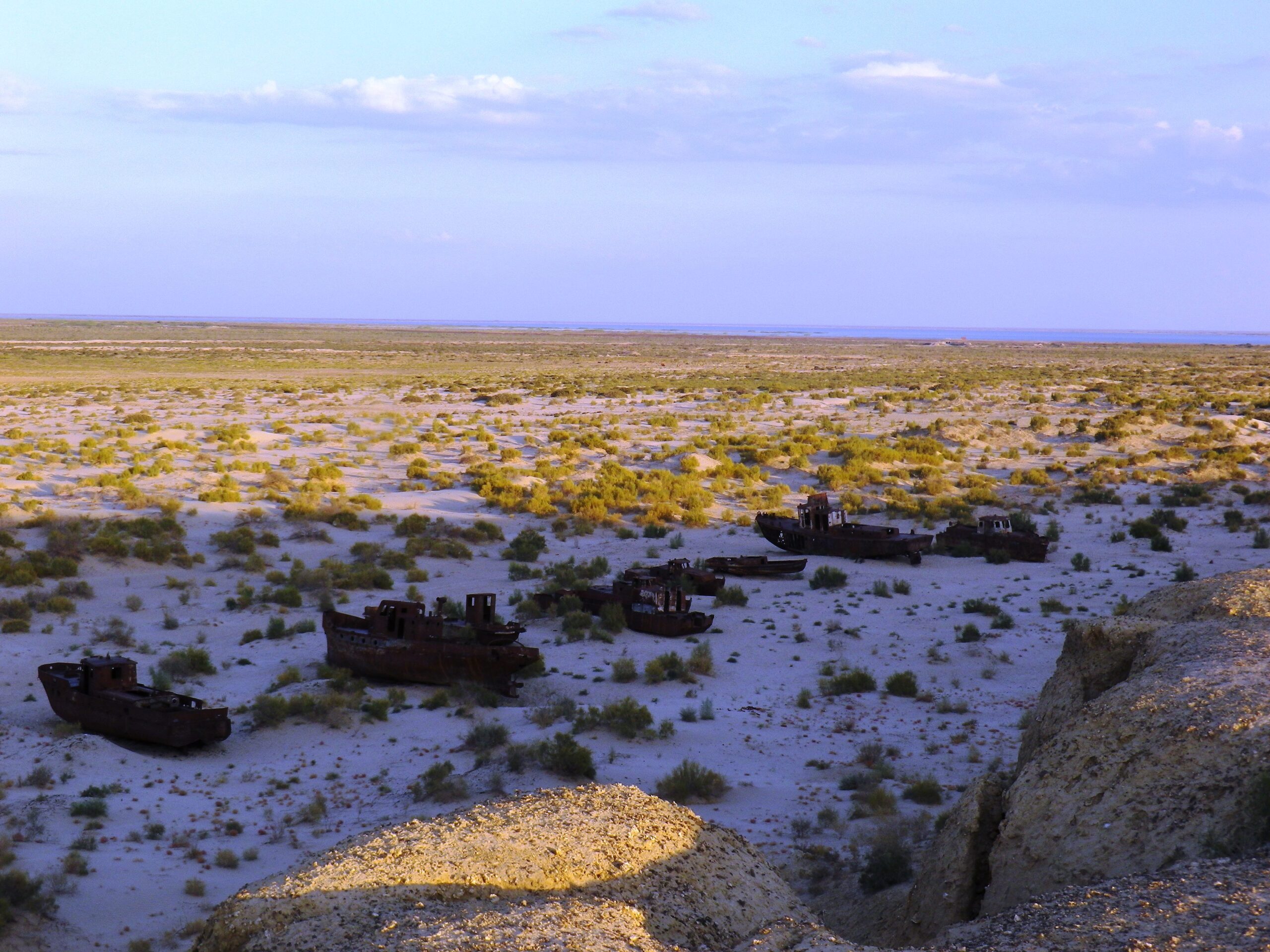
Desert ships on the former Aral Sea in Uzbekistan; image: TCA, Stephen M. Bland

Need for Coordination

Despite longstanding tensions over shared rivers, the countries of Central Asia are returning to dialogue. The IFAS platform has been revived to promote joint projects, while Kazakhstan has increased hydrological data sharing. Events such as the Astana International Forum are also serving to foster a consensus around water as a shared regional priority.

The UN report calls for investing in mountain communities to safeguard headwaters and for the strengthening of cross-border institutions. It warns that the region could lose 30% of its freshwater resources by 2050 if climate trends and infrastructure neglect continue.

With major investment in Kazakhstan, rising cooperation on new dams, and the backing of global donors, Central Asia may be poised to shift from a fragmented crisis response toward integrated, climate-resilient water governance.

Khiva Readies for Melon Festival: A Celebration of Heritage and Harvest

Khiva, the ancient Silk Road city in Uzbekistan’s Khorezm region, will host the traditional Melon Festival, or “Qovun sayli,” from August 8–10. The celebration will be held across the historic Itchan-Kala complex and the Arda Khiva cultural space.

Organized by the State Tourism Committee and the Khorezm khokimiyat (local government), the festival promotes regional identity and agritourism by highlighting Khorezm’s famed melons. Farmers from across the region will exhibit scores of different melon varieties — around 125 types were showcased last year — in pavilions decorated with traditional designs.

More than a fruit fair, the festival offers puppet shows, folk music, national costume displays, and culinary exhibitions, including Khorezm bread and other regional dishes. Artisans will host workshops on handicrafts such as silk weaving and pottery, giving visitors hands-on exposure to Uzbek heritage and traditions. Evening gala concerts featuring local and international performers will take place on August 8–9 in the Itchan-Kala and conclude on August 10 in Arda Khiva.

Image: TCA, Stephen M. Bland

Qovun sayli will also have a competitive edge, with awards sponsored by the regional khokimiyat and private sponsors recognizing standout agronomists, artisans, and performers.

Image: TCA, Stephen M. Bland

Melons occupy a special place in Uzbek tradition. Over 150 varieties are grown nationwide, many prized for their sweetness and storied past. In Khorezm, melons are more than food — they are cultural icons. Ancient Uzbek kingdoms would send the fruit as gifts by camel caravan to Baghdad, and to the Russian tsars and Mughal emperors. Writing in 1876, British colonel and explorer Frederick Burnaby noted that the “taste was so delicious that anyone only accustomed to this fruit in Europe would scarcely recognize its relationship with the delicate and highly perfumed melons of Khiva.”

The festival has become a cornerstone of Khiva’s cultural calendar, attracting approximately 30,000 foreign and 400,000 domestic visitors in 2024 alone. Tourism officials view Qovun sayli as essential to boosting regional visibility and economic growth, with Khiva’s festivals, including the Lazgi International Dance Festival, a key part of Uzbekistan’s broader push to spotlight cultural tourism.

Kyrgyzstan Eases Plastic Ban to Comply with EAEU Standards

Kyrgyz President Sadyr Japarov has signed amendments to the law “On Limiting the Circulation of Polymer Film Bags and Plastic Items in the Territory of the Kyrgyz Republic,” easing some of the country’s planned restrictions on single-use plastics. The law was originally passed by parliament on June 17, 2025.

Initially set to take full effect on January 1, 2027, the legislation included a sweeping ban on the production, import, and sale of several plastic products, including:

  • Polymer film bags
  • All types of disposable plastic tableware
  • Disposable plastic food packaging
  • PET (polyethylene terephthalate) bottles
  • Disposable plastic egg cartons
  • Plastic coffee capsules
  • Grocery bags

Under the newly adopted amendments, PET bottles and disposable plastic food packaging have been removed from the list of banned items. Additionally, the original ban on disposable plastic tableware has been narrowed to apply only to non-recyclable products.

Aligning with Regional Trade Rules

The changes were introduced to align Kyrgyzstan’s environmental legislation with the regulations of the Eurasian Economic Union (EAEU), which comprises Armenia, Belarus, Kazakhstan, Kyrgyzstan, and Russia. Several of the proposed restrictions, particularly the ban on PET bottles and plastic food containers, had sparked concern among domestic and regional businesses, who warned of potential disruptions to manufacturing and cross-border trade.

Industry groups argued that the original provisions would have conflicted with common EAEU standards, complicating compliance and affecting supply chains.

Environmental Efforts Continue in Issyk-Kul

Despite the softening of national restrictions, local efforts to combat plastic pollution remain in place. As The Times of Central Asia previously reported, Kyrgyzstan banned the use and sale of plastic bags in Issyk-Kul’s resort and recreational areas as of March 2025. The move is part of a broader initiative to protect the lake’s fragile ecosystem and preserve environmental cleanliness.

At Least 66 Uzbeks Confirmed Dead Fighting for Russia in Ukraine

A BBC-led investigation has confirmed that dozens of Uzbek citizens have died while fighting for Russia in Ukraine. Journalists from the BBC Russian Service and independent outlet Mediazona have verified 118,139 Russian military deaths in the conflict. Among them were 523 foreign nationals from 28 countries, with Tajiks (72 deaths) and Uzbeks (66 deaths) making up the largest foreign contingents. Investigators caution that the true number of casualties is likely higher.

Alexander Bastrykin, head of Russia’s Investigative Committee, has publicly acknowledged that many recently naturalized Central Asians have been conscripted into the Russian military. Speaking at a public forum, Bastrykin stated that authorities had “caught” around 80,000 new Russian citizens, mostly from Uzbekistan, Tajikistan, and Kyrgyzstan, who had attempted to avoid military service. According to him, they were registered for service, and 20,000 were subsequently sent to Ukraine. These remarks have raised fresh concerns that Russia is using Central Asian migrants to bolster its military ranks.

Official Neutrality and Subtle Retaliation

Central Asian governments have declared neutrality in the Ukraine conflict and have largely abided by Western sanctions. Both Kazakhstan and Uzbekistan have sent humanitarian aid to Ukraine, contributing approximately $2.25 million and $1 million respectively. Kazakhstan has also made it clear that it does not recognize the self-proclaimed Donetsk and Luhansk “people’s republics.”

Some analysts believe this neutral stance has triggered retaliatory actions from Moscow. Notably, a Russian court ordered the temporary suspension of operations at the Caspian Pipeline Consortium (CPC), a key route for Kazakh oil exports to the Black Sea. The 30-day halt severely affected Kazakhstan’s economy, as CPC shipments account for roughly 20% of the country’s GDP.

CCTV Cameras Installed Around Lake Issyk-Kul to Combat Poaching and Environmental Violations

Kyrgyz authorities have begun installing CCTV cameras around Lake Issyk-Kul as part of a broader effort to protect the region’s fragile ecosystem and crack down on poaching. The surveillance system, which includes thermal imaging capabilities, will operate around the clock, the Issyk-Kul Regional Internal Affairs Department announced.

The cameras are designed to capture instances of illegal fishing and to monitor motorists who drive onto beaches or into the lake itself, practices that authorities say are damaging the environment. Police officials stressed that this measure was necessary, as public awareness campaigns and verbal warnings had not been effective in curbing such behavior.

“This is an important step toward preserving the lake’s natural environment,” the regional police stated. “Conversations and warnings have not worked, people continue to pollute Issyk-Kul. Our goal is to install cameras around the entire perimeter. Together, we will succeed.”

Public Involvement and Technological Integration

Authorities have called on both local residents and the business community to support the initiative, including through financial contributions.

The new video system will be integrated into the regional situation center operated by the Kyrgyz Ministry of Internal Affairs. The center currently oversees major settlements in the area and already operates 353 smart cameras capable of tracking movement and recognizing faces.

Staff at the center monitor adherence to environmental regulations and public order. In collaboration with the Ministry of Emergency Situations, law enforcement regularly conducts raids to identify illegal fishing operations. A particular concern is the use of synthetic fishing nets, which are banned from import and considered especially harmful to the lake’s biodiversity.

Environmental Enforcement and Community Outreach

“Issyk-Kul is a gift of nature. Its preservation is the sacred duty of every citizen,” said Chingiz Tokoldashev, head of the Balykchy Internal Affairs Department. “The fight against illegal fishing is our priority.”

Law enforcement also engages in preventive outreach, educating vacationers about fishing regulations and environmental restrictions. Under current rules, legal fishing, including for the endemic chebachka fish, requires payment of a fee of 600 KGS (approximately $7) to the Ministry of Natural Resources.