• KGS/USD = 0.01144 0%
  • KZT/USD = 0.00194 -0%
  • TJS/USD = 0.10896 -0%
  • UZS/USD = 0.00008 0%
  • TMT/USD = 0.28571 0.28%
  • KGS/USD = 0.01144 0%
  • KZT/USD = 0.00194 -0%
  • TJS/USD = 0.10896 -0%
  • UZS/USD = 0.00008 0%
  • TMT/USD = 0.28571 0.28%
  • KGS/USD = 0.01144 0%
  • KZT/USD = 0.00194 -0%
  • TJS/USD = 0.10896 -0%
  • UZS/USD = 0.00008 0%
  • TMT/USD = 0.28571 0.28%
  • KGS/USD = 0.01144 0%
  • KZT/USD = 0.00194 -0%
  • TJS/USD = 0.10896 -0%
  • UZS/USD = 0.00008 0%
  • TMT/USD = 0.28571 0.28%
  • KGS/USD = 0.01144 0%
  • KZT/USD = 0.00194 -0%
  • TJS/USD = 0.10896 -0%
  • UZS/USD = 0.00008 0%
  • TMT/USD = 0.28571 0.28%
  • KGS/USD = 0.01144 0%
  • KZT/USD = 0.00194 -0%
  • TJS/USD = 0.10896 -0%
  • UZS/USD = 0.00008 0%
  • TMT/USD = 0.28571 0.28%
  • KGS/USD = 0.01144 0%
  • KZT/USD = 0.00194 -0%
  • TJS/USD = 0.10896 -0%
  • UZS/USD = 0.00008 0%
  • TMT/USD = 0.28571 0.28%
  • KGS/USD = 0.01144 0%
  • KZT/USD = 0.00194 -0%
  • TJS/USD = 0.10896 -0%
  • UZS/USD = 0.00008 0%
  • TMT/USD = 0.28571 0.28%
09 December 2025

Amidst Diplomatic Tensions, Russia and Uzbekistan Explore Long-Term Youth Exchange Program

During a recent meeting with the heads of global news agencies in St. Petersburg, Russian President Vladimir Putin responded positively to a proposal from Uzbekistan’s National News Agency (UzA) to establish a long-term youth exchange program aimed at strengthening bilateral ties and addressing migration-related issues.

Abdusaid Kochimov, Director General of UzA, initiated the proposal, emphasizing the historical and cultural ties between the two countries. “There is a strong interest in Uzbekistan in everything that happens in and around Russia. Our societies share close mentalities and traditions,” he said.

Kochimov praised the leadership of Presidents Vladimir Putin and Shavkat Mirziyoyev in deepening strategic cooperation, describing their efforts as “titanic.” However, he pointed out persistent challenges in the migration sphere and argued that a structured youth program with defined goals could foster deeper mutual understanding and resolve some of these issues.

“There is a real need for a large-scale and long-term youth exchange program with clear projects and goals,” Kochimov said. “This would bring our young people closer and build a strong, friendly image of each other, based on our shared values and history.”

President Putin welcomed the suggestion, noting ongoing collaboration between Russia and Uzbekistan across several sectors, including energy. He referenced the two countries’ partnership in nuclear energy development and acknowledged Uzbekistan’s rapidly growing population, from 15 million three decades ago to 38 million today, highlighting the resulting pressures on its labor market.

“We agreed with President Mirziyoyev to prepare people who want to work in Russia in advance. This includes learning the Russian language and culture. There’s a good plan in place,” Putin said, adding, “This work is not just important, it’s essential. I fully agree with you.”

Putin also mentioned recent visits by Uzbek officials to Moscow, including Saida Mirziyoyeva, which included discussions on youth engagement. He reaffirmed Russia’s commitment to supporting joint initiatives in this area.

However, this positive diplomatic development comes against the backdrop of recent tensions over the treatment of Uzbek nationals in Russia. On June 10, the Uzbek Foreign Ministry summoned Russian diplomats to protest what it called the aggressive and disrespectful conduct of law enforcement officers during identity checks on Uzbek migrants.

The protest followed a major police raid in Moscow’s Strogino district on June 8. Footage shared online appeared to show migrants being forcibly removed, verbally abused, and subjected to electric shocks. Uzbek authorities criticized these actions as unauthorized and unacceptable.

In response, Uzbekistan’s embassy in Moscow issued an official note requesting a legal explanation and urging Russian authorities to treat migrants with dignity in line with international standards.

Russian Foreign Ministry spokesperson Maria Zakharova confirmed that the matter is currently under official review.

Kazakhstan’s Youth Face Barriers to Entrepreneurship

A recent analysis by the analytical portal Ranking.kz reveals a concerning stagnation in youth entrepreneurship in Kazakhstan. Despite government rhetoric promoting innovation and small business, the number of young individual entrepreneurs has remained nearly flat over the past two years.

Youth Entrepreneurship by the Numbers

As of the end of Q1 2025, Kazakhstan recorded 736,100 individual entrepreneurs (IE) under the age of 35. Of these, 698,900 are active. The growth rate over two years is just 0.2%, signaling stagnation rather than progress.

The decline in young entrepreneurs’ share of the total business landscape underscores this trend. In 2023, they made up 50.9% of all active IEs; by 2025, that figure dropped to 47.3%.

According to the National Statistics Bureau, today’s young entrepreneur in Kazakhstan is more likely to be a woman (55.4%) than a man (44.6%). Urban residents dominate the demographic, comprising about 75.3% of the total, while rural entrepreneurs represent only 24.7%.

Sectoral Growth and Decline

Trade remains the leading sector for young entrepreneurs, employing 303,300 individuals, though it saw no growth over the past year. The most significant expansion occurred in transportation and logistics, which grew by 90.1% to 49,700 entrepreneurs. Construction also showed positive movement, with a 10.7% increase, totaling 21,000 entrepreneurs.

In contrast, other sectors experienced contraction: agriculture dropped by 25.1%, manufacturing by 11.9%, and real estate by 2.8%. These declines suggest a shift away from traditionally accessible sectors for new entrepreneurs.

Geographically, growth was concentrated in major urban centers. Almaty leads with 121,200 active young entrepreneurs, followed by Astana (89,500) and Shymkent (62,100). Modest gains were also observed in the Almaty, Kostanay, Pavlodar, and North Kazakhstan regions. The Ulytau region registered the lowest number, with just 6,700 young individual entrepreneurs.

Barriers to Growth

The Atameken National Chamber of Entrepreneurs’ 2024 “Business Climate” rating provides insight into regional variations in the ease of doing business. Entrepreneurs in Shymkent, Kyzylorda, and Ulytau reported the most favorable conditions. Conversely, Astana, Pavlodar, and North Kazakhstan ranked lowest.

Key challenges cited by entrepreneurs include:

  • High tax burdens (44% of respondents)
  • Excessive bureaucracy and a complex licensing system (43.1%)
  • Frequent inspections by regulatory authorities (42.4%)
  • Corruption, especially in land allocation and public procurement

These issues are reflected in the National Bank’s 2025 Q1 business sentiment survey, where 31.4% of respondents cited taxes as the primary obstacle, while 30% pointed to broader economic conditions and high competition.

Despite a vibrant and youthful potential workforce, Kazakhstan’s business environment continues to present structural challenges that deter innovation and sustainable growth. Addressing these barriers will be critical if the country is to harness its demographic dividend and support the next generation of entrepreneurs.

Kyrgyzstan to Introduce Mandatory QR Code Tax Payments

Beginning July 1, 2025, all taxes and insurance contributions in Kyrgyzstan must be paid exclusively using a unique payment code or QR code. The change was announced by the press service of the State Tax Service (GNS) of the Kyrgyz Republic.

The new system will apply to taxes, non-tax revenues, and mandatory insurance contributions. Taxpayers will be able to generate a QR code through their account on the State Tax Service website or via a dedicated mobile application. Alternatively, QR codes can be obtained at Business Service Centers or local tax offices.

Mirlan Rakhmanov, Deputy Chairman of the State Tax Service, emphasized that the shift to QR code payments is designed to enhance transparency and streamline the payment process.

“Payment via QR code enables real-time crediting of funds to the state budget, eliminates manual entry errors at banks, accelerates service delivery, and reduces the need for queuing,” Rakhmanov stated.

Banking sector representatives who attended consultations with tax officials expressed readiness to support the transition. The State Tax Service confirmed that banks are technically equipped to implement the new system without disruptions.

The announcement comes as part of a broader package of reforms aimed at modernizing tax administration. The agency reported that it has intensified analytical efforts to combat tax evasion, particularly schemes involving the artificial fragmentation of businesses to qualify for tax benefits intended for small enterprises.

“The State Tax Service possesses the digital tools necessary to monitor economic activity, including through data-sharing arrangements with other government agencies,” the statement added.

Another Suspected Drone Discovered in Kazakhstan’s Mangistau Region

On June 19, fragments of a suspicious object resembling an unmanned aerial vehicle (UAV) were discovered in the Karakiyan district of Kazakhstan’s Mangistau Region, near the Bolashak border station.

According to the Mangistau Region Police Department, the UAV debris was found in a remote area, far from populated settlements. Authorities emphasized that “no damage” was reported. The incident is currently under investigation in cooperation with the relevant agencies.

Potential Iranian Link Suggested

While officials have not confirmed the origin or type of the device, speculation is growing. The KazTAG news agency reported that the shape of the debris may resemble that of an Iranian Shahed-136 drone. These drones have been reportedly supplied by Iran to Russia since late 2022 and used extensively in the war in Ukraine.

According to independent sources, Russia may have paid Iran approximately 1.8 tons of gold, worth around $104 million, for a consignment of Shahed-136 drones. Despite denials from both Moscow and Tehran, the drones’ deployment in Ukraine has been documented by independent journalists and military experts.

Meanwhile, pro-Kremlin sources have speculated that it could be a British Banshee drone used by the Ukrainian Armed Forces.

Image: TCA

Pattern Emerges Along Western Border

This is not an isolated occurrence. Since early 2024, at least three similar incidents have been recorded in the West Kazakhstan Region (WKR). UAVs or drone parts were discovered in the villages of Ualy (February 18), Atameken (March 18), and Zhanibek (March 25).

Regional media have noted that some of the discovered objects bear a resemblance to French-made Crecerelle reconnaissance drones, produced by Sagem. However, no official conclusions have been issued.

Broader Security Implications

The repeated discovery of drone-like objects in Kazakhstan raises broader security concerns, particularly given the proximity of Russian regions frequently targeted by Ukrainian drones. Strategic installations in Russia’s Saratov region, including airfields and oil depots, have been hit multiple times.

In this context, the unexplained appearance of aerial objects near Kazakhstan’s borders is concerning. Experts stress the need for transparent investigations and enhanced monitoring of airspace, especially near critical infrastructure and transportation corridors.

Kazakhstan’s Ministry of Defense previously stated that UAV fragments found in February and March 2025 may have originated from activities at Russia’s 929th State Flight Test Center, located near the Kazakh border. The facility, named after Chkalov, is used by the Russian Ministry of Defense for testing military aircraft.

Kazakhstan to Grant Amnesty to More Than 15,000 Inmates and Offenders

Kazakhstan’s Senate has passed a bill granting amnesty to more than 15,000 individuals in connection with the 30th anniversary of the country’s Constitution. The draft law, which has been approved by both chambers of parliament, will take effect once it is signed by President Kassym-Jomart Tokayev.

According to the bill, approximately 4,100 individuals currently serving sentences will be fully released from criminal liability, while the sentences or penalties of an additional 11,000 convicts will be reduced or softened. However, only a small fraction of those covered by the amnesty, fewer than 1,000, are expected to be released from prison.

As explained by MP Abzal Kuspan, 632 of those eligible for full release are currently incarcerated. The remaining 3,500 individuals to be released are to be placed under the supervision of the probation service and are serving non-custodial sentences.

The amnesty targets individuals convicted of minor or moderate offenses, particularly those who have not caused harm or who have compensated for any damage caused. It also applies to socially vulnerable groups.

Among those eligible are 833 women, of whom 109 will be released and 724 will have their sentences reduced. Only four of the 75 convicted minors in Kazakhstan will be granted amnesty, due to the fact that most underage offenders are serving sentences for serious or particularly serious crimes.

“The reason is that minors in our country are mostly convicted of serious and particularly serious offenses,” Kuspan explained.

The amnesty explicitly excludes individuals convicted of serious or particularly serious crimes, including corruption, terrorism, extremism, crimes against the sexual integrity of minors, torture, repeat offenses, and those serving life sentences.

Currently, 624 people in Kazakhstan are imprisoned for corruption-related crimes, 294 for terrorism, 96 for extremism, and 48 for torture. In total, over 40,000 individuals are held in the country’s criminal justice system, which includes 63 penal institutions and 16 pre-trial detention centers. Of these, approximately 33,000 are convicted prisoners, while 7,000 are awaiting trial.

In recent years, the Kazakh authorities have introduced a series of reforms aimed at strengthening the protection of the rights of detainees and convicts. These efforts are part of a broader push to improve transparency and accountability in the justice system.

The Hearth of Hospitality: The Importance of the Chaikhana in Central Asia

“Every meal begins with tea and ends with tea. Every guest is welcomed with tea. Every festival and every ceremony – from the celebration of birth to wedding to funeral – must feature tea” – Ketan Desai.

Across Central Asia, the chaikhana, or teahouse, holds a cherished place in the region’s social and cultural fabric. Beyond serving cups of steaming tea, it represents history, hospitality, and a space where the rhythms of daily life unfold.

For Central Asians, tea isn’t just a drink; it’s a way of life. Every pour, sup, and serving is steeped in tradition. Green tea is considered supreme in the east, while black tea holds court in the west. The offering of tea isn’t just polite, it’s a heartfelt symbol of welcoming and friendship, and to turn it down is practically a cultural crime. Tea is always poured into a piala, a small ceramic or porcelain bowl similar to the Chinese gaiwan or the Japanese chaiwan, but with its own unique steeped allure.

A Link to History
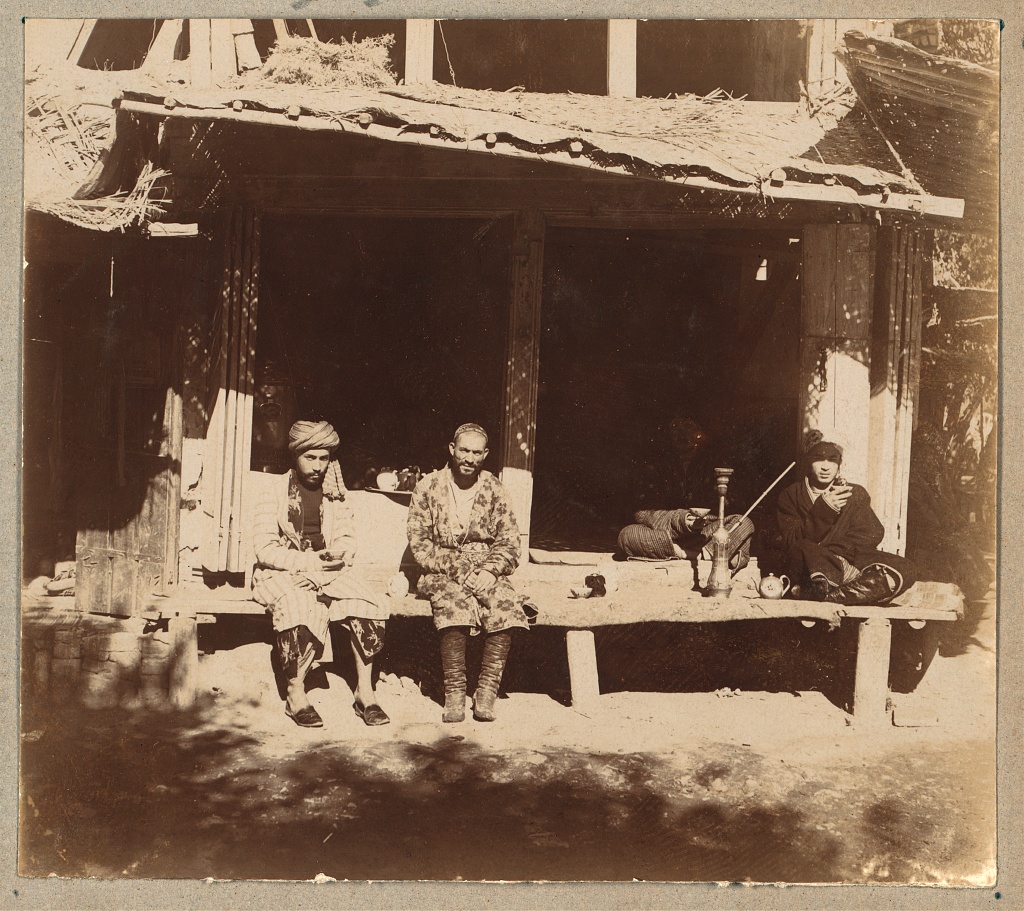
Chaikhana, Samarkand, 1905; image: Prokudin-Gorskiĭ

The chaikhana has roots stretching back centuries, intertwined with the history of the Silk Road. These teahouses sprang up along trade routes as places where merchants, travelers, and locals could rest and exchange goods, ideas, and stories. Over time, chaikhanas became hubs of cultural exchange, bearing silent witness to the blending of a rich tapestry of traditions.

Central Asia is a region shaped by the collapse of the Soviet Union and subsequent episodes of democratization, political coercion, and repression. Throughout history, the chaikhana also played a role in the region’s intellectual life. Much like coffeehouses in Europe, these spaces often served as platforms for debate, poetry readings, and the airing of progressive ideas.

These venues often feature private rooms with enclosed spaces or pull-down shades and outdoor spots with canopies or yurt-like structures, ensuring discretion for guests. Unlike typical restaurants or cafes, which rarely offer such private arrangements, teahouses allow organizations to hold meetings comfortably and confidentially. Teahouses serve a dual purpose by balancing privacy with public engagement, making them invaluable to those seeking both discretion and societal visibility.

Bukhara Chaikhana; image: Joepyrek

Teahouses serve as neutral spaces where the general public and government can freely interact. They offer a safe space for open discussions, even for government employees, highlighting their unique role in fostering dialogue. The subversive potential of teahouses cannot be overlooked, as debates frequently occurred outside formal governmental frameworks. They have quietly allowed people to organize and challenge institutional power in subtle yet meaningful ways.

Tradition and Architecture

Chaikhanas are more than just teahouses; they’re cultural treasures enriched by stunning architecture. From simple wooden benches in rural areas to urban teahouses adorned with intricate carvings, colorful tiles, and ornate patterns, these spaces are as much about artistry as they are about tea.

The interiors feature low tables and cushions, encouraging leisurely conversations and fostering a warm, communal atmosphere. Whether beside a flowing stream or under a carved ceiling, they are designed to make you pause, sip, and savor the moment.

The Chaikhana in Art and Painting: A Cultural Symbol Through Creative Expression
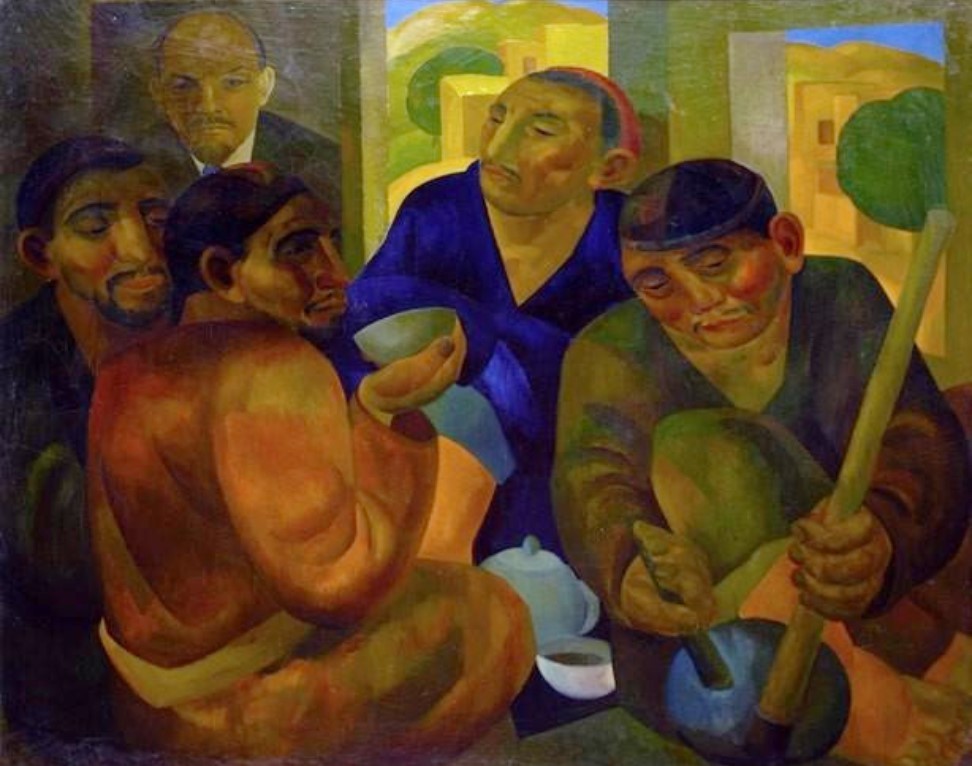
Aleksandr Volkov, Chaikhana with a Portrait of Lenin

Whether through vivid paintings or evocative literature, the chaikhana has emerged as a profound muse for creators across eras and captivated artists and storytellers for generations. Artists have long been drawn to its cozy charm and its role as a social hub. Historical paintings vividly portray these teahouses as dynamic spaces where lively conversations unfold and contemplation takes place. The details speak to the vibrancy of daily life, depicting the pouring of tea into delicate porcelain cups or patrons reclining against intricately carved wooden walls.

A hallmark of these artworks is their masterful use of light, color, and texture. With warm, earthy tones, artists invoke the atmosphere of these teahouses. Richly detailed rugs, ornate teapots, and trays of traditional sweets are constant features, illustrating the significance of cordiality and ritual. Often, these teahouses are depicted nestled beneath shady trees, surrounded by people savoring the simpler joys of life.

Writers often use the teahouse as a symbolic setting to explore themes of community, wisdom, and nostalgia. From classical poets like Alisher Navoi celebrating it as a nucleus for intellectual exchange to modern authors lamenting lost traditions, the chaikhana is deeply woven into literary narratives.

Beyond the written word, the teahouse is a vital backdrop in folk tales, where friendships are formed, disputes resolved, and life lessons shared. It also inspires traditional music and performance art, historically serving as venues for songs and stories that resonate with themes of love, loss, and life. Even today, select chaikhanas keep these traditions alive through music and occasional dance performances, celebrating human connection and interaction.

Novruz Palace; image: TCA, Stephen M. Bland

Choikhona Kokhi Navroz, also known as Novruz Palace, is an architectural marvel in Dushanbe, Tajikistan, and the largest teahouse in Central Asia. Originally built solely as a teahouse, this multi-domed structure with intricate hand-carved details has transformed into a grand palace. Constructed at a staggering cost of $60 million – equivalent to about 1% of the nation’s GDP at the time – the once-exclusive citadel that catered to fat cats and dignitaries now welcomes locals and tourists to its lavish halls. It serves as both a cultural symbol and a popular spot for enjoying traditional Tajik tea and cuisine.

Preserving Identity in Modern Times

Osh Bazaar Chaikhana, Bishkek; image: TCA, Jonathan Campion

Despite the sweeping influence of modernization and globalization, these traditional teashops remain vital in both villages and urban centers. While coffee shops and fast-food chains have gained popularity, the attraction of the chaikhana endures as a cultural touchstone.

Present-day chaikhanas in cities blend old-world aesthetics with contemporary conveniences, ensuring the tradition evolves to suit modern times. Historically, these have been male-dominated areas; however, the landscape is changing. It’s now common to find women enjoying tea and chats in these former forbidden spaces.

Organizations like Chai Khana – a visual multimedia platform – are taking this shift even further by actively working to reclaim these spaces and create a more inclusive environment that bridges gender and cultural divides. Today, the chaikhana is not just a relic of the past but a symbol of how tradition can adapt for an inclusive future.