• KGS/USD = 0.01144 0%
  • KZT/USD = 0.00196 -0%
  • TJS/USD = 0.10899 0%
  • UZS/USD = 0.00008 0%
  • TMT/USD = 0.28490 0%
  • KGS/USD = 0.01144 0%
  • KZT/USD = 0.00196 -0%
  • TJS/USD = 0.10899 0%
  • UZS/USD = 0.00008 0%
  • TMT/USD = 0.28490 0%
  • KGS/USD = 0.01144 0%
  • KZT/USD = 0.00196 -0%
  • TJS/USD = 0.10899 0%
  • UZS/USD = 0.00008 0%
  • TMT/USD = 0.28490 0%
  • KGS/USD = 0.01144 0%
  • KZT/USD = 0.00196 -0%
  • TJS/USD = 0.10899 0%
  • UZS/USD = 0.00008 0%
  • TMT/USD = 0.28490 0%
  • KGS/USD = 0.01144 0%
  • KZT/USD = 0.00196 -0%
  • TJS/USD = 0.10899 0%
  • UZS/USD = 0.00008 0%
  • TMT/USD = 0.28490 0%
  • KGS/USD = 0.01144 0%
  • KZT/USD = 0.00196 -0%
  • TJS/USD = 0.10899 0%
  • UZS/USD = 0.00008 0%
  • TMT/USD = 0.28490 0%
  • KGS/USD = 0.01144 0%
  • KZT/USD = 0.00196 -0%
  • TJS/USD = 0.10899 0%
  • UZS/USD = 0.00008 0%
  • TMT/USD = 0.28490 0%
  • KGS/USD = 0.01144 0%
  • KZT/USD = 0.00196 -0%
  • TJS/USD = 0.10899 0%
  • UZS/USD = 0.00008 0%
  • TMT/USD = 0.28490 0%
09 December 2025

EBRD Finances Coffee-Processing Plant at Kazakh-Chinese Border

The European Bank for Reconstruction and Development (EBRD) has announced a loan of up to $10 million to Empire Manufacturing Kazakhstan (EMK) to support the construction of a coffee-processing facility in the Khorgos Free Economic Zone, located on Kazakhstan’s border with China.

EMK is a subsidiary of Food Empire Holdings, a global food and beverage group listed on the Singapore Exchange. The new plant will enhance the company’s regional production capacity and is expected to set a new standard for food-processing technology and hygiene in Kazakhstan and Central Asia.

Once operational, the facility will export up to 50 percent of its coffee products to markets across Central Asia and the South Caucasus, where demand for Food Empire’s instant beverages is on the rise.

The investment aligns with the EBRD’s broader strategy to support private sector growth in Kazakhstan. To date, the Bank has invested more than €11 billion in 335 projects across the country, with a strong emphasis on fostering entrepreneurship and innovation.

Urban Legends of Central Asia: The Global Allure of Supernatural Tales

Supernatural TV series coming out of the U.S. have captivated audiences with their blend of mystery, horror, and fantasy. Shows like Buffy the Vampire Slayer, and Stranger Things explore themes of good versus evil, the unknown, and human resilience in the face of extraordinary threats. Their storytelling and relatable characters have created devoted fan bases and influenced pop culture.

This year marks the 20th anniversary of Supernatural, the television series that evolved into a global cult phenomenon over its 15-season run and was a hit in Kazakhstan. The show followed the Winchester brothers as they hunted ghosts, demons, and other preternatural beings, drawing on local legends and folklore. But tales of the uncanny are not exclusive to the American Midwest. Central Asia – and Almaty in particular – offers a rich tapestry of urban myths that could easily serve as material for a local paranormal series. Recent years have seen an explosion in the horror/paranormal genre across Central Asia, with domestic productions now outperforming foreign blockbusters at the box office in Kazakhstan, something which was unthinkable just a decade ago.

The Hitchhiking Ghosts of Almaty

One of the earliest episodes of Supernatural features a ghostly hitchhiker, an image that Almaty residents might find eerily familiar.

“I often drive the Kapchagay highway past midnight,” said Vadim, a resident of a village north of Almaty. “A couple of times I’ve seen a figure in white, just like the one my grandfather used to talk about, the ghost of a girl thumbing for a ride. If you stop, she asks you to call her parents and gives you a city phone number. But it’s an old Soviet six-digit number. When people called, someone on the other end would say their daughter had died long ago.”

In another variation, the phantom begins to flirt with the driver, until he looks down and sees that instead of feet, she has hooves.

There are multiple versions of this legend. Another ghostly hitchhiker is said to haunt Zhandosov Street near a former fruit and vegetable factory, reportedly foretelling fatal accidents. A third ghost is rumored to dwell in a bank building at the intersection of Seyfullin and Shevchenko streets, which is allegedly constructed upon the grave of a woman who was murdered.

This last tale, however, doesn’t hold up to scrutiny. The building once housed a design institute and later a high-end nightclub, hardly the kind of place a malevolent spirit would haunt. Local students and clubgoers have reported no paranormal activity.

The Martyr of Baum Grove

Baum Grove in Almaty has long been the subject of ghost stories, many centered on a buried treasure and the murder of an Orthodox bishop during the Russian Civil War. While the Soviet authorities never investigated the legend, literature offers a clue. In his 1925 novel Mutiny, Bolshevik writer Dmitry Furmanov recounted the extrajudicial killing of a bishop outside the city by drunken Red Army soldiers.

Historical records confirm that on September 16, 1918, troops from Ivan Mamontov’s punitive detachment abducted Bishop Pimen (Belolikov) from his residence and executed him in Baum Grove. The Russian Orthodox Church has since recognized him as the first martyr of the church in Kazakhstan, and in 2023, events were held to mark the 105th anniversary of his death. An obelisk now stands on the presumed site of his execution.

Bishop Pimen of Vernoye and Semirechensk; image: Mitropolia.kz

While stories persist about a cursed treasure buried with the bishop, historians note that he was brought to the grove for execution, making it highly unlikely that he hid valuables there, let alone put a curse on them.

Ghosts and Tunnels in Panfilov Park

Nearby Panfilov Park, named after the 28 Panfilov Guardsmen, also enjoys a reputation for the supernatural. Local lore tells of a spectral figure that wanders near the Museum of Folk Musical Instruments at night.

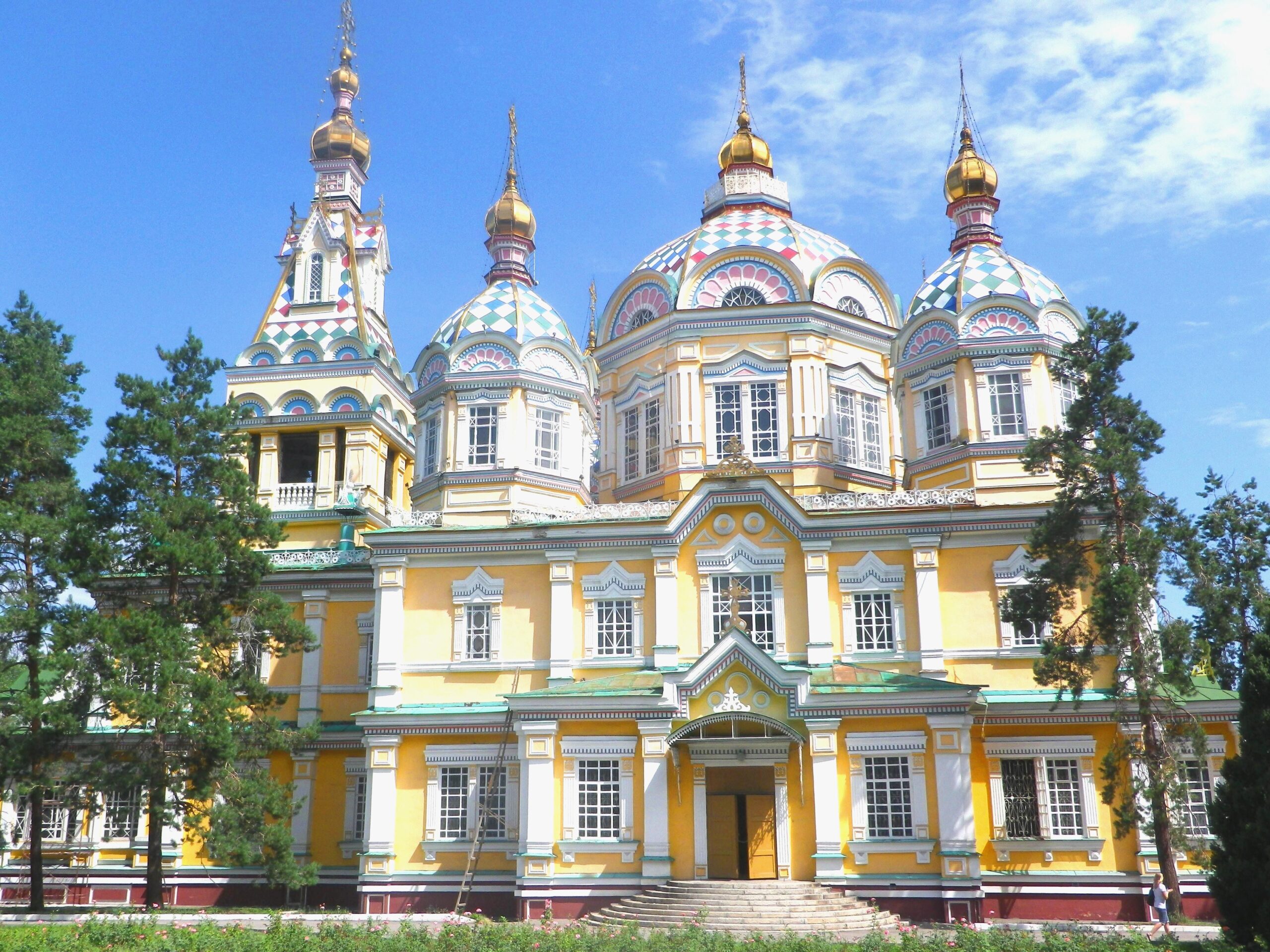
Another widespread belief is the existence of underground tunnels running beneath Almaty. Some say they begin under the Ascension Cathedral and stretch as far as China, and were allegedly used to hide church treasures during the revolution.

The Ascension Cathedral in Panfilov Park; image: TCA, Stephen M. Bland

“There really are underground passages under Almaty,” confirmed local tour guide, Eugenia. “They connect the Ascension Cathedral to the former residence of the Governor-General of Verny, now at the intersection of Tole Bi and Dostyk Street, as well as to the bishop’s former house, now the site of a Citibank on Kazybek Bi Street, and to Kaldayakov Street, where the House of Officers is located.”

The Abandoned Military Hospital

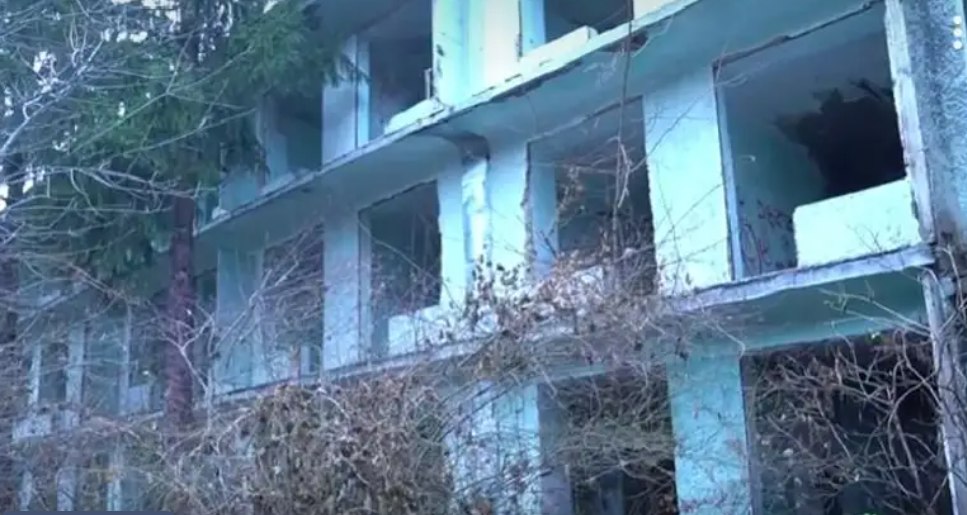
Almaty’s Tau-Samal district is home to an abandoned hospital once used for the treatment and rehabilitation of veterans from World War II, the Soviet-Afghan War, and the Chornobyl disaster. Opened in 1967, the hospital could once house up to 500 patients.

According to legend, the hospital was suddenly evacuated before its closure. Staff and patients reportedly left behind personal belongings, medical equipment, and supplies. The back entrance was said to be barricaded to keep something, unnamed and unsettling, out.

There’s even talk of a ghost soldier who died of battle wounds while being treated at the facility.

Abandoned War Veterans Hospital; image: zakon.kz

But more mundane and, more troubling realities lie behind the story. The hospital was closed in 2010 due to structural issues, including a crack in the wall of its main building. Veterans of the Afghan War and the Chornobyl cleanup have repeatedly petitioned President Kassym-Jomart Tokayev to fulfill government promises to restore the facility.

“In August 2010, the main hospital building, located in one of Almaty’s most prestigious districts, was shut down,” read one such appeal. “We were promised a new state-of-the-art facility with 240 beds for war veterans. Each year we receive letters from the Ministry of Health assuring us that construction will begin soon, but nothing has happened. Perhaps someone has other plans for this prime land?”

The hospital may indeed be haunted, but by neglect and bureaucratic inertia rather than by ghosts.

UN Human Rights Commissioner Raises Alarm Over Air Quality in Bishkek

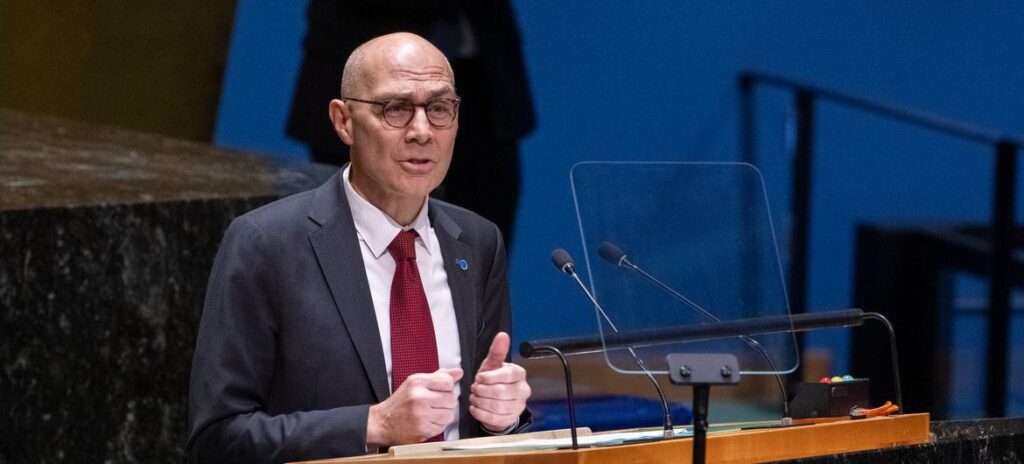
UN High Commissioner for Human Rights Volker Türk has expressed concern over deteriorating air quality in Bishkek during his official visit to Kyrgyzstan. The visit, focused on civil rights, freedom of speech, and economic development, also addressed pressing environmental issues affecting the Kyrgyz capital.

Speaking at a press conference, Türk emphasized that Kyrgyzstan ranks among the most polluted countries in the region, and that air quality in Bishkek poses a serious threat to public health and the environment.

“Despite some progress and financial support from international organizations, much more needs to be done to protect the environment,” he said.

Türk urged Kyrgyz authorities to intensify efforts to combat climate change and to increase investment in green initiatives. He underscored the importance of climate finance and the need for comprehensive, cooperative action.

“This issue must be addressed in partnership and through a climate change lens,” he said. “While there have been financial injections from international donors, they have not yet translated into sufficient results. Each country bears responsibility. Green investments are essential, not just for Kyrgyzstan, but for all nations. The government must take stronger, more effective action.”

According to the 2024 World Air Quality Report from IQAir, cities across Central Asia consistently exceed World Health Organization (WHO) recommendations for fine particulate matter (PM2.5). The report notes the following annual average concentrations (in micrograms per cubic meter):

  • Dushanbe: 46.3
  • Tashkent: 31.4
  • Bishkek: 21.2
  • Osh: 20.5
  • Almaty: 20.3
  • Astana: 15.4

For context, the WHO’s recommended safe limit for PM2.5 is no more than 5 micrograms per cubic meter.

Kazakhstan to Ban Chicken Egg Imports from April

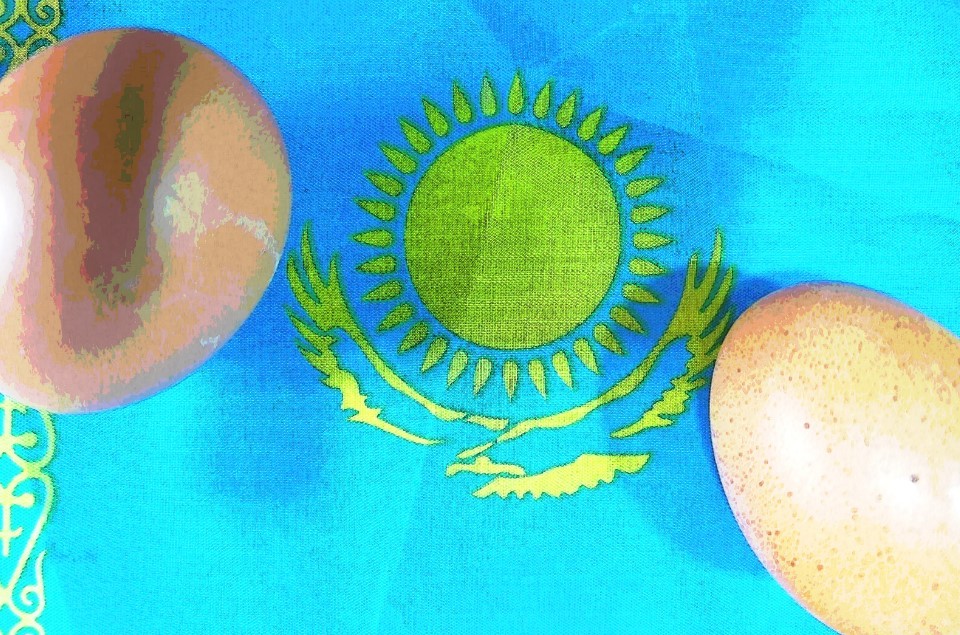
Kazakhstan’s Ministry of Agriculture has drafted an order to ban the import of fresh chicken eggs for six months, beginning in April. The proposal, backed by the government’s interdepartmental commission, is expected to remain in effect through the end of September.

The ban will apply to all imports of fresh eggs, regardless of transport mode, from both countries outside of and member states of the Eurasian Economic Union (EAEU). However, it will not affect the transit of eggs through Kazakhstan, including shipments moving from one EAEU country to another, such as from Russia to Kyrgyzstan.

The initiative was not proposed by the authorities but by the Association of Egg Producers.

“The Association appealed to the Ministry of Trade and the Ministry of Agriculture to consider a ban on egg imports from April to September,” said Kairat Maishev, head of the association. “A similar restriction was in place in 2024, from May to October. The goal is to curb illegal imports, prevent the entry of low-quality eggs, and support the development of the domestic industry.”

Maishev stressed that the ban does not target legitimate importers but aims to ensure that imported eggs are properly documented and taxed. He also noted concerns about substandard products entering the market during the summer months.

“In summer, the market often receives imports that do not meet shelf life and quality standards,” he stated. “It’s also difficult for authorities to regulate pricing for these products.”

Kazakhstan currently has 34 poultry farms producing approximately five billion eggs annually, enough to meet domestic demand, according to the association. “We are confident that local producers can fully supply the population with quality products,” Maishev added.

Official data shows that in 2024, Kazakhstan imported 87.4 million eggs and exported 43.2 million. Domestic production covered 99% of the national demand, with most imports originating from other EAEU countries.

Government officials argue that the temporary ban will help strengthen the domestic egg industry and promote transparent pricing in the local market.

In a related development, Kazakhstan suspended poultry imports in January from the U.S. states of Delaware and South Carolina, as well as Germany’s Baden-Württemberg region, due to outbreaks of avian influenza. 

Celebrating Nauryz: A Timeless Tradition of Unity, Renewal, and Heritage in Central Asia

Nauryz is more than just a holiday – it is a symbol of spring renewal, harmony, and unity that has been celebrated by the peoples of Central Asia for centuries. Marking the arrival of the spring equinox, Turkic communities welcome the New Year with purification rituals, festive gatherings, and traditional games. While the holiday shares common roots across the region, each country celebrates it uniquely, reflecting its distinct cultural heritage.

Nauryz has survived through the centuries, and despite the evolution of the celebration in the modern era, it continues to unite people through traditions.

Kazakhstan

In Kazakhstan, Nauryz is celebrated on a large scale, transforming cities and villages into festival grounds filled with folk rituals, sporting events, and cultural performances. The holiday begins with blessings from elders and family visits. At the heart of the festive table is Nauryz-kozhe, a traditional soup made from seven ingredients, each symbolizing key values in life.

“Nauryz without Nauryz-kozhe is not Nauryz,” Daniyar, 29, from Almaty, told The Times of Central Asia. “When I was a child, my grandmother told me that eating it would bring luck for the year. That’s why the whole family gathers around the table.”

Beyond feasting, Nauryz is a time for competitions. Among the most popular are kokpar, an equestrian contest where riders traditionally competed for a goat carcass – now often replaced with a dummy version (serke), asyk atu, a traditional game of precision using sheep bones, and kazaksha kures, a national wrestling competition.

“As a child, I always looked forward to this day because it was when I could see adults displaying strength and skill,” Sanzhar, 25, from Taraz, told TCA. “These traditions are passed down through generations and strengthen our culture.”

Ancient customs also come to life during the festival. People wear traditional Kazakh attire, exchange gifts, and partake in purification rituals.

“When I put on a [traditional] Kazakh costume, I feel a deep connection with my ancestors. There’s something magical about this holiday – the aroma of freshly cooked kozhe, the sound of the dombra, the folk dances, and the spirit of unity. It’s a day to remember who we are and take pride in our culture,” said Aizhan, 40, from Astana.
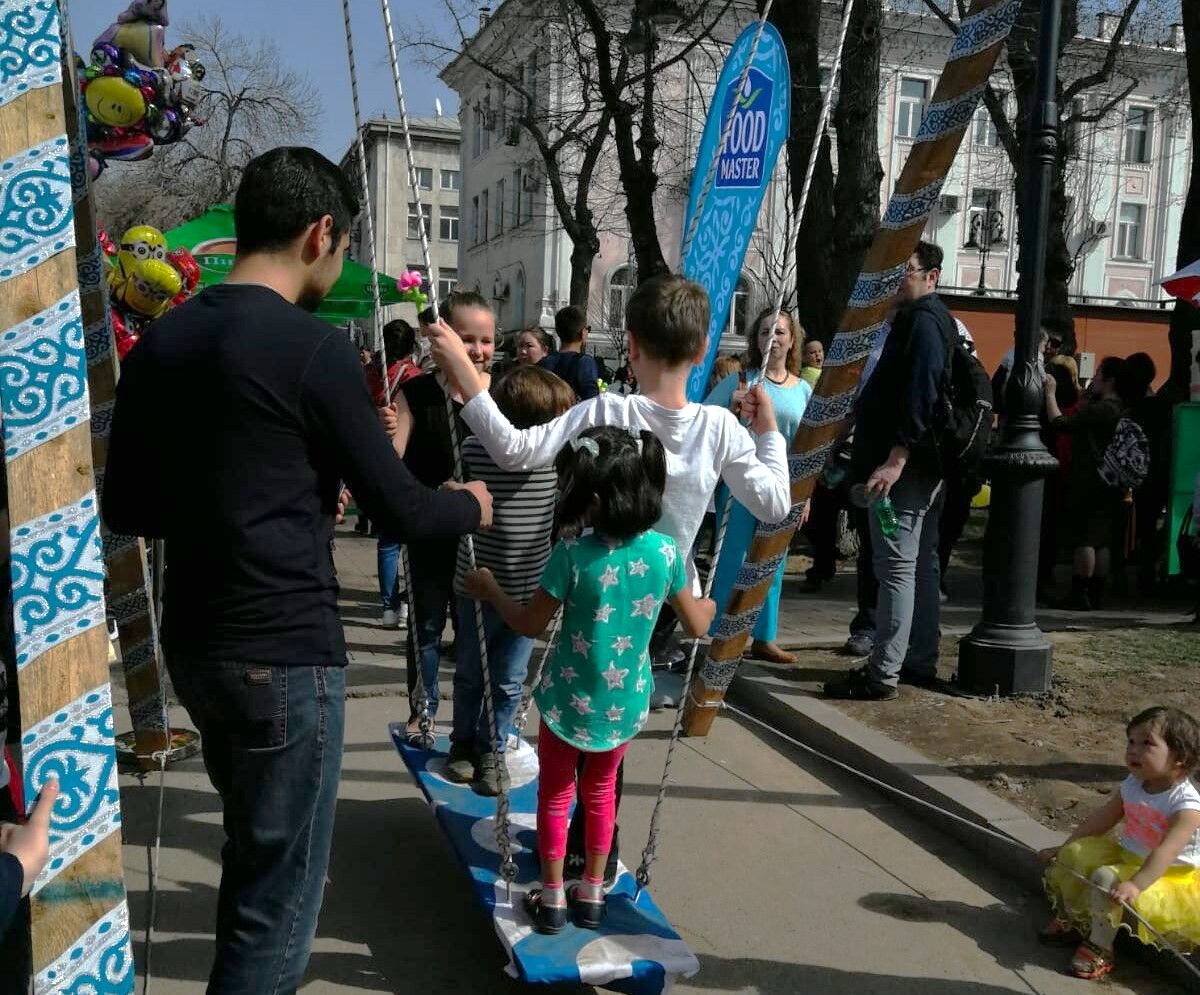
Nauryz celebration in Almaty; image: TCA

Kyrgyzstan

In Kyrgyzstan, Nauryz represents renewal and rebirth. The celebrations begin with a cleansing ritual, where people clean their homes, courtyards, and even their minds, symbolizing a fresh start. Hospitality plays a central role, as it is customary to host and visit seven guests, symbolizing openness and strong social bonds.

Like in Kazakhstan, Nauryz-kozhe is a staple of the festive table. However, Kyrgyz cuisine also features kuurdak, fried meat with potatoes and onions, and osh – also known as plov or palov – emphasizing the tradition of generous feasting.

The holiday is further enriched by national sporting competitions, including horse races, wrestling (kuresh), ordo, a traditional strategy game, and arkan tartysh, a tug-of-war contest.

“For us, Nauryz is more than just a holiday. It’s a time to come together, reconnect with traditions, and welcome the fresh energy of spring,” Asyl, 28, from Bishkek, told TCA.

Uzbekistan

In Uzbekistan, Nauryz carries a deep historical significance. The festival begins with a purification ritual, followed by family gatherings around a festive table. The centerpiece of the Uzbek Nauryz feast is sumalyak, a dish made from sprouted wheat, symbolizing fertility and prosperity. Its preparation is a social event in itself, accompanied by singing and well-wishing.

Other traditional dishes include pilaf, manty (steamed dumplings), naryn (a cold noodle dish), and flatbreads (non). The holiday is marked by folk performances, concerts, and sporting competitions. Among them, Kurash, Uzbekistan’s national form of wrestling, remains a crowd favorite.

“In our family, Nauryz is a special occasion,” Dildora, 32, from Tashkent, told TCA. “We not only bring our relatives together but also pass down our traditions and values to the younger generation. While modern celebrations now include large concerts and street performances in Tashkent, we remain committed to our traditions.”

Traditional treats for Nauryz; image: TCA

Tajikistan

In Tajikistan, Nauryz is a time for renewing family ties, strengthening friendships, and seeking forgiveness. People visit relatives and friends, exchange gifts, and offer sincere well-wishes, embracing the spirit of unity.

As in other Central Asian nations, the Tajik festive table is central to the celebration, with the most important dish being plov. The communal meal brings families together to share not only their food but also joy.

Music is an integral part of Tajik Nauryz traditions. Folk instruments such as the dutar, tanbur, dumbrak, and Kashgar rubab fill the air with festive melodies, while traditional dances serve as a joyful expression of the holiday.

Turkmenistan

Nauryz in Turkmenistan is a vibrant celebration that symbolizes renewal, unity, and the return of warmth following the harsh winter. Deeply rooted in Turkmen heritage, the holiday is celebrated with family gatherings, traditional music, dances, and festive meals. A highlight of the celebration is the preparation of semeni, a dish made from sprouted wheat, symbolizing abundance and prosperity. Communities engage in cultural performances and sports, reaffirming their sense of national pride and cultural identity.

Despite globalization and modernization, Nauryz continues to unite the peoples of Central Asia. It is not just a holiday, but a living tradition, a time for family, gratitude, and cultural pride. Whether through age-old customs, festive meals, or exhilarating competitions, Nauryz remains a powerful symbol of renewal and shared heritage across the region.

Kyrgyzstan, Tajikistan, and Uzbekistan Reach Border Agreement After Years of Negotiations

After nearly two decades of discussions, Kyrgyzstan, Tajikistan, and Uzbekistan have officially determined the junction point of their shared borders. Kamchibek Tashiyev, head of the Kyrgyz National Security Committee, presented the final border demarcation to Kyrgyz lawmakers, AKIpress reported.

On March 19, Tashiyev stated that trilateral negotiations on this issue had been ongoing since 2007. Government delegations from the three countries held six meetings before reaching an agreement. The dispute over the exact location of the border junction remained unresolved until a March 2025 meeting in Dushanbe, where representatives of Kyrgyzstan, Tajikistan, and Uzbekistan finalized the demarcation.

During the meeting, Tashiyev displayed a map marking the agreed border point in blue. He noted that Uzbekistan had previously suggested a location marked in green, while Tajikistan proposed a spot marked in red. Accepting these alternative proposals would have left key roads outside Kyrgyzstan’s territory. Under the final agreement, Kyrgyzstan retains approximately 100 hectares of land, which, although uninhabited, includes an important road.

This breakthrough follows a March 13 border agreement between Kyrgyzstan and Tajikistan, aimed at ending long-standing tensions that had made their shared border the most volatile in Central Asia for over a decade. The deal was underscored by Tajik President Emomali Rahmon’s first visit to Bishkek in nearly 12 years, highlighting its importance.

As part of the agreement, the two countries also agreed to reopen the Kairagach (Leilek district) and Kyzyl-Bel (Batken district) border checkpoints, which had been closed for nearly four years. Both checkpoints resumed operations on March 13.