• KGS/USD = 0.01144 0%
  • KZT/USD = 0.00194 -0%
  • TJS/USD = 0.10896 -0%
  • UZS/USD = 0.00008 0%
  • TMT/USD = 0.28571 0.28%
  • KGS/USD = 0.01144 0%
  • KZT/USD = 0.00194 -0%
  • TJS/USD = 0.10896 -0%
  • UZS/USD = 0.00008 0%
  • TMT/USD = 0.28571 0.28%
  • KGS/USD = 0.01144 0%
  • KZT/USD = 0.00194 -0%
  • TJS/USD = 0.10896 -0%
  • UZS/USD = 0.00008 0%
  • TMT/USD = 0.28571 0.28%
  • KGS/USD = 0.01144 0%
  • KZT/USD = 0.00194 -0%
  • TJS/USD = 0.10896 -0%
  • UZS/USD = 0.00008 0%
  • TMT/USD = 0.28571 0.28%
  • KGS/USD = 0.01144 0%
  • KZT/USD = 0.00194 -0%
  • TJS/USD = 0.10896 -0%
  • UZS/USD = 0.00008 0%
  • TMT/USD = 0.28571 0.28%
  • KGS/USD = 0.01144 0%
  • KZT/USD = 0.00194 -0%
  • TJS/USD = 0.10896 -0%
  • UZS/USD = 0.00008 0%
  • TMT/USD = 0.28571 0.28%
  • KGS/USD = 0.01144 0%
  • KZT/USD = 0.00194 -0%
  • TJS/USD = 0.10896 -0%
  • UZS/USD = 0.00008 0%
  • TMT/USD = 0.28571 0.28%
  • KGS/USD = 0.01144 0%
  • KZT/USD = 0.00194 -0%
  • TJS/USD = 0.10896 -0%
  • UZS/USD = 0.00008 0%
  • TMT/USD = 0.28571 0.28%
09 December 2025

Chinese Investors to Build New Industrial Plants and Residential Compound in Kyrgyzstan’s Naryn

On October 25, Chinese investors launched the construction of four extensive production facilities in Kyrgyzstan’s Naryn region: a car assembly plant, an LED lamp manufacturing plant, a toilet paper and napkin plant, and an agricultural drone manufacturing plant.

At a capsule-laying ceremony, Akylbek Japarov, Chairman of the Cabinet of Ministers of Kyrgyzstan, emphasized that this event proves that Kyrgyzstan has reached “a new, higher level of relations” with its neighbor.

Chinese partners will invest $130 million in the Naryn-Shumkar car assembly plant, which will manufacture more than 20,000 cars annually and create 1,000 jobs.

$10 million will be invested in the LED lamp plant, which will produce 30 million lamps per year and create about 200 jobs.

Another $10 million will be invested in the toilet paper and napkin plant, which will produce 6,000 tons of paper annually and create more than 100 jobs.

On the same day, Japarov attended a ceremony to begin the construction of a new residential compound, Tien Shan City, in the town of Naryn.

The residential compound will consist of six 10-storey apartment blocks. The developer, a construction company from the Chinese city of Kashgar, plans to complete high-quality modern housing construction within a year. The company will also build an administration house for all government services for the local population.

Startups From Central Eurasia Set to Conquer Silicon Valley

The following 10-15 years will see the birth of large tech companies originating from Central Eurasia, a vast region including Azerbaijan, Georgia, Kazakhstan, Kyrgyzstan, Mongolia, Tajikistan, Turkmenistan, Turkey, and Uzbekistan. This was stated at the first technology conference entitled Central Eurasia at Silicon Valley. The conference brought together the region’s top 100 startups, American venture investors, large company leaders, and tech giants from Silicon Valley.

According to the event organizers, Central Eurasia has enormous untapped potential. With a population of more than 100 million people and an average age of 27, about 200,000 young people in the region annually receive an education in the field of STEM (science, technology, education, mathematics). The area has everything necessary to develop the tech industry: universities, a startup ecosystem, venture funds, and its representative in Silicon Valley — Silkroad Innovation Hub, which, in the first year of its operation, attracted 80 resident startups and more than $30 million in investments.

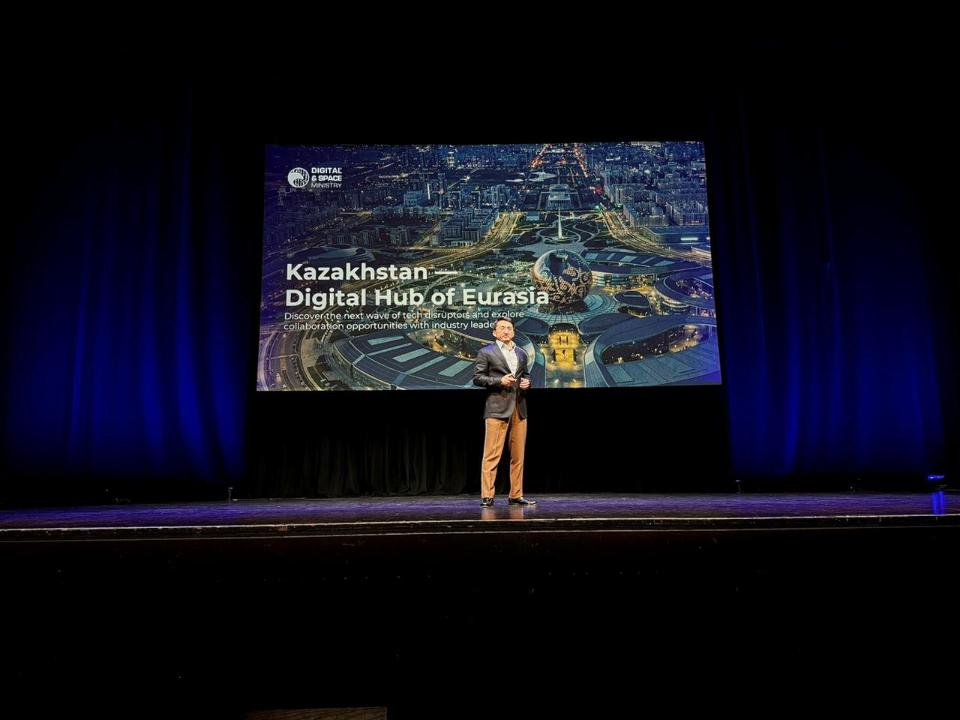
At the conference, Zhaslan Madiyev, Minister of Digital Development, Innovation and Aerospace Industry of Kazakhstan, said that Kazakhstan accounts for 50% of GDP in Central Eurasia. Kazakhstan is in 10th place in the UN GLOBAL Online Services Index and 3rd place among Central and South Asian countries in the Global Innovation Index (after Iran and India).

“Recently, there has been a rapid development of new technologies, AI, blockchain, and all this stimulates the market and entrepreneurs to create startups,” Madiyev said.

The minister added that Kazakhstani investors are ready to invest $100,000-$200,000 in startups at an early stage. Still, finding $1 million or $2 million in investment can be challenging, even in a more mature stage. Therefore, he urged the promotion of Kazakhstani startups abroad, especially in Silicon Valley.

Kyrgyzstan Triples Ice Cream Exports

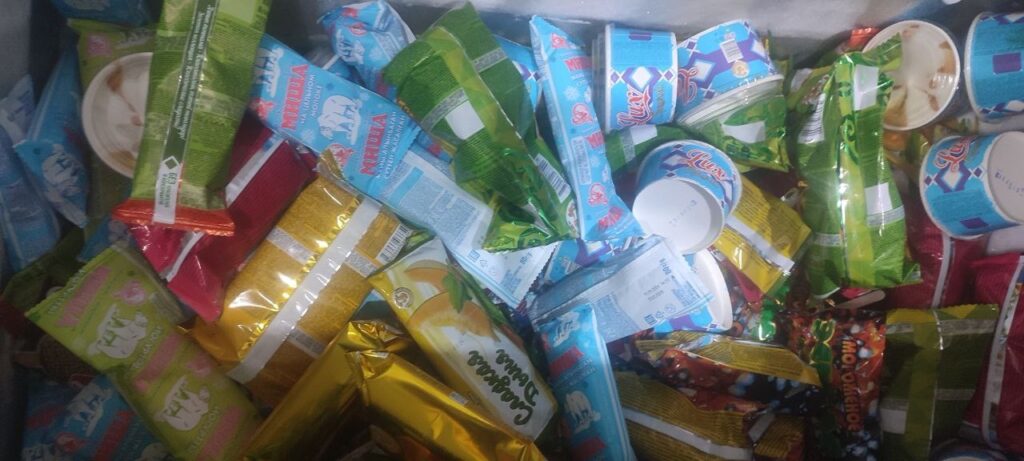
Kyrgyzstan has doubled its ice cream production in the last five years, and tripled its exports to other countries in the region.

Last year, the country produced 10,800 tons of ice cream, up from 5,200 tons five years earlier. This increase is due to growing demand for Kyrgyz ice cream in other Eurasian countries, primarily Kazakhstan, Uzbekistan, and Russia. Exports to these countries have increased from 2,800 tons per year to 6,100 tons since 2019.

“At the same time, imports of ice cream have shown good dynamics recently, and they have decreased from 2,788 tons (per year) to 1,969 tons. This indicates the substitution of imported products with domestic production,” said the Ministry of Agriculture of the Kyrgyz Republic.

According to official data, Kyrgyzstan imports ice cream from Turkey, Belarus, and Lithuania. While a kilogram of ice cream from Russia costs 240 KGS ($3), Lithuania and Turkey ask an average of 570 KGS ($7). The cost of one kilogram of ice cream from Kyrgyzstan is just over 200 KGS ($2.5).

Prosecutor’s Office Urges Caution in Reporting on Alleged Attack on Allamjonov

According to Uzbek media, an assassination attempt was made on October 26 against Komil Allamjonov, the former head of the presidential information department. At about 1:40am near Allamjonov’s home in Tashkent’s Kibray district, two unknown people fired several shots at the car he was sitting in and fled the scene. No-one was hurt.

The type of weapon used in the attack has not been determined. An attempted murder case has been opened, and a search is underway. However, in its statement, the General Prosecutor’s Office did not confirm that this was an assassination attempt against Allamjonov.

The media reported the incident under headlines about “Allamjonov’s assassination,” prompting an official response from the General Prosecutor’s Office. They clarified that the information being circulated about the shooting lacks confirmation from reliable official sources. The prosecutor’s office stated that the investigation was ongoing and promised further updates.

Five Uzbeks and One Tajik Escape Russian Penal Colony

On the morning of October 26, news broke that six prisoners had escaped from a penal colony in Russia’s Lipetsk region. The escapees—five from Uzbekistan and one from Tajikistan—had been planning their escape for over six months. They stole tools seven months prior and used them to dig two tunnels.

The Lipetsk prison is where the infamous Aleksey Sherstobitov is serving a 23-year sentence. Sherstobitov, known as ‘Lyosha the Soldier’, was a notorious hitman in the 1990s, working for the infamous Orekhovskaya crime group.

Law enforcement has detained five of the six prisoners, who escaped through a dug tunnel. The prisoners, all convicted of rape and drug trafficking, had planned to reach the Kazakhstan border but only managed to travel a few dozen kilometers toward Tambov and Moscow. The search for the remaining escapee is ongoing.

A criminal case has been opened for negligence against the colony officials who allowed the prisoners to escape. If found guilty they could face up to seven years in prison under Article 293 of the Russian Criminal Code.

Uzbekistan President’s Party Wins Landmark Election Held Under New Voting System

On October 27, Uzbekistan held elections for deputies of the Legislative Chamber of the Oliy Majlis (Lower House of Parliament) and local councils. This marks the first time these elections were conducted using a mixed (majority-proportional) system and featured electronic voting.

For over a month, parties actively promoted their election programs to the public, with televised debates and messages on public transport urging citizens to participate in the elections and shape the country’s future. As required by law, all campaign activities were halted one day before the election.

The electoral platforms of the five parties registered in Uzbekistan saw The Liberal Democratic Party of Uzbekistan (UzLiDeP) emphasize poverty reduction and promoting internal labor migration over the next five years. The party also campaigned on expanding public-private partnerships in water management, ecology, and energy to increase the private sector’s share in the economy to 85%. Additionally, UzLiDeP pledged to improve education, healthcare, and social services, focusing on providing clean drinking water and sewage systems in schools. The party pledged to double the annual budget for healthcare to $6 billion, and advocated to enhance healthcare and social support for citizens over the age of 70.

The People’s Democratic Party (PDP) focused on accessibility and social support, including assistive technologies at public transportation points for people with disabilities. They proposed adopting a “Social Housing” law, requiring luxury housing developers to allocate funds for social housing. This would benefit vulnerable groups, such as the homeless, people with disabilities, and those coming through the orphanage system. The party’s environmental initiatives included the Water Code and creating “Health Parks” for seniors near apartment complexes.

The Milli Tiklanish (National Revival) Party’s platform spanned various topics, including youth development, cultural enrichment, family support, economic growth, and tourism. One key pledge emphasized Uzbekistan’s international relations, focusing on friendly ties with neighboring countries, cooperation, and maintaining peace – this despite party leader, Alisher Qodirov’s anti-Russian rhetoric, including recent comments that “it would be better for [Russia] to deal with their own affairs [which are] full of problems than to deal with our internal issues.” Qodirov has been actively responding to international discussions about Uzbekistan, reinforcing the party’s commitment to advancing national interests and strengthening Uzbekistan’s presence on the world stage.

The Adolat (Justice) Social Democratic Party ran on a platform of advocating for media freedom, proposing reforms to safeguard journalists’ rights and prevent interference. Adolat pledged to introduce a “Presumption of Property Rights” to protect ownership and put forward affordable energy and price stability initiatives.

The Ecology Party’s motto, “We are responsible for the future!” set out to drive home its focus on environmental and social issues. The party promoted government, business, and civil society efforts to address environmental challenges, whilst seeking to improve environmental legislation and education, and transitioning Uzbekistan toward a green economy.
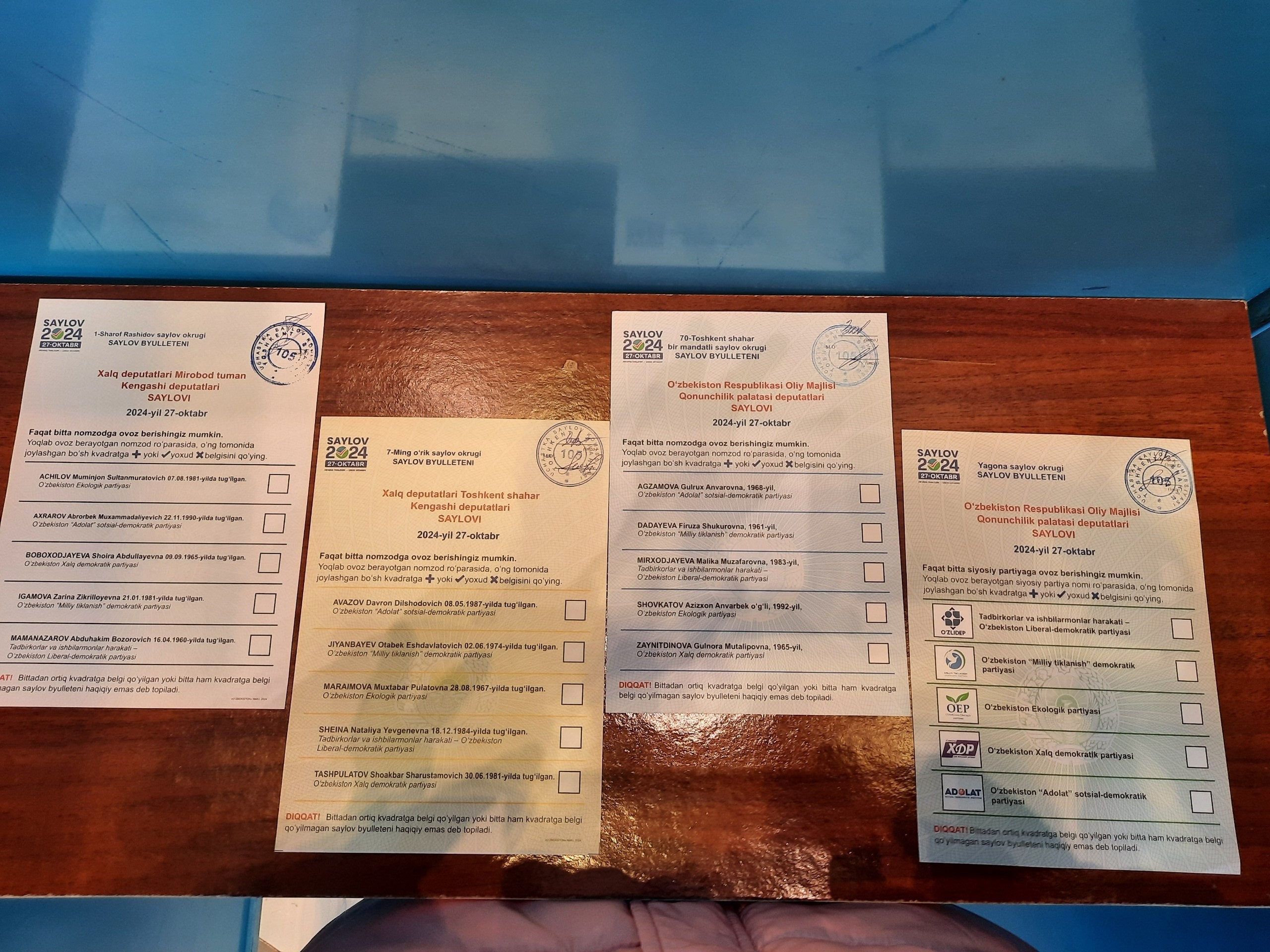
@TCA

According to Uzbek legislation, the election would be deemed valid once 33% of voters participated, and by 1pm local time 47.62% of voters had cast their ballots.

President Shavkat Mirziyoyev and his family voted in the 59th polling station on Tashkent’s Mirzo Ulugbek district. More than 850 international observers participated in the elections as part of fully-fledged missions from the CIS, SCO, the Organization of Turkic States, and the OSCE Bureau for Democratic Institutions and Human Rights. Chairman of the Central Election Commission, Zayniddin Nizamkhodjaev, announced that 74.72% of registered voters had voted in the elections.

According to preliminary results, President Mirziyoyev’s UzLiDeP has won 64 seats in the Legislative Chamber of the Oliy Majlis. National Revival gained 29 seats, Adolat 21, the PDP 20, and the Ecology Party 16 seats. Some Western outlets, such as Barron’s, characterized the elections as “tightly controlled” with “no real opposition,” whilst according to The Diplomat, all of the entities allowed to register “have always been perceived as mere extensions of the state.”

However, since the death of long-term despot, Islam Karimov, Uzbekistan’s “state apparatus [have] become more open,” as noted by an election observer in 2019. Amidst reforms aimed at tackling endemic corruption, in recent years Uzbekistan has gained ground on Transparency International’s global corruption perception index, and recently partnered with the World Bank on “training, projects, and research to combat corruption.”

In it’s preliminary conclusion, the OSCE stated that Uzbekistan’s parliamentary elections “took place amid ongoing reforms, including
significant amendments to the Constitution, but the political environment remained constrained, not providing voters with a genuine choice. While the electoral framework has gradually evolved, and elections were technically well-prepared, significant challenges in meeting international standards for democratic elections persist in such areas as political party registration, the right to stand, campaign
finance transparency, citizen observation, and the publication of polling station results.”