• KGS/USD = 0.01144 0%
  • KZT/USD = 0.00194 -0%
  • TJS/USD = 0.10844 -0.46%
  • UZS/USD = 0.00008 0%
  • TMT/USD = 0.28571 0.28%
  • KGS/USD = 0.01144 0%
  • KZT/USD = 0.00194 -0%
  • TJS/USD = 0.10844 -0.46%
  • UZS/USD = 0.00008 0%
  • TMT/USD = 0.28571 0.28%
  • KGS/USD = 0.01144 0%
  • KZT/USD = 0.00194 -0%
  • TJS/USD = 0.10844 -0.46%
  • UZS/USD = 0.00008 0%
  • TMT/USD = 0.28571 0.28%
  • KGS/USD = 0.01144 0%
  • KZT/USD = 0.00194 -0%
  • TJS/USD = 0.10844 -0.46%
  • UZS/USD = 0.00008 0%
  • TMT/USD = 0.28571 0.28%
  • KGS/USD = 0.01144 0%
  • KZT/USD = 0.00194 -0%
  • TJS/USD = 0.10844 -0.46%
  • UZS/USD = 0.00008 0%
  • TMT/USD = 0.28571 0.28%
  • KGS/USD = 0.01144 0%
  • KZT/USD = 0.00194 -0%
  • TJS/USD = 0.10844 -0.46%
  • UZS/USD = 0.00008 0%
  • TMT/USD = 0.28571 0.28%
  • KGS/USD = 0.01144 0%
  • KZT/USD = 0.00194 -0%
  • TJS/USD = 0.10844 -0.46%
  • UZS/USD = 0.00008 0%
  • TMT/USD = 0.28571 0.28%
  • KGS/USD = 0.01144 0%
  • KZT/USD = 0.00194 -0%
  • TJS/USD = 0.10844 -0.46%
  • UZS/USD = 0.00008 0%
  • TMT/USD = 0.28571 0.28%
09 December 2025

Uzbek Parliament Ratifies Border Agreement with Kyrgyzstan and Tajikistan

On October 28, the Legislative Chamber of Uzbekistan’s parliament, the Oliy Majlis, ratified a law approving a trilateral agreement on the junction point of the state borders of Uzbekistan, Kyrgyzstan, and Tajikistan, according to the chamber’s press service.

The agreement was initially signed on March 31 in the Tajik city of Khujand during a high-level meeting between Presidents Shavkat Mirziyoyev of Uzbekistan, Emomali Rahmon of Tajikistan, and Sadyr Japarov of Kyrgyzstan. The leaders also took part in a remote inauguration of the Dostlik (Friendship) stele, which now marks the exact location where the borders of the three countries meet.

Lawmakers emphasized that Central Asia is increasingly becoming a region of constructive dialogue, mutual trust, and regional cooperation, moving past a legacy of closed borders and unresolved territorial disputes.

Umid Yakubkhodjayev, a member of the parliamentary committee on international affairs, defense, and security, stated that the agreement formally establishes the precise location of the tri-border junction and the delineation of border lines in the area. He noted that the deal would bolster good-neighborly relations, reinforce trust and strategic partnerships, and contribute to the international stature of the Central Asian region.

The agreement also lays a legal foundation for expanding cross-border cooperation, enhancing trade, and launching joint infrastructure initiatives in neighboring regions. These efforts are expected to create jobs and raise living standards.

The draft law was passed in its first reading and, by exception, was adopted immediately in all three readings. It has now been forwarded to the Senate and will enter into force upon presidential signature.


Kyrgyzstan Unveils New Gold Storage Facility Built to International Standards

Kyrgyzstan has launched its own gold storage facility, built to international standards and capable of holding up to 1,000 tons of gold. Until now, the country stored its gold reserves abroad. President Sadyr Japarov announced the development during the October 28 inauguration of the new National Bank of the Kyrgyz Republic (NBKR) building in Bishkek. 

Japarov stated that Kyrgyzstan can now not only securely store its gold domestically but also offer storage services to foreign partners.

According to the National Bank, Kyrgyzstan’s international reserves, comprising gold and foreign currency, have reached a historic high of $7.55 billion.

Data from the World Gold Council shows that Kyrgyzstan’s gold reserves rose by 4.68 tons in the second quarter of this year, totaling 38.95 tons.

Japarov reaffirmed that maintaining the stability of the national currency, the som, remains the National Bank’s top priority. “This is a responsible mission that directly affects the lives of every citizen and the well-being of every family. Public trust in the som is an indicator of the state’s strength,” he said, noting that the currency is now regarded as one of the most stable in Central Asia.

During the ceremony, officials announced that domestic printing of 20- and 50-som banknotes will begin on November 17, with production of all other denominations scheduled to start by mid-2026

Currently, Kyrgyzstan circulates banknotes in denominations of 20, 50, 100, 200, 500, 1,000, 2,000, and 5,000 som.

Previously, the country’s banknotes were produced in several European countries. The new series will be printed by the Bishkek-based company Uchkun (Open Joint Stock Company) and will meet international standards for security and counterfeit protection.

World Happiness Index: Central Asian Countries Stand Out With “Warm Social Climate”

Kazakhstan has been named the happiest country in Central Asia, according to the World Happiness Report 2025 published by the Oxford Wellbeing Centre. Ranking 43rd globally, Kazakhstan outperformed its regional neighbors in metrics such as social support, trust, and freedom of choice. 

The report evaluates national well-being based on six key indicators:

  • GDP per capita
  • Social support (help from family, friends, and society)
  • Healthy life expectancy
  • Freedom to make life choices
  • Generosity (willingness to help others)
  • Perceived absence of corruption

Kazakhstan scored 6.38 out of 10, demonstrating especially strong performance in trust and honesty. The country ranked 30th globally for the likelihood of returning a wallet to a neighbor and 42nd for returning it to a stranger.

Uzbekistan followed at 53rd place with a score of 6.2. The country stood out for its high levels of charitable giving (29th) and public trust in law enforcement (19th).

Kyrgyzstan ranked 75th with 5.9 points and was recognized as the regional leader in helping strangers. Tajikistan placed 90th with a score of 5.4 but made the global top four in volunteering, an indicator linked to longstanding traditions of mutual aid. Turkmenistan was excluded from the ranking due to insufficient data.

The report highlights that Central Asian countries exhibit some of the world’s highest levels of kindness. The region’s mutual aid index ranges from 0.30 to 0.36, compared to the global average of 0.33.

“Despite economic differences, the region maintains strong social ties and a culture of collectivism, where helping others and participating in community life remain important values,” the report notes.

According to the authors, happiness is influenced less by income than by trust, stability, and personal freedom. Central Asia, they conclude, fosters a “warm social climate,” where interpersonal kindness often offsets institutional shortcomings and economic hardship.

Globally, Finland topped the 2025 rankings, followed by Denmark, Iceland, Sweden, and the Netherlands. At the bottom of the list were Sierra Leone (146th) and Afghanistan (147th), where happiness levels remain the lowest worldwide.

U.S. Envoys Hail Stronger Kazakhstan Partnership Ahead of C5+1 Summit

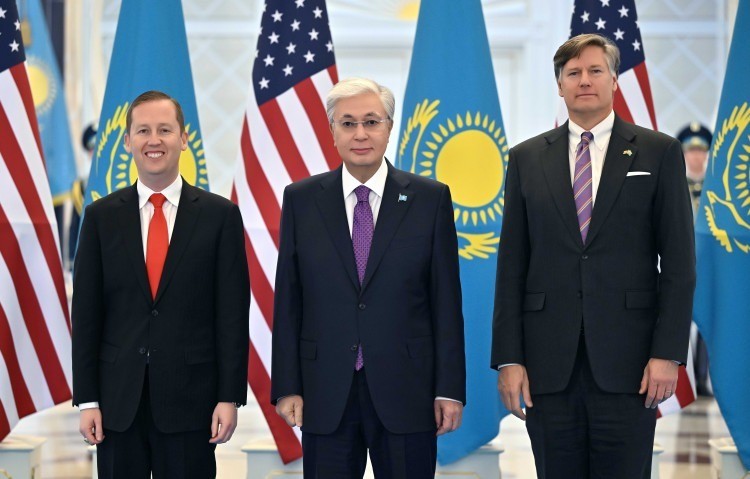
On October 29, Unites States Special Envoy for South and Central Asia Sergio Gor and Deputy Secretary of State Christopher Landau concluded their visit to Kazakhstan ahead of the upcoming C5+1 summit in Washington.

During their trip, the U.S. envoys met with President Kassym-Jomart Tokayev and held discussions with representatives of Kazakhstan’s government and business community, which they described as highly productive.

“We are concluding a memorable trip to Kazakhstan in the beautiful capital, Astana, which did not even exist 30 years ago and now boasts a population of more than 1.5 million,” Landau posted on social media.

He also stated that bilateral relations between the U.S. and Kazakhstan “have never been so strong” and expressed gratitude for the hospitality. 

Gor and Landau held talks with Prime Minister Olzhas Bektenov and key cabinet members, including Minister of Trade and Integration Arman Shakkaliev, Minister of Energy Yerlan Akkenzhenov, Minister of Transport Nurlan Sauranbayev, and Deputy Prime Minister and Minister of National Economy Serik Zhumangarin, to discuss Kazakhstan’s economic priorities and areas for expanding bilateral cooperation.

According to the Kazakh government, the talks focused on expanding trade and investment cooperation between the two countries. Priority areas included transport and logistics, energy, agriculture, the digital economy, and artificial intelligence.

During their visit, the U.S. envoys also met with Deputy Prime Minister Murat Nurtleu, who reaffirmed Kazakhstan’s readiness to cooperate on sustainable development and energy security.

The meetings demonstrated Kazakhstan’s active engagement with the United States in the lead-up to the upcoming Central Asia–U.S. summit.

Deputy Prime Minister and Minister of National Economy Serik Zhumangarin, who highlighted Kazakhstan’s economic strengths during talks with Gor and Landau, had recently returned from a high-level visit to the United States. His delegation, which included Deputy Head of the Presidential Administration Erbolat Dossaev and Chairperson of the Agency for Regulation and Development of the Financial Market Madina Abylkasymova, held meetings in New York and Washington with American business leaders and members of Congress.

During the visit, the Kazakh delegation presented the country’s economic growth strategy, highlighted ongoing GDP expansion, and discussed the potential listing of government securities on the New York Stock Exchange. They also raised the possible repeal of the Jackson–Vanik Amendment, a long-standing priority for Kazakhstan’s diplomatic agenda.

Against this backdrop, the White House’s decision to convene a summit between President Donald Trump and the leaders of the Central Asian republics may partly reflect Kazakhstan’s sustained diplomatic outreach. In that context, Gor and Landau’s remarks of appreciation as they departed Astana underscored recognition of Kazakhstan’s role in shaping this evolving partnership.

Turkmenistan Halts Gas Exports to Turkey Amid Contract Talks

Turkmenistan has temporarily suspended natural gas exports to Turkey, according to an October 24 report by the Chronicles of Turkmenistan, which cited Maksat Babaev, chairman of the state concern Turkmengaz. Babaev made the announcement during a press conference following the Oil and Gas of Turkmenistan 2025 international conference.

Gas deliveries began in March 2025 under a short-term contract for 2 billion cubic meters per year. The project was framed as a pilot initiative to assess technical and logistical challenges.

Murad Archaev, Deputy Chairman of Turkmengaz, stated that the company is fully prepared to resume supplies. “The Turkish side was very pleased with the start of deliveries. We also support it, and once the existing issues are resolved, supplies will continue under the signed contract,” Archaev said, as quoted by MK Turkey.

Babaev added that Turkmenistan has other potential buyers if an agreement on price or volume cannot be reached. “This is the market,” he said, according to Oilcapital, citing Reuters.

As previously reported by The Times of Central Asia, Turkey began importing Turkmen gas via Iran under a swap agreement, with deliveries totaling about 1.3 billion cubic meters by year-end. In May, President Recep Tayyip Erdoğan announced Ankara’s intention to extend the deal for another five years.

Meanwhile, Turkey’s Ministry of Energy said in October that it seeks to increase gas imports from Turkmenistan via the Caspian Sea. The ministry emphasized that the Turkish market could serve as a gateway for Turkmen gas to reach other countries, including European Union members.

Earlier this year, both sides hailed the launch of deliveries as a milestone in regional energy cooperation.

Kazakhstan Explores Uranium Supply Deal with Finland

During Finnish President Alexander Stubb’s official visit to Kazakhstan, the two countries took a step toward deepening cooperation in the peaceful use of nuclear energy. In Astana, a memorandum of understanding was signed between Kazakhstan’s Atomic Energy Agency and Finland’s Radiation and Nuclear Safety Authority (STUK), laying the groundwork for potential uranium supplies to Finland.

According to Almasadam Satkaliev, head of the Kazakh agency, the agreement establishes a legal framework for future deliveries of Kazakh uranium to Finnish nuclear power plants.

“The possibility of supplying Kazakh uranium to Finnish nuclear power plants is currently under discussion,” Satkaliev told reporters. “We’ve made such offers before, and the Finnish side has shown serious interest. This visit is an opportunity to move toward practical negotiations on supply volumes.”

The memorandum also includes provisions for sharing expertise and experience in the nuclear energy sector. Satkaliev praised Finland’s regulatory framework, describing it as a model recognized by the International Atomic Energy Agency (IAEA).

“We have agreed to exchange knowledge and jointly review legislation to align our standards with international best practices,” he said.

Kazakhstan, the world’s largest uranium producer, is also advancing its own nuclear power ambitions. The country plans to commission its first nuclear power plant by 2035. In 2024, a nationwide referendum showed over 71% support for nuclear energy development. As a result, the government selected Russia’s Rosatom to construct the first plant near the village of Ulken on the shores of Lake Balkhash.

Two additional nuclear projects are planned in cooperation with China’s state-owned China National Nuclear Corporation (CNNC). Satkaliev said CNNC is currently assessing potential sites in the Almaty and Zhambyl regions.

“A memorandum has been signed to study Chinese participation. Specific decisions will follow once site surveys are complete,” he explained.

Despite its plans to develop domestic nuclear capacity, Kazakhstan remains committed to expanding uranium exports. In 2024, the state-owned company Kazatomprom sold 16,600 tons of uranium, generating a record $3.3 billion in revenue and capturing 21% of global market share.

In the first half of 2025, the company sold 7,625 tons, down 2% from the same period the previous year.

Kazakhstan currently exports uranium to China, Canada, the U.S., Switzerland, France, India, the Czech Republic, and Bulgaria. China remains the largest customer, accounting for approximately 60% of total shipments.

In summer 2025, Kazatomprom signed a memorandum with Slovenské elektrárne (SEAS), Slovakia’s largest energy producer, potentially expanding its export geography even further.