• KGS/USD = 0.01144 0%
  • KZT/USD = 0.00194 -0%
  • TJS/USD = 0.10844 -0.46%
  • UZS/USD = 0.00008 0%
  • TMT/USD = 0.28571 0.28%
  • KGS/USD = 0.01144 0%
  • KZT/USD = 0.00194 -0%
  • TJS/USD = 0.10844 -0.46%
  • UZS/USD = 0.00008 0%
  • TMT/USD = 0.28571 0.28%
  • KGS/USD = 0.01144 0%
  • KZT/USD = 0.00194 -0%
  • TJS/USD = 0.10844 -0.46%
  • UZS/USD = 0.00008 0%
  • TMT/USD = 0.28571 0.28%
  • KGS/USD = 0.01144 0%
  • KZT/USD = 0.00194 -0%
  • TJS/USD = 0.10844 -0.46%
  • UZS/USD = 0.00008 0%
  • TMT/USD = 0.28571 0.28%
  • KGS/USD = 0.01144 0%
  • KZT/USD = 0.00194 -0%
  • TJS/USD = 0.10844 -0.46%
  • UZS/USD = 0.00008 0%
  • TMT/USD = 0.28571 0.28%
  • KGS/USD = 0.01144 0%
  • KZT/USD = 0.00194 -0%
  • TJS/USD = 0.10844 -0.46%
  • UZS/USD = 0.00008 0%
  • TMT/USD = 0.28571 0.28%
  • KGS/USD = 0.01144 0%
  • KZT/USD = 0.00194 -0%
  • TJS/USD = 0.10844 -0.46%
  • UZS/USD = 0.00008 0%
  • TMT/USD = 0.28571 0.28%
  • KGS/USD = 0.01144 0%
  • KZT/USD = 0.00194 -0%
  • TJS/USD = 0.10844 -0.46%
  • UZS/USD = 0.00008 0%
  • TMT/USD = 0.28571 0.28%
09 December 2025

UN General Assembly Adopts Uzbekistan-Initiated Resolution on Forest Management

The UN General Assembly last week adopted Uzbekistan’s proposed resolution on “Fostering sustainable forest management, including afforestation and reforestation, in degraded lands, including drylands, as an effective solution to environmental challenges.”

The resolution is based on the concept of Uzbekistan’s nationwide program, Yashil Makon (Green Space), which aims to preserve and restore biodiversity through the greening of urban and rural areas. Launched by Uzbekistan’s President Shavkat Mirziyoyev in November 2021, the Yashil Makon initiative allows the planting of one billion trees and shrub saplings across the country over five years.

The resolution reflects the key proposals on effectively countering climate change and combating land degradation, voiced by Mirziyoyev during the 78th session of the General Assembly and the 28th UN Climate Change Conference.

The resolution discloses the economic, social, and environmental benefits of sustainable forest management and tree planting, emphasizing their contribution to increasing biodiversity, mitigating the effects of climate change and air pollution, and achieving the Sustainable Development Goals, including poverty eradication and food security.

The resolution gives specific recommendations to UN member states regarding tree planting to preserve and increase biodiversity using nature-saving and ecosystem methods.

Tajikistan-Kyrgyzstan Border Demarcation Completed

Tajikistan and Kyrgyzstan have completed negotiations to demarcate their common border, which had been disputed for many years. The final meeting of the two countries’ topographic-legal working groups was completed in the town of Batken in Kyrgyzstan on August 11-17. This has been reported by the State Committee for National Security of Tajikistan.

“During this meeting, the parties continued the discussion and exchanged proposals on the description of the passage of the Tajik-Kyrgyz state border line in the remaining sections,” the Committee commented.

At the end of June, The Times of Central Asia reported that 94% of the borderline between Tajikistan and Kyrgyzstan had been fully delineated.

The conflict was caused by uncertainties regarding the exact demarcation of the border between the two republics, which spans some 980 kilometers. With its scant natural resources and dwindling water supplies, the border between Kyrgyzstan and Tajikistan has been the scene of numerous armed conflicts.

This situation arose after the collapse of the USSR – the parties could not agree on the ownership of dozens of disputed territories. The borderless areas have become a zone of conflict between the local population and the border troops of the other country. The last major conflict took place on September 16, 2022, as a result of which hundreds of people were killed and injured on both sides. Huge material damage was caused to the infrastructure of the border areas of the regions of Sogd (Tajikistan) and Batken (Kyrgyzstan).

Kyrgyzstan Lacks Cement Amid Booming Construction

Kyrgyzstan is experiencing a cement shortage as new high-rise residential buildings and thousands of one- and two-story houses are being erected nationwide. This booming construction requires a large amount of cement, which has caused huge demand for the product. Local media quoted Syrgak Omorov, a representative of the Anti-monopoly Regulation Service, as saying that domestic producers are not capable of meeting the growing need.

The Kant cement plant, the country’s largest cement producer, typically produces 600,000 tons of cement annually, but this year the production volume has already exceeded a million tons. According to Omorov, the Kant cement plant can produce up to 4,000 tons daily, but market demand is 5,000 tons. The official attributes the shortage to the unprecedented scale construction of housing and social facilities, such as schools.

Earlier this month, the Chairman of the Cabinet of Ministers of the Kyrgyz Republic, Akylbek Japarov, announced that the number of new schools and residential buildings constructed in Kyrgyzstan has exceeded Soviet-era figures. Japarov cited data from the National Statistical Committee, saying that 1.560 million square meters of residential housing were built in Kyrgyzstan when it was part of the Soviet Union in 1990. In 2023, independent Kyrgyzstan constructed 1.587 million square meters of housing.

The highest numbers of secondary schools were built in 1968 and 1987 — 50 in each of those years, while in 2023, Kyrgyzstan built 105 new schools.

Last week, TCA reported that Kyrgyzstan is also suffering from a shortage of laborers, with the head of the construction agency in the Kyrgyz Republic stating that the construction industry alone urgently needs at least 10,000 workers.

Uzbekistan and Afghanistan to Increase Trade Turnover to $3 Billion

The government portal of the Republic of Uzbekistan has reported that on August 17, a delegation led by the Prime Minister of the Republic of Uzbekistan, Abdulla Aripov, visited Afghanistan. President Mirziyoyev has previously stated that no positive result can be achieved without establishing an international dialogue with the current government in Afghanistan. In a special resolution of the United Nations General Assembly adopted in 2022 at Mirziyoyev’s initiative, it was recognized that Afghanistan has a special place in establishing relations between Central Asia and South Asia.

As the report states, Uzbekistan was one of the first to establish a constructive and mutually acceptable dialogue with the interim government of Afghanistan.

During the meetings, the development of trade relations with Afghanistan, the promotion of effective cooperation in the field of energy to a new level, the implementation of joint development projects in copper, iron, oil and gas fields, transport and logistics, agriculture and water management, education, and further development of inter-regional relations were discussed.

It was also noted that there are possibilities to increase mutual trade turnover to $1 billion this year, and to $3 billion shortly after. It was reported that agreements on the protection of bilateral investments and preferential trade would give great impetus to the further development of trade and economic cooperation.

Former Minister of Foreign Affairs and Director of the Central Asia International Institute, Vladimir Norov, wrote on LinkedIn that 35 contracts with a total value of $2.5 billion were signed between the government of Uzbekistan and the Taliban. “They were signed yesterday in the presence of Taliban Deputy Prime Minister for Economic Affairs, Abdul-Ghani Baradar and Uzbek Prime Minister, Abdulla Aripov. Of these, 12 documents are investment documents worth $1.4 billion, and 13 are trade documents worth $1.1 billion.
Uzbekistan will train 100 Afghan railway specialists and accept 500 Afghan students for a grant work that has begun to simplify the issuance of visas to Uzbekistan for Afghan students and businessmen,” Norov wrote.

One of the main announcements was the introduction of a Preferential Trade Agreement, which will come into effect on October 1, 2024. This agreement will eliminate import duties on 14 different products, simplify the process for exporters, and increase trade flow between the two countries. To further support cross-border trade, the Ayritom-Khayraton border post has switched to 24-hour working hours starting August 1, 2024.

Previously, The Times of Central Asia reported that the Uzbek side has finished repairing the Naibabad railway station in Afghanistan.

Kazakh Deputy Prime Minister Zhumangarin: Astana Will Not “Blindly Follow” Anti-Russian Sanctions

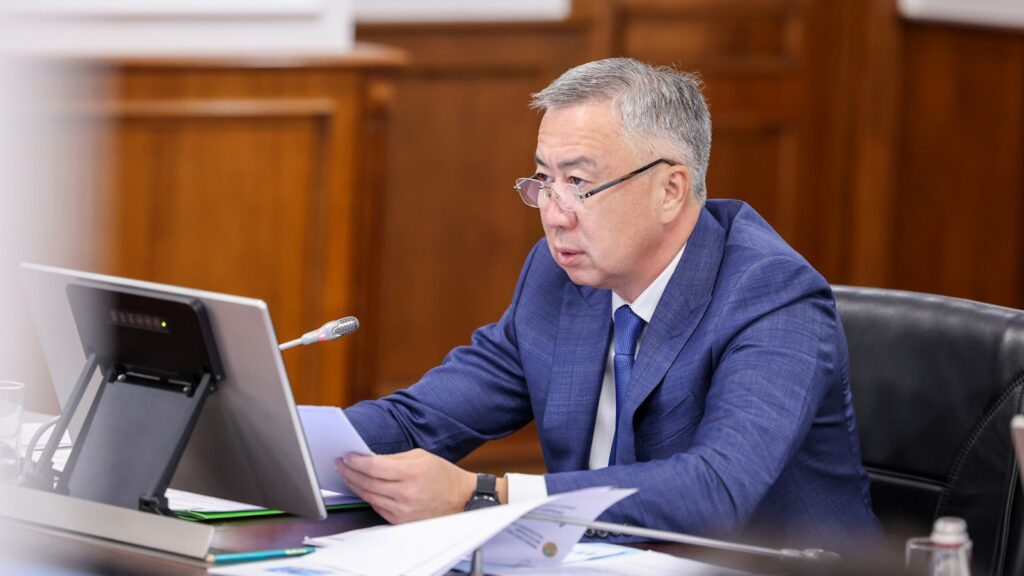
In an interview with Bloomberg, Kazakhstan’s Deputy Prime Minister and Minister of Trade and Integration, Serik Zhumangarin said the country does not intend to “blindly follow” Western sanctions against Russia if they harm Kazakhstan’s economy.

According to Zhumangarin, Kazakhstan will comply with the sanctions, but will also consider the impact on the domestic market and the country’s economic interests. The statement responded to the concerns of Kazakh entrepreneurs, who are already facing difficulties due to disruptions in trade chains and logistical problems caused by the sanctions.

The Deputy Prime Minister emphasized that Western sanctions against Russia have caused disproportionate damage to his country. According to the official, Kazakh producers are suffering huge losses, while their former Russian customers have reoriented themselves to suppliers inside Russia and “continue to prosper.” Without the restrictions, “profits would have stayed in Kazakhstan,” the Deputy Prime Minister said. Instead, he said, they are now “going to those against whom” the West has imposed sanctions.

The Kazakh Deputy Prime Minister noted that the sanctions imposed against Russia had already hurt Kazakhstan’s economy. In particular, in terms of the breakdown of logistics chains and decreased exports to Russia, one of Kazakhstan’s largest trading partners.

Zhumangarin stated that Astana will continue to adhere to Western restrictions, but stressed that in the context of global instability, Kazakhstan is seeking to pursue a balanced policy to minimize the impact of sanctions at home and maintain stability in the domestic market. Kazakhstan adheres to an independent policy and continues to develop trade relations with other countries, such as Iran and China, Zhumangarin noted. In particular, Kazakhstan is studying the possibility of using routes across the Caspian Sea to expand trade to the south. Kazakhstan is also negotiating with Western countries to allow the sale of Kazakhstani goods to Iran, or to use the country for transit.

Kazakhstan’s position reflects its desire to maintain economic independence and minimize the risks associated with external sanctions. At the same time, Kazakhstan is currently complying with international rules and is in dialog with Western countries to find compromise solutions that will avoid further pressure on the economy.

Thus, remaining faithful to its international obligations, Kazakhstan seeks to protect its national interests, maintain stability, and develop its economy in a difficult foreign policy environment.

Central Asians Beaten and Deported from Russia

The punishment for many Central Asians in Russia whose work or residency documents are not in order is pain and humiliation, and then possibly deportation. Xenophobia targeting Central Asians in Russia has been on the rise since the March 22 terrorist attack on Moscow’s Crocus City Hall that left more than 140 people dead. Russian authorities apprehended a group of ethnic Tajiks who allegedly carried out the attack and after that the level of prejudice against Central Asians in Russia, which has always existed, dramatically worsened.

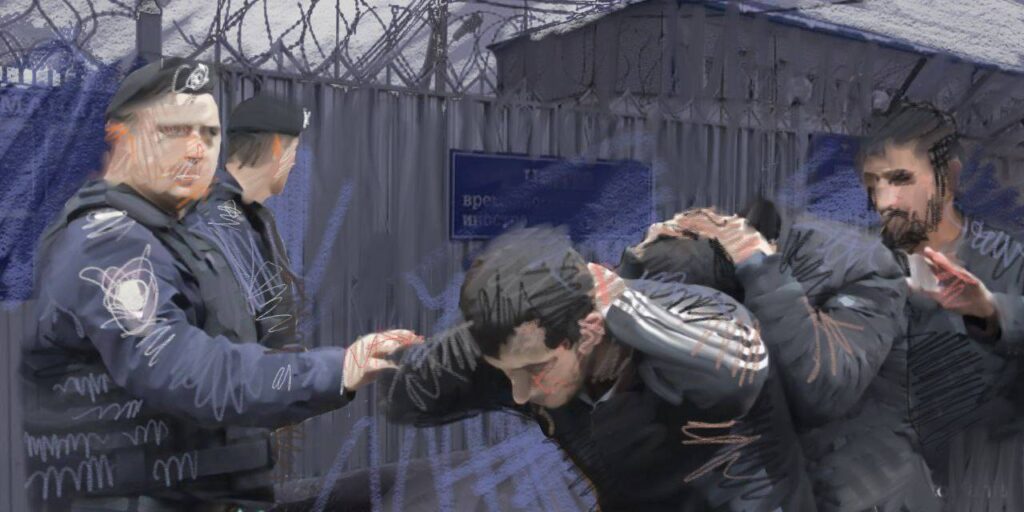
The treatment of Central Asians at the Sakharovo migration center on the outskirts of Moscow is an example. Moscow courts are likely to send Central Asians caught with document problems to the Sakharovo center.

Radio Free Europe’s Kyrgyz Service interviewed several people who passed through the Sakharovo center. Their descriptions shed light on the conditions inside.

One man who spent 18 days in the center said, “The day we entered there, they intimidated us, forced us to walk in single file, run fast… then they examined us and beat us with a stun gun.”

That jibes with another man’s description. “They call your last name, then you go out into the corridor and run. There they hit you on the back of the head and tell you to ‘run.’” Then, the man continued, “They made me face the wall, forced me to raise my arms up, spread my legs, and started hitting me with a stun gun.”

There is an anti-Islamic element to the treatment of detainees at Sakharovo.

A different person remembered this about his detention. “They fed us food with pork. Since we were hungry, we removed the meat and ate what was left.” He said there were some people who recited their daily prayers in their rooms. “When one guy was saying namaz, the guards entered. Then one of them (the guards) hit him in the face twice.” When the person continued saying his prayers, the guards said, “Let him go to Kyrgyzstan, Tajikistan, Uzbekistan, and read his prayer there.”

Some of the detainees with beards were forcibly shaved.

Batygul Moldobayeva is from Kyrgyzstan. She was detained in Moscow this summer with an expired work permit and sent to Sakharovo. Moldobayeva said the guards yelled at women detainees and were rude to them. She added that sometimes the guards “asked them to be their ‘temporary wives.’” Moldobayeva said there were pregnant women in the center, some as far along as six months, and the guards did not pay any attention to their condition. According to Moldobayeva, there were some Kyrgyz citizens at Sakharovo who had been there for three or four months.

Askar Uskenbayev is another Kyrgyz citizen who was detained in Moscow in mid-June and sent to Sakharovo. He said he met fellow Kyrgyz citizens who had been there six months.

After being deported back to Kyrgyzstan, Moldobayeva posted about her experience on social media and warned Kyrgyz citizens to be sure all their documents were in order if they planned on traveling to and staying in Russia. She also confirmed in her posts that guards at the center beat some of the male detainees.

Another common complaint from detainees was that the air-conditioners at the center made it uncomfortably cold. Those detained at Sakharovo were let out into a courtyard once a day and some recalled there were bars all around the yard and even overhead, the sort of cage one would expect in a prison.

A big problem was that all the detainees’ phones were confiscated when they entered Sakharovo. They were allowed to use the center’s push-button telephones once every four days, but this was problematic as many people did not know from memory the phone numbers of the people they wanted to call. Uskenbayev said it was possible “to buy” your mobile phone back from the guards for 15,000 rubles.

Center officials also try to recruit young men detained at Sakharovo to join the Russian army and fight in Ukraine.

Kyrgyzstan’s Labor Ministry says it regularly sends representatives to Sakharovo to check on Kyrgyz nationals held there. Some of the former Sakharovo detainees said they complained to the Kyrgyz Embassy about torture at the center. However, Russian authorities deny the allegations, so there is not much the Kyrgyz government can do to help citizens detained at the center.

Zhandarbek Aitnazaov of Kyrgyzstan’s Ministry of Labor, Social Security and Labor Migration said in an interview at the end of July that “in September a raid called ‘Illegal’ will be conducted in Russia against foreign citizens,” and warned Kyrgyz not to travel to Russia until the situation stabilizes.

As of mid- July, there were 136 Tajik citizens being held at Sakharovo, and 173 Kyrgyz citizens. None of the people at Sakharovo are dangerous criminals, yet some seem to be treated as if they had been sent to the gulag.

The accounts given here are from Kyrgyz citizens, and Kyrgyzstan is a member of the Russian-led Eurasian Economic Union (EEU).

Under EEU agreements, Kyrgyz citizens in Russia should enjoy greater labor rights than Tajiks or Uzbeks, whose countries are not in the EEU, which raises the question that if Kyrgyz are being treated this way at Sakharovo, how are Tajiks, Uzbeks, and others from non-EEU countries being treated?