• KGS/USD = 0.01144 0%
  • KZT/USD = 0.00196 -0%
  • TJS/USD = 0.10899 0%
  • UZS/USD = 0.00008 0%
  • TMT/USD = 0.28571 0.28%
  • KGS/USD = 0.01144 0%
  • KZT/USD = 0.00196 -0%
  • TJS/USD = 0.10899 0%
  • UZS/USD = 0.00008 0%
  • TMT/USD = 0.28571 0.28%
  • KGS/USD = 0.01144 0%
  • KZT/USD = 0.00196 -0%
  • TJS/USD = 0.10899 0%
  • UZS/USD = 0.00008 0%
  • TMT/USD = 0.28571 0.28%
  • KGS/USD = 0.01144 0%
  • KZT/USD = 0.00196 -0%
  • TJS/USD = 0.10899 0%
  • UZS/USD = 0.00008 0%
  • TMT/USD = 0.28571 0.28%
  • KGS/USD = 0.01144 0%
  • KZT/USD = 0.00196 -0%
  • TJS/USD = 0.10899 0%
  • UZS/USD = 0.00008 0%
  • TMT/USD = 0.28571 0.28%
  • KGS/USD = 0.01144 0%
  • KZT/USD = 0.00196 -0%
  • TJS/USD = 0.10899 0%
  • UZS/USD = 0.00008 0%
  • TMT/USD = 0.28571 0.28%
  • KGS/USD = 0.01144 0%
  • KZT/USD = 0.00196 -0%
  • TJS/USD = 0.10899 0%
  • UZS/USD = 0.00008 0%
  • TMT/USD = 0.28571 0.28%
  • KGS/USD = 0.01144 0%
  • KZT/USD = 0.00196 -0%
  • TJS/USD = 0.10899 0%
  • UZS/USD = 0.00008 0%
  • TMT/USD = 0.28571 0.28%
09 December 2025

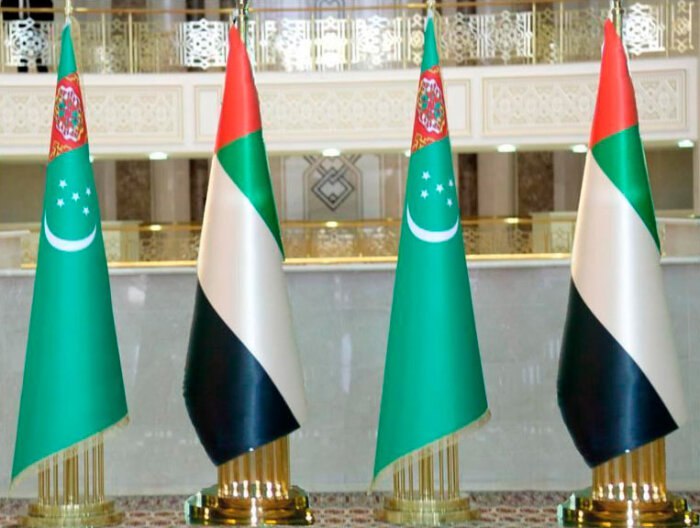
Turkmenistan and UAE Expand Cooperation in Oil and Gas

Turkmenportal reports that prospects for further cooperation in the fuel and energy sector were the focus of recent discussions between Chairman of the Halk Maslahaty of Turkmenistan, Gurbanguly Berdimuhamedov, and the Executive Director of Dragon Oil Company, Ali Rashid Al-Jarwan.

According to the publication, Turkmenistan and the UAE are among the richest countries in the world in terms of natural gas and oil reserves and both have extensive experience in developing the oil and gas industry.

Dragon Oil has now been  operating in Turkmenistan for a number of years.

Commenting on the UAE’s positive relationship with the country Al-Jarwan  expressed gratitude for the opportunity to work in Turkmenistan.

Berdimuhamedov in turn, emphasized that the  active bilateral interaction enjoyed by the parties was due to the joint efforts of the countries’ leaders and expressed Uzbekistan’s readiness to further expand productive cooperation with Dragon Oil .

Both sides expressed confidence that their existing mutual interests would provide a strong basis for more fruitful cooperation in the oil and gas sector.

U.S. Trade Representative Katherine Tay Visits Uzbekistan

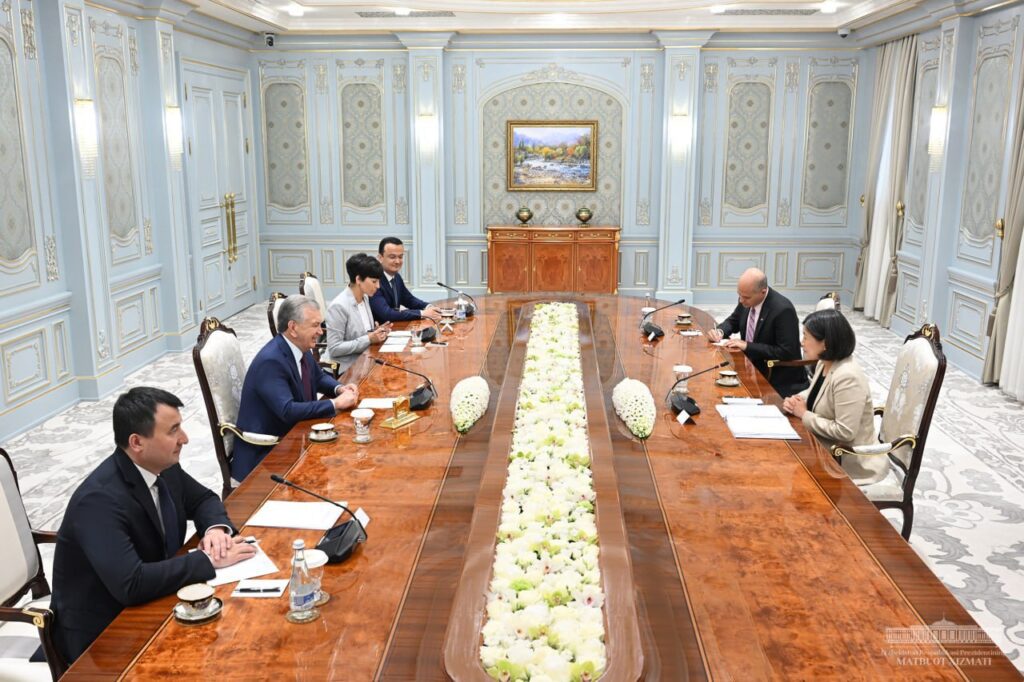
On June 11, President of Uzbekistan, Shavkat Mirziyoyev received U.S. Trade Representative Katherine Tay.

According to the  president’s press service,  discussions focused on strengthening bilateral trade cooperation, during which it was noted that business relations have become more active alongside a steady growth in mutual trade and investment.

Cooperation with Air Products, Coca-Cola, Citibank, Visa, and many other leading companies and banks in the USA is currently under development.

The agenda addressed issues related to Uzbekistan’s membership in the World Trade Organization, the restoration of the GSP system, the “C5+1” format, and  deepening practical cooperation within the Agreement on Trade and Investments framework, and the importance of a joint platform for identifying new areas for industrial cooperation and promoting relevant projects was noted.

During her visit, Katherine Tay also met Uzbekistan’s Presidential Assistant, Saida Mirziyoyeva. Reporting on their dialogue, the Telegram channel wrote that the purpose  of Uzbekistan’s economic reforms was outlined, with particular emphasis on benefits afforded to the well-being of its people.

Welcoming the dialogue, Mirziyoyeva said, “We intend to become a full-fledged participant of the international trade system, and rely on the support of the United States to accelerate the process of Uzbekistan becoming a member of the WTO.”

Decolonial Futurism: A Focus on Kazakhstan’s Pavilion at the 60th Venice Biennale

Kazakh artists have traditionally been marginalized in the global art scene due to political intricacies and a complex cultural identity. With historical influences and colonization by both Russia and China, Kazakh artists are now carving out a unique artistic identity and sharing it with international audiences.

The Kazakh pavilion “Jerūiyq: Journey Beyond the Horizon” at the 60th International Art Exhibition of the Venice Biennale, from April 20 to November 24, represents a major milestone in changing perceptions of Kazakh art.

Staged in the Naval Historical Museum, the exhibition reinterprets the ancient legend of Jerūiyq, drawing inspiration from Kazakh myths and the visionary journey of the 15th-century philosopher Asan Kaigy.

The word “kaigy” means “pain” in Kazakh, symbolizing the nation’s traumatic encounters with modernity’s darker aspects: the devastating famine of the 1930s, the craters left by nuclear tests in Semey, the shrinking of the Aral Sea, and the wounds inflicted on the Kazakh landscape.

The exhibition traces the evolution of Kazakh utopian imagination from the 1970s to today through artists’ visions of ideal worlds, where their utopian imagination merges with the artistic movement of “decolonial futurism.”

On behalf of TCA, Naima Morelli interviewed curator Anvar Musrepov on the concept and significance of Kazakhstan’s participation in the Venice Biennale.

TCA: How did the idea for the Kazak pavilion “Jerūiyq: Journey Beyond the Horizon” evolve?

A.M: In our curatorial research, we found that the theme of utopia and futuristic imagination has concerned several generations of Kazakhstan’s artists since the 1970s. Using this as a starting point, we decided to establish, in chronological order, a collection of works by multiple generations of artists. Divided by decades, the collection manifested a wave of Kazakh futurism, including themes of spirituality, cosmism, nomadism, and utopian ideas. This in turn, will help formulate a term to comprehensively describe and unite all these intuitions that have concerned Kazakh artists in different historical periods.
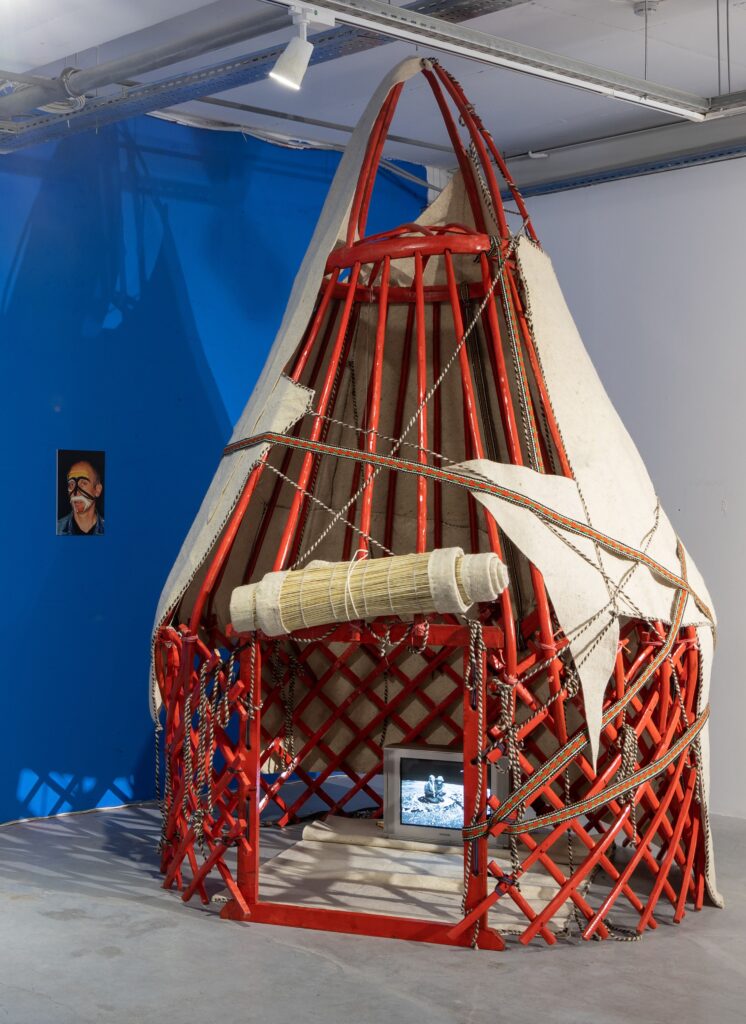
Sergey Maslov, “Baikonur” at the Venice Biennale


TCA: The exhibition’s title alludes to the ancient legend of Jerūiyq. What is it about and  how have you interpreted it?

A.M: Jeruiq is an ancient legend about a utopian land that according to many myths, was sought by Asan Kaigy, advisor to the first Kazakh khans Zhanibek and Kerey. Legend describes it as a land that has fermented, a place where time has stopped, a land full of vividness, devoid of disease or longing. We found in this ancient Kazakh legend, an ideal metaphor to unite all the intuitions presented in the exhibition and manifest the chronology of post-nomadic futuristic imagination. If established, the definition of this unique phenomenon, could become a movement in Kazakh art.

TCA: What can you tell us about the philosopher Asan Kaigy?

A.M: Asan Kaigy is a quasi-historical character who features in Kazakhstan’s rich oral tradition where history and memory are passed down from mouth to mouth. Every region of Kazakhstan has local legends about miracles performed by Asan Kaigy. One such legend says that he found Zheruyik when he and his people passed through a rock and entered another, metaphysical dimension.

TCA: How did you select the participating artists?

A.M: We identified key works from each decade from the 1970s to the present day. Unfortunately, many works worthy of inclusion were omitted for various reasons, including managerial and administrative issues such as logistics, insurance, and the scale of our pavilion. However, as a continuation of this theme, we are planning an exhibition in Kazakhstan that will serve as an anthology of works within the concept of the pavilion.

TCA: How was the exhibition curated to allow interaction between artworks spread across different rooms?

A.M: We began with the nomadic perception of time, which differs from the Eurocentric linear perception of a narrative with a beginning and an end, forming instead, a cycle of rebirth; a closed circle associated with the changing seasons, where winter represents death and spring, renewal. In our pavilion, the artworks and halls form a closed system that balances utopias and dystopias through the lens of Kazakh artists.

TCA: The pavilion reflects the dark side of modernity, referencing tragic events in the country’s recent history. Were artists directly inspired by such to create work for the exhibition?

A.M: Certainly, these themes are the leitmotif of many works of Kazakh art. For example, Yerbolt Tolepbay’s “The End of the World,” painted during the Cold War, reflects the anxiety of a period when people expected the world to end. During the famine in Kazakhstan, locals likewise, believed the end of the world was nigh. After the advent of Islam, apocalyptic narratives also became part of Kazakh mythology, merging with pagan culture. In the same hall, we find works by Lena Pozdnyakova and Eldar Tagi. The sound installation “Presence” includes traditional Kazakh mattresses depicting stages of the Aral Sea desiccation. The Semipalatinsk test site becomes the central image in Anvar Musrepov’s post-apocalyptic movie “Alastau,” filmed in the exclusion zone still affected by radiation.

TCA: The theme of “decolonial futurism” is currently predominant in the art world. What does the term mean to you, within the context of this show?

 A.M: In the early 2000s, the international art scene discovered a new phenomenon in Kazakh art. Artists of the time were searching for their identity and often exaggerated the image of steppe barbarians, portraying an image of self-exoticization to European audiences. Today, this perception has changed significantly. In modern Kazakhstan, we no longer feel like barbarians; we want to move beyond this stigmatization and conveying our current state, recreate an image drawn from our local perspective.

TCA: How important are events like the Venice Biennale for Kazakh artists to assert a distinct artistic identity?

A.M: During the years of independence, artists, researchers, and writers have worked extensively to make sense of the past; a history that was silenced during the Soviet period. Kazakhstan, like other countries under Soviet rule, was subjected to the future projections and utopias dictated by Moscow. Now, we have the opportunity to create our vision of the future without reference to the metropolis, aligning with other movements of decolonial futurism. This approach allows us to achieve a more complete and diverse picture of the future, overcoming the limits of Western futurism, and creating our unique image of the future.

TCA: This is the second time Kazakhstan has exhibited in its own pavilion at the Venice Biennale. Did you reference  themes of the first and add another layer, or instead, start afresh?

A.M: The theme of the first pavilion was somewhat different and focused on the artist Sergei Kalmykov. Certainly, given that we worked within the same cultural context, parallels can be drawn. This time however, we decided to approach the theme from the perspective of the chronology of utopian and futuristic imagination, tracing a line from the earliest related works to those of the present day.

TCA: Why do you think Kazakh artists have historically been underrepresented in the global art scene?

A.M: The fact that Kazakhstan is participating for only the second time in this prestigious event, reflects the status of contemporary art and its transformations and trends to date. During the Soviet period, Kazakhstan was a closed country, making it difficult for foreigners to obtain visas. The subsequent isolation from international competition has certainly left its mark, which continues to this day.

TCA: What is the public response to the Kazakh pavilion?

A.M: We have received a lot of positive feedback from colleagues around the world, in praise of our innovative approach, unexpected angle, and convincing research. It was important for us to showcase the intuitions that existed across different generations of Kazakh artists. We are not inventing Kazakh futurism; we are simply collecting works from various periods within a single framework to garner discussion on a possible movement in Kazakh art. This movement currently lacks a specific term and is still in the process of formation.


The project was made possible thanks to sponsors and especially, Halyk Charity.

Eight Men from Tajikistan, Suspected of Terror Links, Face Deportation from U.S.

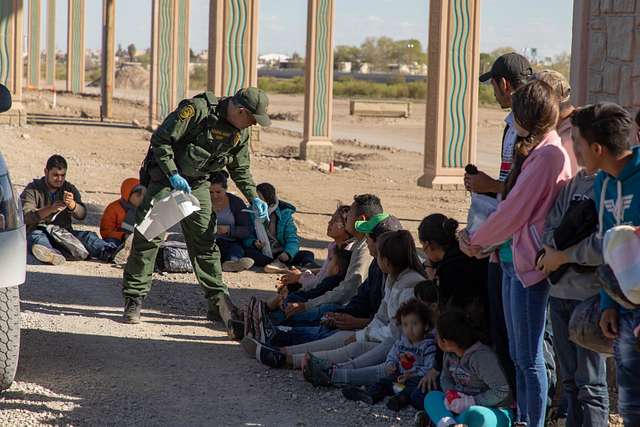
Authorities in the U.S. have arrested eight people from Tajikistan who have possible ties to the Islamic State group, according to U.S. media reports.

The men had entered the United States through the southern border with Mexico after background checks failed to turn up any security concerns and were detained this past weekend in New York, Philadelphia and Los Angeles, according to the reports on Tuesday. The reports cited officials who were familiar with the investigation and requested anonymity.

Agents from the U.S. Immigration and Customs Enforcement, or ICE, arrested the men on immigration charges after being alerted by the FBI’s Joint Terrorism Task Forces of their possible links to the terror group, according to the sources.

“At least two of the men crossed the border in the spring of 2023 and one of those men used the CBP One app, created by the Biden administration to allow migrants to book appointments to claim asylum, those officials say, NBC News reported. “The FBI’s Joint Terrorism Taskforce has been aware of a potential terror threat originating in Central Europe and began monitoring these men as part of that investigation, three sources say.”

ABC News carried a similar report, saying U.S. authorities had “uncovered derogatory information indicating ties or affiliation” with the Islamic State.

“Efforts are underway to deport the suspects as currently authorities have not developed enough evidence to bring any terrorism charges,” ABC said.

Several men from Tajikistan were among suspects arrested for the killing of more than 140 people in an attack on the Crocus City Hall, an entertainment venue, on the outskirts of Moscow on March 22. The Islamic State group, which has recruited some people from Central Asia, claimed responsibility. The extremist group has disseminated propaganda in languages including Tajik and Uzbek.

Earlier this year, ICE agents arrested an Uzbek man with alleged Islamic State ties after he had been living in the United States for over two years, U.S. officials said. The man, Jovokhir Attoev, was held after crossing the southern border in 2022, but later released. In May 2023, Uzbekistan put out a notice saying Attoev was wanted for his alleged links to the militant organization.

EU and Kazakhstan Launch Coordination Platform of Trans-Caspian Transport Corridor

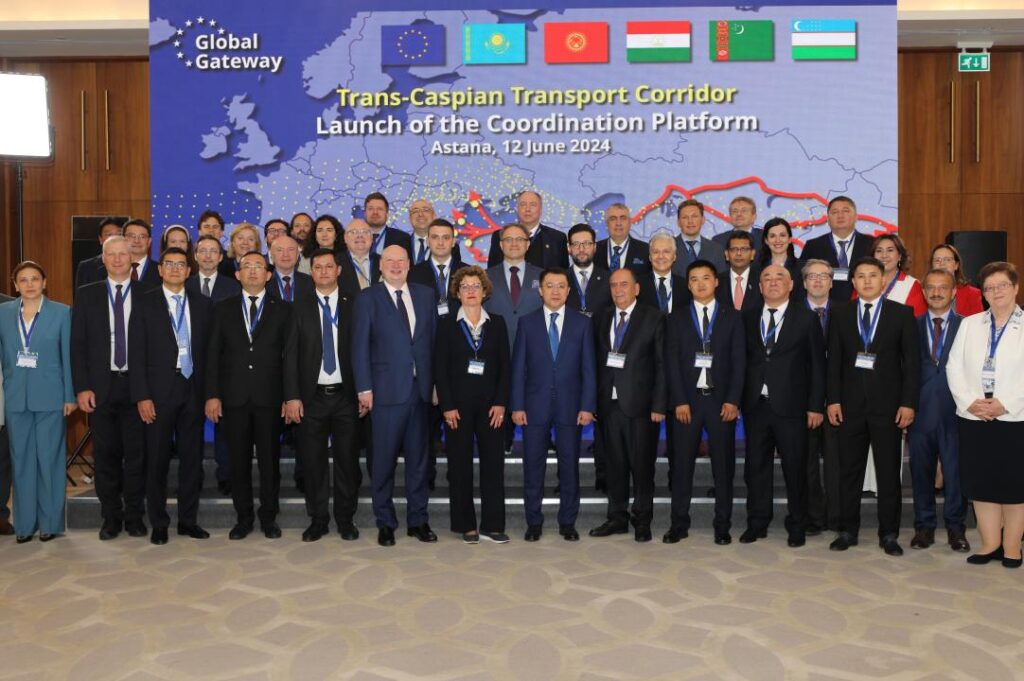
On 12 June, the European Commission and Kazakhstan launched the Coordination Platform for the Trans-Caspian Transport Corridor, also known as the Trans-Caspian International Transport Route (TITR) or the Middle Corridor, in Astana.

According to Kazakhstan’s Ministry of Transport, the newly established Coordination Platform will improve the safety and sustainability of the Trans-Caspian Transport Corridor and turn it into a multimodal and competitive route linking Europe and Asia in 15 days or less.

The event was attended by representatives of Central Asian countries and other states sited along the corridor, as well as international financial institutions and non-EU G7 countries.

Emphasizing the critical development of transport infrastructure and strengthening transport links for the regions’ economic growth and prosperity, Marat Karabayev, Minister of Transport of Kazakhstan, stated: “The establishment of the Coordination Platform provides us with a unique opportunity to join forces, exchange experience and perspectives to reach common goals. I would like to note that our partners from Armenia, Azerbaijan, Georgia, as well as Turkey have been invited to join this effort, which plays an important role in terms of achieving major and sustainable goals for the development of the Trans-Caspian International Transport Route.”

The Minister of Transport expressed gratitude to the European Union for its invaluable support and efforts towards the development of Central Asian countries.

Speaking at the event, Henrik Hololei, Hors-Classe Adviser at the Directorate-General for International Partnerships in the European Commission, stated: “The Coordination Platform created for the Trans-Caspian Transport Corridor marks a significant step forward in our cooperation to bring Central Asia and Europe closer together. Sustainable transport connections are crucial for consolidating the region’s economic growth and connectivity with Europe.”

Ms. Maja Bakran, Deputy Director General for Mobility and Transport at the European Commission, then added: “The Coordination Platform will be instrumental in making the Trans-Caspian Transport Corridor a multimodal, modern, competitive, sustainable, predictable, smart and fast route linking Europe, the Caucasus and Central Asia. The coordination efforts among the various stakeholders will drive forward deeper connections and contribute to sustainable economic development of the region.”

The Platform’s key objectives are to promote the corridor and coordinate efforts on the implementation of priority hard and soft infrastructure projects in Central Asia. It will also boost and coordinate investments in rail, road, and port infrastructure.


Kazakhstan and Congo Ready to Cooperate in Oil and Gas

On June 11, Chairman of the Board of Kazakhstan’s national oil and gas company KazMunayGas (KMG), Askhat Khasenov attended a meeting in Astana with Adviser to the President of the Republic of Congo for strategic issues and international negotiations, Francoise Joly, and General Director of Congo’s national petroleum company SNPC (Societe nationale des petroles du Congo), Maixent Raoul Ominga.

The Congolese officials opened discussions by stating that after Nigeria and Angola, their country is Africa’s third largest player in the oil and gas sector. It was stated that whilst SNPC actively cooperates with international companies (Total Energies, Chevron, Eni), the company seeks to attract new investments to maximize the potential of its energy projects.

The parties exchanged views on potential cooperation in the oil and gas sector, including trade in oil and petroleum products and human capital development, and agreed to work towards the signing of a cooperation agreement between KMG and SNPC.

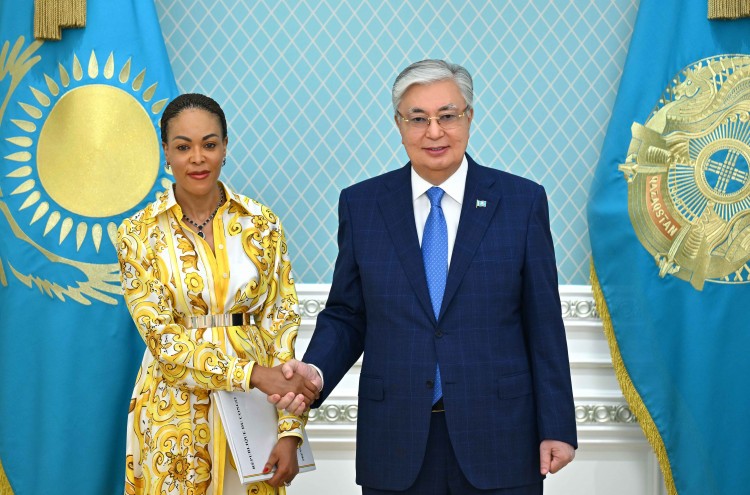
On 10 June, in preparation for the state visit of  the President of the Republic of Congo, Kazakhstan President Kassym-Jomart Tokayev received Ms. Joly.

In addition to identifying promising areas of bilateral cooperation, Tokayev expressed his readiness to strengthen contacts with the Republic of Congo.