• KGS/USD = 0.01144 0%
  • KZT/USD = 0.00194 -0%
  • TJS/USD = 0.10896 -0%
  • UZS/USD = 0.00008 0%
  • TMT/USD = 0.28571 0.28%
  • KGS/USD = 0.01144 0%
  • KZT/USD = 0.00194 -0%
  • TJS/USD = 0.10896 -0%
  • UZS/USD = 0.00008 0%
  • TMT/USD = 0.28571 0.28%
  • KGS/USD = 0.01144 0%
  • KZT/USD = 0.00194 -0%
  • TJS/USD = 0.10896 -0%
  • UZS/USD = 0.00008 0%
  • TMT/USD = 0.28571 0.28%
  • KGS/USD = 0.01144 0%
  • KZT/USD = 0.00194 -0%
  • TJS/USD = 0.10896 -0%
  • UZS/USD = 0.00008 0%
  • TMT/USD = 0.28571 0.28%
  • KGS/USD = 0.01144 0%
  • KZT/USD = 0.00194 -0%
  • TJS/USD = 0.10896 -0%
  • UZS/USD = 0.00008 0%
  • TMT/USD = 0.28571 0.28%
  • KGS/USD = 0.01144 0%
  • KZT/USD = 0.00194 -0%
  • TJS/USD = 0.10896 -0%
  • UZS/USD = 0.00008 0%
  • TMT/USD = 0.28571 0.28%
  • KGS/USD = 0.01144 0%
  • KZT/USD = 0.00194 -0%
  • TJS/USD = 0.10896 -0%
  • UZS/USD = 0.00008 0%
  • TMT/USD = 0.28571 0.28%
  • KGS/USD = 0.01144 0%
  • KZT/USD = 0.00194 -0%
  • TJS/USD = 0.10896 -0%
  • UZS/USD = 0.00008 0%
  • TMT/USD = 0.28571 0.28%
09 December 2025

Despite Negative Outlook, Moody’s Upgrades Kyrgyzstan’s Credit Rating

The international rating agency Moody’s has raised Kyrgyzstan’s credit rating from negative to stable.

Contrary to Moody’s forecasts, the country’s economy and budget indicators have been almost unaffected by western sanctions against Russia, Kyrgyzstan’s largest trading partner. The agency had previously speculated that foreign investment in the mining sector could decline significantly after the nationalization of the Kumtor gold mine in 2022; however, this did not happen.

Nevertheless, Moody’s analysts noted Kyrgyzstan’s large public debt ($6.2 billion), and its vulnerability to depreciation of the national currency. “Financing from development partners, which reduces debt service costs, is a key factor supporting the rating. Political risks and external vulnerability risk continue to drive event risks,” Moody’s said.

The ratings agency believes that the Kyrgyz government strongly influences the nation’s economy. The unpredictability of some government decisions and the unstable domestic political situation may hinder long-term development. Analysts predicted Kyrgyzstan’s economy to grow by 4% this year.

Economist Nurgul Akimova explained to The Times of Central Asia that the country’s macroeconomic indicators have contributed to the change in Moody’s rating. According to Akimova, Kyrgyzstan’s economic fundamentals remain unchanged. Despite the low level of income and dependence on remittances from Russia, there is some sustainability — GDP indicators are growing.

“Let’s highlight three important points. The first is the lesser impact of geopolitical factors than the agency’s analysts expected. Kyrgyzstan’s economy has suffered to a lesser extent because of ties with Russia. This is due to the diversification of economic ties and the stability of key sectors of the economy.  The second is the sustainability of the mining sector. You know that after the nationalization of the Kumtor mine, activity and investment in the mining sector remained stable, which also positively impacted the economy. The third is the support from international partners. We continue to work with development partners. You know that we take grants and loans from international organizations. These loans come at low rates, with low debt service costs, which has also played a role in maintaining the economic system,” Akimova said.

Kyrgyzstan avoids negative outlooks by trying to diversify its cooperation with different countries. For example, Kyrgyz labor migrants work in Russia, South Korea, the United States, and the EU.

“The very fact of multidirectional labor migration also affects the stable and sustainable development of the economy. Kyrgyz abroad have close ties with their homeland,” Akimova said.

The Kyrgyz Ministry of Economy and Commerce noted that the change in Moody’s forecast indicates the balance of risks in the country. Speaking at a press conference in Bishkek, economy minister Dastan Amangeldiev noted positive economic dynamics.

“Structural adaptation to the changed external conditions, the recovery of domestic demand and investment activity contributes to an upturn in economic activity and economic growth,” Amangeldiyev said.

According to the National Statistics Committee, in January-March 2024, the GDP volume was valued at 248.8 billion soms (around $2.8 billion), showing a real growth rate of 8.8%. The key growth drivers in the first quarter of this year were the service sector and construction.

Focus on Ethnic Germans in Kazakhstan

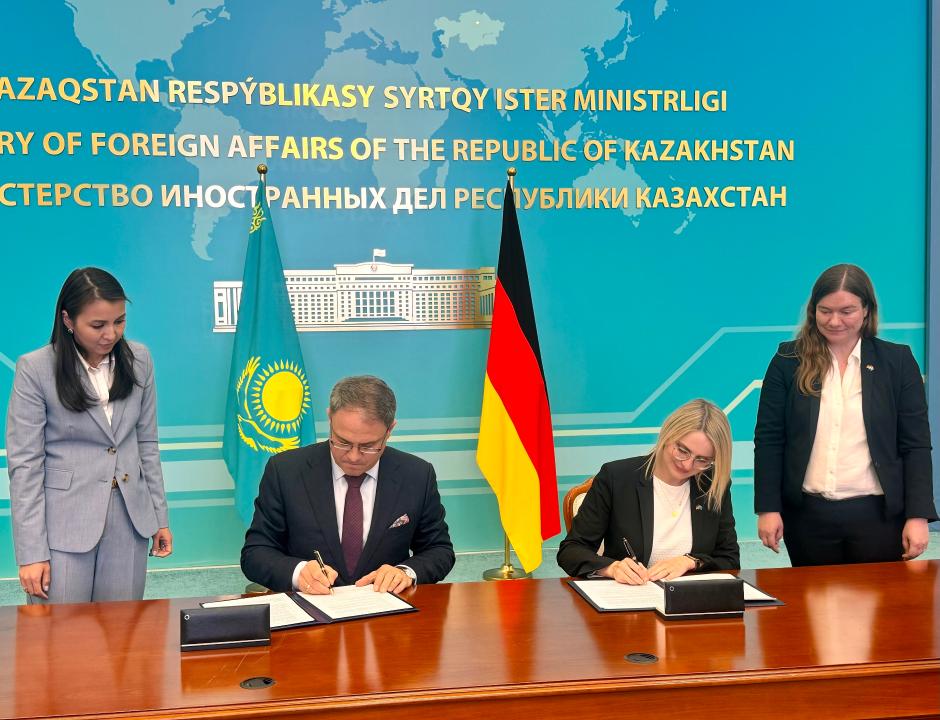
On 21 May, Astana hosted the 20th meeting of the Kazakh-German Intergovernmental Commission for the Affairs of Ethnic Germans in Kazakhstan, co-chaired by Deputy Minister of Foreign Affairs of Kazakhstan Roman Vassilenko and Germany’s Federal Government Commissioner for Matters Related to Ethnic German Resettlers and National Minorities, Member of the Bundestag, Natalie Pawlik.

Representatives of the two countries’ ministries and organizations, including the Wiedergeburt (Rebirth) foundation also participated.

The agenda focused on cooperation between Kazakhstan and Germany to support the cultural, linguistic, and national identity of Kazakh Germans, as well as the implementation of joint projects in science, education, and culture.

The parties reiterated their mutual interest in expanding partnerships within the framework of the Intergovernmental Commission and strengthening the “living bridge” connecting Kazakhstan and Germany.

During World War II, Stalin’s henchman, Lavrentiy Beria supervized the mass deportation of the Volga Germans, Chechens, Ingush, Pontic Greeks, Crimean Tatars, Balkars and the Karachays, largely to Central Asia. With the crowded wagons stopping only to bury the dead in the snow, approximately 30% perished. According to statistics, 226,000 ethnic Germans reside in Kazakhstan, today, whilst some one million Germans have moved from Kazakhstan to their ancestral homeland.

Emphasizing the importance of Kazakhstan’s multi-ethnic population in the successful development of the country, Vassilenko stated that: “Thousands of kilometers separating our countries do not hinder the development and deepening of Kazakh-German relations, as well as the promotion of rapprochement of our peoples. By virtue of history, Kazakhstan has a large German diaspora, while many former citizens of Kazakhstan have resettled in Germany.”

Ethnic Germans are represented in all spheres of life in Kazakhstan. The Kazakh-German Center in Astana, the Kazakh-German University in Almaty, the Kazakh-German Institute of Sustainable Engineering in Aktau, the German Drama Theatre, as well as the Deutsche Allgemeine Zeitung newspaper play significant roles in strengthening cultural and humanitarian interaction between Kazakhstan and Germany.

Natalie Pawlik welcomed the dynamically developing bilateral cooperation and emphasized that Germany regards Kazakhstan as a key partner in its relations with Central Asia.

In her commendation of assistance provided by the German Federal Government to the Germans of Kazakhstan, she mentioned that the study of the German language in Kazakhstan can not only contribute to the preservation of the ethnic Germans’ national identity but prove beneficial to professionals engaging in joint investment projects.


Alatau IT Hub Opens in Kazakhstan’s Almaty Region

The Alatau Hub, Kazakhstan’s most recent regional  IT hub has now opened in Konaev in the Almaty region.

Supported by the Ministry of Digital Development, Innovation and Aerospace Industry of Kazakhstan, the Alatau Hub is the 14th regional IT hub launched under the management of Astana Hub.

Kazakhstan is now on course to establish similar hubs in all of its regions by the end of this year.

During the launch, Ersultan Ermanov, director of the Information Technology Development Department at the Ministry of Digital Development, commented: “The opening of a hub in the Almaty region is a very significant event for IT specialists in the region. Our regional hubs play a key role in creating and developing an ecosystem that stimulates the emergence of new innovative projects, expansion of business activity and technological progress. In the future, Alatau Hub will become a center of attraction for young ambitious talents. It will also contribute to the emergence of new jobs, economic growth, and increased competitiveness of the country in the international arena.”

The IT hubs currently in operation across 14 of Kazakstan’s regions include: Abai IT Valley, Kyzylorda Hub, Digital Jetisu, Zhambyl Hub, Oskemen IT Hub, Jaiq Hub, Turkistan IT Hub, Qostanai IT Hub, Aqtobe IT Hub, Aqmola IT Hub, Pavlodar IT Hub, Terrikon Valley, Mangystau Hub, and Alatau Hub.

By the end of 2024, further hubs will open in the cities of Atyrau, Shymkent, Zhezkazgan, Petropavlovsk, and Zhanaozen.


Amid Russian Sanctions, Kazakhstan Can Benefit From Shanghai Cooperation Organisation

After Astana hosted the latest meeting of the Council of Foreign Ministers of the Shanghai Cooperation Organisation (SCO) member states, Almaty-based financial analyst and expert in cross border business and asset value recovery, Rassul Rysmambetov believes that Kazakhstan still has huge potential in the organization that is yet to be utilized.

The SCO was founded in 2001 by the leaders of China, Russia, Kazakhstan, Tajikistan, Kyrgyzstan and Uzbekistan. In 2017 India and Pakistan joined, followed by Iran in 2022. Belarus is expected to join the SCO this summer. The association’s main objectives are to strengthen stability in the region, fight terrorism and drug trafficking, as well as develop economic cooperation, energy, scientific, and cultural partnerships.

At the Astana meeting 22 decisions were adopted. The SCO’s secretary general Zhang Ming praised Kazakhstan’s work as the organization’s chair, saying: “Since July 2023, within the framework of Kazakhstan’s chairmanship in the SCO, the Kazakh side has organized more than 180 events in various fields. Kazakh partners have put a special emphasis on economic, investment, transportation, cultural and humanitarian issues.”

Sources report that Kazakh president Kassym-Jomart Tokayev met with the foreign ministers of the other SCO member states. He mentioned that more than 100 large-scale events have been held recently, including the SCO digital, tourism, and energy forums. “Work on the SCO project ‘Spiritual Sanctuaries’ is being completed. On our initiative, 2024 has been declared the SCO Year of Ecology. The government of Kazakhstan continues to prepare for several additional significant events in the spheres of energy, transportation, and culture. Of course, we pay great attention to the upcoming Astana SCO summit,” Tokayev said.

Financial analyst Rasul Rysmambetov, in a conversation with The Times of Central Asia, spoke about the SCO’s significance on a global scale. “Its member states have a combined population of over three billion people,” he said. “The SCO has not undergone any serious changes in its 22-year existence. Of course some countries try to promote a political agenda, but the organization is focused on economic and security interests.”

“Of course, the SCO benefits Kazakhstan in the context of western sanctions against Russia, because we have China, Pakistan, and Russia, all of which are large countries that are markets for our goods. Of course, we must open markets for them, but we are open to the goods of many countries within the WTO. Concerning Kazakhstan, sanctions are not an obstacle to the work of the SCO. We do not trade in weapons, so there are no problems. Members of the organization see sanctions restrictions in terms of re-exports, and everything works fine in terms of ordinary, non-sanctioned goods,” Rysmambetov added.

Regarding Belarus’s imminent accession to the SCO, he said: “It’s beneficial for us. We can’t produce and sell much yet, but at least we’ll earn on transit. This is an opportunity to develop our logistics, improving our export prospects when more production facilities are launched in Kazakhstan.”

Only Turkmen Graduates Allowed to Participate in “Last Call”

In Balkan velayat (administrative district) this year, only graduates of Turkmen nationality will be able to participate in the “last call” –  the secondary-school graduation ceremony held throughout the CIS, which is held annually in front of the Central Library of Balkanabad. This decision by the local authorities caused bewilderment among the residents of the velayat, where representatives of many nationalities live.

This is the second known case in the last four months when the authorities of the western velayat have infringed on the rights of ethnic minorities. In early February, it was reported that in Balkanabad and Turkmenbashi, only Turkmen music was allowed at weddings, whilst songs in the languages of other ethnicities were prohibited.

Violations of the rights of ethnic minorities, limiting their opportunities for education in their native language, and observance of cultural traditions is a long-standing problem. Turkmenistan says it “condemns racial discrimination and constantly pursues a policy of mutual understanding between peoples.” However, members of minorities complain of systematic restrictions of their rights on ethnic grounds.

Green Light for Uzgen Bypass, South Kyrgyzstan

The Eurasian Development Bank (EDB) and a consortium comprising Tez Zhol, Zhagalmai, and DemirBank, have signed agreements to build and maintain a bypass road around the historic town of Uzgen in the Osh region of south Kyrgyzstan.

According to EDB’s press office, the project which includes new information technologies for toll road management, aims to improve connectivity in the Osh region, enhance road safety and improve Uzgen’s environment.

The Bishkek–Osh highway, one of the country’s main transport arteries and used by approximately 23,000 vehicles per day, causes serious issues for the densely populated town of Uzgen.

The route through its center impacts the town’s socioeconomic situation by increasing levels of noise and pollution whilst congestion poses risks for pedestrians, exacerbating safety concerns.

The projected timeline for such a large-scale project is 49 years, from 2024 to 2073, and comprising 14.1-km of new roads, three bridges and a toll management system, the estimated cost of its construction is US $29.9 million.

Commenting on the initiative, Nikolai Podguzov, Chairman of the EDB Management Board, stated:  “The Uzgen Bypass is the first toll road initiative in the Kyrgyz Republic. This project will increase the daily capacity of the Bishkek–Osh road from 8,000 to 12,000 vehicles, create approximately 300 jobs and boost demand for local industrial enterprises such as reinforced concrete and concrete plants. Additionally, it will improve the environmental situation and reduce the load on Uzgen’s roads by diverting traffic to bypass the residential sector.”