
• KGS/USD = 0.01143 -0%
  • KZT/USD = 0.00198 -0%
  • TJS/USD = 0.10899 0.93%
  • UZS/USD = 0.00008 0%
  • TMT/USD = 0.28490 -0.28%
  • KGS/USD = 0.01143 -0%
  • KZT/USD = 0.00198 -0%
  • TJS/USD = 0.10899 0.93%
  • UZS/USD = 0.00008 0%
  • TMT/USD = 0.28490 -0.28%
  • KGS/USD = 0.01143 -0%
  • KZT/USD = 0.00198 -0%
  • TJS/USD = 0.10899 0.93%
  • UZS/USD = 0.00008 0%
  • TMT/USD = 0.28490 -0.28%
  • KGS/USD = 0.01143 -0%
  • KZT/USD = 0.00198 -0%
  • TJS/USD = 0.10899 0.93%
  • UZS/USD = 0.00008 0%
  • TMT/USD = 0.28490 -0.28%
  • KGS/USD = 0.01143 -0%
  • KZT/USD = 0.00198 -0%
  • TJS/USD = 0.10899 0.93%
  • UZS/USD = 0.00008 0%
  • TMT/USD = 0.28490 -0.28%
  • KGS/USD = 0.01143 -0%
  • KZT/USD = 0.00198 -0%
  • TJS/USD = 0.10899 0.93%
  • UZS/USD = 0.00008 0%
  • TMT/USD = 0.28490 -0.28%
  • KGS/USD = 0.01143 -0%
  • KZT/USD = 0.00198 -0%
  • TJS/USD = 0.10899 0.93%
  • UZS/USD = 0.00008 0%
  • TMT/USD = 0.28490 -0.28%
  • KGS/USD = 0.01143 -0%
  • KZT/USD = 0.00198 -0%
  • TJS/USD = 0.10899 0.93%
  • UZS/USD = 0.00008 0%
  • TMT/USD = 0.28490 -0.28%
07 December 2025

Viewing results 1 - 6 of 79

Kinship Clans in Modern Kazakhstan: Historical Continuity and New Realities

Ancestral ties are seemingly embedded in the DNA of every Kazakh. This tradition, rooted in antiquity, reflects the clan structure that historically shaped Kazakh society. The notions of zhuz (a set of clans) and ru (clan) largely determined the social organization of the nomadic lifestyle. Kazakh society traditionally consisted of three zhuzes, the Older, Middle, and Younger which in turn united many clans. The zhuzes were large tribal unions, a kind of higher-level “horde” that included dozens or even hundreds of distinct clan groups (ru), while ru referred specifically to a group of close blood relatives. Such clan structures formed the basis of traditional society. Historical Roots: The System of Zhuzes and Shezhire The origin of the three Kazakh zhuzes remains a subject of historical debate. In early written sources from the 17th century, the names of the zhuzes had not yet been formalized. Chronicles described only a geographic custom: those living in the upper reaches of a river were called the “Big zhuz,” those in the middle the “Middle zhuz,” and those in the lower reaches the “Younger zhuz.” The 16th-century work Majmu al-Garaib mentions Kazakhs but notes that the terms Uly zhuz, Orta zhuz, and Kishi zhuz were not yet in use. The classical three-zhuz system only fully formed by the late 17th to early 18th century, during the reign of Tauke Khan (1680-1715), when the Kazakhs united under a single Kazakh Khanate. According to a legend recorded by traveler G. N. Potanin, one ruler gathered 300 warriors and divided them into three groups: the first hundred, Uly zhuz, were settled upstream along the Syr Darya; the second hundred, Orta zhuz, in the middle; and the last hundred, led by the chief Alshin, downstream as Kishi zhuz. These legends provide a cultural explanation for the emergence of the zhuzes, though historians stress there is no single agreed version. Hypotheses range from military-administrative divisions into “wings” to the influence of geography and climate across Semirechye, Saryarka, and Western Kazakhstan. Alongside the zhuz system, clan identity was reinforced through genealogical chronicles, shezhire, in which Kazakhs recorded their ancestors’ names and clan history. Knowledge of seven generations (jeti ata) was obligatory for every Kazakh and was absorbed “with mother’s milk”. These genealogies had practical implications: knowing one’s lineage helped determine kinship laws, including prohibitions on marrying within the same clan. The clan was not just a social structure, but a fundamental part of identity. As publicist Khakim Omar wrote: “The main idea of the shezhire is revealed in the close connection of ancestors’ and descendants’ names, in the continuity of generations,” allowing a person, through genealogy, “to define their place in the world”. Transformation of Tradition in the Soviet Era Under Soviet rule, internationalism and a break from “tribalism” were officially promoted. Yet in practice, the clan system continued to operate informally as a mechanism of social mobility and legitimacy. While divisions into zhuzes and clans were no longer legally recognized, they endured as a way of thinking, a cultural filter...

Marking 34 Years of Independence: Uzbekistan’s Past, Present, and Future

Uzbekistan declared its independence from the Soviet Union on August 31, 1991, during the final, turbulent months of the USSR's collapse. On that day, an extraordinary session of the Uzbek SSR Supreme Council in Tashkent adopted a Declaration of Independence and passed the law “On the Foundations of State Independence.” The same session resolved that September 1 would henceforth be celebrated annually as Independence Day. The move came just days after the failed Moscow coup attempt (GKChP) against Soviet leader Mikhail Gorbachev, and in the wake of Ukraine and Belarus declaring their own independence. Uzbekistan’s then-leader Islam Karimov moved swiftly to follow suit. At the time, Karimov served both as the leader of Soviet Uzbekistan and First Secretary of the Communist Party of Uzbekistan. He presided over the landmark session on August 31 and proposed September 1 as the national holiday. Shortly afterward, his administration began establishing the institutions of statehood, including a Ministry of Defense and a National Security Service, both created in early September 1991. Later that year, on December 29, a national referendum overwhelmingly supported independence, and Karimov was elected the first president of the new republic. Karimov’s position in 1991 was not without contradictions. Earlier that year, during a USSR-wide referendum in March, he had campaigned for the preservation of the Soviet Union. At the time, he reportedly warned Uzbeks: “Our rivers will run with milk if we stay within the Soviet Union, but if we leave it, our rivers will fill with blood.” For many Uzbeks, the first Independence Day came as a surprise. The declaration was made hastily, and the celebrations of September 1, 1991, were unlike the orchestrated commemorations seen in later years. According to Kursiv, citizens awoke to an unfamiliar atmosphere, karnay horns echoed through the streets, cars were spontaneously decorated, and celebrations broke out informally. “Citizens didn’t even know they had woken up in a new independent state,” one account recalled. Emotions ranged from pride and elation to confusion and concern. The post-Soviet transition proved challenging: economic hardship and shortages left some wondering whether independence had been a mistake. “People in the villages were very unhappy, a bit scared, and already wondering if independence was a big mistake,” wrote Bruce Pannier in 2016. At the time, Pannier, now a contributor to The Times of Central Asia, was traveling through Uzbekistan in 1992. Others remained hopeful, viewing independence as a long-awaited moment of self-determination. For older generations raised under Soviet rule, the sense of historic transformation was profound. Today, 34 years later, Independence Day remains Uzbekistan’s most important national holiday, marked by public ceremonies and official remembrances. The events of 1991 continue to shape national identity and memory. Islam Karimov is remembered by some as the founding father of the republic; a legacy still debated in public discourse. For those who lived through the early 1990s, memories of watching a new flag rise and hearing a new anthem are inseparable from the hardship and promise of the era. Journalist Aziza Qurbonova reflected...

Henry Wallace’s Journey to Central Asia and Its Connection to Kazakhstan

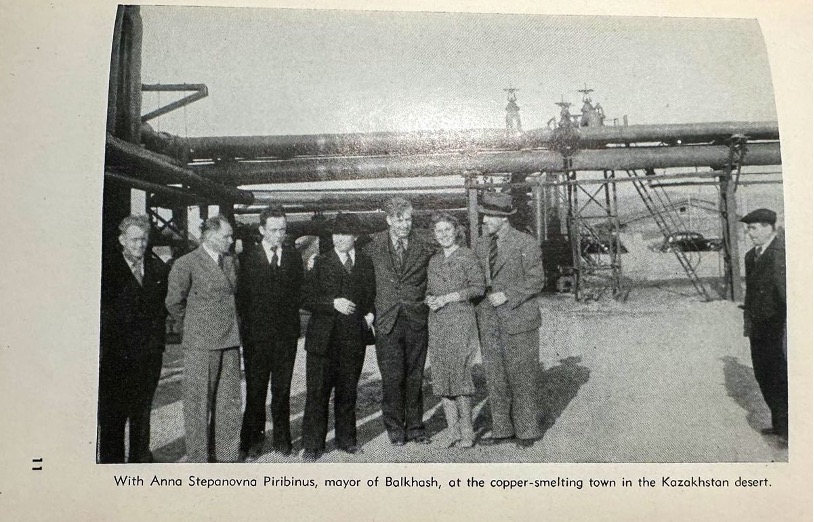
Central Asia has long held significance for the Western world — both in the past century and today. The region is home to ancient peoples and rich indigenous traditions. As a journalist from Kazakhstan, I became curious about the cultural ties between the United States and my country. In 2023, I studied at George Washington University through the Bolashak scholarship program to explore this subject in depth. My research led me to numerous works written by American travelers and scholars. Among them, I discovered a book authored by former U.S. Vice President Henry Wallace, based on his journey to Central Asia. [caption id="attachment_35215" align="aligncenter" width="351"] Henry WallaceCredit Hudson Institute[/caption] His book, Soviet Asia Mission, was published in New York in 1946 and reflects observations from that trip. During this special mission in 1944, Wallace first traveled through Siberia, where he studied the conditions of the local population, before continuing on to the Kazakh steppe. Wallace describes the social and political realities of Kazakhstan under Soviet rule, as well as the industrial projects that caught his attention. As a senior American politician, he was particularly interested in production and agriculture. “Down to meet us at the airfield was the director, Georg Georgevich Spitsen. In motorcars, we drove at once to the largest of Karaganda's three big open-pit coal mines. With a sweeping gesture, Spitsen said: “We are digging 6,000 tons of coal a day here. Production began a year ago." A proud shovel operator, scooping up tons of run-of-mine coal to load into steel hopper cars, waved to us. The tracks were driven directly into the cut. We looked closely at the shovel's trademark. It was a Bucyrus Erie electric shovel, one of three at work here, and had been shipped in under lend-lease from the United States.” His journey to Kazakhstan in the previous century demonstrates that U.S.–Kazakh political contacts began earlier than is often assumed.. Although Kazakhstan’s place in the Soviet system was highly constrained, Wallace’s account provides valuable insight into the wartime Soviet republics.. “After lunch at Karaganda, we took off, flying southwest over very dry country. Even the streams were dried out, except in deep valleys where clusters of huts could be seen in the midst of green oases. When still a long distance away, we could see a wide expanse of water ahead. It was Lake Balkhash, bright blue in the midst of gray, treeless country. Along the shore rose the smoking stacks of smelters. On landing at the dirt airfield, we were welcomed to the copper-smelting town of Balkhash by its mayor, Anna Stepanovna Piribinus, president of the city Soviet.” His next stop was Semipalatinsk (today’s Semey). There Wallace spoke with Dimitri Chuvakhin of the Soviet Foreign Office, who accompanied him on the trip. “This kind of thing,” he said, referring to the new towns we had seen, “this kind of thing saved Russia. Trotsky was against it; he thought there had to be a world revolution. Stalin had faith in the moral stamina of...

Honoring Abai Qunanbaiuly: Kazakhstan’s Enlightened Voice, Now Celebrated Worldwide

Today, August 10, Kazakhstan observes Abai Day, honoring the birth of Abai Qunanbaiuly (1845–1904)—a towering poet, philosopher, composer, and reformist who laid the foundations of written Kazakh literature. Since 2020, this date has been officially enshrined in the national calendar, reflecting Abai's inestimable role in shaping the Kazakh cultural and moral consciousness. Across the country, poetry readings, concerts, and flower-laying ceremonies are held to mark the anniversary of the man whose influence still guides Kazakh identity. Abai’s literary oeuvre—spanning some 170 original poems and 56 translations—brought new poetic meters, rhyme schemes, and philosophical depth to Kazakh verse. His celebrated Words of Edification (Kara sozder) remains a timeless guide on education, morality, and personal integrity, inspiring generations with its call for intellectual growth and ethical living. He did not merely write; he transformed the role of literature in Kazakh society, blending folk traditions with universal humanist ideals. A pivotal moment in his international recognition came in 1885, when American journalist George Kennan visited Semey (then Semipalatinsk). Struck by the city’s public library and by Abai’s active presence among its patrons, Kennan recorded his impressions in Siberia and the Exile System—one of the earliest Western literary references to the Kazakh thinker. This encounter symbolized the beginning of Abai’s journey beyond Kazakhstan’s borders, his name finding a place in the literary consciousness of the wider world. Abai’s creative spirit extended beyond the written word into music. In 1970, Wesleyan University Press in Connecticut published Music of Central Asia, which devoted a chapter to his musical influence. The book featured a verse of his that celebrates the enduring power of song: “Song opens the doors of the world to you, Song opens the death to you. Listen, Kazakh, grasp its wisdom. Song accompanies you your whole life.” These lines capture his belief that art—whether sung or spoken—has the power to illuminate the human spirit and guide a person through life’s trials and triumphs. What makes Abai truly global is not just his artistic genius, but his vision. As one scholar aptly put it, “We participate in global intellectual culture through Abai. He is the moral compass of our people”. His works urge individuals toward self-awareness, ethical living, and cultural openness—values that resonate far beyond Kazakhstan’s borders. On this day, the 180th anniversary of his birth, the words and music of Abai Qunanbaiuly continue to inspire not just a nation, but a world in search of wisdom, integrity, and the beauty of truth.

How Did Kazakh Poet Abai Qunanbaiuly`s Name Reach the U.S.?

Kazakh literature is filled with towering figures who have shaped the nation’s cultural and spiritual identity. Among them, Abai Qunanbaiuly (1845–1904) remains the most iconic. A poet, philosopher, and intellectual of global stature, Abai left behind a legacy that continues to resonate within world literature. As Kazakhstan celebrates the 180th anniversary of his birth, it is a fitting moment to explore how his influence extended far beyond the steppe, reaching as far as the United States. George Kennan: The American Who Introduced Abai to the World In 1885, American journalist George Kennan visited Semey (then Semipalatinsk) and was deeply impressed by the city’s public library. To his surprise, local Kazakhs actively borrowed and read books, a rare sight for that time and region. In his influential work Siberia and the Exile System, Kennan specifically mentioned Abai, marking one of the earliest references to the Kazakh thinker in Western literature. Kennan’s account stands out for its authenticity. It is based not on secondhand stories but on direct observation. His writings confirm Abai’s presence in Semey’s intellectual life and suggest that the poet had begun to attract attention well beyond the Kazakh steppe. [caption id="attachment_34625" align="alignnone" width="232"] Credit «Siberia and the Exile System», by George Kennan[/caption] From Kennan’s descriptions, we gain insight into what Abai read, who his associates were, and how his worldview aligned with major thinkers of the time. Abai’s intellectual growth was greatly influenced by E. P. Mikhaelis, a Russian political exile and lifelong friend. Under Mikhaelis’s guidance, Abai refined his reading habits and began a new phase of self-education. Through Mikhaelis, he was introduced to other exiled Russian intellectuals such as S. S. Gross, A. A. Leontiev, and N. I. Dolgopolov. These thinkers were struck by Abai’s intellectual depth, civic engagement, and dedication to the betterment of his people. In return, Abai introduced them to Kazakh culture, history, and oral traditions, becoming a cultural bridge between East and West. [caption id="attachment_34627" align="alignnone" width="300"] Аbai and E.P. Mikhaelis[/caption] Kennan also described the library in Semey, where Abai was a frequent visitor and reader. Since the original excerpt is in English, it is often shared as an image in historical archives rather than a transcription. [caption id="attachment_34628" align="alignnone" width="201"] Credit «Siberia and the Exile System», by George Kennan[/caption] [caption id="attachment_34629" align="alignnone" width="300"] The exterior appearance of the library in Semey where Abai was a reader[/caption] Abai’s Songs and Wesleyan University Abai’s influence extended not only through literature but also through music. In 1970, Wesleyan University Press in Connecticut published Music of Central Asia: Essays on the History of Music of the Peoples of the USSR, a groundbreaking volume by V. Belyaev and other scholars. The book includes a chapter titled Kazakh Music: From the 15th Century to the Mid-18th Century, which devotes special attention to Abai’s musical legacy. Belyaev describes Abai as a progressive thinker and a voice for enlightenment, quoting one of his famous verses: "Song opens the doors of the world to you, Song opens the death to...

Opinion: Ghosts of the Gulag – A View From the Ground

Recently, The Times of Central Asia published an article titled Ghosts of the Gulag: Kazakhstan’s Uneasy Dance With Memory and Moscow. While it is essential to consider outside opinions, it is equally important to articulate how this perspective looks from within. In Kazakhstan, there are three large museums dedicated to the memory of the victims of the communist regime. These are the infamous ALZHIR (Akmolinsk Camp for Wives of Traitors to the Motherland), the museum dedicated to the memory of victims of political repression, KARLAG (Karaganda camp), and a smaller memorial complex to the victims of political repression at Zhanalyk, located about 40 kilometers from Almaty. Historians believe that around 2,500 people are buried there, including prominent members of the Kazakh intelligentsia, such as Akhmet Baitursynov, Mukhamedzhan Tynishpaev, Saken Seifullin, Ilyas Jansugurov, and Beimbet Maily. In addition to these museums, there are monuments to the victims of political repression and the famine of the 1920s–30s in many cities across the country. But it's not just about the number of museums and monuments. What matters most is that the memory of these events is preserved, and it is being carefully studied. In 2020, a state commission for the full rehabilitation of victims of political repression was established by the government. Over several years, 425 scholars, researchers, and experts have participated in its work. More than 2.6 million documents and materials have been declassified. Most importantly, this commission has rehabilitated more than 311,000 victims of political repression within the framework of existing legislation. The results of this work are documented in 72 volumes. There are no sections in these research materials divided by nationality. The approach is the same for everyone: justice and fairness for all. This calls into question the “collective amnesia that obstructs historical reckoning” referred to by Guillaume Tiberghien, a specialist in dark tourism at the University of Glasgow. Regarding any "emphasis on what the prison system ‘contributed’ to the nation” mentioned by Margaret Comer, a memory studies expert at the University of Warsaw, there are conflicts of interest and truths people would rather not face. One of the main purposes of Karlag was to serve as a major base of food supplies for Kazakhstan’s growing coal and metallurgical industries. In addition to industrial development, by 1941 the camp had 70 sheep farms, 45 cattle farms, one horse farm, and two pig farms. By 1950, 4,698 people worked on these farms, including 13 academic scientists. The communist system of corrective labor camps was an integral part of economic development, achieved through what was essentially slave labor. This is the full cynicism of the regime on display: prisoners were expected to “work off” their guilt. “The country is walking a tightrope,” Tiberghien suggests, pointing to President Tokayev’s speech on May 31, the official Day of Remembrance for Victims of Political Repression. “It wants to keep things calm, to avoid upsetting Russia.” In this speech, while calling for the rehabilitation of victims and greater access to archives, Tokayev also condemned the...
