• KGS/USD = 0.01143 -0%
  • KZT/USD = 0.00198 -0%
  • TJS/USD = 0.10899 0.65%
  • UZS/USD = 0.00008 -0%
  • TMT/USD = 0.28490 -0.28%
  • KGS/USD = 0.01143 -0%
  • KZT/USD = 0.00198 -0%
  • TJS/USD = 0.10899 0.65%
  • UZS/USD = 0.00008 -0%
  • TMT/USD = 0.28490 -0.28%
  • KGS/USD = 0.01143 -0%
  • KZT/USD = 0.00198 -0%
  • TJS/USD = 0.10899 0.65%
  • UZS/USD = 0.00008 -0%
  • TMT/USD = 0.28490 -0.28%
  • KGS/USD = 0.01143 -0%
  • KZT/USD = 0.00198 -0%
  • TJS/USD = 0.10899 0.65%
  • UZS/USD = 0.00008 -0%
  • TMT/USD = 0.28490 -0.28%
  • KGS/USD = 0.01143 -0%
  • KZT/USD = 0.00198 -0%
  • TJS/USD = 0.10899 0.65%
  • UZS/USD = 0.00008 -0%
  • TMT/USD = 0.28490 -0.28%
  • KGS/USD = 0.01143 -0%
  • KZT/USD = 0.00198 -0%
  • TJS/USD = 0.10899 0.65%
  • UZS/USD = 0.00008 -0%
  • TMT/USD = 0.28490 -0.28%
  • KGS/USD = 0.01143 -0%
  • KZT/USD = 0.00198 -0%
  • TJS/USD = 0.10899 0.65%
  • UZS/USD = 0.00008 -0%
  • TMT/USD = 0.28490 -0.28%
  • KGS/USD = 0.01143 -0%
  • KZT/USD = 0.00198 -0%
  • TJS/USD = 0.10899 0.65%
  • UZS/USD = 0.00008 -0%
  • TMT/USD = 0.28490 -0.28%
07 December 2025

Viewing results 1 - 6 of 6

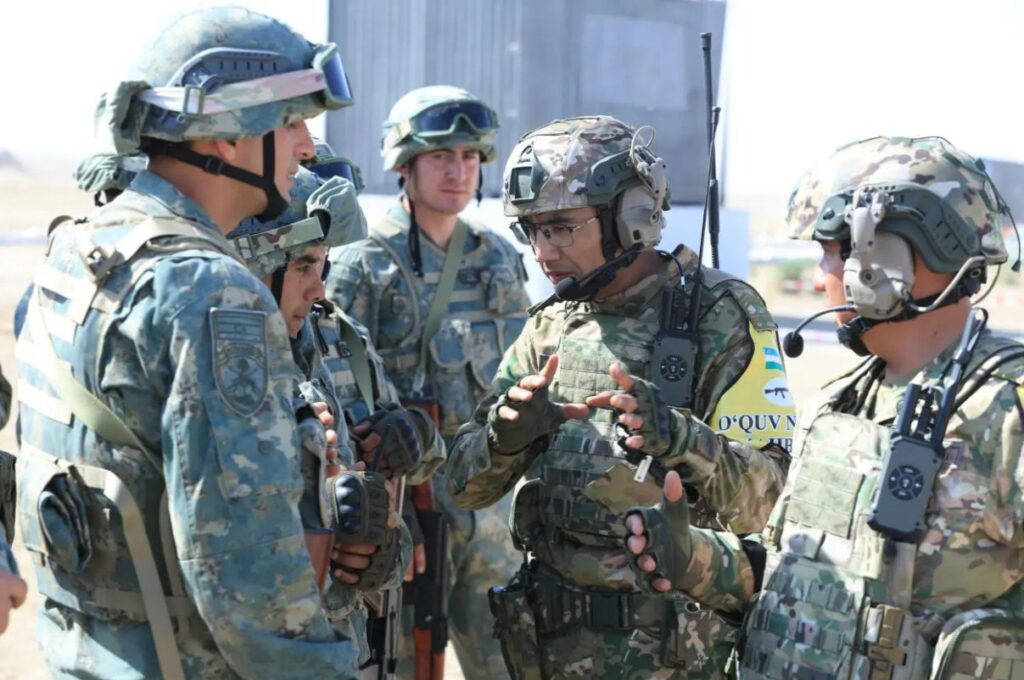
Five Countries Complete Large-Scale ‘Birlik-2025’ Military Exercises in Uzbekistan

The multinational military exercises Birlik-2025 ("Unity-2025") have concluded at the Kattakurgan training ground in Uzbekistan’s Samarkand region. The joint maneuvers, which began on October 14, brought together armed forces from Uzbekistan, Kazakhstan, Kyrgyzstan, Tajikistan, and Azerbaijan. According to the Uzbek Ministry of Defense, the drills were among the largest in the history of regional military cooperation. The exercises focused on counterterrorism and defense operations, aiming to enhance interoperability, tactical coordination, and combat readiness among the participating countries. Scenarios included simulated urban warfare, reconnaissance, and joint air-ground operations. Commanders utilized computer modeling and simulation technologies to analyze battlefield decisions and identify optimal tactical responses. These digital tools played a key role in shaping the exercise outcomes and refining strategic planning. [caption id="attachment_37891" align="aligncenter" width="351"] @Ministry of Defense of Uzbekistan[/caption] Observers included the defense ministers of all participating states, along with military representatives from Turkmenistan, who attended in a monitoring capacity. The drills were conducted across more than 20 training grounds in multiple regions of Uzbekistan. In the initial phase, reconnaissance units deployed unmanned aerial vehicles to assess the territory of a hypothetical enemy. This was followed by a special operation to neutralize simulated illegal armed groups in an urban environment. Precision artillery and air strikes were executed by ground forces, while the air forces of Uzbekistan and Kazakhstan provided air cover and destroyed critical enemy positions. Combat helicopters and fighter jets demonstrated joint tactical coordination with land-based units. Troops also practiced offensive operations along the defensive line using a range of weapons and military equipment. The multi-stage training format included tasks of varying complexity, replicating conditions of high-intensity conflict. [caption id="attachment_37893" align="aligncenter" width="352"] @Ministry of Defense of Uzbekistan[/caption] According to the Uzbek Ministry of Defense, Birlik-2025 served as a valuable platform for exchanging experience in combating international terrorism, extremism, and armed insurgency. “Joint operations have made it possible to consolidate advanced methods of combat and improve interoperability between units from different countries,” the ministry stated. Following the conclusion of the active phase, participants visited mobile maintenance workshops, command posts, and exhibits showcasing modernized weaponry and defense technologies.

Samarkand Issues Safety Warnings after Gas Explosion Kills Seven in Home

The Uzbek city of Samarkand is intensifying a home safety campaign following the death of seven people in what authorities call “a flash of a gas-air mixture” in a house last week. Emergency officials in the Samarkand region have said an investigation is underway into the explosion in the city on the night of May 8-9. “The kinetic impact of the flash caused the collapse of the reinforced concrete structures of the house, damaging the 1st, 2nd, and 3rd floors and the basement. There was no fire,” the regional emergency situations department said on Telegram. It reported six deaths, and several media outlets in Uzbekistan later reported a seventh death. The victims were found under the rubble. Since the accident, regional emergency officials have issued appeals to residents to not install non-standard gas cylinders on gas stoves and gas appliances. They are also advising people to take other safety measures, including not connecting gas cylinders to equipment using rubber hoses that can’t operate under specific pressure; regularly checking for gas leaks by using soapy water on cylinder connections and valves; and ensuring that flammable items are at least 10 meters away from gas cylinders. Following those rules “will prevent accidents that could happen to you and your loved ones!” the emergency situations department warned. In a separate incident on May 7, two people were killed and one was injured in an explosion at a gas station in the Katakurgan district of Samarkand region. A fire broke out during the fueling of two diesel fuel storage tanks, according to reports on UzDaily.com and other Uzbek media. The reports attributed the information to the state Committee for Industrial, Radiation and Nuclear Safety.

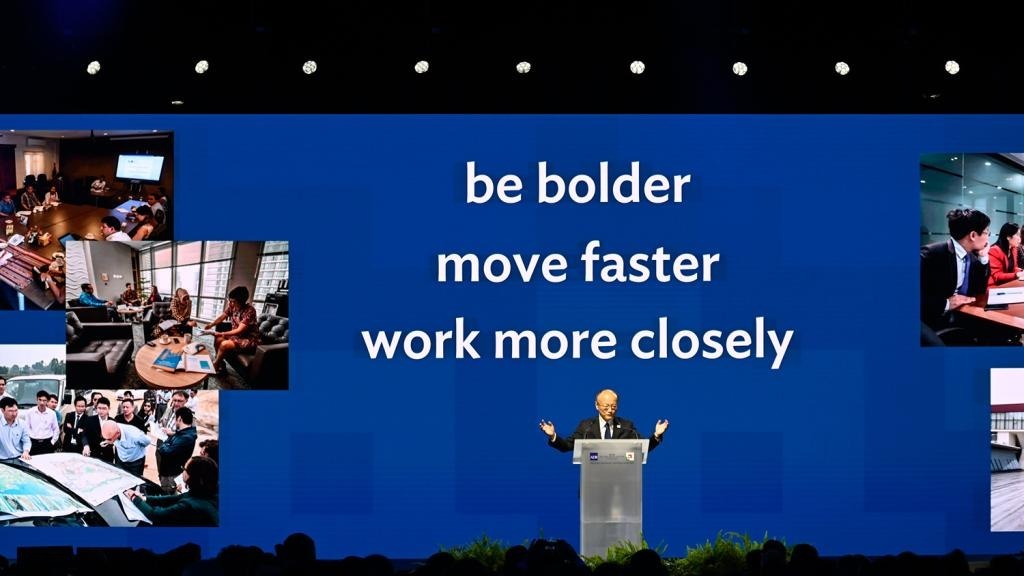
Uzbekistan to Chair ADB Board, Host 2026 Annual Meeting in Samarkand

Uzbekistan is poised to assume a greater leadership role within the Asian Development Bank (ADB) following key announcements at the institution’s 58th Annual Meeting of the Board of Governors, held on May 6-7 in Milan, Italy. Uzbekistan’s delegation, led by Deputy Prime Minister Jamshid Khodjaev, participated in the high-level event. According to the Ministry of Investments, Industry and Trade of Uzbekistan, the meeting concluded with the formal announcement that Uzbekistan will chair the ADB Board of Governors for the 2025-2026 term. Khodjaev was confirmed as the board’s next chair, a move widely seen as a reflection of the growing trust and confidence of international financial institutions in Uzbekistan’s reform trajectory. Additionally, it was agreed that Samarkand will host the ADB’s 59th Annual Meeting in May 2026. During the Milan meeting, the parties also signed an ambitious cooperation program outlining 23 new projects valued at $3.6 billion, to be implemented over the next two years. These initiatives will target strategic sectors such as education, drinking water supply, transport, and technical assistance. The announcement builds on an existing track record of cooperation. Recent projects include a $125 million ADB loan aimed at modernizing Uzbekistan’s water systems. This initiative encompasses the installation of smart water meters, mapping of water infrastructure, modernization of customer service centers, and training for utility staff, all intended to enhance national water security and service efficiency. Uzbekistan’s expanding partnership with the ADB is expected to accelerate its social and economic development objectives, particularly as the country continues to pursue wide-ranging reforms and infrastructure upgrades.

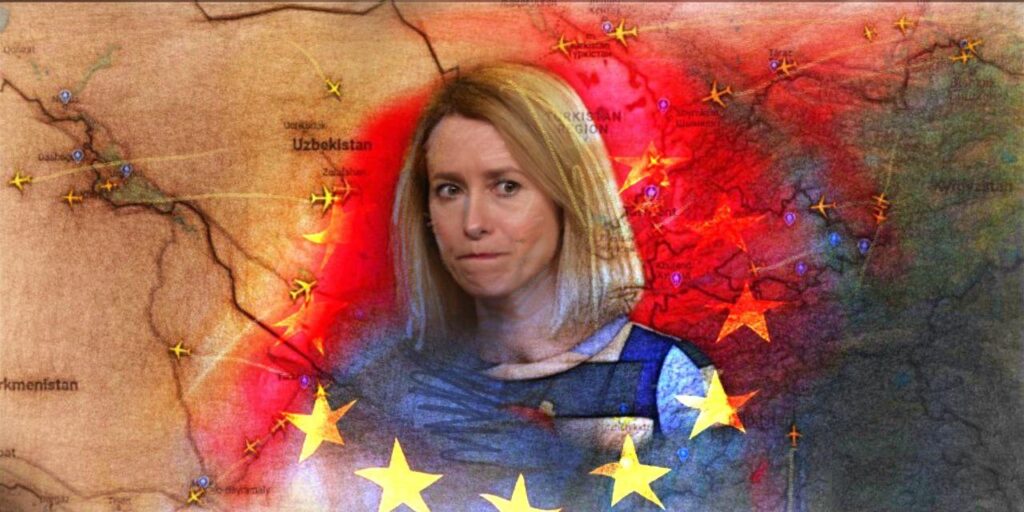
Inside the EU’s New Power Play in Eurasia

Kaja Kallas’s late-March 2025 tour of Central Asia, in her role as the European Union’s High Representative for Foreign Affairs and Security Policy, was a high-signal intervention in structural terms. It indicates a major re-evaluation of the EU’s posture toward a region historically treated as a far-flung, liminal borderland. As the inaugural EU–Central Asia Summit in Samarkand on April 3–4 approaches, her visible diplomatic activity was less about spectacle than about configuring a new field of co-adaptive engagement. Not only the European Union but also, separately, the United Kingdom are both seeking new regional footholds for building durable alignments. Central Asia, for decades considered through a lens of post-Soviet dependency or one of Chinese infrastructural absorption, is now increasingly recognized as a network node of emergent geopolitical agency. No longer just a space "between" other spaces, it is becoming a strategic space in its own right. Kallas’s mission and the UK’s parallel outreach signify a turn toward a negotiated interdependence that does not dissolve classical interest-based diplomacy but rather "complexifies" it by embedding it in a landscape of developmental trajectories and overlapping power centers. The arc of Kallas’s visit traced a deliberate sequence: Ashgabat, Tashkent, Almaty, Bishkek. In Ashgabat, she chaired the 20th EU–Central Asia Ministerial Meeting, a session nominally bureaucratic but substantively strategic. Discussions reaffirmed the 2023 EU–Central Asia Roadmap and activated the Global Gateway as an organizing frame for infrastructural, digital, and energy cooperation. Bilateral exchanges with officials in Turkmenistan brought the sensitive issue of sanctions circumvention into the open: Turkmenistan, though nominally neutral, remains enmeshed in logistics corridors proximate to Russian interest. From there, Kallas moved to Uzbekistan, where preparations for the April 3–4 Samarkand summit took clearer shape. Talks with President Shavkat Mirziyoyev and Foreign Minister Bakhtiyor Saidov in Tashkent widened the terrain of diplomatic discourse to include the energy transition, educational exchange, and regional transport integration. By hosting summits and fostering cooperation, Uzbekistan is seeking to establish for itself a profile as a key facilitator in Eurasian affairs. In Kazakhstan, her final significant stop, the meetings with President Kassym-Jomart Tokayev and Foreign Minister Murat Nurtleu emphasized macroeconomic diversification and critical raw material supply chains. These are areas in which the EU is not merely a partner but a principal stakeholder. And yet, it is not only the EU that has begun this strategic deepening. The United Kingdom, post-Brexit and still actively reconfiguring its global engagements, has moved in parallel. April 2025 marked the first anniversary of the UK–Kazakhstan Strategic Partnership and Cooperation Agreement. Foreign Office Minister Stephen Doughty’s recent hosting of the Kazakhstan–UK Strategic Dialogue marked 33 years of formal relations. These diplomatic celebrations, beyond their performativity, represent the UK’s recognition that Kazakhstan, and Central Asia more broadly, is a region where its strategic, commercial, and normative interests intersect. In this broader convergence, Kazakhstan plays a central structural role of a balancing nature. It shares long borders with both Russia and China; it hosts a significant Russian-speaking population; and it has maintained a political posture...