


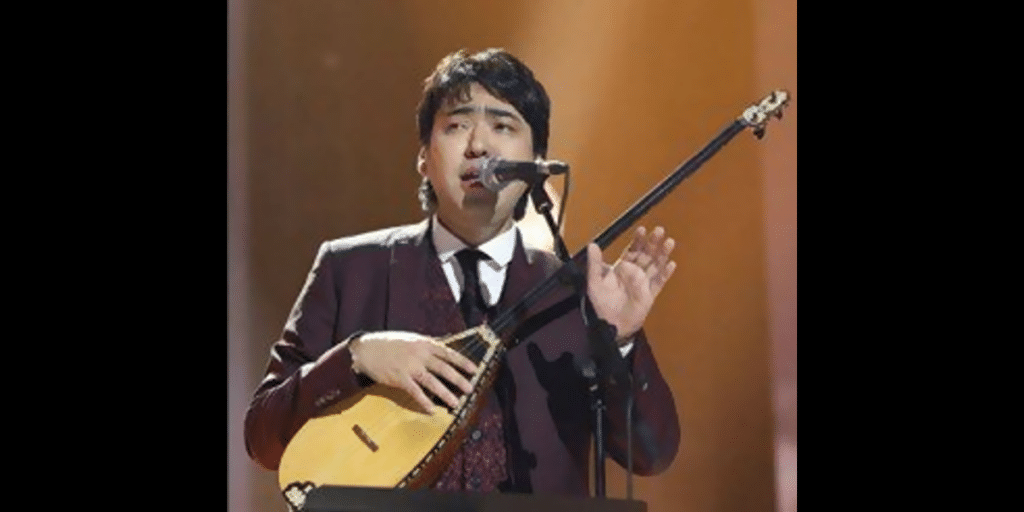
Meirambek Besbayev and the Dombra: Music That Connects Generations
As a teenager, Meirambek Besbayev became famous across Kazakhstan with Boztorgai (The Lark), a song about an orphan searching for his mother. He sang it on all three days of a national competition in 1991, and it became his signature piece. Besbayev turned 50 on November 7, 2026, and marked the occasion with a concert tour across Kazakhstan. He gave two concerts at the Palace of the Republic in Almaty on November 6. The Gaissin Orchestra and his mentor, composer Altynbek Korazbayev, joined him onstage. Today, Besbayev is one of the most recognizable figures in Kazakh popular music, with a repertoire spanning folk songs, traditional musical poetry, and contemporary compositions. From Childhood Talent to National Fame Born in 1976 in the Zhambyl region of southern Kazakhstan, Besbayev was ten when Korazbayev first heard him sing. In the summer of 1987, he performed at the Balasagun Palace of Culture in what is now Taraz, during a poetry competition honoring the Kazakh poets Zhambyl Zhabayev and Kenen Azerbayev. He sang Sagyndym Kenen Atamdy (I Miss Grandfather Kenen). Korazbayev was one of the judges and sent for him afterward, Besbayev later recalled. Abdirakhman Asylbekov wrote the lyrics to Boztorgai, and Korazbayev composed the music. In 1989, the song was written down as Kara Bala (literally, The Black Boy). Korazbayev later named it for the lark in the song. Besbayev continued his musical education in Almaty at the music boarding school named for Kulyash Baiseitova. He later earned an acting diploma at the Kazakh State Institute of Theater and Cinema, a predecessor of the Temirbek Zhurgenov Kazakh National Academy of Arts. His theatrical training is evident in his singing, particularly in the way he uses pauses to bring out the meaning of the lyrics. He favors a natural vocal sound over elaborate ornamentation. The Dombra and the Art of Kazakh Singing The dombra is a traditional Kazakh instrument with a long neck and two plucked strings. For centuries, musicians have used it to accompany songs and poetry. They also play kuis, instrumental compositions that can tell a story, evoke a mood, or recall a historical event without words. Two of the most prominent dombra composers are Kurmangazy Sagyrbayuly and Dauletkerey Shygayuly. Kurmangazy’s Saryarka, named for the uplands of central Kazakhstan, and Adai, named for a Kazakh clan, are among the best-known works in the national repertoire. In 2014, UNESCO inscribed the Kazakh traditional art of dombra kuy on its Representative List of the Intangible Cultural Heritage of Humanity. Musicians pass the pieces from teacher to pupil and within families, along with the stories associated with them. Although Besbayev is best known as a pop singer, his concerts also draw on two forms of Kazakh musical poetry, terme and tolgau. In terme, the performer sings instructive or philosophical verses rhythmically, usually to the accompaniment of the dombra. Tolgau is a freer poetic form that reflects on human destiny, society, and historical events. Both call for a strong command of language and the ability to bring...
