


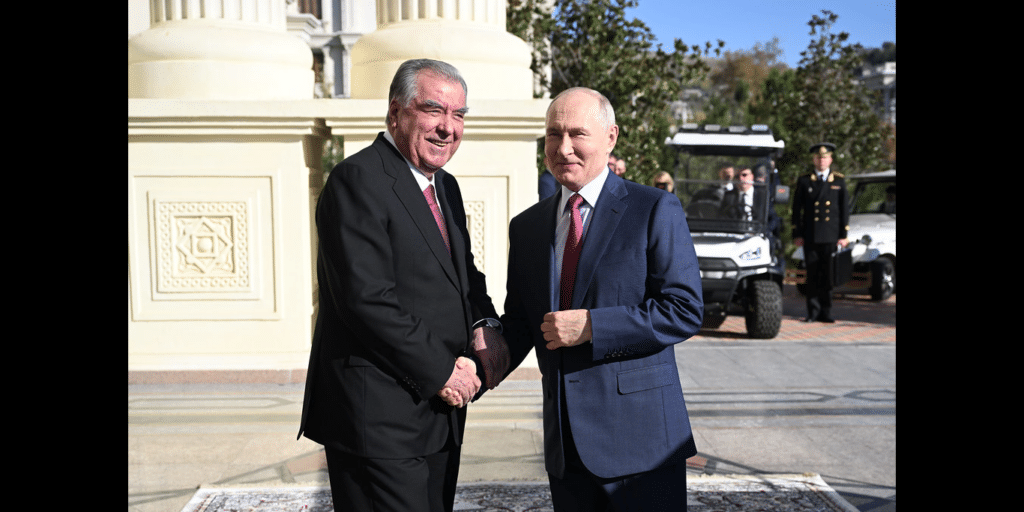
Tajikistan to Withdraw From International Criminal Court
Tajikistan is formally withdrawing from the treaty that established the International Criminal Court (ICC), after alleging that the court is politicized and failing to act on an ICC arrest warrant for Russian President Vladimir Putin when he visited Dushanbe. The court’s oversight body said a decision to withdraw could undermine “global efforts to end impunity.” A United Nations filing says the withdrawal process for Tajikistan was initiated on November 20, 2026, and will take effect on November 20, 2027, under Article 127 of the Rome Statute, the international treaty that established the court and was adopted in 1998. Article 127 reads: “A State Party may, by written notification addressed to the Secretary-General of the United Nations, withdraw from this Statute. The withdrawal shall take effect one year after the date of receipt of the notification, unless the notification specifies a later date.” The presidency of the Assembly of States Parties to the Rome Statute said it was concerned about the move by Tajikistan, the only Central Asian country to have ratified the treaty. “Decisions by States Parties to disengage from the Rome Statute risk undermining the collective pursuit of justice and weakening global efforts to end impunity,” the presidency said. “The ICC stands at the heart of the international system of accountability, and its effectiveness depends on sustained and unequivocal support from the international community. The pursuit of justice is strengthened through unity of purpose.” The European Union also said it regretted Tajikistan’s decision, saying the country’s involvement in the ICC “reflected its commitment to the rules-based international order, multilateralism, and international justice.” Both the Assembly of States Parties and the European Union said Tajikistan still has obligations under the Rome Statute as long as it remains a state party to the accord. Idibek Kalandar, Tajikistan’s deputy foreign minister, said in remarks to the lower house of parliament in October that bias in the International Criminal Court was undermining its independence. The lower house approved a resolution to withdraw. The formal start of the process coincided with a visit by Putin to Tajikistan, where he and President Emomali Rahmon discussed security, economic, and other issues. Rahmon described Russia as a “strategic partner and reliable ally.” In 2023, the International Criminal Court issued an arrest warrant for Putin for alleged war crimes in Ukraine. As a state party to the Rome Statute, Tajikistan would be obligated to carry out ICC arrest warrants. However, earlier this year, Tajikistan outlined reasons for not arresting Putin when the Russian leader visited Dushanbe in 2025. Arguing before the ICC, Tajikistan’s representatives noted that Russia was not a party to the Rome Statute. According to an ICC document, Tajikistan also said it had a bilateral agreement with Russia under which “high-ranking officials enjoy immunity from the jurisdiction of third parties and thus cannot be arrested or extradited to third parties.” Earlier this year, Niger, Burkina Faso, Mali, Chad, Venezuela, and Naoero also started their withdrawals from the Rome Statute of the International Criminal Court.
