
• KZT/USD = 0.00221
  • TJS/USD = 0.10830
  • UZS/USD = 0.00008
  • TMT/USD = 0.29760
  • KZT/USD = 0.00221
  • TJS/USD = 0.10830
  • UZS/USD = 0.00008
  • TMT/USD = 0.29760
  • KZT/USD = 0.00221
  • TJS/USD = 0.10830
  • UZS/USD = 0.00008
  • TMT/USD = 0.29760
  • KZT/USD = 0.00221
  • TJS/USD = 0.10830
  • UZS/USD = 0.00008
  • TMT/USD = 0.29760
  • KZT/USD = 0.00221
  • TJS/USD = 0.10830
  • UZS/USD = 0.00008
  • TMT/USD = 0.29760
  • KZT/USD = 0.00221
  • TJS/USD = 0.10830
  • UZS/USD = 0.00008
  • TMT/USD = 0.29760
  • KZT/USD = 0.00221
  • TJS/USD = 0.10830
  • UZS/USD = 0.00008
  • TMT/USD = 0.29760
  • KZT/USD = 0.00221
  • TJS/USD = 0.10830
  • UZS/USD = 0.00008
  • TMT/USD = 0.29760
17 October 2026

Viewing results 1 - 6 of 2

Kyrgyzstan’s Asman Airlines Considers COMAC Jets

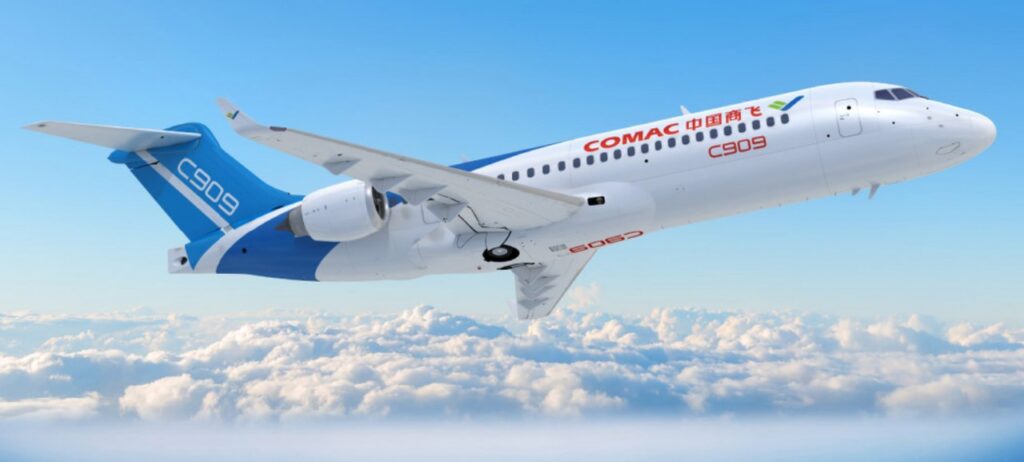
Kyrgyzstan’s state-owned Asman Airlines is considering C909 and C919 jets from the Commercial Aircraft Corporation of China (COMAC) while pursuing separate plans to add Airbus A321 aircraft for international routes. Under the proposed cooperation, COMAC will provide technical and commercial information on the two aircraft, while the sides assess whether they would be economical to operate on Asman’s existing and planned routes. Airline representatives will also visit COMAC’s production facilities in Shanghai. The talks will also cover certification. Before Asman could operate either jet, Kyrgyzstan’s State Civil Aviation Agency is expected to help validate its type certificate, the safety approval for the aircraft design. The C909 is a regional jet seating 78 to 97 passengers, with a range of about 1,380 to 2,300 miles. COMAC says it is suited to short and narrow runways and high-altitude airports, a feature that could be useful in mountainous Kyrgyzstan. The C919 is a considerably larger single-aisle jet seating 158 to 192 passengers, with a range of about 2,530 to 3,450 miles. It competes in the same broad market as the Airbus A320 and Boeing 737 families. Both models are already in commercial service. COMAC said in February that more than 200 C909 and C919 aircraft had been delivered in total. The C909 has also entered service with airlines in Southeast Asia. The C919’s expansion outside China has been slower. It is certified by the Civil Aviation Administration of China, while European certification remains incomplete. In January, the European Union Aviation Safety Agency confirmed that its pilots had conducted validation flights of the C919 in Shanghai. Asman Airlines currently operates three Canadian-built Dash 8 Q400 turboprops, each seating up to 80 passengers, primarily on domestic and short regional routes. In July, the airline resumed seasonal flights between Almaty and Issyk-Kul. Asman’s parent company, Airports of Kyrgyzstan, signed a deal with BBAM Aircraft Leasing & Management in March to acquire two Airbus A321 aircraft for the carrier. The airport operator said in July that Asman plans to add eight A321s over five years, with the first two forming the initial stage. The European Commission removed all airlines certified in Kyrgyzstan from the EU Air Safety List in June, ending restrictions imposed in 2006. Removal from the list does not automatically authorize flights to the European Union; carriers still need suitable aircraft and the necessary operating approvals. Kyrgyzstan has also been restoring regional airports and domestic routes. Between 2021 and 2025, passenger traffic at the country’s airports increased by 52%, while the number of flights rose by 53%. Five airports were operating in 2021; the government said in March 2026 that all 11 were operational.


Kazakhstan’s Al-Farabi University Joins Central Asia’s First Flying Hospital Project

Al-Farabi Kazakh National University (KazNU) has joined a project to create what Kazakhstan’s Ministry of Science and Higher Education described as Central Asia’s first flying hospital, a specialized medical aircraft intended to provide healthcare in remote parts of the region. A launch ceremony was held in Almaty last week for the Central Asian Flying Hospital Mission for Ophthalmology and ENT Care. The project uses a C909 aircraft and is being implemented under the global Air Silk Road of Health initiative. The initiative involves KazNU, the Eye and ENT Hospital of Fudan University, and the Commercial Aircraft Corporation of China (COMAC). COMAC has developed a specialized medical aircraft using the C909 regional jet platform. Passenger versions of the aircraft can carry between 78 and 97 passengers, depending on configuration, while extended-range versions can fly up to 3,700 kilometers. The medical version has a flexible cabin that can be reconfigured for medical teams and emergency care in remote areas. It can also be used for patient evacuation. The aircraft presented in Almaty will provide ophthalmology and ear, nose, and throat services. It is equipped with an operating room and telemedicine systems. It also uses artificial intelligence technology to diagnose eye diseases. The platform is intended to support care from screening and diagnosis through surgery and rehabilitation. Kazakhstan’s Ministry of Science and Higher Education said the project is being implemented for the first time in Kazakhstan and Central Asia. During the presentation, KazNU and the Eye and ENT Hospital of Fudan University signed a cooperation agreement to develop medical education and research, as well as professional training. A multilateral agreement was also signed to expand cooperation in ophthalmology between China and Central Asian countries. “The C909 flying hospital mission will give new momentum to cooperation between Kazakhstan and China in medicine, science, and higher education, expanding opportunities for academic mobility, research, and the introduction of innovative medical technologies,” said Bakytzhan Omarov, a board member at Al-Farabi Kazakh National University. The Air Silk Road of Health project is expected to help introduce advanced medical technologies and support joint research. It is also intended to expand access to high-tech healthcare in Central Asia. The initiative comes as Kazakhstan seeks to expand its scientific and medical research infrastructure. The Times of Central Asia previously reported that Kazakhstan opened Central Asia’s first brain research institute this summer.