
• KGS/USD = 0.01144 0%
  • KZT/USD = 0.00208 0%
  • TJS/USD = 0.10429 0.1%
  • UZS/USD = 0.00008 0%
  • TMT/USD = 0.28530 0%
  • KGS/USD = 0.01144 0%
  • KZT/USD = 0.00208 0%
  • TJS/USD = 0.10429 0.1%
  • UZS/USD = 0.00008 0%
  • TMT/USD = 0.28530 0%
  • KGS/USD = 0.01144 0%
  • KZT/USD = 0.00208 0%
  • TJS/USD = 0.10429 0.1%
  • UZS/USD = 0.00008 0%
  • TMT/USD = 0.28530 0%
  • KGS/USD = 0.01144 0%
  • KZT/USD = 0.00208 0%
  • TJS/USD = 0.10429 0.1%
  • UZS/USD = 0.00008 0%
  • TMT/USD = 0.28530 0%
  • KGS/USD = 0.01144 0%
  • KZT/USD = 0.00208 0%
  • TJS/USD = 0.10429 0.1%
  • UZS/USD = 0.00008 0%
  • TMT/USD = 0.28530 0%
  • KGS/USD = 0.01144 0%
  • KZT/USD = 0.00208 0%
  • TJS/USD = 0.10429 0.1%
  • UZS/USD = 0.00008 0%
  • TMT/USD = 0.28530 0%
  • KGS/USD = 0.01144 0%
  • KZT/USD = 0.00208 0%
  • TJS/USD = 0.10429 0.1%
  • UZS/USD = 0.00008 0%
  • TMT/USD = 0.28530 0%
  • KGS/USD = 0.01144 0%
  • KZT/USD = 0.00208 0%
  • TJS/USD = 0.10429 0.1%
  • UZS/USD = 0.00008 0%
  • TMT/USD = 0.28530 0%

Viewing results 1 - 6 of 10

Kazakhstan-China Agricultural Research Center to Open in Key Grain-Producing Region

A Kazakhstan-China Agricultural Research Center will be established in the North Kazakhstan region, one of the country's top three grain-producing areas. The initiative was announced by region's governor Gauez Nurmukhambetov following a business delegation’s visit to China. “Last week, a business delegation from our region visited the People’s Republic of China and held meetings with leading Chinese investors. As a result, seven strategic memoranda were signed, opening new economic opportunities for our region. These agreements include the construction of new factories and the creation of a Kazakh-Chinese agricultural research center,” Nurmukhambetov said at a press conference. The region continues to post record harvests. In 2025 it harvested 6.5 million tons of grain, nearly a quarter of Kazakhstan’s total gross harvest of 27.1 million tons. Nevertheless, the region is actively diversifying its agricultural profile. Sugar beet cultivation is expanding, with experimental plots from Asyl Farms showing strong crop adaptation. Based on this success, plans are underway to build a processing facility capable of handling 1 million tons of raw material annually, producing up to 200,000 tons of sugar. In the Kyzylzhar district, Salar Farm is building a plant for processing granulated alfalfa with an annual capacity of 60,000 tons. The main export markets include China and other Central Asian countries. The facility is scheduled to open in 2026. The region is also home to Maslo-Del, an oil extraction plant with an annual processing capacity of 370,000 tons of oilseeds and a production output of 120,000 tons, much of which is exported. Alongside its growth in crop production, the region is making notable progress in livestock farming. “SK Agro will construct the largest cattle farm in Central Asia, with a herd of 10,000 and a state-of-the-art Carousel milking system,” said Nurmukhambetov. “The farm is expected to increase milk production by 68 million tons annually. This will raise the share of milk produced by agricultural enterprises in Kazakhstan to 70%.” He noted that in Belarus, modern farms account for 77% of milk production, in China around 70%, and in European countries more than 93%. North Kazakhstan region aims to boost its share of the country’s total milk output to 20%. Meanwhile, 17 projects valued at $555.6 million are underway in the Qyzyljar special economic zone. Agricultural cooperation with China continues to grow. Kazakhstan views China as a key export destination for its processed agricultural products. In November, QazTrade signed a partnership agreement with Optimize Integration Group, one of China’s largest food importers, responsible for 18% of the country's frozen meat imports. In a related development, a joint Kazakh-Chinese veterinary laboratory was opened in East Kazakhstan region in October 2025. The facility is designed to streamline and accelerate export procedures for agricultural goods.
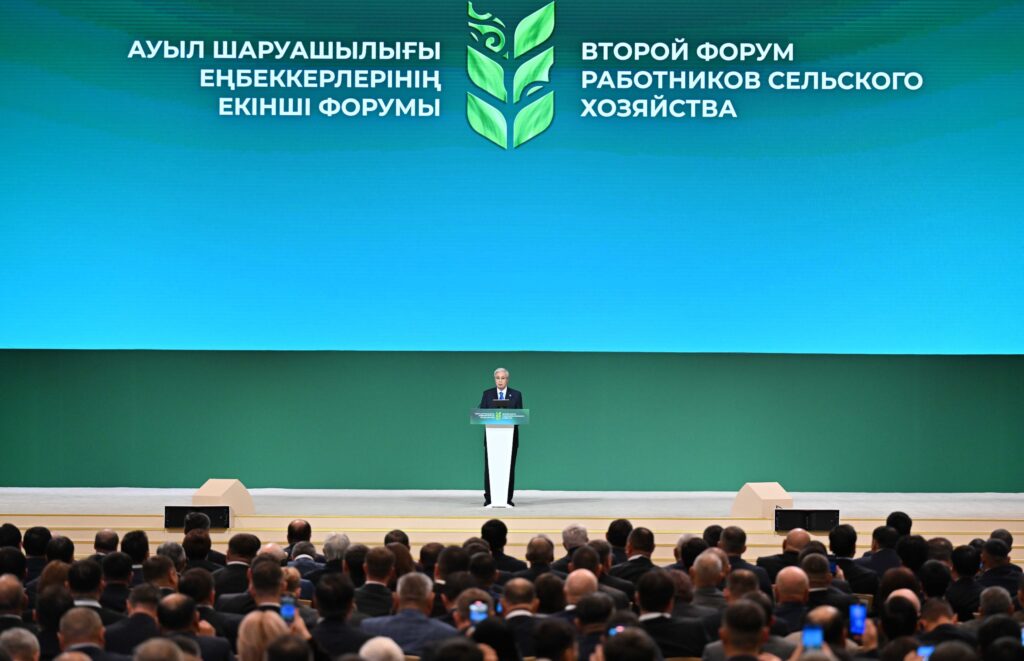
Tokayev Proposes Linking Farm Subsidies to Advanced Technologies

Kazakhstan’s President Kassym-Jomart Tokayev has proposed that state support for farmers be tied to their adoption of advanced technologies, including artificial intelligence (AI). The proposal was made during his speech at the country’s second Agricultural Workers Forum. Tokayev noted that while many farms are already using innovations such as smart farming systems, agricultural drones, satellite monitoring, and AI, technological development at the national level remains uneven. “We must move from isolated ‘smart’ solutions to full-scale digital agricultural production,” Tokayev stated. “Every farm should be incentivized to adopt digital technologies. State support should be directed toward those enterprises implementing innovations, including artificial intelligence.” Tokayev also reported that preferential lending to the agricultural sector has exceeded $1.9 billion in 2025, ten times more than five years ago. He stressed that the adoption of innovative technologies must extend beyond producers to include the regulatory authorities overseeing the agro-industrial sector. “It is necessary to develop an effective system for tracking and controlling state grain reserves using digital technologies and AI tools,” he said. “This requires modernizing existing grain elevators and constructing new, modern facilities. In state-backed financing programs for private elevators, having electronic systems for grain intake and dispatch should be a mandatory requirement.” Tokayev also highlighted persistent issues in agricultural data systems, which he described as fragmented and lacking integration. This, he said, results in policy decisions based on unreliable statistics. He called for comprehensive, objective data to be provided by the upcoming National Agricultural Census, which should serve as the foundation for updating digital infrastructure across the agro-industrial complex. Previously, The Times of Central Asia reported that Kazakhstan achieved a record harvest this year of grains, oilseeds, and legumes.

Kyrgyzstan Launches Autumn Sowing of Winter Crops on 250,000 Hectares

Kyrgyzstan has launched its autumn sowing campaign, with winter crops expected to cover 250,000 hectares, according to the Ministry of Water Resources, Agriculture, and Processing Industry. To date, over 81,000 hectares, approximately one-third of the planned area, have already been sown with wheat and barley. “Sowing is underway in all regions of the country. The necessary agricultural equipment has been deployed, and a sufficient amount of seed material has been provided to meet the targets,” the ministry said. Experts note that work is proceeding within optimal agrotechnical timelines, with the campaign scheduled for completion by the end of November. In the Chui and Issyk-Kul regions, more than 40% of the targeted areas have already been sown, despite the campaign beginning only a month ago. In an experimental effort, one farm in the Chui region sowed 50 hectares with the Canadian wheat variety “Jersey,” known for its high yield and grain quality. Farmers state that adherence to agrotechnical standards, including timely soil preparation and the application of modern cultivation techniques, is crucial for achieving strong harvests. In the Talas region, farmers have already cultivated more than a third of the targeted sowing area. Other regions across the country are also progressing on schedule.

Kyrgyzstan Restores Irrigation System Amid Growing Water Demand

In the dry and hot year of 2025, Kyrgyz farmers received one billion cubic meters more water than in 2024, according to the Ministry of Water Resources, Agriculture, and Processing Industry. Despite the challenging weather conditions, 7 billion cubic meters of water were delivered during the growing season, enabling the irrigation of over 1.1 million hectares of agricultural land. Chronic water shortages during the irrigation season have long plagued Kyrgyzstan's agriculture, frequently sparking disputes in rural areas. The primary cause is the aging irrigation infrastructure, much of it dating back to the Soviet era. Many canals are clogged or damaged, leading to significant water losses. In 2025, the ministry reported that 429.5 kilometers of canals were repaired and cleaned, alongside the restoration of 302 hydraulic structures, 123 water gauges, 91 pumping stations, and 156 pumping units. Nine units were fully replaced, and 53.5 kilometers of collector and drainage systems were cleaned. To modernize the network, the government plans to construct 106 daily and ten-day water regulation basins by 2030. These facilities are intended to improve water storage and distribution across farms. Ten basins have already been commissioned this year, with 12 more under construction. Officials are also combining modern and traditional solutions to address irrigation challenges. Sprinkler systems, popular in the 1980s, are being revived due to their efficiency, they require 500 to 1,000 cubic meters of water per hectare, compared to two to three times more with the traditional ary system. However, most farmers continue to rely on the ary method due to the high cost of sprinkler and drip irrigation equipment. According to the ministry, drip and sprinkler systems are now in use on 8,365 hectares: 1,702 hectares on state-owned land and 6,663 hectares on private farms. Restoration of old wells and construction of new canals also continue. This year, work began on a plant to manufacture concrete linings for irrigation canals, with a target of producing 500,000 square meters of concrete canal linings in 2025.
