• KZT/USD = 0.00221
  • TJS/USD = 0.10830
  • UZS/USD = 0.00008
  • TMT/USD = 0.29760
  • KZT/USD = 0.00221
  • TJS/USD = 0.10830
  • UZS/USD = 0.00008
  • TMT/USD = 0.29760
  • KZT/USD = 0.00221
  • TJS/USD = 0.10830
  • UZS/USD = 0.00008
  • TMT/USD = 0.29760
  • KZT/USD = 0.00221
  • TJS/USD = 0.10830
  • UZS/USD = 0.00008
  • TMT/USD = 0.29760
  • KZT/USD = 0.00221
  • TJS/USD = 0.10830
  • UZS/USD = 0.00008
  • TMT/USD = 0.29760
  • KZT/USD = 0.00221
  • TJS/USD = 0.10830
  • UZS/USD = 0.00008
  • TMT/USD = 0.29760
  • KZT/USD = 0.00221
  • TJS/USD = 0.10830
  • UZS/USD = 0.00008
  • TMT/USD = 0.29760
  • KZT/USD = 0.00221
  • TJS/USD = 0.10830
  • UZS/USD = 0.00008
  • TMT/USD = 0.29760
18 October 2026

Viewing results 1 - 6 of 4

Uzbekistan Wins FIDE Chess Olympiad Gold on Home Soil in Samarkand

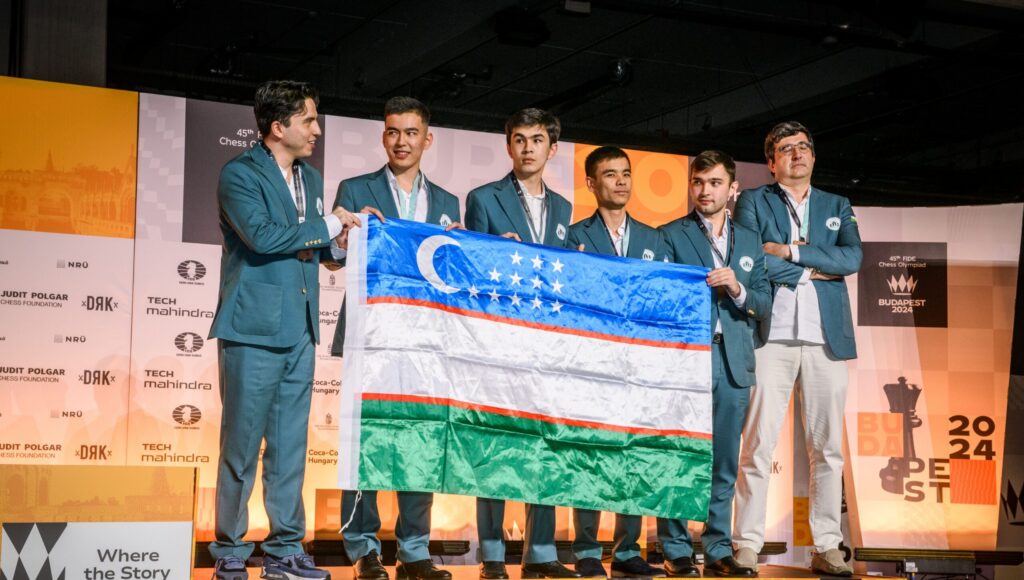
Uzbekistan has won the Open section of the 46th FIDE Chess Olympiad in Samarkand, claiming its second title after its breakthrough victory in Chennai in 2022. The hosts entered the final round with 18 match points, one ahead of defending champions India. Uzbekistan defeated Ukraine 2.5-1.5 to finish with 20 points, while India drew 2-2 with Hungary. India’s draw meant Uzbekistan had secured gold even before its match against Ukraine had finished. India and Germany both finished on 18 points, with India taking silver on tiebreak and Germany bronze. Mukhiddin Madaminov delivered the decisive win on board four against Ukraine, while the other three games ended in draws. [caption id="attachment_57312" align="aligncenter" width="1774"] Uzbekistan’s players during the final round of the Chess Olympiad in Samarkand. Image: FIDE[/caption] Uzbekistan won its first seven matches before Germany handed the hosts their only defeat of the tournament, 2.5-1.5, in Round 8. The team responded by beating the United States, the top seed in the Open section, in Round 9, before defeating Armenia 3.5-0.5 in the penultimate round. The winning squad consisted of Javokhir Sindarov, Nodirbek Abdusattorov, Nodirbek Yakubboev, Shamsiddin Vokhidov, and Mukhiddin Madaminov, with former FIDE world champion Rustam Kasimdzhanov serving as captain. Four of the five players had also been part of Uzbekistan’s gold medal team in Chennai in 2022. “The most important thing is how much attention is being paid to chess in our country,” Kasimdzhanov said at the Olympiad’s final press conference. He credited support from the president and prime minister with giving the team the conditions it needed to prepare and compete. Kasimdzhanov also pointed to the relationship among the players as an important factor in the team’s performance. “Such unity does not exist in every team. We are together, we are friends, and that helps us.” Preparations, he added, extended to details beyond the chessboard. “We did everything we could. We left nothing to chance,” he said. “Considering how important this tournament was, we carefully thought through even the smallest details.” The Samarkand victory extends Uzbekistan’s run of medals at three consecutive Olympiads: gold in Chennai in 2022, bronze in Budapest in 2024, and gold again in Samarkand. Abdusattorov also won the individual gold medal on board one in Samarkand, posting a performance rating of 2869. Kazakhstan won silver in the women’s competition after drawing 2-2 with Poland in the final round. China took gold, while India claimed bronze on tiebreak. The competition ran from September 16 to 27, following the opening ceremony on September 15. Before the tournament, FIDE said a record 400 teams had registered across the two main competitions, with 208 in the Open section and 192 in the Women’s section, surpassing the previous record set in Budapest in 2024. The home victory also came days after Uzbekistan increased financial rewards for its leading chess players. Under Presidential Resolution No. PP-346, adopted on September 21, gold at the senior World Chess Olympiad or Chess Paralympiad carries a one-time award of $200,000 for each player. The corresponding...

Samarkand Chess Olympiad Hosts FIDE Election as Timur Turlov Outlines His Plans

The 46th FIDE Chess Olympiad in Samarkand, Uzbekistan, brings national teams together from September 15 to 27. Alongside the competition, delegates will elect the next leadership of FIDE, the International Chess Federation. Three presidential tickets have been approved for the September 26 election. Entrepreneur Jan Henric Buettner, co-founder of Freestyle Chess with Magnus Carlsen, is running with Malcolm Pein for deputy president. WR Chess founder and WR Group chairman Wadim Rosenstein is standing with Gordon Tang. Freedom Holding Corp. founder and CEO Timur Turlov, who also heads the Kazakhstan Chess Federation, is running with Viswanathan Anand. The Times of Central Asia spoke with Turlov about his experience of chess within his family and his proposals for managing the international federation. TCA: Before we talk about professional chess and FIDE, let’s start at the beginning. What is your personal history with chess? Turlov: I learned to play chess as a kid; my grandfather taught me. He saw it as a parenting tool, and it just became part of the family. Over time I drifted away from the game, but I eventually came back. What brought me back wasn't nostalgia or any urge to win; it was my kids, and the sense that real relationships are built on substance, on actually connecting with and sharing with people. Having six children has been one of the great blessings of my life, and when they started playing and asked me to join them, I had good reason to pick the game back up, this time as a parent, and not as a student. It's a small thing, but it reminded me how much family life keeps you grounded, thinking about someone other than yourself. Chess is one way for people to develop relationships and grow in virtue. TCA: You describe chess as a parenting tool as much as a sport. How does that work in practice? Turlov: With six children, finding one consistent way to connect with all of them isn't easy. They're each unique, of different ages, and with different personalities. Chess turned out to be that common ground for us that could be cultivated year after year. Sitting across the board from your child is different from a conversation at dinner. It's slower, calmer, and it opens the door to talking about things that usually don't come up otherwise. Honestly, some of my favorite moments as a parent have happened over a chessboard, not in spite of the game but because of it. TCA: Can you give an example of what a chess game actually teaches a child that a normal conversation can't? Turlov: Beyond strategic thinking- call it looking ahead- there's something in chess that matters even more: learning how to win, and especially how to lose. Chess is one of the few structured experiences where a child loses clearly, sees exactly why, and has to sit with that calmly, without a tantrum, without blaming anyone else. As a parent, that's also a moment for reflection. You can talk through the...

Samarkand Expects Record Turnout for Chess Olympiad

Samarkand is preparing to host the largest Chess Olympiad yet, with organizers expecting 398 teams as Uzbekistan stages the tournament for the first time in Central Asia. The 46th Chess Olympiad opens on September 15 at the Silk Road International Tourism Center and runs until September 27, with the first round to be played on September 16, according to the official schedule. Organizers say 208 teams will compete in the Open section and 190 in the women’s competition. The expected field of 1,974 players includes 240 grandmasters. More than 4,000 guests are expected when coaches and delegation members are included. That turnout would exceed the 374 teams recorded by FIDE at the 2024 Budapest Olympiad. Both sections will be contested over eleven rounds, with four players competing for each team in every match. Teams may also register one reserve player. The Olympiad dates back to 1927. Its arrival in Samarkand brings the competition to a historic Silk Road city whose center is inscribed on UNESCO’s World Heritage List. Uzbekistan enters the Open competition as the third seed, according to the organizers’ figures based on average team ratings. The United States leads the seedings, ahead of defending champions India. The U.S. team includes Fabiano Caruana, Wesley So, and Levon Aronian, while Hans Niemann is set to make his Olympiad debut. Vincent Keymer will represent Germany, and France’s squad includes Maxime Vachier-Lagrave. For Uzbekistan, Javokhir Sindarov and Nodirbek Abdusattorov bring top-ten credentials to the home challenge. Sindarov is fourth in FIDE’s September rankings, while Abdusattorov is seventh. The rankings cited by the organizers also place Nodirbek Yakubboev 39th and Shamsiddin Vokhidov 61st, giving the main squad four players among the world’s top 100. Former FIDE world champion Rustam Kasimdzhanov has also been named in the main Open lineup. His inclusion adds experience to a squad built around Uzbekistan’s younger grandmasters. The hosts will field three teams in each section, opening places for emerging players. Nilufarkhon Imomkuziyeva and Khumoyun Begmurodov, both 16, are among those making their Olympiad debuts. In the women’s competition, Gulrukhbegim Tokhirjonova is set to represent Uzbekistan after playing for the United States at the 2024 Budapest Olympiad. Nafisa Muminova, Uzbekistan’s first woman grandmaster, will serve as captain. The organizers cite Afruza Khamdamova’s position at 26th in the women’s world rankings, with Tokhirjonova 80th. Uzbekistan’s women have climbed 17 places since 2025 to 21st in FIDE’s federation rankings, while the Open side has risen 15 places to sixth. India is the top seed in the women’s competition. Kazakhstan’s lineup includes three-time women’s world blitz champion Bibisara Assaubayeva, who also won Norway Chess Women 2026, securing the title in Oslo with a round to spare. Ukraine’s first board will be 16-year-old Anastasiia Hnatyshyn, who won the European Women’s Championship in June after entering the tournament as the 76th seed. Samarkand will also host the third FIDE Chess Olympiad for People with Disabilities from September 10 to 18. Organizers expect a record 41 teams, compared with 26 at the inaugural event in...

Will Host Uzbekistan Be the “Most Dangerous Team” at the Chess Olympiad?

Some 400 teams have been confirmed for the FIDE Chess Olympiad in Samarkand, Uzbekistan, next month, an increase of 20 teams over the previous record number that competed at the Olympiad in Budapest, Hungary two years ago. In the open section, the United States is the top seed with Fabiano Caruana leading the five-player team, while India will aim to defend its 2024 title with Arjun Erigaisi at the head of its lineup, according to FIDE, the international governing body of chess. “The host nation might be the most dangerous team in Samarkand,” FIDE said this week. Uzbekistan’s Javokhir Sindarov, winner of the prestigious Candidates Tournament in April, leads the team, ahead of Nodirbek Abdusattorov, another of the world’s top players. Nodirbek Yakubboev, Shamsiddin Vokhidov, Madaminov will also play for Uzbekistan, which won the Chess Olympiad in Chennai, India in 2022 and took bronze in Budapest. China is also fielding a strong team in the open section, while Germany is seeded fifth. The gender-neutral category is called open because women have occasionally participated in male-dominated chess events. In the women’s competition in Samarkand, India is the top seed with Humpy Koneru at the head of the team, followed by Georgia, China, Kazakhstan and the U.S., according to FIDE. Kazakhstan’s female chess players have been progressing strongly in recent years, finishing fifth at the Chess Olympiad in Chennai, India in 2022, and second in Budapest in 2024. Bibisara Asaubayeva, who was second at the women’s Candidates tournament this year, leads her squad, followed by Alua Nurman, Meruert Kamalidenova, Elnaz Kaliakhmet and Zarina Nurgaliyeva. Host Uzbekistan is seeded 13th on the women’s side in Samarkand. The Chess Olympiad will feature 11 rounds of classical chess from September 16 to 27.