
• KGS/USD = 0.01144 0%
  • KZT/USD = 0.00198 -0%
  • TJS/USD = 0.10879 -0%
  • UZS/USD = 0.00008 0%
  • TMT/USD = 0.28571 0%
  • KGS/USD = 0.01144 0%
  • KZT/USD = 0.00198 -0%
  • TJS/USD = 0.10879 -0%
  • UZS/USD = 0.00008 0%
  • TMT/USD = 0.28571 0%
  • KGS/USD = 0.01144 0%
  • KZT/USD = 0.00198 -0%
  • TJS/USD = 0.10879 -0%
  • UZS/USD = 0.00008 0%
  • TMT/USD = 0.28571 0%
  • KGS/USD = 0.01144 0%
  • KZT/USD = 0.00198 -0%
  • TJS/USD = 0.10879 -0%
  • UZS/USD = 0.00008 0%
  • TMT/USD = 0.28571 0%
  • KGS/USD = 0.01144 0%
  • KZT/USD = 0.00198 -0%
  • TJS/USD = 0.10879 -0%
  • UZS/USD = 0.00008 0%
  • TMT/USD = 0.28571 0%
  • KGS/USD = 0.01144 0%
  • KZT/USD = 0.00198 -0%
  • TJS/USD = 0.10879 -0%
  • UZS/USD = 0.00008 0%
  • TMT/USD = 0.28571 0%
  • KGS/USD = 0.01144 0%
  • KZT/USD = 0.00198 -0%
  • TJS/USD = 0.10879 -0%
  • UZS/USD = 0.00008 0%
  • TMT/USD = 0.28571 0%
  • KGS/USD = 0.01144 0%
  • KZT/USD = 0.00198 -0%
  • TJS/USD = 0.10879 -0%
  • UZS/USD = 0.00008 0%
  • TMT/USD = 0.28571 0%
04 December 2025

Viewing results 1 - 6 of 3

Kyrgyz Authorities Take Action to Curb Rising Food Prices

Kyrgyzstan’s Deputy Prime Minister Bakyt Torobaev has directed key government agencies to implement urgent measures aimed at stabilizing prices for socially significant food products. According to official information, the government’s list of essential goods includes meat, vegetable oil, flour, potatoes, sugar, carrots, onions, and other staples, totaling 50 items. Torobaev’s directive includes enhanced monitoring of price fluctuations, tighter oversight of food imports and exports, and a focus on inflation risk mitigation. He has called for the development of short-term mechanisms to contain price increases. The Antimonopoly Regulation Service and the National Statistics Committee have been tasked with conducting daily price monitoring in major cities. The State Tax Service has been instructed to explore the possibility of reducing VAT on imported food products. In parallel, the National Bank of Kyrgyzstan is expected to design preferential loan mechanisms for agricultural producers and livestock breeders. Torobaev emphasized the urgency of these measures, noting that approximately 65% of the population derives income from agriculture, and that expanded state support is critical to economic stability. In Bishkek, the government plans to open municipal pavilions where essential food items will be sold at fixed prices. If successful, the model will be scaled to other regions as part of broader anti-crisis efforts. “The Cabinet of Ministers is continuously working on implementing and overseeing a unified pricing policy,” said Torobaev. According to the National Statistics Committee, Kyrgyzstan’s consumer price index rose by 4% in the first half of 2025. Food prices increased by an average of 6%, with potatoes showing the steepest rise, nearly 50%, during the same period.
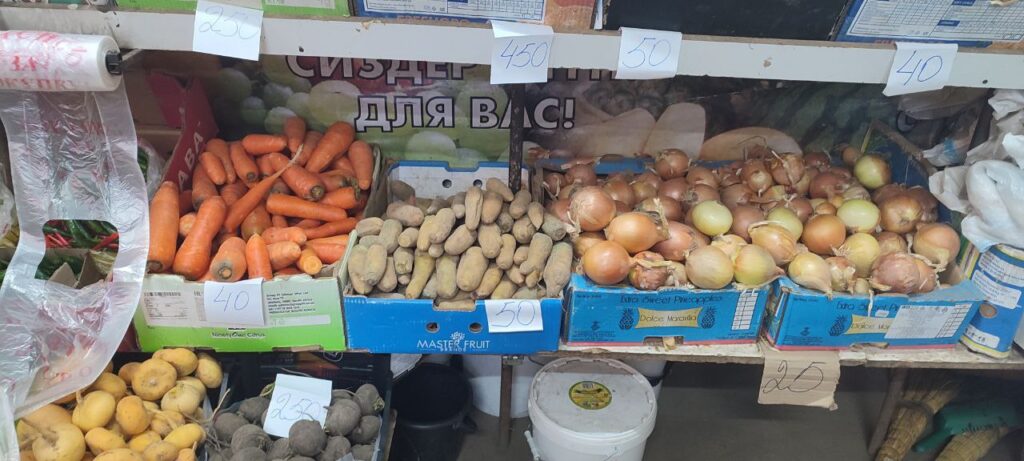
Kyrgyzstan Grows Toward Food Security with Surplus Potato and Carrot Harvests

The Kyrgyz government is stepping up efforts to ensure food security and stabilize prices for socially important goods, including staple vegetables such as potatoes and carrots. In response to rising prices, the Ministry of Water Resources, Agriculture, and Processing Industry has decided to maintain existing potato crop volumes while expanding carrot cultivation. According to the ministry, the active open-field growing season is currently underway. In 2025, potato planting areas reached over 64,000 hectares, with a projected harvest exceeding 1.1 million tons. Domestic demand is estimated at approximately 760,000 tons annually, allowing for surplus exports. However, the ministry cautioned farmers against indiscriminately expanding potato acreage in pursuit of higher profits, warning that an oversupply could depress prices and reduce incomes. “To prevent unjustified price increases for socially significant products, the Ministry of Agriculture continues to monitor market prices daily. If risks of domestic shortages arise due to excessive exports or speculative practices by intermediaries, temporary export restrictions will be considered,” the ministry stated. Amid recent price surges for carrots, the government has expanded carrot cultivation by 223 hectares in the Chui region. “The second carrot harvest will ensure a stable domestic supply and help contain price increases,” said Agriculture Minister Bakyt Torobaev. The ministry attributes the current price increases to heightened demand for Kyrgyz vegetables from member states of the Eurasian Economic Union (EAEU) and neighboring countries. Uzbekistan remains the largest importer of Kyrgyz potatoes. In 2024, Kyrgyz exports to Uzbekistan doubled to 68,500 tons, prompting state intervention and temporary export restrictions to prevent domestic shortages and inflation. In addition to Uzbekistan, Kyrgyzstan annually exports over 10,000 tons of potatoes to Kazakhstan, as well as smaller volumes to Russia and Azerbaijan.

Kazakhstanis Spend Over Half Their Family Budget on Food

Over the past two decades, food expenditures have claimed an increasingly large share of Kazakh family budgets. According to analysts at Finprom.kz, food accounted for 55.4% of total consumer spending in 2024, nearly 10 percentage points higher than in 2004, when the figure stood at 45.7%. The rise has been gradual, with a peak of 58% during the COVID-19 pandemic in 2020, followed by a slight decline. The Growing Burden of Food Costs This trend signals concern about living standards. Under UN benchmarks using the Engel coefficient, households that spend over 50% of their income on food are considered to have a very low standard of living The burden varies significantly across Kazakhstan’s regions. In the capital, Astana, where average incomes are higher, food accounts for 49.4% of consumer spending. In contrast, the economically vulnerable Turkestan region reports a figure of 62.6%. High levels are also recorded in the Almaty (62.1%), Zhambyl (61.8%), and Zhetysu (60.9%) regions. This regional disparity is not new. In 2004, residents of the capital and central regions also spent less on food than those in the country’s western and southern areas. Back then, Atyrau, Mangistau, and Almaty regions led in food expenditure shares. Rising Food Budgets Driven by Consumption, Not Cuts Despite the heavier budget allocation toward food, Kazakhstanis are not cutting back. On the contrary, consumption has grown in several food categories. Compared to 2004, annual per capita meat consumption has doubled to 82.6 kg. Consumption of fish and seafood has risen by 79.5% to 14.2 kg, and sweets by 51.4% to 43.1 kg. Only two categories saw declines: fruit consumption dropped by 41%, and potato consumption by 8.5%. These changes suggest that the rising share of food expenditures is driven more by shifts in dietary preferences and expanded consumption than by inflation alone. Food Spending as a Barometer of Prosperity Kazakhstan ranks near the bottom globally for food expenditure efficiency. According to 2023 estimates by Euromonitor International, the country placed 99th out of 105, with food accounting for 49.4% of total consumer spending. In comparison, food spending made up 46.5% in Uzbekistan, 36.9% in Turkmenistan, and just 29% in Russia. In high-income countries, the figures are significantly lower: 6.7% in the United States, 8.4% in Singapore, and 8.7% in the United Kingdom. These disparities reflect not only income differences but also broader variations in economic structures and the effectiveness of social policies. A Symptom of Structural Strain The trend in Kazakhstan highlights a broader economic challenge. While food consumption has increased, the rising proportion of household budgets spent on food signals a systemic issue: wages and social benefits are not keeping pace with rising costs and evolving consumer expectations. As long as more than half of family budgets are directed toward food, substantial growth in other sectors of consumer spending remains out of reach.
