
• KGS/USD = 0.01144 0%
  • KZT/USD = 0.00198 -0%
  • TJS/USD = 0.10903 0.18%
  • UZS/USD = 0.00008 0%
  • TMT/USD = 0.28571 0%
  • KGS/USD = 0.01144 0%
  • KZT/USD = 0.00198 -0%
  • TJS/USD = 0.10903 0.18%
  • UZS/USD = 0.00008 0%
  • TMT/USD = 0.28571 0%
  • KGS/USD = 0.01144 0%
  • KZT/USD = 0.00198 -0%
  • TJS/USD = 0.10903 0.18%
  • UZS/USD = 0.00008 0%
  • TMT/USD = 0.28571 0%
  • KGS/USD = 0.01144 0%
  • KZT/USD = 0.00198 -0%
  • TJS/USD = 0.10903 0.18%
  • UZS/USD = 0.00008 0%
  • TMT/USD = 0.28571 0%
  • KGS/USD = 0.01144 0%
  • KZT/USD = 0.00198 -0%
  • TJS/USD = 0.10903 0.18%
  • UZS/USD = 0.00008 0%
  • TMT/USD = 0.28571 0%
  • KGS/USD = 0.01144 0%
  • KZT/USD = 0.00198 -0%
  • TJS/USD = 0.10903 0.18%
  • UZS/USD = 0.00008 0%
  • TMT/USD = 0.28571 0%
  • KGS/USD = 0.01144 0%
  • KZT/USD = 0.00198 -0%
  • TJS/USD = 0.10903 0.18%
  • UZS/USD = 0.00008 0%
  • TMT/USD = 0.28571 0%
  • KGS/USD = 0.01144 0%
  • KZT/USD = 0.00198 -0%
  • TJS/USD = 0.10903 0.18%
  • UZS/USD = 0.00008 0%
  • TMT/USD = 0.28571 0%
05 December 2025

Viewing results 1 - 6 of 5

Opinion: Ghosts of the Gulag – A View From the Ground

Recently, The Times of Central Asia published an article titled Ghosts of the Gulag: Kazakhstan’s Uneasy Dance With Memory and Moscow. While it is essential to consider outside opinions, it is equally important to articulate how this perspective looks from within. In Kazakhstan, there are three large museums dedicated to the memory of the victims of the communist regime. These are the infamous ALZHIR (Akmolinsk Camp for Wives of Traitors to the Motherland), the museum dedicated to the memory of victims of political repression, KARLAG (Karaganda camp), and a smaller memorial complex to the victims of political repression at Zhanalyk, located about 40 kilometers from Almaty. Historians believe that around 2,500 people are buried there, including prominent members of the Kazakh intelligentsia, such as Akhmet Baitursynov, Mukhamedzhan Tynishpaev, Saken Seifullin, Ilyas Jansugurov, and Beimbet Maily. In addition to these museums, there are monuments to the victims of political repression and the famine of the 1920s–30s in many cities across the country. But it's not just about the number of museums and monuments. What matters most is that the memory of these events is preserved, and it is being carefully studied. In 2020, a state commission for the full rehabilitation of victims of political repression was established by the government. Over several years, 425 scholars, researchers, and experts have participated in its work. More than 2.6 million documents and materials have been declassified. Most importantly, this commission has rehabilitated more than 311,000 victims of political repression within the framework of existing legislation. The results of this work are documented in 72 volumes. There are no sections in these research materials divided by nationality. The approach is the same for everyone: justice and fairness for all. This calls into question the “collective amnesia that obstructs historical reckoning” referred to by Guillaume Tiberghien, a specialist in dark tourism at the University of Glasgow. Regarding any "emphasis on what the prison system ‘contributed’ to the nation” mentioned by Margaret Comer, a memory studies expert at the University of Warsaw, there are conflicts of interest and truths people would rather not face. One of the main purposes of Karlag was to serve as a major base of food supplies for Kazakhstan’s growing coal and metallurgical industries. In addition to industrial development, by 1941 the camp had 70 sheep farms, 45 cattle farms, one horse farm, and two pig farms. By 1950, 4,698 people worked on these farms, including 13 academic scientists. The communist system of corrective labor camps was an integral part of economic development, achieved through what was essentially slave labor. This is the full cynicism of the regime on display: prisoners were expected to “work off” their guilt. “The country is walking a tightrope,” Tiberghien suggests, pointing to President Tokayev’s speech on May 31, the official Day of Remembrance for Victims of Political Repression. “It wants to keep things calm, to avoid upsetting Russia.” In this speech, while calling for the rehabilitation of victims and greater access to archives, Tokayev also condemned the...
Opinion: Ghosts of the Gulag: Kazakhstan’s Uneasy Dance With Memory and Moscow

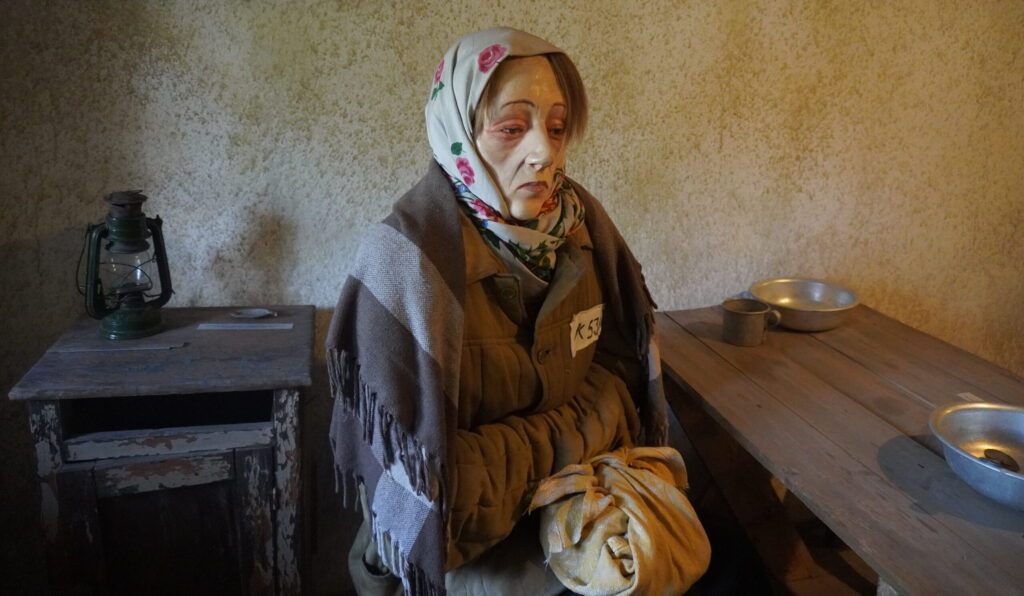
In May 2025, the authorities in Moscow unveiled a life-size bas‑relief sculpture of Josef Stalin in the Taganskaya metro station. The next month, a statue of Lenin was pulled down in Osh, Kyrgyzstan. Between these two symbolic acts lies Kazakhstan, caught in a tug-of-war over the memory of Soviet-era repression. Between 1920 and 1960, millions of prisoners were deported to more than fifty labor camps across what was later to become the Republic of Kazakhstan. Those who weren’t executed on the spot — political opponents, intellectuals, artists — were forced to work in mines, construction sites, or collective farms feeding Soviet industrial expansion. The death toll remains unknown but is believed to be in the millions. Today, this dark past draws in history buffs and thrill-seekers. But darktourism.com, the go-to website on the topic, warns them: forgotten cemeteries, ghost villages, crumbling camps — this gulag archipelago is well hidden in the steppes. No sign points the way to the Museum of Political Repression in Dolinka, housed in the former headquarters of Karlag, one of the largest camps of the Soviet Gulag system. The only other gulag transformed into a museum is ALZHIR, built on the ruins of the Akmola camp near Astana. It commemorates the 18,000 women imprisoned between 1939 and 1953 for being the wives of “traitors to the motherland.” These two museums now stand as official symbols of Soviet repression in Kazakhstan, and, more subtly, as frontline sites in a broader memory war across the former Soviet Union. Selective Memory When the museums were nationalized in the 2000s, their message became tightly controlled. Portraits and quotes from former president Nursultan Nazarbayev began to cover the walls. Guillaume Tiberghien, a specialist in dark tourism at the University of Glasgow, calls it a “selective interpretation of history.” The goal? To unify the country’s 160 ethnic groups under a shared narrative of collective suffering. At both Karlag and ALZHIR, guides emphasize acts of solidarity between Kazakh villagers and deportees — hospitality, compassion, bits of cheese tossed over barbed wire fences to feed the starving. [caption id="attachment_34338" align="aligncenter" width="2560"] Execution scene recreated at the Karlag museum; image: Manon Madec.[/caption] The past is staged. Between wax statues with sunken faces, sound effects mimicking heartbeats, and torture room reconstructions, the visitor is drawn into a visceral experience, sometimes at the cost of accuracy. “You wonder if the museum overdoes it to trigger emotion,” Tiberghien remarks. Margaret Comer, a memory studies expert at the University of Warsaw, explains: “It’s sometimes easier to mourn victims than to identify perpetrators.” [caption id="attachment_34337" align="aligncenter" width="2560"] Execution scene and fake blood, reconstructed in the Dolinka museum; image: Manon Madec.[/caption] The complicity of local Kazakhs is never addressed. Russian responsibility is blurred behind vague terms like “NKVD” or “Stalinist repression.” At ALZHIR, visitors learn only about Sergey Barinov — a Russian commandant described as cultured, discreet, and caring toward the women detained. The other two camp directors are never mentioned. In other former Soviet republics — Ukraine, the Baltics, Georgia — such...

Tokayev Honors Victims While Putin Rewrites Stalin’s Past

On May 31, 2025, President Kassym-Jomart Tokayev of Kazakhstan stood at the Museum and Memorial Complex “ALZhIR,” which Stalin had established in 1937 as a camp in the Soviet Gulag. Akmola was the name of Astana at the time, and “ALZhIR” is a Russian acronym for “Akmola Camp of Wives of Traitors to the Motherland.” The former Gulag camp, as its name indicates, was for women (a total of roughly 8,000, not to mention over 1,500 children born in the camp) who were detained solely for their familial associations with accused intellectuals or political dissidents. The full name of the Complex, which opened in 2007, is the Museum and Memorial Complex in Memory of Victims of Political Repression and Totalitarianism. In a solemn wreath-laying ceremony, declaring the imperative to preserve memory and confront the Soviet past directly, Tokayev provided a stark contrast to simultaneous developments in Russia, where orchestrated celebrations and symbolic gestures have contributed to the resurrection and sanitization of Stalin’s legacy. [caption id="attachment_32500" align="aligncenter" width="1200"] The Museum and Memorial Complex “ALZhIR”; image: TCA [/caption] This year, Russia’s state apparatus has initiated a broad and deliberate campaign to reinsert Stalin into the country’s national consciousness. Major new monuments have been erected, existing public spaces have been renamed, and state-controlled media have popularized new narratives of Stalin’s leadership. The unveiling of a statue of Stalin in mid-May at the Taganskaya metro, one of Moscow’s busiest stations, received a significant degree of international attention. It was a meticulous restoration of the bas-relief sculpture, “The People’s Gratitude to the Commander-in-Chief,” a work that had been destroyed during the Khrushchev-era de-Stalinization. Cities like Vologda, where Stalin was exiled from 1911 to 1914, have joined this revival, with local leaders organizing public lectures praising his wartime “strategic genius.” Volgograd’s airport was renamed as Stalingrad International Airport by presidential decree. The 80th anniversary of the Soviet victory over Nazi Germany provided a ready pretext for these efforts. The resurrection of Stalin’s image in Russia serves more than a commemorative function. It represents a strategic deployment of a historical narrative to justify present-day authoritarian practices. President Vladimir Putin has repeatedly drawn explicit parallels between the sacrifices of the Battle of Stalingrad and contemporary military operations in Ukraine, framing the use of force as a historical imperative. State-controlled media in Russia reinforce this framing, while educational curricula have been revised to highlight Stalin’s leadership while marginalizing the atrocities of his regime. This selective memory is an active construction of ideological hegemony, consolidating state power through the manipulation of historical truth. Yet while Russia is reconstructing a mythic narrative that merges nostalgia with political expediency, Kazakhstan is confronting the traumas of its past. Over the past five years, the State Commission on the Rehabilitation of Victims of Political Repression has reviewed thousands of cases, exonerating over 300,000 individuals. Public debates, academic conferences, and community initiatives have reinforced this commitment, along with the publication of survivor testimonies and the release of new archival materials. These materials cover not just...
