


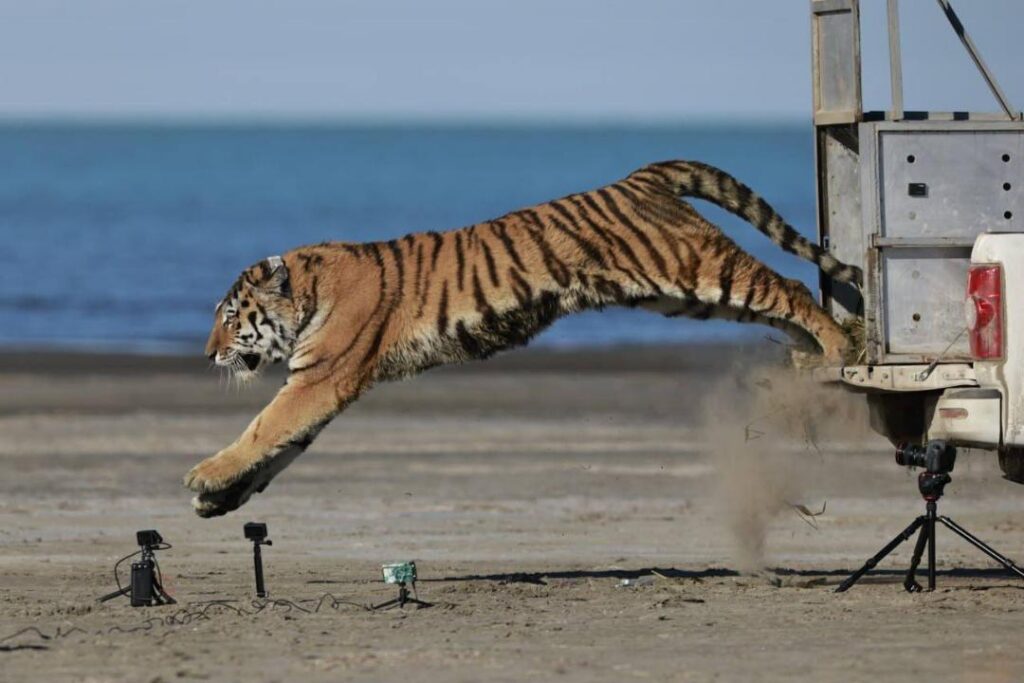
Kazakhstan Tiger Reintroduction: Second Amur Tiger Released into the Wild
Kazakhstan has released a second Amur tiger into the wild as part of a program to restore the big cats to Central Asia. The male, named Amur, was freed in the Ile-Balkhash State Nature Reserve in southeastern Kazakhstan on October 31. The first tiger, a female named Umit, was released on July 31. According to Kazakhstan's Ministry of Ecology and Natural Resources, she is already hunting independently and exploring her new territory. Both animals are being tracked using satellite collars. Tigers disappeared from the wild in Kazakhstan by the middle of the 20th century. Hunting contributed to their local extinction, while the development of river valleys destroyed the dense woodlands and shrublands along rivers in Central Asia's arid regions. Populations of wild boar, deer, and other prey animals also declined. The Turan, or Caspian, tiger once ranged from Central Asia to the Caucasus and northern Iran. Genetic studies have established its close relationship with the Amur tiger, which inhabits Russia's Far East. Conservationists therefore selected Amur tigers for reintroduction to this historical range. In November 2025, Kazakhstan and Russia agreed to transfer four tigers. In May 2026, two adult tigers and two cubs captured in the wild were brought from Russia's Khabarovsk region. They were placed in enclosures to adjust to conditions at the reserve, established in 2018 on the southern shore of Lake Balkhash. Before releasing Amur, specialists assessed his health, ability to find food independently, and response to human presence. The two cubs remain under observation. A decision on their release will be made once they reach an appropriate age and pass the necessary assessments. The return of tigers has raised concerns among some Kazakhstanis. After Umit's release, social media users questioned the safety of tourists and residents around Lake Balkhash. They worried that the tigress might approach settlements or attack livestock, while some said they were reconsidering trips to the lake. The ministry outlined a system of three safety zones around Umit's habitat. A specialized response team is tasked with intervening if a tiger approaches populated areas. Measures include warning residents, driving the animal back to a safe area, and, if necessary, sedating and relocating it. Public access to the reserve is restricted. An AI-generated tiger adjusting to life near Lake Balkhash has become a social media sensation through videos posted by @qreative_qazaq on Instagram. In the videos, the tiger speaks Russian and Kazakh, complains about mosquitoes, searches for a mobile phone signal, and tries to figure out where to find food. By August 11, the first video had attracted approximately 3.2 million views. Other images circulating online have caused confusion. In August, the ministry rejected a photograph purportedly showing a chance sighting of Umit. Officials said the image showed signs of possible AI generation and that specialists knew Umit's actual location through satellite monitoring. To support the tigers' return, conservationists are restoring tugai forests, woodlands that grow along rivers, and increasing populations of wild hoofed animals in the delta of the Ili River, which flows into Lake...
