


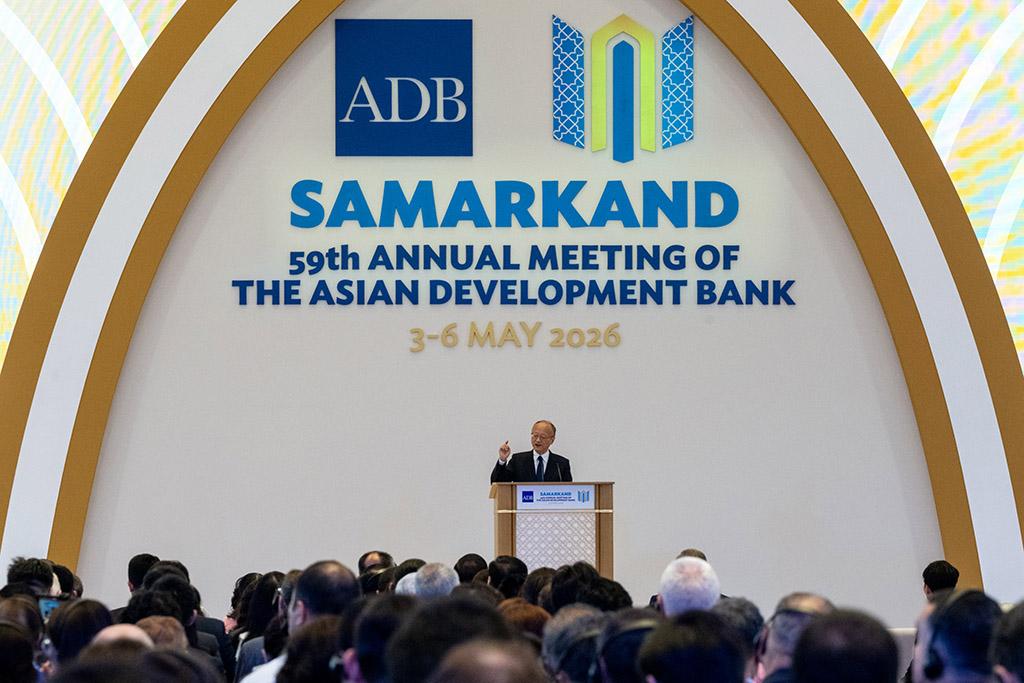
ADB Annual Meeting in Samarkand Unveils Major Energy, Climate, and Development Initiatives
The Asian Development Bank’s (ADB) 59th Annual Meeting concluded in the historic Uzbek city of Samarkand after four days of discussions focused on energy connectivity, climate financing, and economic resilience across Asia and the Pacific. Held from May 3 to 6, the gathering brought together government officials, development institutions, economists, and private sector representatives at a time of growing geopolitical and economic uncertainty. It marked the second time Uzbekistan has hosted the ADB Annual Meeting, following the 43rd edition in Tashkent in 2010. A central announcement at the meeting was the unveiling of a broader $70 billion regional infrastructure program aimed at accelerating energy and digital connectivity across Asia and the Pacific. The initiative is structured around two major pillars: a $50 billion Pan-Asia Power Grid Initiative focused on cross-border electricity systems, and a $20 billion digital connectivity component aimed at strengthening broadband and data infrastructure across the region. Together, these programmes are intended to reduce energy costs, improve reliability, and deepen regional economic integration. The Pan-Asia Power Grid Initiative (PAGI) In his address to delegates, ADB President Masato Kanda noted that PAGI seeks to support more interconnected and resilient infrastructure systems. "To survive and thrive in this new era, we must build deeply connected and resilient systems," he said, adding that stronger regional grids and digital networks can help countries manage rising energy demand whilst also accelerating the transition to cleaner power sources. The initiative seeks to integrate around 20 gigawatts of renewable energy capacity and the develop enough transmission infrastructure to expand electricity access for up to 200 million people. ADB officials said the bank would use its role as a regional convener to bring together governments, regulators, and private investors to overcome barriers that often slow regional infrastructure projects. The bank pointed to earlier success stories, including the Bangladesh-India power grid interconnection and the Monsoon Wind Power Project in Laos, as examples of cross-border cooperation supported through blended finance mechanisms. [caption id="attachment_37211" align="aligncenter" width="1536"] Image: TCA, Stephen M. Bland[/caption] Climate and Food Security Concerns Climate and environmental financing also featured prominently during the Samarkand meetings. On May 5, the ADB announced that the German government had joined the bank’s Nature Solutions Finance Hub with €5.5 million ($6.5 million) in grant co-financing, some of which has been earmarked for sorely needed watershed rehabilitation in Uzbekistan. The discussions also reflected growing concern over global food security and supply chain vulnerabilities linked to the ongoing war in Iran. Qingfeng Zhang, Senior Director of ADB’s Agriculture, Food, Nature, and Rural Development Sector Office, warned that disruptions around the Strait of Hormuz were increasing the cost of everything from energy to insurance, freight to fertilizer – placing additional pressure on food systems across Asia and the Pacific, including Central Asia. Unlike the shock caused by Russia’s invasion of Ukraine, which directly disrupted grain and fertilizer exports, Zhang said the current crisis was affecting agriculture primarily through higher operating and transportation costs. The Strait of Hormuz handles roughly one-quarter of global seaborne oil...
