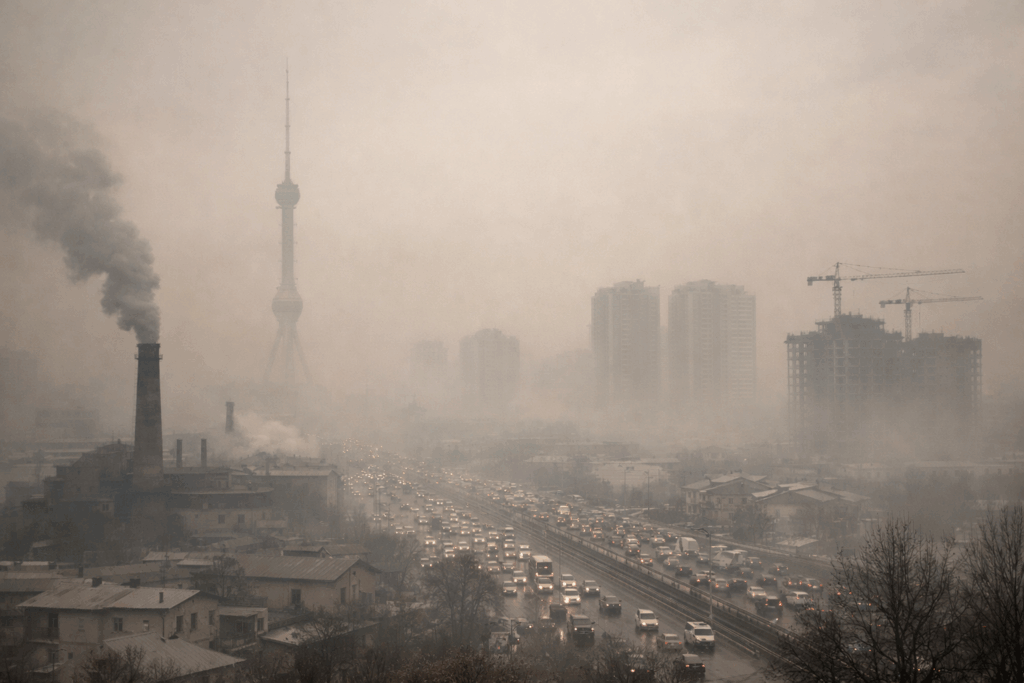
Tashkent Choked by Smog: What 2025 Revealed and How Residents Are Responding
The year 2025 proved especially challenging for air quality in Uzbekistan’s capital, with Tashkent repeatedly ranking among the world’s most polluted cities during peak smog episodes. At times, short-term air quality readings placed it alongside major Asian megacities during severe pollution spikes. These rankings were more than just statistics. Thick smog became a daily reality for residents, disrupting everyday life and intensifying concerns over public health and long-term environmental sustainability. Coal, Cars, and Construction: What’s Fueling the Smog Officials from Uzbekistan’s Ministry of Ecology and independent environmental researchers say Tashkent’s air pollution is primarily caused by human activity. The heaviest blow came from municipal furnaces and boiler houses. Amid ongoing natural gas shortages, many public facilities, including schools, kindergartens, and hospitals, were converted to coal or fuel oil, resulting in a surge of emissions. Uzbekistan’s coal consumption jumped from 3.9 million tons in 2019 to 6.7 million tons in 2023. Emissions from these sources accumulate in the lower atmosphere during the cold season, exacerbating pollution. Vehicle emissions are another major contributor. Tashkent has approximately 193 vehicles per 1,000 residents, roughly double the national average. Many cars run on low-octane AI-80 gasoline, which contains high levels of harmful impurities. While coal use has surged, vehicle emissions remain a serious issue. In 2019, motor transport accounted for the majority of urban air emissions in several districts of the city. Adding to the problem are industrial plants on the city’s outskirts, frequent dust storms during dry seasons, and unregulated urban development. High-rise construction has created wind barriers that disrupt air circulation, while green spaces, Tashkent’s natural air filters, have steadily disappeared. Despite an official moratorium on tree cutting, official and environmental group estimates indicate that around 49,000 trees have been felled since 2019, often by developers who face only minimal penalties. According to Uzbekistan’s Ministry of Ecology, PM2.5 concentrations in Tashkent routinely exceed World Health Organization guidelines. During peak smog episodes in early February 2024, pollutant levels were recorded at up to 22 times the WHO’s recommended annual limits. These fine particles penetrate deep into the lungs, triggering allergies, inflammation, and cardiovascular issues. A 2019 World Bank report cited air pollution as the cause of 89 deaths per 100,000 people in Uzbekistan, the highest rate in Central Asia. Winter smog episodes have intensified since then. Living Under a Haze: Residents Speak Out For many Tashkent residents, smog has become part of everyday life. People commonly report throat and eye irritation, a constant dusty haze, and difficulty breathing. “It’s dusty and hard to breathe, you feel it all the time,” said Victoria Son, 18, a student at Bucheon University. Karina Sagidullina, 19, a videographer and programmer with severe dust allergies, said the polluted air significantly affects her health. “My nose often gets blocked, I sneeze a lot. I have to do wet cleaning at home every day,” she said. Some residents, however, say they are less affected. “So far, I don’t really feel the air pollution. I breathe normally and don’t wear a mask,”...