


1856 Sketches Lead to Rediscovery of Petroglyphs in Kazakhstan
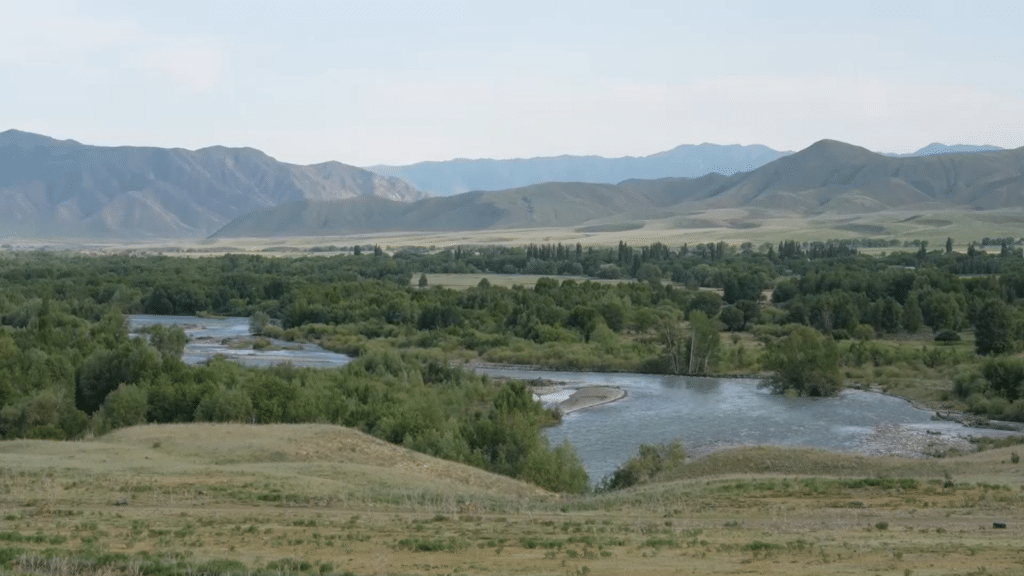
An explorer’s sketches of deer and wild goats have led archaeologists back to ancient rock carvings, or petroglyphs, in Kazakhstan, 170 years after he recorded them. A team from Kazakhstan and Russia identified the carvings in the valley of the Koksu River on October 13, according to an expedition account published on October 20 by the Institute of Archaeology of the Russian Academy of Sciences. Russian geographer and statistician Pyotr Semyonov-Tyan-Shansky recorded the carvings during his 1856 journey toward the Tian Shan mountains of Central Asia. After hearing about a rock bearing figures or inscriptions, he left his carriage and rode downstream along the Koksu River to investigate. His memoir’s August 26 entry describes deer and wild goats. At the site, archaeologists found his sketches and landscape descriptions remarkably accurate. They attribute the animal figures to the early Iron Age and the medieval period, identifying the largest deer, with its branching antlers, as an example of early Saka art. The Saka lived in what is now Kazakhstan during the first millennium BC. Gold ornaments recovered from their burial mounds include deer designs used to decorate clothing and horse equipment. The researchers compare the Koksu deer with animal designs in early Saka jewelry. The expedition is part of a Russian Geographical Society program retracing Semyonov-Tyan-Shansky’s journeys through present-day Kazakhstan and Kyrgyzstan in 1856 and 1857. Researchers are returning to the places he studied ahead of the 200th anniversary of his birth in 2027. His route led to Lake Issyk-Kul, in what is now Kyrgyzstan, where he investigated the course of the Chu River. European geographers had believed it flowed out of the lake, but he established that it turned away through a mountain gorge. In 1906, 50 years after his first journey, Emperor Nicholas II recognized his exploration of the Tian Shan by authorizing him to add Tyan-Shansky to his surname. Underwater excavations at Issyk-Kul’s submerged medieval settlement of Toru-Aygyr form another part of the anniversary program. Recent finds there include medieval coins dating to the 10th and 11th centuries. Archaeologists are investigating why the settlement ended up beneath the lake. The team that located the Koksu carvings mapped sites along the Kazakhstan route and took aerial photographs. Researchers now plan to create three-dimensional models of the monuments and an interactive map of Semyonov-Tyan-Shansky’s route through southeastern Kazakhstan, to be published on the society’s website.
