
• KZT/USD = 0.00214
  • TJS/USD = 0.10800
  • UZS/USD = 0.00008
  • TMT/USD = 0.29760
  • KZT/USD = 0.00214
  • TJS/USD = 0.10800
  • UZS/USD = 0.00008
  • TMT/USD = 0.29760
  • KZT/USD = 0.00214
  • TJS/USD = 0.10800
  • UZS/USD = 0.00008
  • TMT/USD = 0.29760
  • KZT/USD = 0.00214
  • TJS/USD = 0.10800
  • UZS/USD = 0.00008
  • TMT/USD = 0.29760
  • KZT/USD = 0.00214
  • TJS/USD = 0.10800
  • UZS/USD = 0.00008
  • TMT/USD = 0.29760
  • KZT/USD = 0.00214
  • TJS/USD = 0.10800
  • UZS/USD = 0.00008
  • TMT/USD = 0.29760
  • KZT/USD = 0.00214
  • TJS/USD = 0.10800
  • UZS/USD = 0.00008
  • TMT/USD = 0.29760
  • KZT/USD = 0.00214
  • TJS/USD = 0.10800
  • UZS/USD = 0.00008
  • TMT/USD = 0.29760
14 August 2026

Viewing results 1 - 6 of 2

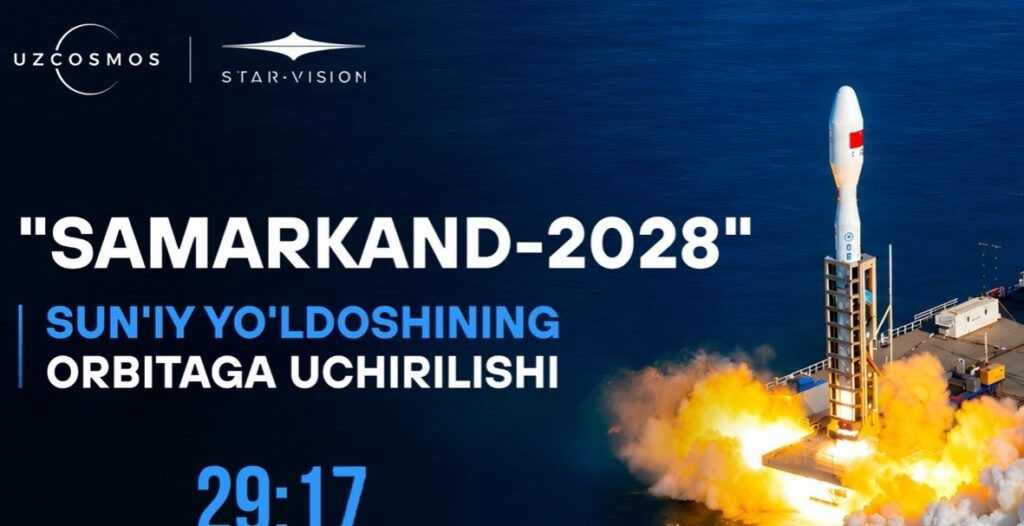
Uzbekistan’s AI Module Reaches Orbit Aboard Samarqand-2028 Satellite

A Chinese-built Earth observation satellite carrying artificial intelligence developed by Uzbek specialists was launched from a sea platform off China’s Shandong province on August 5. The Samarqand-2028 satellite was launched alongside Lampung-1, another Earth observation satellite from China’s STAR.VISION Aerospace. A livestream showed the rocket lifting off from the platform. STAR.VISION developed Samarqand-2028, while specialists from Uzbekistan’s national space agency, Uzbekcosmos, created its onboard AI module. Uzbekcosmos said this was the first time Uzbek specialists had participated in developing artificial intelligence for a satellite. Samarqand-2028 carries a hyperspectral sensor that records reflected light in 22 wavelength bands. A conventional color image records visible light in only three broad bands, while the additional bands can reveal details difficult to see with the human eye. Uzbekcosmos plans to use the images to create national maps of cotton and wheat cultivation and make initial assessments of air quality. As The Times of Central Asia reported on August 4, processing images onboard the satellite could reduce the amount of data transmitted to Earth and allow useful information to reach officials more quickly. Samarqand-2028 is separate from Uzbekistan’s first national scientific satellite, Mirzo Ulugbek. Seven Uzbek engineers studying at Kyushu Institute of Technology in Japan have begun developing the 6U satellite, which is scheduled for launch in 2028. The program is intended to train specialists and establish a domestic satellite engineering team. The next stage will be commissioning Samarqand-2028 and testing whether its AI module functions as intended in orbit. Its practical value will depend on whether Uzbek institutions can convert the imagery into useful information for agriculture and environmental monitoring.


Russia Offers Support for Uzbekistan’s First Cosmonaut and Satellite Launch

Russia is ready to help Uzbekistan prepare and send its first national cosmonaut into orbit and launch its first artificial satellite, Russian First Deputy Prime Minister Denis Manturov was quoted as saying by TASS. Manturov noted that Uzbekistan has set an ambitious goal of entering space exploration. “At the end of last year, President Shavkat Mirziyoyev outlined the task of preparing and sending the country’s first national cosmonaut into near-Earth orbit and launching its first artificial satellite,” he said. “As a strategic partner of Uzbekistan, we welcome these plans and are ready to use all our extensive experience and expertise to help implement them,” Manturov added. He also said Russia is currently engaged in preliminary discussions with several countries across the Commonwealth of Independent States, as well as in Asia, Africa, and the Middle East, on training astronauts and developing communication and Earth observation satellites. Russia has made similar offers to other Central Asian states. A few days earlier, Russia’s ambassador to Turkmenistan, Ivan Volynkin, said Moscow would support the training of a cosmonaut from Turkmenistan if Ashgabat expressed interest. His comments were published on the embassy’s official Telegram channel during an event marking the 65th anniversary of the first human spaceflight. Volynkin also highlighted the achievements of Oleg Kononenko, a native of Turkmenabat, who holds the record for the longest cumulative time spent in space, exceeding 1,100 days. He currently heads the Gagarin Cosmonaut Training Center. According to the ambassador, cooperation between Russia and Turkmenistan in the space sector could also include satellite production, launch services, navigation technologies, and joint scientific research.