


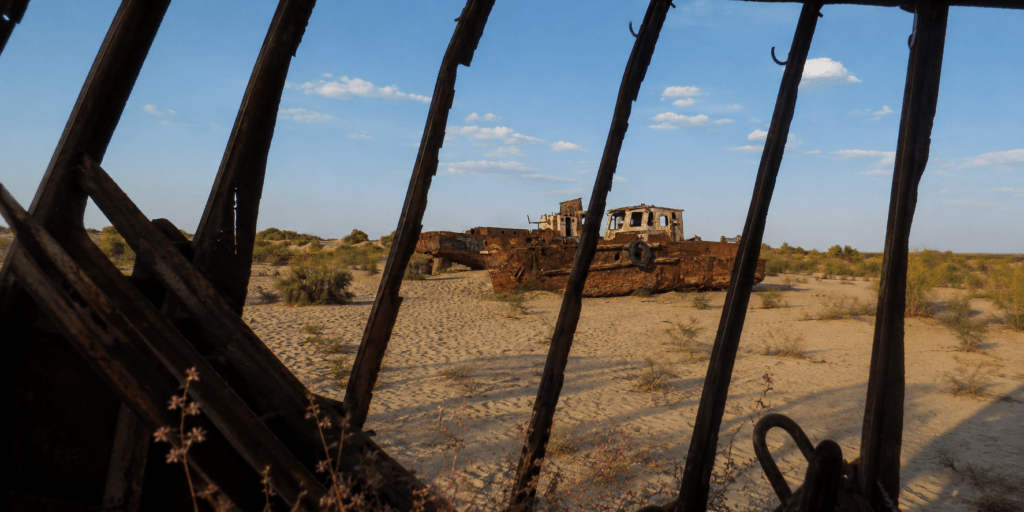
Aral Sea Restoration Could Prevent 605 Million Tons of CO2 Emissions
The drying of the Aral Sea has created another environmental problem: according to a study, exposed lakebed sediments released about 748 million tons of CO2 into the atmosphere between 1960 and 2022. Organic carbon remains stored in the sediments, and restoring part of the water cover could prevent the release of another 605 million tons of CO2. This gives efforts to restore the Aral Sea region a new climate dimension. The study, conducted by an international team of researchers led by scientists from Spain’s Centre for Advanced Studies of Blanes (CEAB-CSIC), was published in Science on July 16. The findings add another consideration to restoration efforts already underway across the region, from refilling part of the sea in Kazakhstan to planting saxaul and rehabilitating degraded land in Uzbekistan. The Aral Sea’s Carbon Legacy When the Aral Sea was still a fully-fledged body of water, plants and algae absorbed carbon dioxide, while some organic matter settled on the lakebed. As the water retreated, those sediments were exposed to the air, organic matter began to decompose, and the stored carbon started returning to the atmosphere as CO2. At the same time, winds carry salt and dust from the newly formed Aralkum Desert, spreading the consequences of the sea’s disappearance far beyond its former shoreline. In 2022, researchers conducted an expedition to the dried Aral Sea bed, collecting sediment samples and measuring how much CO2 was being released. Combined with satellite data, this allowed them to estimate carbon losses as the sea retreated. According to the researchers’ calculations, exposed sediments lost about 204 million tons of carbon between 1960 and 2022, equivalent to roughly 748 million tons of CO2. New vegetation growing on the dried lakebed has offset less than 1% of those emissions. A significant amount of organic carbon remains in the sediments. The researchers estimate that restoring water cover could prevent the release of another 605 million tons of CO2. The authors also considered the economics of such an effort. Using 2024 voluntary carbon market prices for land-use and forestry projects as a benchmark, they estimate that the avoided emissions could potentially be worth $3.6 billion to $18 billion in carbon credits. That money could theoretically become one source of funding for ecosystem restoration. Researchers estimate that about $9.7 billion in water-management improvements could increase inflows enough to restore roughly half of the area covered by the Aral Sea in 1960, while potentially generating about 323 million tons of CO2-equivalent carbon credits. Restoring the Entire Aral Sea Is No Longer the Goal Under current conditions, fully restoring the sea is widely considered unrealistic. The central issue is water. The Amu Darya and Syr Darya flow through several Central Asian countries. Significantly increasing the amount of water reaching the Aral Sea would be impossible without basin-wide agreements, irrigation modernization, and reductions in water losses. This is why restoration of the Aral Sea remains a regional issue rather than solely an Uzbek or Kazakh one. Central Asian countries coordinate part of this work...

