


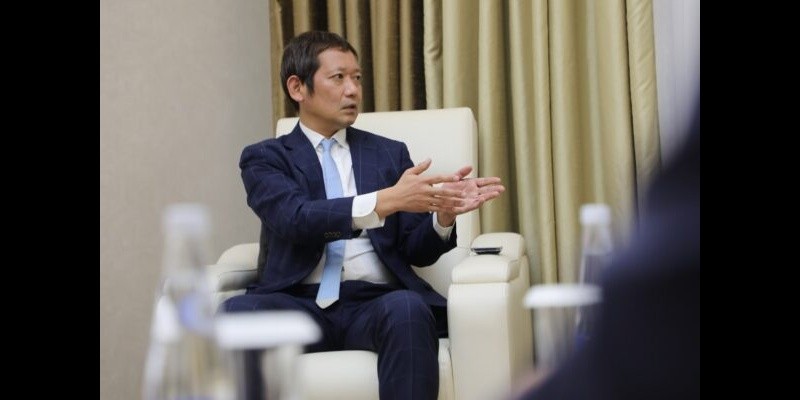
JICA’s Sota Tosaka on Afghanistan’s Economic Ties With Uzbekistan
Uzbekistan is deepening trade and transport ties with Afghanistan despite continuing political and humanitarian concerns, drawing its southern neighbor closer to Central Asian markets. In an interview with The Times of Central Asia, Sota Tosaka, chief representative of the Japan International Cooperation Agency (JICA) for Afghanistan, described that engagement as part of a practical regional approach. Uzbekistan and other Central Asian countries, he said, are seeking areas where economic cooperation can continue. Tosaka, who previously worked at JICA headquarters overseeing Central Asia and the Caucasus, has also visited Uzbekistan several times, including Termez. He said his current position gives him a different perspective on the relationship between Afghanistan and its northern neighbors. “I previously visited Termez in 2019 when I was overseeing the Central Asia and Caucasus region at JICA headquarters,” Tosaka told The Times of Central Asia. “At that time, the free trade zone aimed at facilitating business with Afghanistan did not exist yet. Returning to Termez recently, I was genuinely surprised to see how much progress has been made and how actively various cross-border initiatives are now being explored and implemented through Termez to connect Uzbekistan and Afghanistan.” Since taking charge of JICA’s Afghanistan operations, his work has focused on supporting Afghan people through international organizations. Tosaka noted that JICA’s primary focus remains on addressing the immediate needs of the Afghan population. To ensure that assistance directly reaches local communities and vulnerable groups, the agency coordinates its support through United Nations agencies and international partners. “Our priority is to deliver tangible support directly to the people of Afghanistan,” he said. “Working alongside UN partners allows us to effectively implement humanitarian activities that address daily challenges on the ground.” “Although the geopolitical environment surrounding Afghanistan has shifted significantly, Central Asian nations are actively pursuing opportunities to expand economic ties from their respective strategic viewpoints,” Tosaka continued. “Recognizing the importance of regional stability, countries like Uzbekistan are taking pragmatic steps to foster trade and commercial cooperation that serve mutual interests.” In particular, Uzbekistan’s proactive approach to encouraging business initiatives reflects a broader regional trend aimed at maintaining essential economic linkages. For Uzbekistan, the economic relationship has already become significant. Deputy Prime Minister Jamshid Khodjaev said in February that bilateral trade between Uzbekistan and Afghanistan has increased 2.5 times over the past five years, from $653 million in 2021 to $1.7 billion in 2025. The two countries have set a goal of raising annual trade to $5 billion. Tosaka noted that this economic orientation may become increasingly crucial given the diplomatic and logistical constraints Afghanistan faces on its eastern and western borders. “Complex relations with Pakistan and the geopolitical situation involving Iran present significant challenges for Afghanistan,” he explained. “Consequently, deepening economic ties with its northern neighbors becomes a vital strategic alternative. In this context, Central Asian nations serve as indispensable partners, creating mutually beneficial opportunities for sustainable regional development.” In parallel with these macro-economic trends, JICA is dedicated to strengthening grassroots economic resilience by empowering Afghan entrepreneurs, particularly women, in...
