


Kazakh Academic Kanysh Satpayev in Britain: A View from 1947
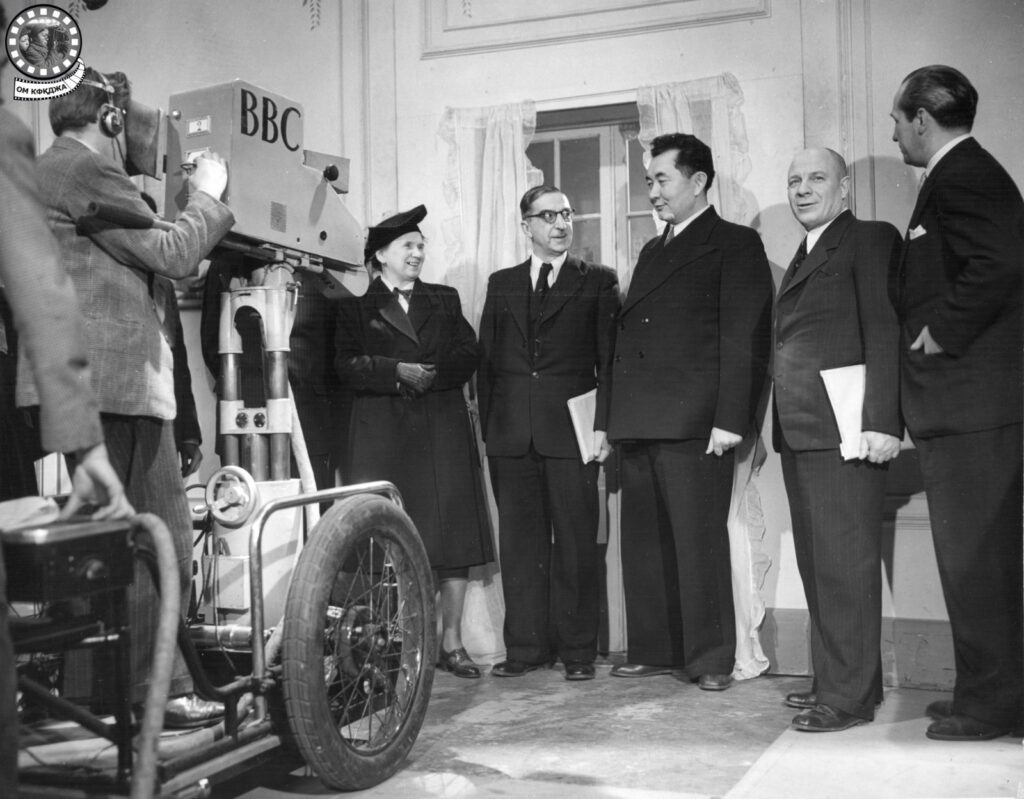
After the end of World War II, relations between the Soviet Union and Western countries began to deteriorate rapidly. Although Britain, France, the United States, and the Soviet Union had been allies, the period known as the Cold War began. Winston Churchill's famous speech in Fulton, Missouri, on March 5, 1946, is often regarded as one of its defining early moments. Nevertheless, just over a year after the speech, a large official Soviet delegation visited Britain in March 1947. The delegation represented the Supreme Soviet, the Soviet Union's legislature, and arrived in London at the invitation of both houses of the British Parliament. Clement Attlee's Labour government supported expanding contacts with the Soviet Union despite growing disagreements over the postwar settlement in Europe. [caption id="attachment_59046" align="aligncenter" width="1600"] Soviet delegates at Karl Marx’s grave. From left: Kanysh Satpayev, president of the Kazakh SSR’s Academy of Sciences; mathematician N. I. Muskhelishvili; and Soviet official P. A. Shariya. The other individuals have not been identified.[/caption] The delegation consisted of 20 people and was led by Vasily Kuznetsov, chairman of the Soviet of Nationalities, one of the Supreme Soviet's two chambers. Among its members were Alexander Fadeev, head of the Union of Soviet Writers and author of The Young Guard, about Soviet youth resisting Nazi occupation during World War II, and the poet and writer Konstantin Simonov. Aviator Mikhail Gromov, a Hero of the Soviet Union who commanded a nonstop flight from Moscow across the North Pole to San Jacinto, California, in 1937, also joined the delegation. Kanysh Satpayev, president of the Academy of Sciences of the Kazakh Soviet Socialist Republic, was also among the invited delegates. [caption id="attachment_59047" align="aligncenter" width="1600"] Soviet delegates meeting Newcastle’s Lord Mayor Pearson. From left: Ukrainian poet N. P. Bazhan, test pilot M. M. Gromov, Kanysh Satpayev, an unidentified individual, Soviet official P. A. Shariya, Communist Party foreign policy department head M. A. Suslov, and Pearson.[/caption] The delegation stayed for almost a month, from March 13 to April 11, 1947. The visitors met with Prime Minister Attlee, Conservative opposition leader Churchill, and members of Parliament. According to Satpayev's notes, the participants visited the University of London, the Royal Society, the British Museum, industrial enterprises, and government institutions. Outside the capital, the delegation visited Newcastle, Sheffield, Cardiff, Manchester, Oxford, Cambridge, Stratford-upon-Avon, Coventry, Edinburgh, and Glasgow. [caption id="attachment_59048" align="aligncenter" width="1600"] Soviet delegates viewing armor in the White Tower at the Tower of London. Among the delegates, from right: A. M. Ivanov, Kanysh Satpayev, and M. Z. Babayev.[/caption] In his report following the trip, Satpayev claimed that the British organizers had tried to overwhelm the visitors with official events and limit their contact with ordinary workers: "It should be noted that government officials tried to organize our visits to industrial enterprises in such a way that the delegation had practically no opportunity to communicate with workers. Visits to factory workshops often coincided with lunch breaks. Sometimes the delegation was shown workshops during working hours, but these were places where there were few...
