


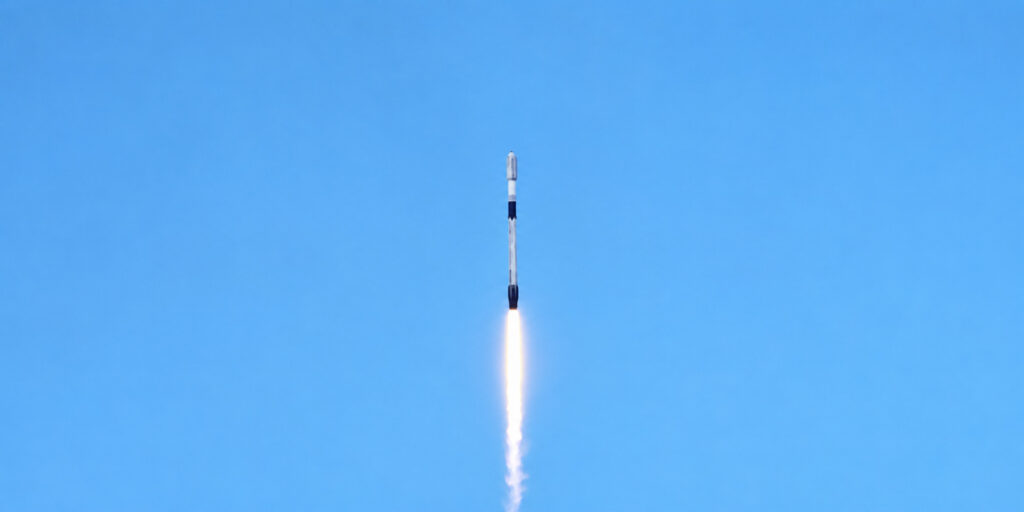
Two Central Asian Satellites Reach Orbit on SpaceX Rocket
A single SpaceX rocket carried two Central Asian spacecraft into orbit: Kyrgyzstan’s first national satellite and a spacecraft developed with the participation of students in Kazakhstan. The Falcon 9 lifted off from Vandenberg Space Force Base in California on October 1 as part of the Transporter-18 rideshare mission. The flight carried 130 payloads into low Earth orbit. Kyrgyzstan’s satellite weighs about five kilograms and is designed for Earth observation, with its data intended to help monitor agriculture, water resources, and environmental change. A team of about 10 engineers worked on the spacecraft for roughly two and a half years. Kazakhstan’s NIS PocketQube is a cube measuring just 5 × 5 × 5 centimeters and weighing about 250 grams. The spacecraft was developed at NIS Astana-Nura, part of the Nazarbayev Intellectual Schools (NIS) network. The satellite project began in 2019, and the school established its NIS Space laboratory and introduced a course in space technology electronics the following year. Seventeen students worked on the satellite’s hardware and software and helped prepare it for testing. In December 2022, the spacecraft underwent thermal-vacuum and mechanical testing at Kazakhstan’s National Space Center. Specialists from Kazakhstan Gharysh Sapary, Kazakhstan’s national space company, and Ghalam, a Kazakh-French spacecraft joint venture, also participated in the project. Unlike Kyrgyzstan’s Earth-observation satellite, NIS PocketQube is primarily an educational project. NIS says a ground station will be installed to receive and process telemetry, giving students across Kazakhstan access to the data for research and engineering projects. Kazakhstan already operates communications and Earth-observation satellites. By 2030, the country plans to establish an international Earth-observation constellation of nine satellites: six from Kazakhstan and one each from Mongolia, the Republic of the Congo, and Nigeria.
