


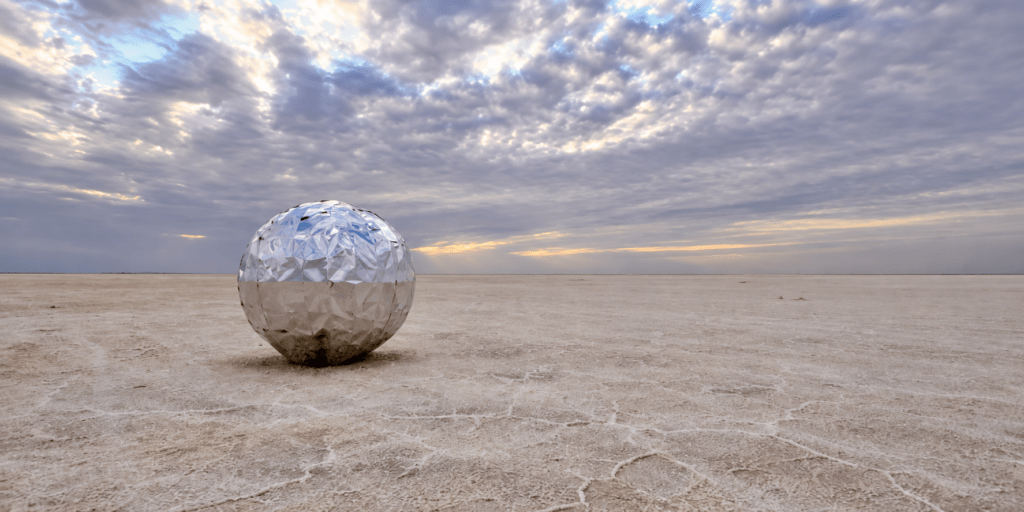
Artists Build a Temporary White Salt City in Karakalpakstan
For three days, a city appears on the Barsakelmes salt flat in Karakalpakstan. It has no permanent residents, shops, or spectators. There are tents and yurts, art installations, music, and several dozen people who have come to build, paint, perform, cook, and live together. Then the city disappears. The second international YONAR experimental art festival is taking place in Uzbekistan’s Kungrad District from September 17 to 19. Its site is about 200 kilometers from Nukus. Organizers call the temporary settlement White Salt City. There is no conventional festival audience: anyone who comes to YONAR becomes a participant. They can create an installation, play music, run a workshop, help build the camp, or take responsibility for part of the community’s daily life. Participation is free, subject to application. There is no commercial trade or advertising. After three days, participants are expected to dismantle the camp and remove their belongings and waste. YONAR follows a leave-no-trace principle: the salt flat should be left without signs of the temporary city. YONAR was created by the team behind Stihia, an electronic music, art, and science festival that originated in Karakalpakstan. Some of its principles clearly echo Burning Man: instead of a stage and an audience, there is a space created by the participants themselves; instead of commerce, exchange and communal living; instead of permanent architecture, structures built to last only a few days. The setting gives YONAR its particular character. The white surface of the salt flat has almost none of the usual landmarks. During the day, there is salt, horizon, and harsh light; at night, darkness and an open sky. Against this backdrop, even a temporary structure begins to look like part of the landscape. The first YONAR was held here on September 11-13, 2025. According to Uzbekistan’s Tourism Committee, 35 local and international participants created six major installations: Sphere, Monolith, Teleport, Statue of Amorphosis, Hologram of the Future, and Art Car Scorpion. Participants lived in five yurts, with generators providing electricity. At the end, Sphere and Teleport were burned, the other structures were dismantled, and the camp area was cleaned. This year’s theme is dreams. Surrealism, absurdity, and the space between reality and imagination come with an almost ready-made setting here: an empty salt horizon. More than 70 applications were submitted. Organizers expected around 40 participants from Tashkent, Nukus, Moynaq, Almaty, Bishkek, Berlin, Vienna, London, Moscow, and other cities. Barsakelmes is in Karakalpakstan, in the wider Aral Sea region. But describing the festival site simply as the dried bed of the Aral Sea would be misleading: YONAR takes place on the distinct Barsakelmes salt flat in Kungrad District. Outside Central Asia, Karakalpakstan has for decades appeared in the news largely alongside the words “Aral Sea,” “environmental disaster,” and “desertification.” YONAR uses the region’s stark landscape differently, as a space for contemporary art. The state is also taking an interest. The festival is being held with the support of Uzbekistan’s Tourism Committee. The Tourism Committee has announced familiarization tours for journalists, bloggers, and...
