Ted Kennedy’s 1978 Visit to Kazakhstan in Archival Photos
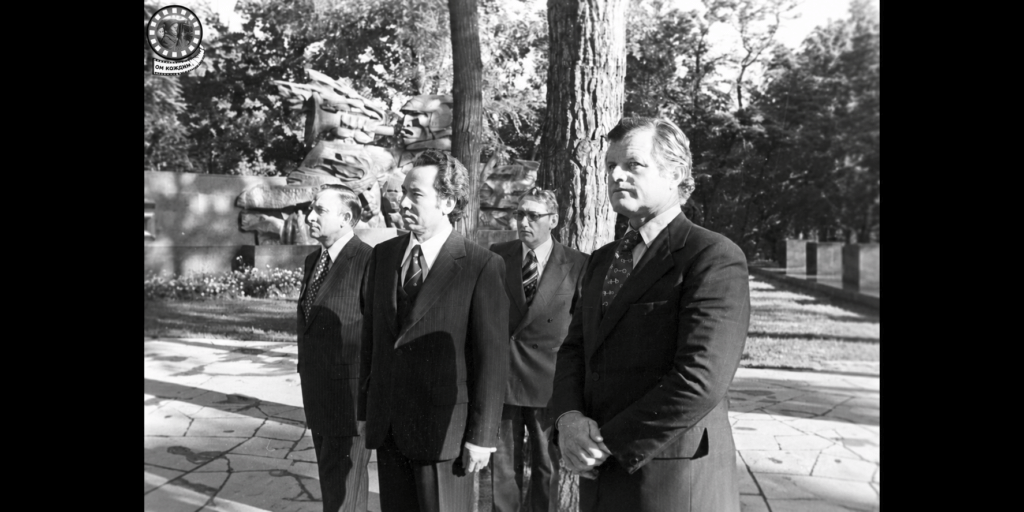
United States Senator Ted Kennedy’s visit to Alma-Ata in 1978 came at a time when foreign tourists were much less common in Central Asia than they are today. Most tourists from Western countries came through Intourist, the Soviet state travel organization that handled foreign visitors. Private enterprise was largely absent from the Soviet economy, although limited forms of individual work were legally permitted. But high-ranking visitors sometimes came to the region as official guests, most often to take part in international events. [caption id="attachment_57860" align="aligncenter" width="1024"] Edward Kennedy (second from left) at a World Health Organization congress.[/caption] In September 1978, Kennedy, the brother of former U.S. President John F. Kennedy, visited Alma-Ata, then the capital of the Kazakh Soviet Socialist Republic (Kazakh SSR). He had first visited the Soviet Union in April 1974 and met with Leonid Brezhnev, general secretary of the Communist Party of the Soviet Union. During that trip, Kennedy discussed arms control and Soviet emigration policy and advocated a comprehensive nuclear test ban. [caption id="attachment_57864" align="aligncenter" width="1024"] Kennedy with surgeon K. Ormantayev at the WHO-UNICEF International Conference on Primary Health Care.[/caption] The senator also took part in the International Conference on Primary Health Care in Alma-Ata, jointly sponsored by the World Health Organization (WHO) and the United Nations Children's Fund. The conference adopted the Declaration of Alma-Ata, which identified primary health care as the key to achieving "Health for All" and as an integral part of national health systems. More than 3,000 delegates attended; 134 governments and 67 international organizations and agencies were represented. [caption id="attachment_57862" align="aligncenter" width="1024"] Kennedy (second from left) with Kazakh SSR Health Minister T. Sharmanov (second from right) and Zh. Kaliev, chairman of Kaz-ODKS (far right), at the airport.[/caption] Amid the Soviet Union’s Cold War with Western countries and its intensifying rivalry with China, the conference had a clear political dimension. David A. Tejada de Rivero, WHO deputy director-general from 1974 to 1985 and twice Peru's minister of health, noted that "the choice of Alma-Ata was due to two fundamental considerations: the dynamism and leadership of Kazakhstan's minister of health (Toregeldy Sharmanov was Minister of Health of the Kazakh SSR), and the ability to prepare the necessary physical infrastructure at very short notice. Alma-Ata, which means 'father of apples,' was in the republic where the Soviet Union had its Cold War space programs. It was also close to China." [caption id="attachment_57863" align="aligncenter" width="1024"] Kennedy with A. Akpayev (center) and Zh. Kaliev (right) at the Medeo high-altitude skating rink.[/caption] Of course, people both inside the Soviet Union and abroad showed enormous interest in every detail of the stay of such a high-ranking guest from the U.S., a senator from a distant country across the ocean who bore such a famous name. For example, Dinmukhamed Kunaev, then first secretary of the Central Committee of the Communist Party of Kazakhstan, recalled his meeting with Kennedy in his book O moem vremeni (About My Time): "...He liked the capital of Kazakhstan, and especially the Memorial of Glory...