• KZT/USD = 0.00221
  • TJS/USD = 0.10850
  • UZS/USD = 0.00008
  • TMT/USD = 0.29760
  • KZT/USD = 0.00221
  • TJS/USD = 0.10850
  • UZS/USD = 0.00008
  • TMT/USD = 0.29760
  • KZT/USD = 0.00221
  • TJS/USD = 0.10850
  • UZS/USD = 0.00008
  • TMT/USD = 0.29760
  • KZT/USD = 0.00221
  • TJS/USD = 0.10850
  • UZS/USD = 0.00008
  • TMT/USD = 0.29760
  • KZT/USD = 0.00221
  • TJS/USD = 0.10850
  • UZS/USD = 0.00008
  • TMT/USD = 0.29760
  • KZT/USD = 0.00221
  • TJS/USD = 0.10850
  • UZS/USD = 0.00008
  • TMT/USD = 0.29760
  • KZT/USD = 0.00221
  • TJS/USD = 0.10850
  • UZS/USD = 0.00008
  • TMT/USD = 0.29760
  • KZT/USD = 0.00221
  • TJS/USD = 0.10850
  • UZS/USD = 0.00008
  • TMT/USD = 0.29760
25 October 2026

Viewing results 1 - 6 of 3

Kazakhstan Ranks 34th, Uzbekistan 71st Among World’s Most Powerful Countries

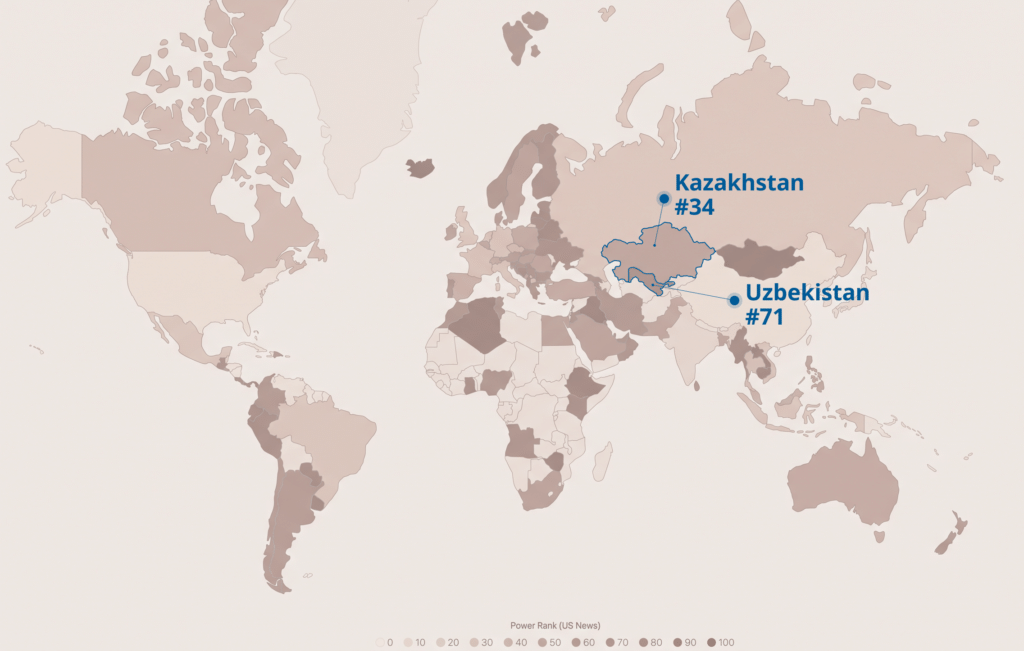
Kazakhstan and Uzbekistan were the only Central Asian countries included in World Population Review’s 2026 ranking of the world’s 100 most powerful countries, placing 34th and 71st, respectively. Kazakhstan ranked immediately ahead of Egypt (35th), and also placed above the United Arab Emirates (37th), South Africa (38th), Norway (39th), Saudi Arabia (40th), Pakistan (42nd), and Iran (46th). Among former Soviet republics, Russia ranked higher, in 11th place, while Ukraine came in 51st and Belarus 57th. Uzbekistan placed below Cambodia (69th) and Oman (70th), but ahead of Sri Lanka (72nd), Estonia (75th), Kenya (77th), Algeria (79th), and Armenia (80th). World Population Review attributes the ranking to the Best Countries study by U.S. News & World Report. The assessment considers perceptions of countries’ economic and political influence, military strength, international alliances, and leadership. Kazakhstan’s international standing is supported by its established energy and mining industries and extensive diplomatic relationships. The country is the world’s largest uranium producer, accounting for approximately 40% of global mine output in 2025. It also exported 78.7 million tons of oil that year, supplying international energy markets through an extensive network of pipelines and commercial partnerships. Its multivector foreign policy has allowed Astana to maintain relationships with Russia and China while expanding economic and political cooperation with the United States, Europe, and other partners. Kazakhstan’s uranium industry illustrates this approach, with established customers and industrial partnerships spanning several competing geopolitical blocs. Kazakhstan’s existing railway network, connections with China, and Caspian ports also support its role in international trade between Asia and Europe. The Trans-Caspian International Transport Route, commonly known as the Middle Corridor, carried approximately 4.1 million tons of freight in 2025, including around 77,000 twenty-foot equivalent units of container traffic. Uzbekistan’s $147 billion economy in 2025 was larger than those of Oman ($110 billion), Sri Lanka ($109 billion), and Kenya ($136 billion), all ranked in the same range. Algeria, despite an economy approaching $287 billion and its role as a major natural gas supplier to Europe, ranked eight places below Uzbekistan. Beyond economic size, Uzbekistan has an established position in global mineral markets. According to the U.S. Geological Survey, it was the world’s fifth-largest uranium producer and ninth-largest gold producer in 2024, accounting for 6.6% and 3.9% of global output, respectively. These industries provide an important source of international economic engagement, alongside a domestic market of approximately 39 million people. The ranking’s top 10 were China, the United States, India, Germany, Japan, South Korea, France, the United Kingdom, Mexico, and Italy. Kyrgyzstan, Tajikistan, and Turkmenistan did not appear among the 100 countries listed.  

Kazakhstan Ranks 38th in IMD World Competitiveness Ranking

Kazakhstan ranked 38th among 70 economies in the 2026 IMD World Competitiveness Ranking. With an index score of 65.4, Kazakhstan ranked ahead of Spain, Portugal, Poland, India, and Italy. Singapore took first place, followed by Hong Kong and Switzerland. The annual ranking assesses economies across four main areas — economic performance, government efficiency, business efficiency and infrastructure. IMD combines statistical data with a survey of senior executives. Hard data account for two-thirds of the ranking and covered 172 criteria in 2026, while responses from around 6,900 executives were used for another 92 criteria. IMD’s methodology explains that the indicators are designed to measure both quantifiable economic conditions and how businesses view the environment in which they operate. Kazakhstan’s strongest results came in government and business efficiency, where it ranked 23rd globally in both categories. Tax policy was a particular strength, placing ninth among the 70 economies assessed. Kazakhstan’s economy expanded by 6.5% in 2025, the sixth-highest growth rate among the economies assessed by IMD. It also ranked sixth among economies with GDP per capita below $20,000. Kazakhstan is the only Central Asian economy included in the 2026 IMD World Competitiveness Ranking. IMD relies heavily on internationally comparable statistics and business survey data. Reliable data is essential for judging competitiveness. Kazakhstan leads Central Asia in the World Bank’s Statistical Performance Indicators and, alongside Kyrgyzstan, was one of only two regional governments to meet the U.S. State Department’s 2026 minimum fiscal-transparency requirements. Kazakhstan has also subscribed to the International Monetary Fund’s Special Data Dissemination Standard since March 2003. The standard sets requirements for the coverage, periodicity, and timeliness of economic data, as well as public access, integrity and information on methodology.

Central Asia’s Billionaires Make Forbes Rich List in 2025

Forbes has released its annual list of the world’s billionaires for 2025, featuring a record 3,028 individuals, 247 more than last year. Their combined wealth has surged to $16.1 trillion, nearly $2 trillion more than in 2024. The United States leads the list with 902 billionaires, followed by China with 516 (including Hong Kong), and India with 205. Rankings were based on stock prices and exchange rates as of March 7, 2025. Elon Musk, CEO of Tesla and SpaceX, once again tops the list with an estimated net worth of $342 billion, nearly double his fortune from the previous year. Meta CEO Mark Zuckerberg ranks second with $216 billion, while Amazon founder Jeff Bezos remains in third with $215 billion. Billionaires with Central Asian Ties Among the global elite is Alisher Usmanov, a billionaire with Uzbek roots. Ranked 125th, his net worth is estimated at $16.7 billion. Usmanov holds stakes in the steel and mining conglomerate Metalloinvest, as well as investments in Xiaomi and various telecom, mining, and media companies. Though he currently resides in Tashkent, Usmanov holds Russian citizenship and remains under U.S., U.K., and EU sanctions imposed following Russia’s invasion of Ukraine. Kazakhstan’s Wealthiest on the List Kazakhstan is well represented on this year’s list. Vyacheslav Kim, chairman of Kaspi Bank, ranks 464th with a net worth of $7.1 billion. Timur Turlov, CEO of Freedom Holding, follows at 605th with $5.8 billion. Vladimir Kim, another prominent Kazakh businessman, is ranked 620th with $5.7 billion. Dinara Kulibayeva and Timur Kulibayev, ranked jointly at 673, hold an estimated fortune of $5.3 billion. Kulibayeva, daughter of former president Nursultan Nazarbayev, and her husband are majority shareholders in Halyk Bank and have extensive investments in the oil and gas sector. Kulibayev also founded Altyn Alma, an investment firm that later became Almex LLP. Another Kazakh billionaire, Bulat Utemuratov, is ranked 979th with an estimated fortune of $3.7 billion.