Viewing results 619 - 624 of 893
Kazakhstan and U.S. Issue Joint Statement on Methane Reduction The Special Representative of the President of the Republic of Kazakhstan for International Environmental Cooperation, Zulfiya Suleimenova, and Special U.S. Presidential Envoy for Climate Change, John Kerry issued a joint statement on accelerating methane reductions to meet the Global Methane Pledge (GMP). Kazakhstan and the United States declared their mutual commitment to accelerate the development and implementation of policies and projects to rapidly reduce methane emissions, especially in the fossil energy sector. Building on more than 30 years of successful partnership between Kazakhstan and the United States, this statement commemorated the fifth anniversary of the Enhanced Strategic Partnership between Kazakhstan and the United States and expanded opportunities for cooperation in the field of methane control. The statement: recognized the key role the two countries play in creating a greener, safer and better world; stressed the importance of rapidly reducing methane emissions by 2030 to limit global warming to 1.5 degrees Celsius; recognized the significant potential of the fossil energy sector to reduce methane emissions and the need to rapidly reduce emissions in this sector. The statement also served as a memorandum of understanding of the importance of voluntary action in promoting collective efforts to reduce global methane emissions; highlighted the need to seek to mobilize global action and strengthen support for existing international initiatives to reduce methane emissions through effective bilateral action; and recognized the critical participation of the private sector, development banks, financial institutions and international aid agencies in supporting the implementation of the Pledge.
By 2050, the available resources in the Syr Darya and Amu Darya basins – the region’s two largest sources of water - situated in southern Kazakhstan and along Uzbekistan’s southern border with Turkmenistan - could decrease by 10% to 15%. Water shortages inevitably impact the region’s agricultural sector, which relies on water as a critical factor in food production, the Eurasian Development Bank (EDB) has stated in a news release. The reduction in wheat yields in seven oblasts of Kazakhstan could result in direct economic losses exceeding U$1.2 billion by 2030. These concerns were highlighted by Conrad Albrecht, Managing Director and Head of the Directorate of Sustainability at the Eurasian Development Bank (EDB) during the recent Seventh North and Central Asia Multistakeholder Forum on the Implementation of the SDGs in Almaty. “Kazakhstan, being the only Eurasian nation to have implemented a carbon pricing system, faces the additional challenge of a potential carbon tax amounting to U$250 million. Most economies in the region rely heavily on carbon-intensive industries, necessitating a transition towards more sustainable production methods”, Albrecht said. He also pointed out that the region’s carbon dioxide (CO2) emissions significantly exceed its contribution to the global economy in terms of both GDP and population. However, countries such as Armenia, the Kyrgyz Republic, Tajikistan and Uzbekistan have a share of global CO2 emissions lower than their share of the world’s population, indicating that the region’s economies are critically carbon intensive. “All countries in the Eurasian region are taking climate change extremely seriously, acknowledge their direct contribution to the global agenda and are ready to make ambitious commitments to decarbonization”, Albrecht stressed. “Nevertheless, Central Asian countries still require substantial support from multilateral development banks, and while climate finance to the region is increasing, it remains significantly smaller compared to other low- and middle-income countries”.
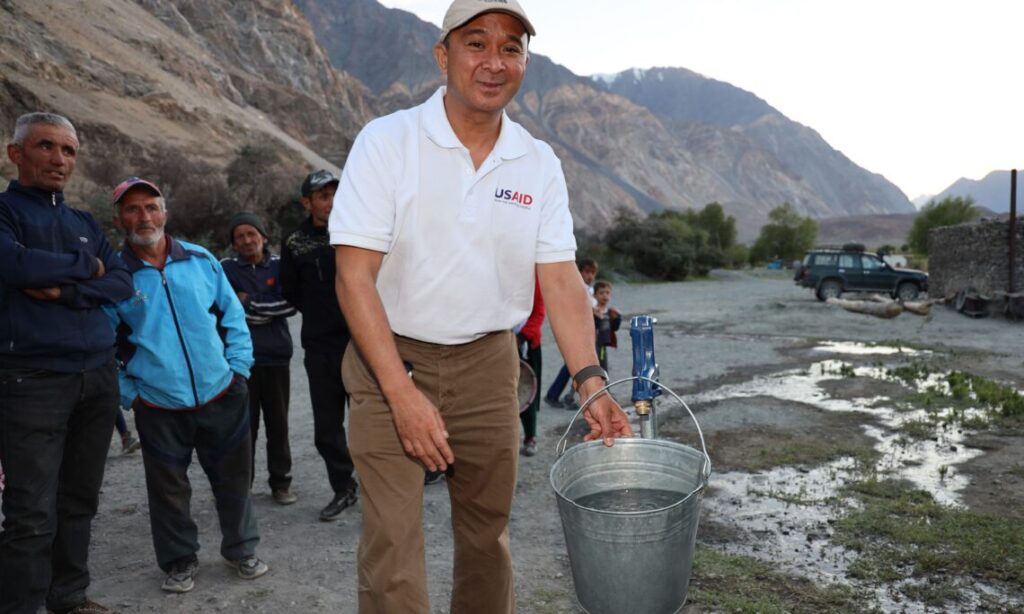
As outlined in a press release on its website, the United States Agency for International Development (USAID) and the Aga Khan Foundation (AKF) in partnership with the Government of Tajikistan completed and inaugurated a new drinking water supply system and a school latrine in two villages of Rushan’s Bartang valley. The drinking water supply systems will provide uninterrupted access to clean water for 72 households (397 people) in Pasor and Bopasor villages. Additionally, 40 schoolchildren and teachers will have access to sanitary toilets in school #40 of Bopasor village, the U.S. Embassy in Tajikistan said. In the remote mountainous villages of Pasor and Bopasor, lack of access to potable water was a significant problem. Although the villages are blessed with an abundance of water, the absence of infrastructure forced the residents to fetch water from a distance of 500-800 meters at an elevation of 3,000 meters above sea level during harsh winters that last for five months. The USAID and AKF joint partnership, Thrive Tajikistan, works hand-in-hand with the Government of Tajikistan and people of the Bartang Valley to tackle this monumental challenge. To date, Thrive Tajikistan has provided 14 potable water supply systems and 14 school latrines in Farkhor, Hamadoni, Nosiri Khusrav, Panj, Qubodiyon, Roshtqala, Shahritus, and Rushan districts. These systems provide 43,558 people with access to clean drinking water and improved sanitation and hygiene services to 8,344 people. The five-year (2018-2023) “Thrive Tajikistan: Partnership for Socio-Economic Development” program expands the partnership between USAID, AKF and the Government of Tajikistan to improve the quality of life for people in all 16 districts of Tajikistan along the country’s border with Afghanistan in Khatlon province and Gorno-Badakhshan Autonomous Oblast.