
• KGS/USD = 0.01144 0%
  • KZT/USD = 0.00208 0%
  • TJS/USD = 0.10442 0.19%
  • UZS/USD = 0.00008 0%
  • TMT/USD = 0.28530 0%
  • KGS/USD = 0.01144 0%
  • KZT/USD = 0.00208 0%
  • TJS/USD = 0.10442 0.19%
  • UZS/USD = 0.00008 0%
  • TMT/USD = 0.28530 0%
  • KGS/USD = 0.01144 0%
  • KZT/USD = 0.00208 0%
  • TJS/USD = 0.10442 0.19%
  • UZS/USD = 0.00008 0%
  • TMT/USD = 0.28530 0%
  • KGS/USD = 0.01144 0%
  • KZT/USD = 0.00208 0%
  • TJS/USD = 0.10442 0.19%
  • UZS/USD = 0.00008 0%
  • TMT/USD = 0.28530 0%
  • KGS/USD = 0.01144 0%
  • KZT/USD = 0.00208 0%
  • TJS/USD = 0.10442 0.19%
  • UZS/USD = 0.00008 0%
  • TMT/USD = 0.28530 0%
  • KGS/USD = 0.01144 0%
  • KZT/USD = 0.00208 0%
  • TJS/USD = 0.10442 0.19%
  • UZS/USD = 0.00008 0%
  • TMT/USD = 0.28530 0%
  • KGS/USD = 0.01144 0%
  • KZT/USD = 0.00208 0%
  • TJS/USD = 0.10442 0.19%
  • UZS/USD = 0.00008 0%
  • TMT/USD = 0.28530 0%
  • KGS/USD = 0.01144 0%
  • KZT/USD = 0.00208 0%
  • TJS/USD = 0.10442 0.19%
  • UZS/USD = 0.00008 0%
  • TMT/USD = 0.28530 0%

Viewing results 1897 - 1902 of 3209

Samarkand Replaces Paris as Host of UNESCO Conference

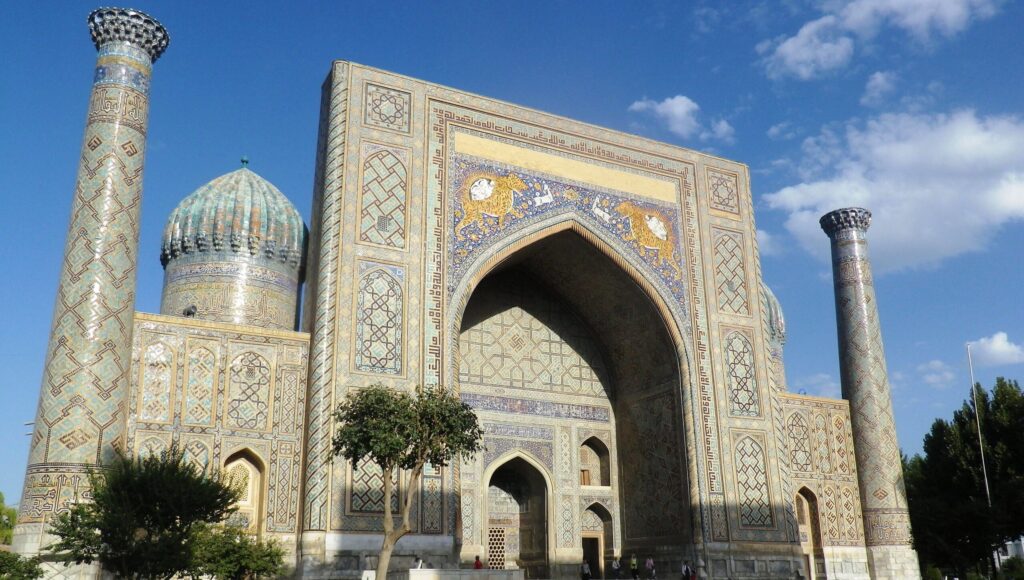
The Silk Road Samarkand tourism and convention complex will host the 43rd session of the UNESCO General Conference in 2025 -- the first time the globally significant event will be held outside of Paris since 1985. The conference will focus on discussions and decisions on UNESCO's activities. Besides Samarkand, conference events will also be held in the cities of Tashkent, Bukhara, Khiva and Shahrisabz. Samarkand was not chosen as the host venue by chance. Not only is it a great historical open-air museum city, but it has also managed to host a number of important international events over the past six months. At next year's UNESCO conference, officials plan to develop projects for establishing the State Museum of the Great Silk Road in Samarkand, restoring Amir Timur's gardens, restoring the Bibi-Khanum complex -- as well as a master plan for protecting the historical center of Bukhara, which is on the UNESCO World Heritage List. Samarkand, by the way, has recently become the subject of heated debate over the construction of the ethnographic tourist center Bokiy Bukhoro (Eternal Bukhara) on the borders with the historical center and buffer zone of Bukhara. The complex, which will occupy an area of 32.6 hectares, involves the demolition of 29 state facilities, including the buildings of the hokimiyats (municipal offices) of Bukhara region and Bukhara city, the regional prosecutor's office, school No. 2, Bukhara State Medical College, College of Culture, Bukhara Arena stadium and others. Since 2017, 14 unique examples of Uzbek national cultural heritage have been included in the UNESCO lists. Bukhara was included in the UNESCO Creative Cities Network, and last September, the 1,050th anniversary of the birth of the great polymath and scholar Abu Rayhon Beruni was widely celebrated at UNESCO headquarters.

What Bank Loan Data Can Tell Us About Kazakh Business in 2023

After being severely tested by the pandemic in 2020-21, several thousand companies in Kazakhstan closed due to decreased demand and supply chain disruptions. Though the problems of local businesses began long before the pandemic, the two years of lockdown wiped out many good players and made those that survived more dependent on government orders and projects. Overall, Kazakhstan has a primarily commodity-driven economy (crude oil, metals and petrochemicals account for the majority of export earnings), and the country's economic fortunes have tracked the prices of a short list of major commodity exports. Thus, the government finds it hard to diversify the economy. Oil price volatility affects the national currency, and the ups and downs in the tenge exchange rate versus hard currencies make it difficult to be in a business with an investment cycle longer than one and a half to two years, as you have lower revenues amid dollar investments. This is one of the reasons why launching long-term projects in the country is difficult when there are no guarantees of sales, while currency risks can hit any project. The government has been active in attracting foreign investment, offering state support and protection, but only relatively recently did it begin to pay the same attention to the demands of domestic investors. However, this is only the beginning of a very long journey towards reducing dependence on imports and expanding the range of exports to stabilize the economy.   A debt-driven economy The share of the private sector in Kazakhstan is difficult to measure. If we take SMEs (small to medium-sized enterprises) as the core of private business, in different years it fluctuates between a range of 20-30% of GDP. However, since state capitalism is entrenched in the country, even among SMEs there are contractors working for state and quasi-state structures, receiving funds from state companies and agencies. One-hundred-percent private companies that do not depend on government contracts finance their operations from their own or borrowed capital. This is why, in a transparent economy like Kazakhstan’s, looking at loan data can reveal the main trends in business and which niches have not yet been occupied and could be interesting for investment by both foreign and local players. It is best to look at the country's economy through the loan portfolio of banks that are subject to international banking regulation, whose indicators meet an easily understandable standard. There is a caveat: in Kazakhstan there is also the Development Bank of Kazakhstan, which is not included in the table below. It is technically not a bank, but rather a development institution financed from the quasi-public sector by Baiterek National Management Holding, which receives budgetary funds. In addition, most extractive-industry companies in Kazakhstan – due to their high capital expenditures and the shallowness of the country’s financial market – raise funds in the U.K., Switzerland, the U.S. and Russia. Chinese banks rarely lend to 100%-Kazakh companies, limiting themselves to trade credits (in the form of equipment) or loans to joint ventures with Chinese...

Turkmenistan’s Food Prices Continue to Rise

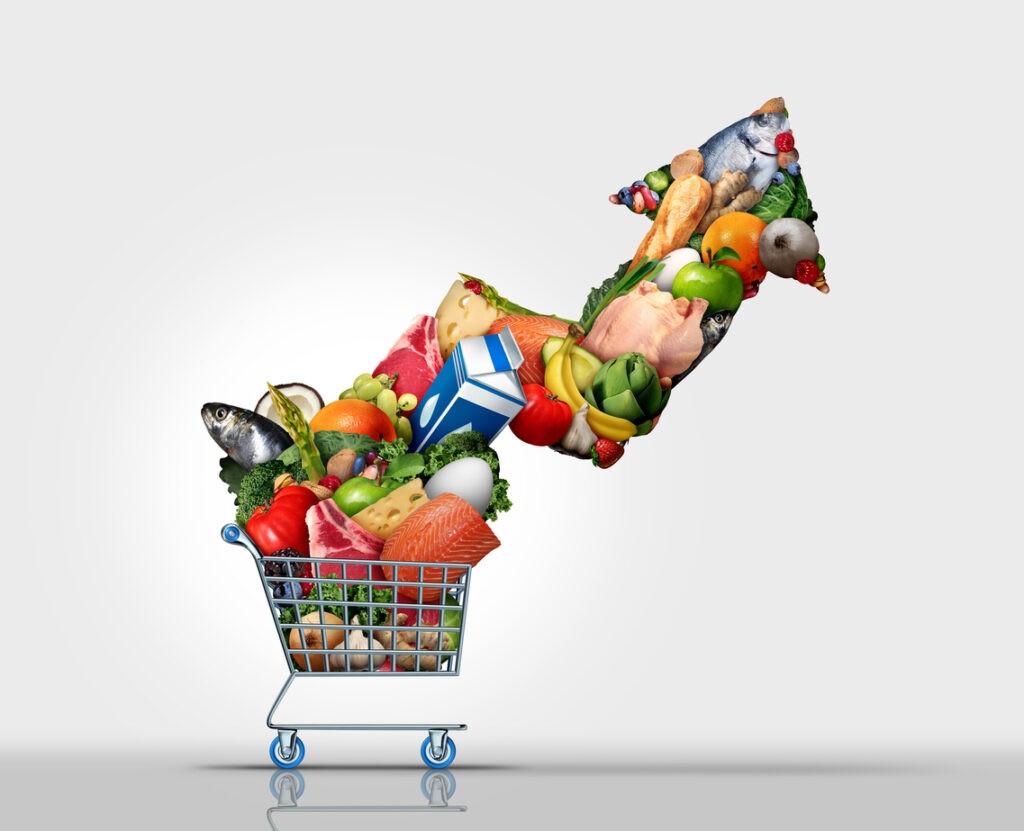
The prices of subsidized products in Turkmenistan's state stores continue to rise, according to a report by correspondents from the Chronicles of Turkmenistan. Beginning March 12, the price of a kilogram of poultry increased to 35 manat ($10) from 21 manat ($6). The price for domestically produced chicken is the same as for poultry imported from Turkey. In some stores chicken legs are still being sold at the old price -- 16 manat ($4.57) per kilogram -- but according to sellers, new batches could be more expensive. These days in various parts of Turkmenistan's capital Ashghabat, private traders are selling rice -- the price of which has increased by three manat per kilo -- directly from trucks. As of March 6, eggs have become more expensive in Ashgabat's state stores. The price has increased to 1.50 manat ($0.43) and 45 manat ($12.86) for a 30-egg tray, respectively, from one manat ($0.29) per egg or 30 manat ($8,57) per tray. The cost of flour went to 3-5 manat ($0.86 – $1.43) per kilogram from one manat ($0.29) in February -- while the cost of bread increased to four manat ($1.14) from one manat ($0.29) per loaf. Turkmenistan's president Serdar Berdimuhamedov signed an order to raise the purchase prices of wheat and cotton by two to three times beginning with the harvest of 2024 -- just before the sharp increase in the prices of goods in state stores.

Starting Over: Central Asian Countries Celebrate the Arrival of Spring

It’s time for renewal in Central Asia. Spring is arriving and it’s time to tidy up the home. Time for traditional music, cuisine, and brightly colored costumes. An occasion to reflect and renew, give thanks for the past, and build toward the future. Or set aside bad things that happened and start over. One of the world’s oldest holidays happens on the spring equinox, which is March 20 (Central Asia time) this year. Known as Nowruz, Navruz, Nauryz, and other variations, it means “New Day” in Farsi and traces its roots to the ancient Persian religion of Zoroastrianism. This year, it coincides with the Muslim holy fasting month of Ramadan. The holiday is also celebrated in the Caucasus, the Middle East, and other regions. [caption id="attachment_15786" align="aligncenter" width="1200"] A view of the shanyrak, the central part of the upper dome of the yurt is shown to guests as an art object during Nauryz festivities. A shanyrak design, containing blue that represents the sky, is the national emblem of Kazakhstan. Photo: TCA[/caption] Celebrations are already in full swing. This year, Kazakhstan introduced a new format for Nauryz, with events running from March 14-23. In 2009, UNESCO included the day on its list of “intangible cultural heritage of humanity.” In many parts of Central Asia, people decorate houses with branches of fruit trees to ensure a prosperous year. On the night before the spring equinox, people fill vessels with water from springs, milk, and grain. It is believed that such a ritual will bring abundant rains and a successful harvest in the coming year. Holiday concerts feature traditional instruments. There are the karnai and surnai (wind instruments) and dutar (strung) in Tajikistan and Uzbekistan, or the dombra and kobyz (both strung) in Kazakhstan and Kyrgyzstan. [caption id="attachment_15785" align="aligncenter" width="1200"] Baursak, a fried bread, and Nauryz kozhe, a cool, hearty drink that symbolizes good luck, are shown during Nauryz celebrations in Almaty, Kazakhstan in 2023. Ingredients of Nauryz kozhe can include water, meat, salt, milk or yogurt, and grain. Photo: TCA[/caption] A beautifully set table is another Nauryz tradition. The central place on the table in Tajikistan, Uzbekistan, Kyrgyzstan, and Turkmenistan is occupied by sumanak, a dessert. It is made of germinated wheat and cooked in a metal pot for about 12 hours. According to legend, you should make a wish while stirring the sumanak. It is said that if you make a wish from a pure heart, it will definitely come true. In Kazakhstan, a special place on the table is occupied by Nauryz kozhe, a hearty soup of milk, meat, butter, two kinds of millet, rice, and corn, symbolizing the seven principles of life: growth, luck, happiness, wealth, health, wisdom, and heavenly protection. At home, it is poured into seven bowls and placed before seven wise elders, known as aksakals. The number has a special meaning in many aspects of the celebration. Traditionally, everyone should invite seven guests to their home and visit seven houses themselves. Nauryz is also a time...

Optimism Meets Reality at the B5+1 Forum in Almaty

The inaugural B5+1 Forum, a conference dedicated to strengthening business between the five Central Asian republics and the United States, came to a close today in Almaty after a second well received day of panel discussions. The B5+1 Forum was created by the Center for International Private Enterprise (CIPE), which aims to use public-private partnerships to create a better environment for business and trade. The B5+1 platform brings international and local companies together with high-ranking government officials from all six countries, to learn about the difficulties that each side faces, and suggest new ways to attract partners and investment. Following an opening day focused on “Looking within Central Asia”, today’s speakers brought attention to “Central Asia’s place in the world economy”. The morning began with a keynote speech by Eurasian affairs expert S. Frederick Starr, who argued that because the five countries are now members of different trade blocs, the revival of the Central Asian Economic Union could break down their existing barriers to business and trade with the United States. During a morning session on international partnerships, foreign experts brainstormed ways to speed up the Central Asia region’s economic integration with the rest of the world. To an audience of business leaders whose overall mood was optimistic, the EU’s ambassador to Kazakhstan Kestutis Jankauskas and World Bank economist David Knight brought a dose of realism, by explaining that business in Central Asia is not performing as well as in other emerging regions. This, they both said, is because the governments – and business owners – have mostly still not let go of self-defeating ways of approaching markets and investment. The middle session went into more detail about the investment landscape, particularly in terms of IT and fintech. Jennifer Miel, executive director for Kazakhstan for the US Chamber of Commerce, mentioned that all five Central Asian countries have seen healthy increases in foreign direct investment since 2021. This was soon tempered by Anatoly Motkin of the agency StrategEast, who said that to achieve further sustainable growth, the region must unify its legislation and best practices, so that foreign investors can treat it as a single market as much as possible. The Forum’s closing session explored the role of business associations in public-private dialogue. The panel was moderated by Eric Hontz, CIPE’s director for accountable investments, and featured the executive directors of the US Chambers of Commerce in Kyrgyzstan, Tajikistan and Uzbekistan – Aisuluu Sydygalieva, Nilufar Bulbulshoeva and Tatyana Bystrushkina. Discussion centered on best practices and solutions for effective member representation. The B5+1 Forum forms part of CIPE’s program called “Improving the Business Environment in Central Asia” (IBECA). CIPE themselves are affiliated to the US Chamber of Commerce – the catalyst behind the B7 and B20 platforms – and receive funding from the US Department of State. Early indications are that the B5+1 Forum in 2025 will be held in Bishkek, Kyrgyzstan.

World Bank Supports Economic Reforms in Kazakhstan

Approval was granted on March 14th for the loan of $600 million to Kazakhstan by the World Bank’s Board of Executive Directors. The loan will be used to implement the first phase of a series of reforms aimed to promote sustainable growth in the country and support Kazakhstan's transition to a more competitive, greener, and inclusive economy. As a carbon-intensive economy, Kazakhstan has ambitions to scale-up action on tackling climate change and reduce reliance on the extraction of natural resources. The reforms aim to increase renewable energy generation, gradually phase out fossil fuel subsidies, improve energy efficiency, and protect poor and vulnerable households. These measures are integral to Kazakhstan’s Nationally Determined Contributions, which are committed to reducing harmful emissions by 25 percent by 2030. “This new partnership with the Government of Kazakhstan supports tangible measures to advance a low-emissions development strategy as part of the global fight against climate change,” said Andrei Mikhnev, World Bank Country Manager for Kazakhstan. Funding provided by the World Bank, with a low-cost and long-term repayment option, will support the government’s reforms in the following areas: In developing greener and more efficient energy, the program implements key recommendations by the Country Climate and Development Report (CCDR) to support the reduction of Kazakhstan’s carbon footprint and contribute to global efforts to combat climate change. In developing more competitive digital and financial markets and promoting transparent procurement practices, the program aims to enable more firms to provide digital services, develop safeguards essential for a digital economy, allocate credit to support productivity and increase transparency in procurement practices. In targeting the poor and supporting regional development, reforms aim to strengthen the social protection system and enhance regional development, as part of broader efforts to enhance inclusion and provide greater opportunities nationwide.