• KGS/USD = 0.01144 0%
  • KZT/USD = 0.00209 0%
  • TJS/USD = 0.10523 0%
  • UZS/USD = 0.00008 0%
  • TMT/USD = 0.28530 0%
  • KGS/USD = 0.01144 0%
  • KZT/USD = 0.00209 0%
  • TJS/USD = 0.10523 0%
  • UZS/USD = 0.00008 0%
  • TMT/USD = 0.28530 0%
  • KGS/USD = 0.01144 0%
  • KZT/USD = 0.00209 0%
  • TJS/USD = 0.10523 0%
  • UZS/USD = 0.00008 0%
  • TMT/USD = 0.28530 0%
  • KGS/USD = 0.01144 0%
  • KZT/USD = 0.00209 0%
  • TJS/USD = 0.10523 0%
  • UZS/USD = 0.00008 0%
  • TMT/USD = 0.28530 0%
  • KGS/USD = 0.01144 0%
  • KZT/USD = 0.00209 0%
  • TJS/USD = 0.10523 0%
  • UZS/USD = 0.00008 0%
  • TMT/USD = 0.28530 0%
  • KGS/USD = 0.01144 0%
  • KZT/USD = 0.00209 0%
  • TJS/USD = 0.10523 0%
  • UZS/USD = 0.00008 0%
  • TMT/USD = 0.28530 0%
  • KGS/USD = 0.01144 0%
  • KZT/USD = 0.00209 0%
  • TJS/USD = 0.10523 0%
  • UZS/USD = 0.00008 0%
  • TMT/USD = 0.28530 0%
  • KGS/USD = 0.01144 0%
  • KZT/USD = 0.00209 0%
  • TJS/USD = 0.10523 0%
  • UZS/USD = 0.00008 0%
  • TMT/USD = 0.28530 0%

Viewing results 1285 - 1290 of 2389

China to Invest in Electric Scooter Production in Uzbekistan

The Chinese company ECOMOTO has announced plans to become a joint producer of electric scooters in the Yangiyul district of Uzbekistan. A memorandum was signed at a meeting between Odiljon Ataullayev, hokim of Yangiyul district and investors whereby the project will be funded by direct foreign investment of 10 million dollars and create 50 jobs. The production of modern, competitively-priced electric scooters is expected to begin in the second quarter of 2025. A metal construction plant, built by the Chinese company Da Fu which recently started operating near Yangiyul, will produce up to 500 tons of products per year.  

Turkmenistan Launches Railroad Route Between Iran and China via Kazakhstan

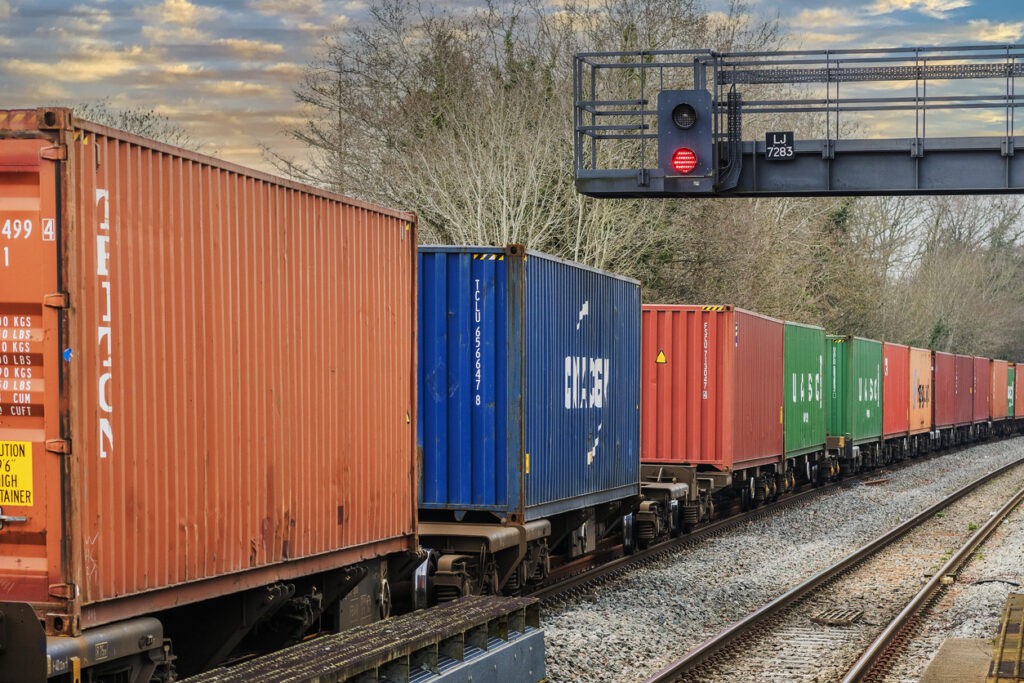
Turkmenistan has launched a test container train on the China-Kazakhstan-Turkmenistan-Iran route. The project, which provides a fast transportation corridor between East and West, is the result of negotiations between representatives of the railway departments of China, Kazakhstan, Turkmenistan, and Iran. Thanks to the new route, cargo delivery between China and Iran will be reduced to 15 days. The parties have agreed on a full schedule of container trains and preferential tariff rates, and set up an expert group to develop a fixed schedule. During the test run, a train with 45 forty-foot containers loaded with auto parts departed from Xi'an, China, and traveled the route Xi'an, China - Altynkol, Kazakhstan - Bolashak, Kazakhstan - Etrek, Turkmenistan - Tehran, Iran. In the opposite direction, a train with 50 containers of gypsum powder traveled on the route Kum (Iran)—Etrek (Turkmenistan)—Bolashak (Kazakhstan)—Altynkol (Kazakhstan)—Yiwu (China). Containers are reloaded from broad gauge to narrow gauge and back again at the Etrek railway terminal, allowing efficient cargo transportation between countries with different railway gauges.

What Does the Future Hold for the Middle Corridor?

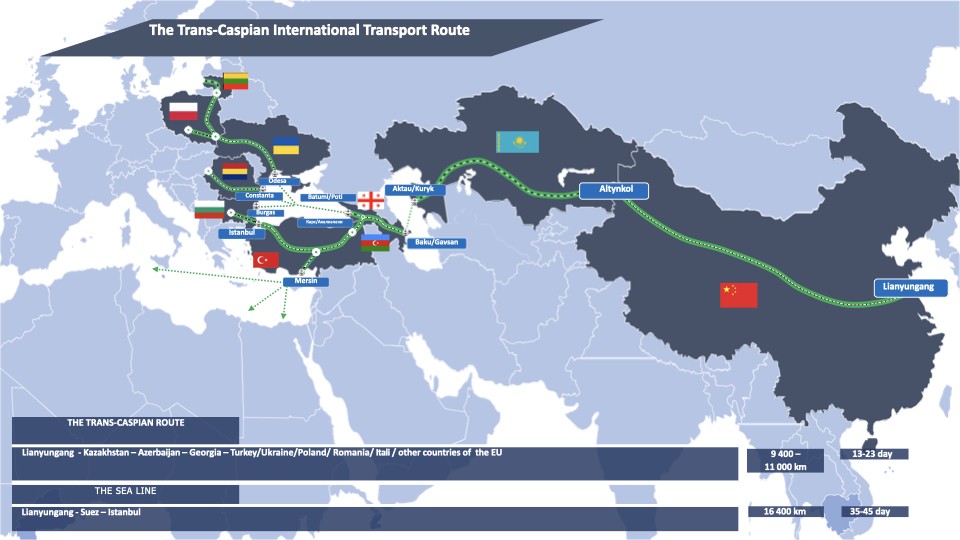
With the outbreak of Russia's war in Ukraine and the subsequent sanctions against Russia, the traditional logistics corridor between East and West has significantly narrowed. In order to ensure the safe and uninterrupted export of locally produced goods and attract transit cargoes, the Kazakh government is therefore developing new routes. One of these is the Trans-Caspian International Transport route. But, given the aggravated geopolitical situation in the region and growing competition for cargo transportation between the East and West, will the Caspian transport corridor - also known as the Middle Corridor - allow the government to meet its ambitions? Infrastructural vector of the Caspian Sea Logistics have focused on the transportation route across the Caspian Sea, considerably increasing the role of the Middle Corridor, which is facing a huge increase in demand. The countries along which the TITR route runs have started building their transport infrastructure capacities, replenishing their maritime fleets, and pooling capital and competencies in logistics and transportation. In particular, at the end of 2022, a Road Map on synchronous elimination of so-called "bottlenecks" along the route along the territories of Kazakhstan, Azerbaijan, and Turkey for 2022-2027 was signed. A joint venture, the Middle Corridor Multimodal, was established by the railway administrations of Kazakhstan, Azerbaijan, and Georgia to increase the volume of cargo transportation. A unified approach to infrastructure development by all route participants has been formed, and several projects are planned to improve the transportation infrastructure of the road's Kazakh, Azerbaijani, and Georgian sections. For the development of transportation on TITR through the seaports of Aktau and Kuryk, Kazakhstan plans to create a container hub in the port of Aktau, dredging, construction of additional berths in both harbors, restoration of oil infrastructure and renewal, as well as re-equipment of the transshipment park in the port of Aktau. In addition, a grain terminal will be built at Kuryk's seaport. Implementing these measures will increase the throughput capacity of Kazakhstan's sea harbors to 27.3 million tons per year and increase cargo traffic along the Middle Corridor. Ten oil barges, eight ferries, six tankers, and a container ship will start operating in the Caspian Sea by 2030. Furthermore, the construction in Aktau has attracted investment from the Chinese company, LLC GC Port Lianyungangan, which manages one of the largest ports in China and has signed an agreement to create a container hub at the seaport. Additionally, in partnership with the Singaporean company PSA Eagle Pte., a joint venture called KPMC Ltd has been established at the Astana International Financial Center. This venture aims to attract more cargo to the Middle Corridor, develop a digital transport corridor to optimize transportation processes, enhance the competitiveness of routes, streamline interactions, integrate partners along the cargo flow path, and improve supply chain management. Work is being undertaken to expand the presence of companies from the Caspian region in global markets. Establishing such transport and logistics enterprises along the Middle Corridor will improve transportation organization and build efficient logistics chains. The willingness of large enterprises,...

Demarcation of the Tajikistan-Kyrgyzstan Border Nears Completion

As reported by Asia-Plus, on July 26, the governor of the Sughd region in Tajikistan, Rajabboy Ahmadzade, announced that the state border between Tajikistan and Kyrgyzstan, which has been closed for three years,  is expected to open soon. The commission for delineating the border between Tajikistan and Kyrgyzstan has been in progress since 2022 but as stated by Ahmadzade, “To date, 94% of the border line has been fully delineated. We believe that everything will be resolved positively shortly." The minister advised that on July 21-24, representatives of the Ministry of Transport of Kyrgyzstan and Tajikistan visited the disputed areas and Tajik towns of Chorkukh and Vorukh. He did not disclose the location of the remaining 6% of disputed territories, but added that the commission would meet again from August 11 - 17 in Botken, Kyrgyzstan. The armed border between Tajikistan and Kyrgyzstan was closed after clashes on 14-17 September 2021. A year later, officials and representatives of both countries' border commission met in Sughd to discuss means of resolving the issue. The conflict was caused by uncertainties regarding the exact demarcation of the border between the two republics which spans some 980 kilometers. With its scant natural resources and dwindling water supplies, the border between Kyrgyzstan and Tajikistan has been the scene of numerous skirmishes for many years. In 2014, all borders between Kyrgyzstan and Tajikistan were closed indefinitely to Kyrgyz and Tajik citizens following clashes over a bypass road in disputed territory; mortars were fired and both armies suffered casualties. Trouble spilled over again throughout 2021 and 2022, reportedly starting over a water dispute in the Vorukh enclave, and leaving an unknown number in the hundreds killed, and up to 136,000 people evacuated. In September 2022, another shooting took place on the border between the two countries.

Kyrgyz Exporters to Trade on Alibaba Marketplace

The second international e-commerce forum, Sellers Forum E-COM.kg, at Lake Issyk-Kul in Kyrgyzstan from July 26 to 28, was attended by Sanjar Bolotov, Deputy Minister of Economy and Commerce of the Kyrgyz Republic, and Tilek Jumaliyev, Deputy Director of the Kyrgyz Export Centre. During the event, the parties met representatives of the World Bank and Alibaba Group Global Digital Business within the framework of E-GATE; a program, aimed at providing subsidies for small and medium-sized businesses to ensure their entry into the world's leading B2B e-commerce platforms. In their discussions , the Deputy Minister emphasized the country's export potential, the successful export of environmentally -friendly Kyrgyz products to the Chinese market, and the readiness of local producers to interact with Alibaba Group to promote their wares. The meeting concluded with an agreement to work with the Kyrgyz Export Centre to place Kyrgyz exporters' products on the Alibaba marketplace and organize training.

Can the Aral Sea Be Saved?

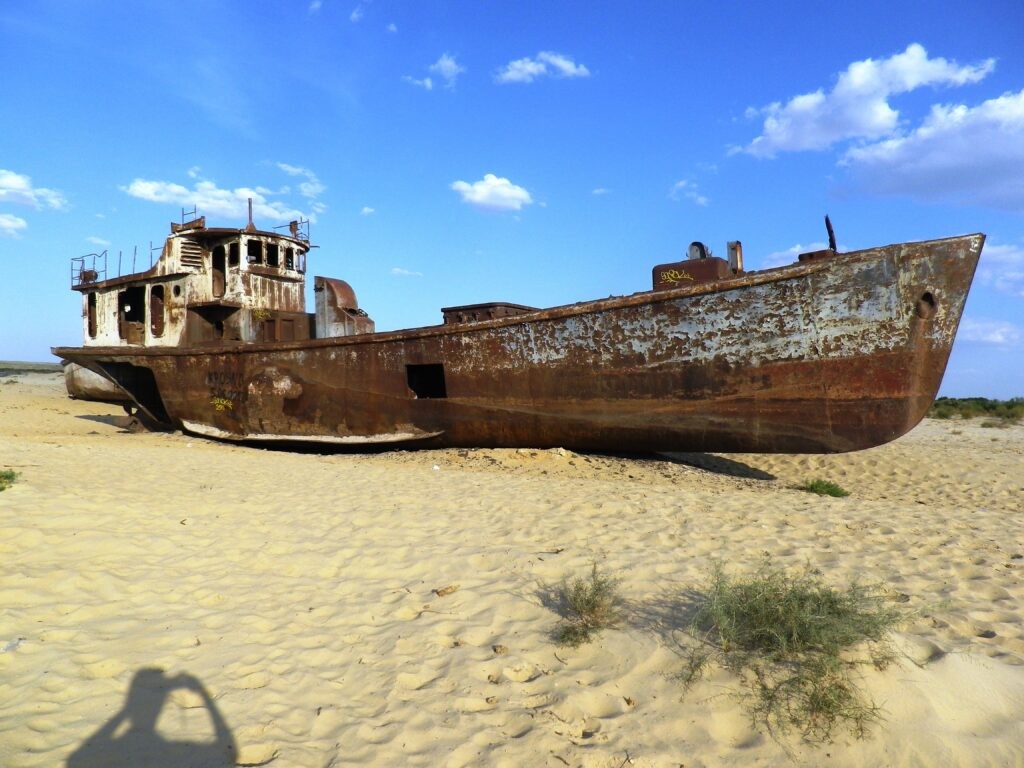
Thanks to cooperation between the Central Asian states, the ultimate demise of the Aral Sea has been prevented. This year, the Northern Aral Sea has significantly replenished its water reserves. The Northern portion of the Aral Sea has received 12.5 times more water this year than the previous year - up to 75 cubic meters per second, the Ministry of Water Resources and Irrigation of Kazakhstan stated in July. The Syr Darya River delivers 650 cubic meters of water per second to the Kyzylorda Oblast. "Joint work has been carried out with Uzbekistan and Kyrgyzstan. In particular, approved water supply schedules are being observed,” Minister of Water Resources and Irrigation, Nurzhan Nurzhigitov explained. Formerly the world's fourth-largest lake covering 68,000 km², the destruction of the Aral Sea first dates back as far as the U.S. Civil War, when, finding his supply of American cotton under threat, the Russian Tsar decided to use the sea’s tributaries to irrigate Central Asia and create his own cotton bowl. With 1.8 million liters of water needed for every bale of cotton, the water soon began to run out. From the 1960s onwards, the sea level began to decline rapidly due to water withdrawal from the main feeder rivers, the Amu Darya and Syr Darya. The local population was growing, and fields needed irrigating. In 1989, the sea split into the Northern (Small) and Southern (Large) Aral reservoirs. [caption id="attachment_21020" align="aligncenter" width="591"] The former port of Zhalanash, Kazakhstan; image: TCA, Stephen M. Bland[/caption] Since independence, the rate of shoaling and desertification have continued to increase. Up until the late-1990s, the land surrounding the Aral Sea was still cotton fields; but today, it’s largely an expanse of salinized grey emptiness. The desiccation of the landscape has led to vast toxic dust-storms that ravage around 1.5 million square kilometers. Spreading nitrates and carcinogens, these storms – visible from space – used to occur once every five years, but now strike ten times a year. By 2007, the Aral had shrunk to one-tenth its original size. In 2014, the eastern part of the Southern Lake dried up completely, and the sea's area reached a historical low of 7,297 km². Over half a century, the volume of water had decreased 30-fold, and the sea's salinity has risen sharply. Nevertheless, Kazakhstan still manages to preserve the remnants of the once colossal lake; the region's fisheries and farms continue, and rare species of birds still inhabit the lands surrounding the shoreline. Today, most scientists say restoring the Aral Sea completely is impossible, but Kazakhstan is attempting to preserve the Northern portion, sometimes referred to as the "Small Aral Sea." In 1993, the International Fund for Saving the Aral Sea (IFSAS) was established, which united Kazakhstan, Uzbekistan, Kyrgyzstan, Turkmenistan, and Tajikistan in this most challenging of tasks. At the time of IFSAS creation, the water area stood at approximately 36,000 km². Over the following decades, it continued to decline, and in 2001 Vozrozhdeniya (Renaissance) Island became connected to the mainland. Vozrozhdeniya contains...