• KGS/USD = 0.01144 0%
  • KZT/USD = 0.00211 0%
  • TJS/USD = 0.10515 0.48%
  • UZS/USD = 0.00008 0%
  • TMT/USD = 0.28530 0%
  • KGS/USD = 0.01144 0%
  • KZT/USD = 0.00211 0%
  • TJS/USD = 0.10515 0.48%
  • UZS/USD = 0.00008 0%
  • TMT/USD = 0.28530 0%
  • KGS/USD = 0.01144 0%
  • KZT/USD = 0.00211 0%
  • TJS/USD = 0.10515 0.48%
  • UZS/USD = 0.00008 0%
  • TMT/USD = 0.28530 0%
  • KGS/USD = 0.01144 0%
  • KZT/USD = 0.00211 0%
  • TJS/USD = 0.10515 0.48%
  • UZS/USD = 0.00008 0%
  • TMT/USD = 0.28530 0%
  • KGS/USD = 0.01144 0%
  • KZT/USD = 0.00211 0%
  • TJS/USD = 0.10515 0.48%
  • UZS/USD = 0.00008 0%
  • TMT/USD = 0.28530 0%
  • KGS/USD = 0.01144 0%
  • KZT/USD = 0.00211 0%
  • TJS/USD = 0.10515 0.48%
  • UZS/USD = 0.00008 0%
  • TMT/USD = 0.28530 0%
  • KGS/USD = 0.01144 0%
  • KZT/USD = 0.00211 0%
  • TJS/USD = 0.10515 0.48%
  • UZS/USD = 0.00008 0%
  • TMT/USD = 0.28530 0%
  • KGS/USD = 0.01144 0%
  • KZT/USD = 0.00211 0%
  • TJS/USD = 0.10515 0.48%
  • UZS/USD = 0.00008 0%
  • TMT/USD = 0.28530 0%

Viewing results 133 - 138 of 620

Former Energy Minister to Lead Kazakhstan’s New Nuclear Energy Agency

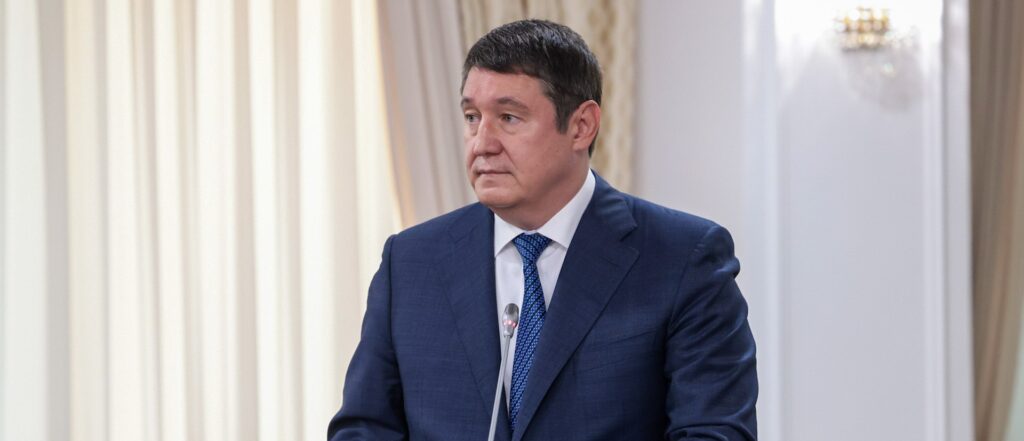
Kazakh President Kassym-Jomart Tokayev has signed a decree establishing the Atomic Energy Agency, a new government body that will report directly to the head of state. The decision, announced on March 18, is part of broader efforts to improve the country’s public administration system. The new agency will oversee uranium mining, the use of atomic energy, radiation safety, and the management of the Semipalatinsk nuclear safety zone. Previously, these responsibilities fell under the Ministry of Energy. Along with its functions, the agency will also inherit its first leader from the ministry: Almasadam Satkaliyev, who has been appointed as its head after being relieved of his role as energy minister. Satkaliyev has held key positions in Kazakhstan’s energy sector, including serving as vice president for economics at KazTransOil, head of the Kazakhstan Electricity Grid Management Company (KEGOC), and chairman of Samruk-Energo. Since 2023, he has led the Ministry of Energy, where he played a central role in preparing for a national referendum on nuclear power plant construction and negotiating with potential suppliers from Russia, China, South Korea, and France. As head of the new agency, Satkaliyev is expected to work closely with the presidential administration on drafting regulations and structuring the agency’s operations. His successor at the Ministry of Energy is Yerlan Akkenzhenov, who previously served as deputy energy minister and has experience within the national oil company KazMunayGas. Tokayev first announced plans to establish the Atomic Energy Agency just days ago during a meeting of the National Kurultai (Assembly), as reported previously by The Times of Central Asia.

Opinion: Are Kazakhstan and the U.S. Reaching Common Ground on Sovereignty and Mutual Engagement?

Kazakhstan’s President Kassym-Jomart Tokayev has made his position clear: his country must remain sovereign, and activities to exert foreign influence should be closely monitored. The message from Astana is that cultural impositions from abroad are not welcome. Tokayev’s longstanding view that Kazakhstan’s democracy should evolve on its own terms has gained new traction with the return of U.S. President Donald Trump to the White House. Washington's avoidance of values-based diplomacy in favor of a hard-nosed, transactional model reinforces Astana’s instincts and creates an opening for a new kind of engagement between the two. "The so-called democratic moral values," Tokayev said, "have been imposed on many countries for decades." Moreover, "under this guise, open interference in the internal affairs of states through international non-governmental organizations and foundations has become widespread. Its ultimate goal," he concluded, "is only theft, that is, pocketing billions of dollars in budgets." For decades, the U.S. policy in Central Asia was fixated on democratic governance, press freedoms, and minority rights, seeking to advance these objectives through NGO funding and media support. In principle, these directions align with Kazakhstan’s own institutional reforms. In practice, however, they became points of friction. Astana has pursued decentralization and anti-corruption measures on its own terms, so any tension with Washington did not concern governance itself. It was, rather, about Washington’s insistence on deeper cultural and political shifts. The unease was not hypothetical. It was spelled out in statements by U.S. officials visiting Kazakhstan. They "were glad to discuss key human rights issues including the freedoms of expression and peaceful assembly, and respect for the rights of disabled persons, members of the LGBTQI+ community, and political prisoners." Moreover, these issues were framed as non-negotiable pillars of engagement, without reference to the cultural context of Kazakhstan’s legal and political traditions. In some cases, the “political prisoners” were propped up by NGOs funded by the U.S. Government. From Washington’s perspective, these were essential democratic norms; from Astana’s, they were foreign expectations imposed from outside. In truth, Kazakhstan had seen this dynamic before. Its wariness of Western-backed NGOs was informed by patterns of events. In Astana’s view, some so-called civil society initiatives weren’t merely fostering grassroots activism. They were vehicles for political engineering. For instance, Mukhtar Ablyazov, who remains accused of embezzling $10 billion from Kazakhstan's BTA Bank, fled to Britain in the mid-2000s before escaping criminal charges to France, where he was granted asylum until being ordered to leave in 2023. Despite his history of corruption, he rebranded himself as a political opposition figure and human rights leader, cultivating a network of international NGOs and earning significant support within the European Union. As recently as February 2025, he and his NGO allies received backing from members of the Parliamentary Assembly of the Council of Europe. A similar strategy has been employed by public figures like Bergey Ryskaliyev, Akezhan Kazhegeldin, and Karim Massimov. These individuals, despite facing criminal allegations, have amassed significant wealth that appears to have been used to fund lobbyists, NGOs, media and other...

Kazakhstan to Establish Nuclear Energy Agency

Kazakhstan will create a Nuclear Energy Agency, President Kassym-Jomart Tokayev announced during a session of the National Kurultai (annual assembly). "Given the special significance of this issue, I have decided to establish the Agency for Nuclear Energy under the President. We must maximize the potential of gas and coal-fired generation, as well as renewable energy sources," Tokayev said​. Tokayev emphasized the need for a comprehensive, long-term approach to energy sector development. "By approving the construction of the first nuclear power plant in a referendum, citizens have given the green light to this initiative. However, it is crucial not only to meet current energy demands but also to lay the foundation for future economic growth. That is why I believe it is necessary to construct not one, but three nuclear power plants to establish a full-fledged nuclear cluster," he said​. Kazakhstan held a referendum on October 6, 2024, regarding the construction of its first nuclear power plant. According to the Central Election Commission, 63.66% of eligible voters participated, with 71.12% (5.56 million people) supporting the project​. In January 2025, the government finalized a shortlist of potential technology suppliers for the plant. The candidates include Russia's Rosatom, South Korea's KHNP, China's CNNC, and France's EDF​. Simultaneously, authorities are completing an analysis of possible locations for the second and third nuclear power plants. The final construction plan is expected to be unveiled in the second quarter of 2025, with the city of Kurchatov among the potential sites under consideration​.

Kazakh MP Calls for Restrictions on Children’s Access to TikTok

Kazakh MP Murat Abenov has proposed limiting children's access to TikTok, citing concerns over its negative effects on young users’ mental health. He warned that the platform could contribute to depression, reduced concentration, and memory problems, urging parents to monitor their children’s screen time​. Abenov referenced a case described by journalist Gulmira Abykay on her Facebook page, where a seven-year-old girl reportedly stopped recognizing her loved ones after excessive exposure to TikTok content​. He emphasized that such concerns are backed by research, as TikTok’s algorithm is designed to maximize user engagement by presenting emotionally stimulating or even distressing videos. The MP pointed out that TikTok has already faced regulatory scrutiny in the United States, where efforts have been made to ban it, and in Europe, where restrictions on data collection from minors have been imposed. He argued that Kazakhstan should also consider introducing regulations for such platforms. “TikTok is structured in a way that delivers an emotional surge every 15 seconds, whether admiration, fear, anxiety, or sadness. Studies show that frequent TikTok users are more prone to depression, struggle with academic performance, and face challenges in processing large amounts of information and logical thinking,” Abenov stated​. While many countries have imposed restrictions on TikTok, the platform remains widely accessible in Kazakhstan, Tajikistan, and Mongolia​. However, TikTok has recently taken steps to enhance child protection, expanding its Family Settings feature. This allows parents to set time limits for app use, including restrictions after 10p.m. and during school hours​.

Time Zone Turmoil: Kazakhstan’s Shift Sparks Backlash and Political Action

Kazakhstan is preparing to put an end to a year-long debate over its transition to a single time zone (UTC+5). However, opposition to the change has evolved beyond public discontent. Critics, including well-known public figures, are now considering the creation of a political party with the goal of overturning what they argue is one of the most unpopular government decisions in the country’s history. Even a year later, many citizens remain unconvinced of the benefits of the time zone shift, while the government continues to defend it with unwavering determination. Origins of the Controversy Discussions about adopting a single time zone in Kazakhstan have surfaced multiple times over the years. In 2021, the proposal failed to gain widespread approval. However, in the fall of 2023, a clutch of parliamentary deputies once again pushed for unifying the country’s time zones, citing public requests and scientific studies. Supporters of the transition argued that a single time zone would eliminate time barriers between regions, improve transport coordination and business operations, and enhance government and emergency service interactions. Advocates also referred to the Barcelona Declaration on Time Policy (adopted in October 2022), which suggests that maintaining permanent time zones aligned with solar time is beneficial for health, the economy, and safety. Additionally, they pointed out that 175 countries operate within a single time zone, whereas only 22 nations use multiple zones. Despite earlier resistance, the government proceeded with the change. At midnight on March 1, 2024, Kazakhstan moved its clocks one hour back, effectively adopting UTC+5, barring a few regions. Public Backlash and the Petition Movement The reaction was swift. On April 22, 2024, an online petition titled "Return the Time Back" appeared, addressed to President Kassym-Jomart Tokayev and key ministers, including those responsible for energy, health, and labor. The petition was also directed to the head of KazNII Oncology and Radiology, though the reason for this remains unclear. Petition organizers listed several negative effects of the time change: Increased darkness during morning and evening hours, impacting public safety and economic activity. Disruptions to biological rhythms leading to fatigue, reduced productivity, and poorer sleep quality. Economic losses, as changes in daylight hours affected certain industries. The petition quickly gathered over 50,000 signatures, compelling the government and parliament to formally consider the issue. On June 21, 2024, an initial public hearing took place, where opponents of the time zone shift voiced their concerns. However, after three rounds of discussions, no changes were made, and Kazakhstan remained in UTC+5. Renewed Opposition in Parliament Despite the government's firm stance, opposition to the change resurfaced in September 2024 when deputies returning from summer recess reported that the time zone issue was the most frequently raised concern among voters. Prime Minister Olzhas Bektenov reaffirmed that the decision was final but instructed the Ministry of Health to conduct a three-year study on the impact of UTC+5 on public health. This announcement only fueled opposition claims that the transition was an unwarranted experiment affecting 15 million citizens, the number of people...

Kazakhstan Cancer Drug Could Hit the Market This Year

Kazakhstan’s Minister of Science and Higher Education, Sayasat Nurbek, has announced the development of a domestic anti-cancer drug currently undergoing clinical trials. According to Nurbek, Phase II clinical trials were completed in 2023, and the number of patients participating in the testing has since been significantly expanded. "At the moment, the drug is being tested on different types of cancer. Last year, trials were conducted exclusively on patients with colorectal cancer. By the end of 2024, we expect the drug to be officially registered and introduced to the market. Preliminary results indicate stable positive dynamics," the minister stated. He noted that patients in clinical trials have experienced remissions, with tumor sizes decreasing by an average of 30%. "By the end of the year, we plan to hold a conference to present the results. The Ministry of Health has been highly supportive, and we have optimized the registration process without violating regulations," Nurbek added. The official registration of the drug is expected to be finalized as soon as possible. Kazakhstan's development of its first domestically produced anti-cancer drug was first reported in January 2024. Later, Nurbek provided updates on the trial progress and expressed confidence in the drug’s effectiveness.