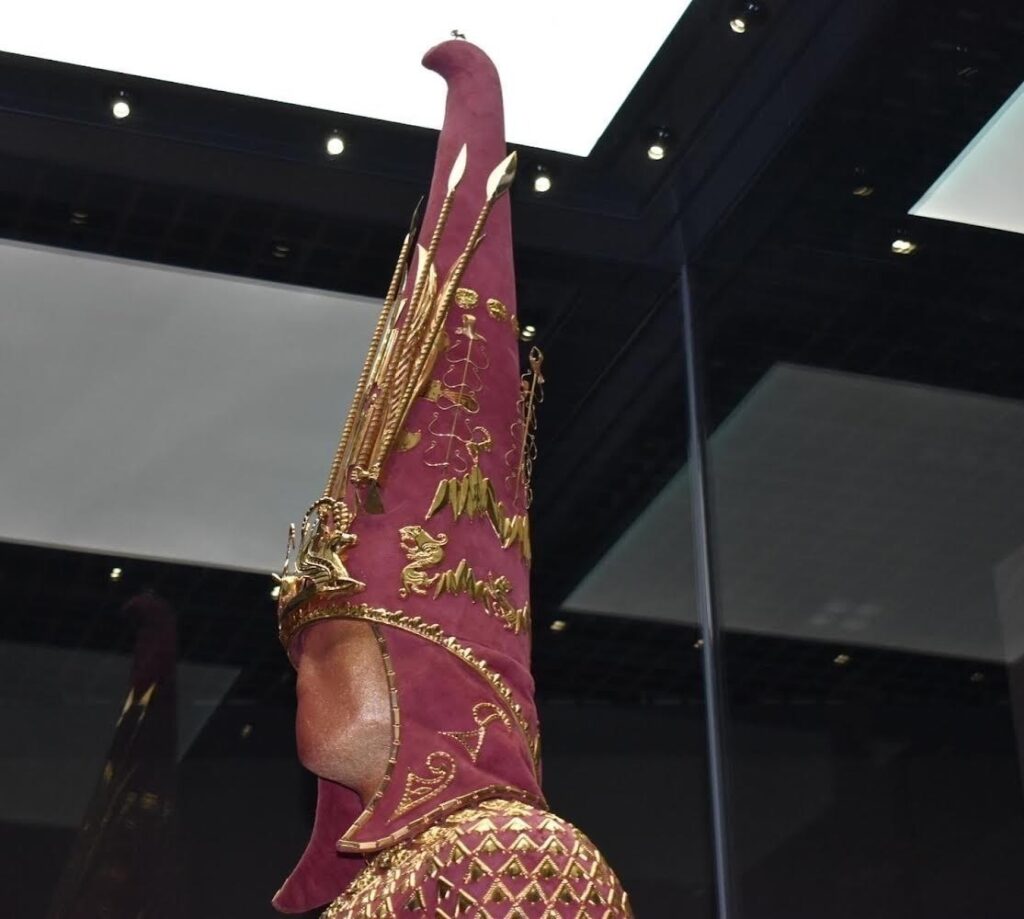
The historical connections between Kazakhstan and India span thousands of years, with the migration of Huns and Śakas from Central Asia to India playing a significant role in shaping the history of these two nations. The Huns, first mentioned by Roman historian Tacitus in the late first century A.D., originated near the Caspian Sea, in present-day Kazakhstan. They migrated to India, where they had a profound influence on the local population. Notable among the Huns was Toramana, who, around 500 A.D., launched attacks on India, eventually settling in Malwa in Central India and establishing himself as a powerful ruler. These historical ties are evident in archaeological finds in Kazakhstan, such as the 45 Hun burial mounds discovered near Almaty in the valley of the River Kegen in 2015. Similarly, the Saka people, another group of nomadic Eastern Iranian peoples, left their mark in the region with several burial mounds located near Almaty. The most notable among these was found in 1969, when the Kazakh archaeologist, Kemal Akishev, discovered a teenage Saka prince adorned with almost 4,800 gold items in an Issyk kurgan. Known as the “Golden Man,” the figure was adopted as one of the symbols of modern Kazakhstan, with a likeness standing atop the Independence Monument on the central square of Almaty.[/vc_column_text][vc_single_image image="13850" img_size="full" el_class="scond-image" parallax_scroll="no" woodmart_inline="no"][vc_column_text woodmart_inline="no" text_larger="no"]In India, the influence of the Huns is palpable in places like Gwalior, a metropolis recently designated as a Creative City of Music by the UNESCO Creative Cities Network. The earliest historical record of Gwalior is an inscription by the Hun ruler Mihirakula, the second and last Alchon Hun king of the north-western region of the Indian subcontinent between 502 and 530 CE, referencing his father, Toramana, as a "a ruler of the earth.” Mihirakula was a patron of Shaivism, and his reign left a lasting impact on the Indian landscape. The historical connections between Kazakhstan and India continue to be celebrated today, with India being one of the first countries to recognize Kazakhstan's independence. The two countries actively cooperate under various multilateral fora, including the Conference on Interaction and Confidence Building Measures in Asia (CICA), the Shanghai Cooperation Organization (SCO), and United Nations organizations.[/vc_column_text][vc_single_image image="13849" img_size="full" el_class="scond-image" parallax_scroll="no" woodmart_inline="no"][vc_column_text woodmart_inline="no" text_larger="no"]This historical connectivity is deeply rooted in the migration of two nomadic groups, the Huns and Śakas, from what is now known as Kazakhstan to India. Both these communities, though distinct in their origins - with the Huns being Turanic and the Śakas of Iranian descent - migrated to India, embraced the local culture, and significantly influenced the country's history and development. The first Saka king in India was Maues, also known as Moga, who established Saka dominion in areas covering Gandhara, the Indus Valley, and regions that are part of present-day Afghanistan. The Śakas ruled over vast territories, including the north-west frontier, Punjab, Sindh, Kashmir, western Uttar Pradesh, Saurashtra, Kathiawar, Rajputana, Malwa, and the north Konkan belt of Maharashtra. Saka ruler Nahapana held sway over Kathiawar and neighboring territories,...