Viewing results 673 - 678 of 985
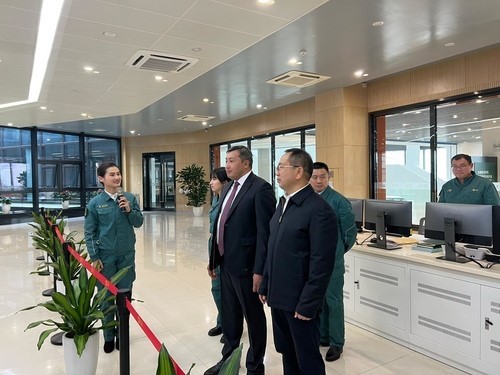
Mayor Zhyrgalbek Shamyraliev, together with a group of his representatives and Ulana Bakirova, an expert from the Information Policy Service of the Presidential Administration, visited Hunan Junxing Company in Changsha, China. The purpose of their visit was to study advanced waste treatment methods and familiarize themselves with the transportation and logistics complex. Hunan Junxing is a high-tech enterprise engaged in the development and implementation of innovative methods for municipal solid waste treatment, municipal wastewater treatment, landfill leachate treatment, fly ash utilization, and other types of waste. The technologies used include advanced methods of physical and chemical treatment and mechanical sorting, which allows the company to effectively solve the problems of environmental pollution and waste utilization. During the visit, the delegation was shown the transshipment complex of the Hunan Junxing Company, and received information on the operation of the waste utilization plant. The potential prospects for the application of technologies implemented in Changsha being adopted in Bishkek were high on the agenda. At the end of the meeting, a ceremony was held with the company gifting two advanced garbage trucks to the Bishkek administration. During the visit, a meeting was also held with Gao Wenqi, Deputy Mayor of the People's Government of Changsha, wherein the parties discussed the development of infrastructure of the city, and prospects for cooperation in the areas of trade, economy, culture, and the social sphere.
On January 9th, the President of the Kyrgyz Republic, Sadyr Japarov signed a Decree “On the introduction of a temporary ban (moratorium) on conducting inspections of business entities.” The Decree has been issued with the purpose of stabilizing the economic activities of businesses, ensuring the further development of the business environment, improving the investment climate, and eliminating unjustified and unnecessary interference by government bodies, the presidential press service said in a statement. The moratorium will run until December 31st, 2024. In a post on Facebook, President Japarov called on representatives of small and medium-sized businesses to report unjustified inspections to him. Japarov wrote that only enterprises against which a criminal case has been initiated will be subject to inspections. “If representatives of government agencies come to check businessmen without reason, without identifying signs of an economic crime, you can contact me through the Presidential Administration,” Japarov stated, promised that measures will be taken in such cases.
As reported in a news release on its website, on December 28th the Asian Development Bank (ADB) and Kompanion Bank Closed Joint Stock Company on December 28th signed off a loan of up to $5 million in local currency financing to boost micro, small, and medium-sized enterprises (MSMEs) in Kyrgyzstan, especially those owned or led by women. Established in 2004, Kompanion Bank is one of the large commercial banks in the Kyrgyz Republic and dominates the MSME market through its wide network with 93 branches across the country. More than half of Kompanion’s portfolio is with micro and small enterprises. “Women account for about a third of entrepreneurs in the Kyrgyz Republic, but they nevertheless face significant challenges in accessing financial services and credit,” said ADB Director General for Private Sector Operations, Suzanne Gaboury. “This partnership with Kompanion Bank will help bridge the financing gap for women-led small businesses, as well as provide a strong case for the sustainability of local currency lending to these companies.” To strengthen development impact and address finance and bankability constraints, transactions incorporate a credit guarantee from the Asian Development Fund’s (ADF) Private Sector Window facility (PSW) of up to $2.3 million. ADB will also provide technical assistance to Kompanion Bank to enhance its digital capabilities and operational efficiency. “We are happy to be a partner with ADB in this initiative to support micro and small entrepreneurs in the Kyrgyz Republic. We believe that our experience in the MSME market will allow us to make a significant impact on the local economy, and we look forward to working closely with ADB for the benefit of our clients and the community,” said Kompanion Bank CEO, Margarita Cherikbaeva. ADB will also help Kompanion Bank to develop a gender action plan to promote gender equality and women’s empowerment in its business activities. Key activities will include increasing the number of women borrowers and delivering training on improved agricultural practices and digital and financial literacy for female clients.
A meeting of the Supreme Eurasian Economic Council was held in St Petersburg on December 25th. The meeting was attended by leaders of the Eurasian Economic Union (EEU) member countries - the Prime Minister of Armenia, Nikol Pashinyan, President of Belarus, Alexander Lukashenko, President of Kazakhstan, Kassym-Jomart Tokayev, President of Kyrgyzstan, Sadyr Japarov, and President of Russia, Vladimir Putin. Opening the meeting, Russian President Putin said that the Eurasian Economic Union will soon be ten years old, and over this period, the mutual trade between its member countries has almost doubled and the aggregate GDP of the EEU countries has grown from US$1.6 trillion to US$2.5 trillion. “We have created deep common markets for goods, services, capital, and workforce, which are operating in line with agreed-upon rules. The main point is that the Eurasian Union has become an authoritative international integration association with an efficient structure and a good foundation,” he said. Putin added that the work on aligning integration processes within the EEU and China's Belt and Road Initiative is also yielding results. The Council’s meeting adopted the declaration “Eurasian Economic Path,” which is aligned with China’s Belt and Road Initiative.
The Russian-Kyrgyz Development Fund (RKDF) has said it will finance both new and existing projects in Kyrgyzstan totaling more than $140 million in 2024. The Fund will focus on strategic sectors of the economy: industry, infrastructure development in education and healthcare, logistics, agriculture and agro-processing, strengthening food security, and energy independence. Work in the country’s regions will continue and be expanded, for which the Fund’s Council approved financing of $1 million. “The strategic decision to approve the budget will allow the Fund to continue operating as usual. The RKDF has the necessary amount of resources, and we will continue to accept new applications. We hope that the number and quality of interesting, important and necessary projects for the country will grow, and the Fund, by financing them, will continue to contribute to the development of the economy,” stated Artem Novikov, Chairman of the Board of the RKDF. Member of the RKDF Council, and Minister of the Economy and Commerce of Kyrgyzstan, Daniyar Amangeldiev said that compared to the previous year, the Fund’s overall project portfolio in Kyrgyzstan will be increased by 50%.
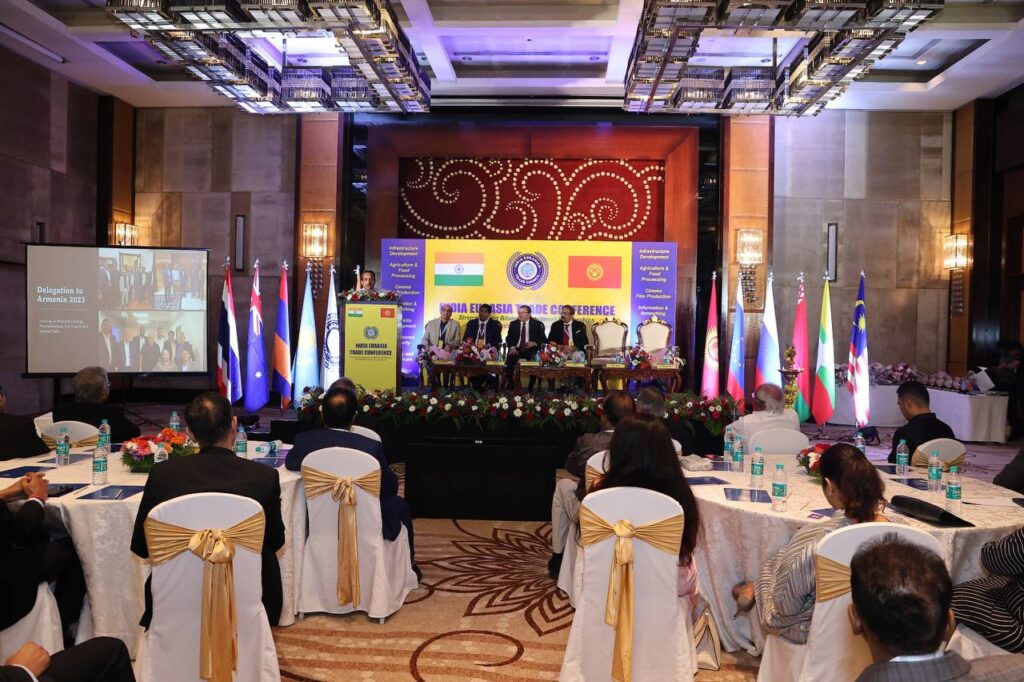
On December 21st and 22nd, the Ambassador of the Kyrgyz Republic to India, Askar Beshimov paid a working visit to Chennai, Tamil Nadu state in southern India, discussing the possibility of using the port of Chennai in trade with the Kyrgyz Republic. The main event during the visit was a Kyrgyz-Indian business forum held on December 21st, organized by the Embassy of the Kyrgyz Republic in India jointly with the Indian Economic Trade Organization (IETO). The forum was attended by the Minister of Foreign Affairs of the state of Tamil Nadu, the consuls-general of a number of countries, the President of IETO, representatives of the business community, the academic sector, agencies in the field of education and human resources, and banks of South India. In his speech, Ambassador Beshimov focused on the main aspects of bilateral trade, economic, investment and cooperation, as well as interaction in the field of human resources, education, and tourism. He emphasized that investments and trade with Kyrgyzstan can open doors for Indian companies to the entire Eurasian Economic Union market. Indian ministers, the IETO President, and business representatives expressed their interest in expanding economic ties with Kyrgyzstan. As a result, an agreement was reached to organize a visit of a business delegation from South India to Kyrgyzstan in 2024.