Viewing results 277 - 282 of 491
The Center for Employment of Citizens Abroad has signed a partnership agreement with the Italian association of farmers, Coldiretti Sardegna, which stipulates that labor migrants from Kyrgyzstan can work in Sardinia. The Italian association is interested in attracting Kyrgyz citizens to work in agriculture, with preference being given to married couples. A representative from the Center for Employment of Citizens Abroad stated that “social packages were discussed, including housing, legal presence, and health insurance. Moreover, after moving to Italy, employers expressed that training in the Italian language will be provided.” Baktybek Kudaberdiyev, director of the Center, said this is the first agreement with Italian companies on hiring Kyrgyz people. “We are confident that this agreement will become the basis for successful and long-term cooperation, benefiting both sides,” Kudaberdiyev stated. The cooperation agreement was organized by the Kyrgyz ambassador to Italy, Taalai Bazarbayev. Coldiretti Sardegna is a trade union representing Italian enterprises working in Sardinia's agriculture and agri-food sectors.
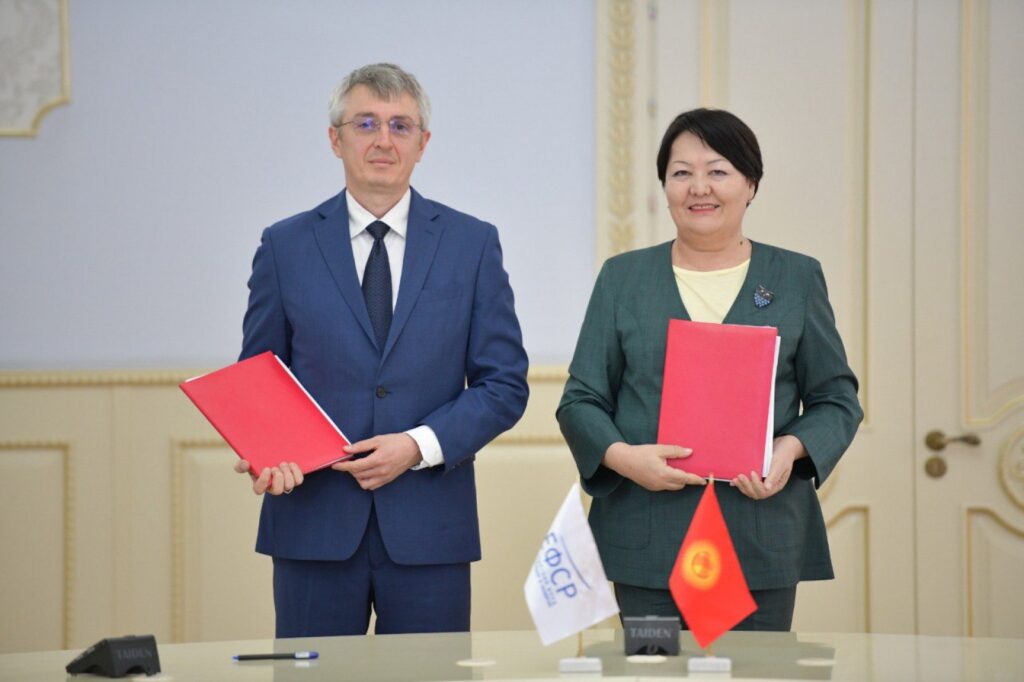
On July 23, Dogdurkul Kendirbaeva, Minister of Education and Science of Kyrgyzstan, and Andrey Shirokov, Executive Director of the Project Unit at the Eurasian Fund for Stabilization and Development (EFSD), signed an agreement to construct and fully equip nine secondary schools in Kyrgyzstan on a grant basis. The EFSD is a financial institution established in 2009 by Armenia, Belarus, Kazakhstan, Kyrgyzstan, Russia, and Tajikistan to promote economic and financial stability in its member states. The document was signed following a meeting between Andrey Shirokov and Akylbek Japarov, Chairman of the Kyrgyz Republic's Cabinet of Ministers, during which the latter reiterated the parties' commitment to cooperate on the implementation of projects prioritized by his country. In addition to the schools, a $60 million project will be launched to provide drinking water to 32 villages in the southern Osh region. Other proposed initiatives include improving the country’s irrigation system and purchasing ambulances. EFSD is also invested in cooperating on improvements to Kyrgyzstan's roads and as stated by Japarov, “the planned Aral–Suusamyr highway project is expected to reconstruct approximately 80 km of the road connecting the Bishkek–Osh and North-South transport corridors, vital to the Kyrgyz Republic. The successful implementation of this project will promote the socio-economic development of the Naryn and Talas regions and the remote areas of the Chui region, reduce travel times, and significantly improve road safety in the country."
Kyrgyzstan's capital Bishkek plans to introduce a tourist tax for foreign visitors staying in the city. The Kabar news agency reported that according to the draft resolution submitted by the mayor's office for public discussion, visitors will be charged 50 KGS (approximately 0.59 dollars) for every day spent in the Bishkek's hotels, hostels, campsites, guest houses, and holiday lets. The fee is not included in the cost of accommodation. Instead, operators will be obliged to advise their guests of the charges and collect the fee when they register their stay. Following the requirements of the Kyrgyz Republic's tax legislation, cash register machines are mandatory in all types of accommodation and the fee, paid in Kyrgyzstan's national currency, will be accepted either in cash or by bank card.
At the beginning of July, records showed that 218 children without parental care were being raised by 110 foster families in Kyrgyzstan; an increase of 29% compared to the previous year. Active in promoting fostering as a far better alternative to orphanages , the Kyrgyz Ministry of Labor reports, "A foster or adoptive family is a trained family that provides upbringing for children in difficult life situations for a certain period of time, based on a contract with the state. Citizens between the ages of 30 to 65 are eligible to apply to become foster parents and to ensure the safety and wellbeing of their charges, receive specialist training as well as monthly checks by social service employees. Contracted by the state, they also receive an allowance of $80 a month until the orphans come of age. According to the Ministry of Social Services, "If applicants have one or two children, they can only foster three. If foster parents have no children of their own, they can raise up to five toddlers or teenagers from three to 16 years of age." Beneficial on many levels, fostering provides children with both a secure base and opportunities to master a trade, work in agriculture or follow a profession, to enable them to lead independent lives as adults.
The brother-in-law of the head of Kyrgyzstan's State Committee for National Security (SCNS), Kamchybek Tashiyev, has been detained on suspicion of large-scale fraud. The investigation found that the relative, having conspired with a Turkish citizen by deceit and breach of trust, took possession of a large sum of money from a local businessman, who then appealed to the SCNS with a corresponding statement. The Committee said that despite close family relations, Tashiyev was instructed to conduct an objective investigation and give a legal assessment. Based on the decision of the Pervomaisky District Court of Bishkek, the suspects were detained and taken into custody as part of the investigation. The investigation is underway, and measures are being taken to compensate the injured party.
The chairman of Kyrgyzstan's Cabinet of Ministers, Akylbek Japarov, has spoken about the country’s economic results for the first half of this year. At a government meeting on July 17 Japarov said that Kyrgyzstan needs to make a further big step forward in its economic development. The phrase Japarov used was "leopard's leap", referencing the fact that the snow leopard was recently announced as Kyrgyzstan’s official symbol. Japarov announced that Kyrgyzstan's GDP growth rate in 2023 was 7%, rising to 8.1% in the first half of 2024. He added: “We need to triple our efforts to put the economy on a sustainable development course and achieve the goals set by the Head of State to have a GDP of $30 billion by 2030 and $200 billion by 2050.” Japarov opined that the government should launch a new program to support domestic entrepreneurs purchasing new technological equipment, and also support small and medium-sized enterprises to expand production and open new jobs. These measures would be in addition to the lowering of the interest rate of the National Bank (which has lowered the interest on bank loans for business) and decreasing Social Fund payments by employers from 12.5% to 2%. Japarov ordered the Ministry of Economy and Commerce to pay more attention to the development of commodity exchanges, and develop an export development program that will propose initiatives for import substitution and promote domestic products. He also emphasized the importance of the ministry’s work in improving the position of Kyrgyzstan in Moody's and Fitch's ratings. Regarding credit ratings, Japarov said: “The Moody's rating agency has revised the credit rating of the Kyrgyz Republic from negative to stable. This indicates that the state is strengthening itself as a reliable partner, capable of promptly and fully fulfilling its financial obligations. However, we must not stop there. I ask you to work carefully in this direction. First, this is a question of the country’s reputation in the eyes of international financial institutions and investors. We must constantly improve our position.”