• KGS/USD = 0.01143 0%
  • KZT/USD = 0.00205 0%
  • TJS/USD = 0.10433 0.1%
  • UZS/USD = 0.00008 0%
  • TMT/USD = 0.28577 0%
  • KGS/USD = 0.01143 0%
  • KZT/USD = 0.00205 0%
  • TJS/USD = 0.10433 0.1%
  • UZS/USD = 0.00008 0%
  • TMT/USD = 0.28577 0%
  • KGS/USD = 0.01143 0%
  • KZT/USD = 0.00205 0%
  • TJS/USD = 0.10433 0.1%
  • UZS/USD = 0.00008 0%
  • TMT/USD = 0.28577 0%
  • KGS/USD = 0.01143 0%
  • KZT/USD = 0.00205 0%
  • TJS/USD = 0.10433 0.1%
  • UZS/USD = 0.00008 0%
  • TMT/USD = 0.28577 0%
  • KGS/USD = 0.01143 0%
  • KZT/USD = 0.00205 0%
  • TJS/USD = 0.10433 0.1%
  • UZS/USD = 0.00008 0%
  • TMT/USD = 0.28577 0%
  • KGS/USD = 0.01143 0%
  • KZT/USD = 0.00205 0%
  • TJS/USD = 0.10433 0.1%
  • UZS/USD = 0.00008 0%
  • TMT/USD = 0.28577 0%
  • KGS/USD = 0.01143 0%
  • KZT/USD = 0.00205 0%
  • TJS/USD = 0.10433 0.1%
  • UZS/USD = 0.00008 0%
  • TMT/USD = 0.28577 0%
  • KGS/USD = 0.01143 0%
  • KZT/USD = 0.00205 0%
  • TJS/USD = 0.10433 0.1%
  • UZS/USD = 0.00008 0%
  • TMT/USD = 0.28577 0%

Viewing results 835 - 840 of 1444

Water Shortages in Kyrgyzstan’s Cities Despite Full Reservoirs

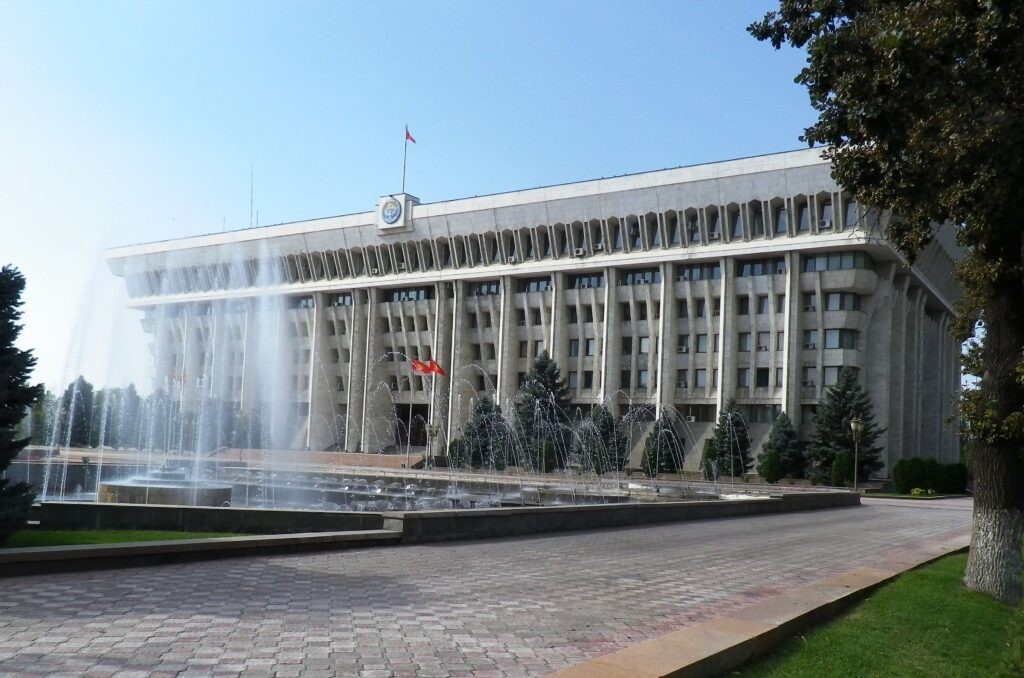
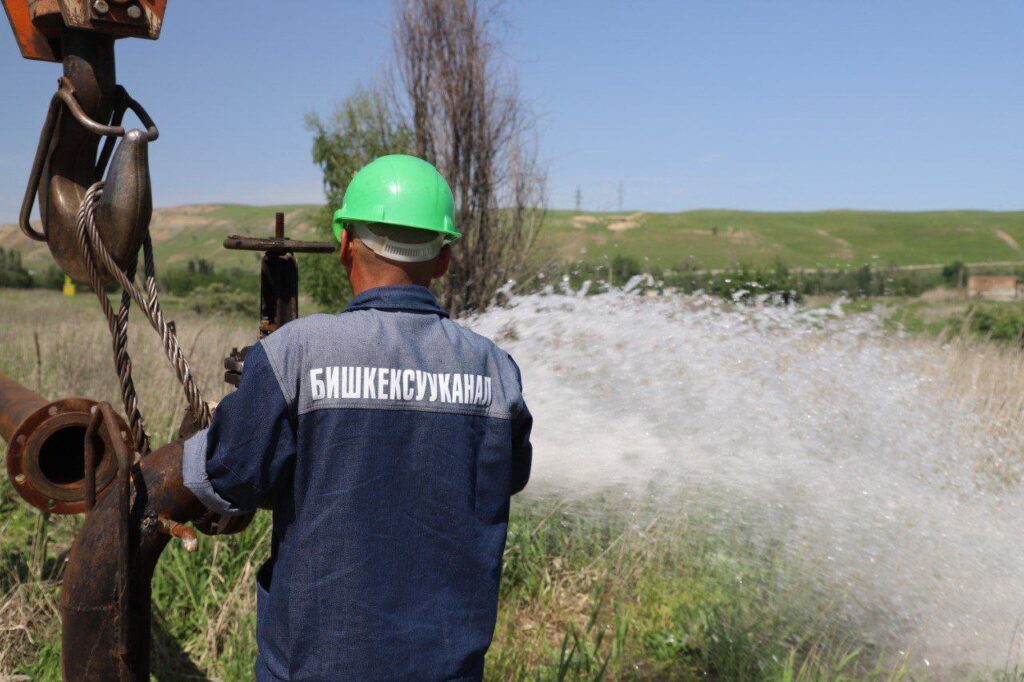
Due to a shortage, Kyrgyz authorities have banned the use of drinking water to irrigate cities' gardens and orchards. Implemented in Bishkek and Osh, the ban which operates during daytime hours, is set to run until the end of the summer. In a report to TCA,  Erlan Timurov, chief public relations specialist for Bishkekgorvodokanal, the company in charge of drinking water in Bishkek, stated: "Every year, Bishkekvodokanal produces about 145 million cubic meters of drinking water, around  48m cubic meters of which are lost as a result of  illegal connections to our networks and leaks caused by worn-out infrastructure" The situation is similar in southern Kyrgyzstan and in Osh, utility companies in the course of monitoring levels, regularly identify and cut off water supplies to those illegally  connected to the system. "The average daily consumption of drinking water in residential areas increases fivefold in summer," explained Timurov. "Most of this increase is spent on watering vegetable gardens and filling swimming pools. As a result, some residents experience water shortages." Ironically, the water deficit is developing against a backdrop of overflowing local reservoirs caused partly by abnormal weather melting mountain glaciers. Under the circumstances, the Tien Shan High Mountain Research Centre at the Institute of Water Problems and Hydropower in Kyrgyzstan blames cities' water shortages on irrational use. "In the 1980s , collective and state farms universally introduced the so-called sprinkler system. Back then,  500 to 1,000 cubic meters of water were required to irrigate one hectare.  Today, that has risen to  2 to 3 thousand cubic meters. The problem is that we have lost many technologies and do not know how to use water effectively," claimed  the scientific center. Drip irrigation used worldwide, is now being introduced in Kyrgyzstan. However, because  it's expensive, the percentage of Kyrgyz farmers using this type of irrigation is extremely small and the majority  continue their habit of using drinking water in their fields, gardens, and orchards using outdated irrigation systems .

The Evolution of Kazakh Ornamentation

Ornamentation, evolved over the centuries and influenced by the country’s history, is integral to Kazakhstan’s rich and unique cultural heritage. Art historian Raushan Yeschanova outlines its evolutionary path, significance to Kazakh life and society, and how it continues to develop and inspire contemporary art and culture. Origins of Kazakh Ornamentation Kazakh ornamentation emerged in ancient times, reflecting the peculiarities of nomadic life and the country’s natural environment. Simple geometric shapes and symbols were used in rituals and to decorate everyday objects, textiles, clothing, jewelry, dwellings and graves. The main components of Kazakh ornamentation were lines, curves, dots, circles, zigzags and geometric figures, arranged and intertwined to create rhythmic compositions and patterns. Abstracted from natural phenomena and zoomorphic, these early ornaments were valued both aesthetically and for their deep symbolic significance. Influence of Cultural Traditions Over time, due to exposure to other nations’ cultural traditions through trade and the passage of caravans through the country, Kazakh ornamentation became more complex and diverse. Many of its motifs share similarities with designs found in artefacts made by other Turkic-speaking peoples, including the Kyrgyz and Mongolian Alai Kazakhs. Interaction with Turkic, Mongolian, Persian and other cultures, enriched Kazakh ornaments making them more multi-layered and multifaceted. For example, the Mongolian influence is apparent in the introduction of more complex zoomorphic and plant motifs, whilst that of Persia is evident in the refinement and elegance of linear design. Among plant patterns, Raushan singles out the early "shytyrman"; a complex interweaving of geometric, horn-shaped and plant motifs. [caption id="attachment_19112" align="alignnone" width="4000"] Image Source: liveinternet.ru[/caption] Ornamentation in the Medieval Period One of the most important stages in the development of Kazakh ornamentation was the formation of the khanate and the development of urban centers during the medieval period. At this time, complex ornamental compositions including abstract patterns, plant motifs, animal images and heraldic symbols appeared in the khans’ palaces as well as religious buildings. Widespread in their application, these ornaments decorated architectural features, luxury items, jewelry, and textiles. Totemism and Symbolism in Kazakh Ornamentation Kazakh ornamentation is also closely related to the totemic beliefs of the ancient Turks. Totemic signs and symbols, often related to animals, had a deep sacred meaning. A symbol of prosperity and vitality, the ram’s horn is ubiquitous in ancient cultures from the Pacific Ocean to the Mediterranean Sea, and is widespread among both Iranian and Turkic tribes. Images of the ram and closely related animals, such as the argali and the Siberian goat, are the most common themes in ancient Eastern art. For millennia, horns have appeared in fluid, interlocking designs in Turkic artefacts, and, denoting prosperity and wellbeing in Kazakh ornamentation, are frequently seen above the doors of yurts and on ancestral graves. The bird is also a powerful symbol within Kazakh ornamentation. Representing freedom, "kus kanat" or "kus muryn" was commonly used in jewelry. Images of eagles were favored in the art of the Saks, whilst nationwide the popular abstracted image of ravens’ claws represents protection. [caption id="attachment_19113" align="alignnone" width="4000"] "Kus...

USAID Supports Central Asian Women Working in Hospitality

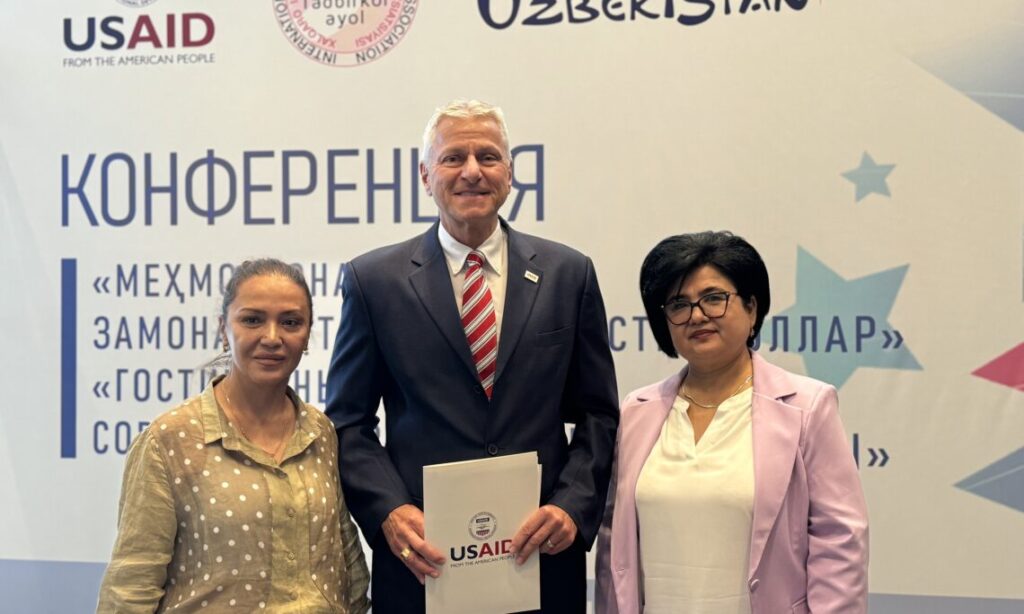
The U.S. Agency for International Development (USAID) and the International Association of Businesswomen “Tadbirkor Ayol” last week hosted a Central Asian Conference on “Women of Central Asia in the Hospitality Business: Current Challenges and Opportunities”. The event in Tashkent attracted some 200 women entrepreneurs, professionals, and industry experts from Uzbekistan, Tajikistan, and Kyrgyzstan to discuss achievements, trends, and challenges in the region’s hospitality sector. As reported by the U.S. Embassy in Uzbekistan, the conference focused on service quality, digitalization, and modern standards in tourism, culminating in recommendations to enhance regional cooperation in tourism and hospitality. Praising the resilience and creativity of women in the hospitality industry and emphasizing their role in the sector’s future, Edward Michalski, USAID Deputy Mission Director in Uzbekistan, commented: “Investing in women and girls is essential to transforming communities. When women do better, families do better, communities do better, and countries do better.” Gulnora Makhmudova, Chairwoman of “Tadbirkor Ayol,” noted that the growing importance of the region’s hotel business and the increasing involvement of women, had spurred the association into launching “Women in the Hotel Business: Hospitality from the Future;” a project aimed to introduce innovation and digitalization in the hospitality sector. Since its launch in April 2024, with support from USAID, the project has provided training for 115 women in modern hotel management in Tashkent, Andijan, and Samarkand.  

Kyrgyzstan’s President Says Acquitted Protesters Deserved “At Least a Fine or Probation”

International rights groups welcomed the recent acquittal of more than 20 Kyrgyz activists and political figures who would have faced long jail sentences if convicted of plotting riots and other crimes, but Kyrgyzstan’s president says the defendants should have been fined or put on probation. President Sadyr Japarov commented about the case on Saturday in an interview with the official Kabar News Agency, one day after the activists were acquitted because of insufficient evidence. The activists were arrested in 2022 after protesting against a border demarcation agreement with Uzbekistan that involved the Kempir-Abad Dam and surrounding lands. “The court is a separate branch of government,” Japarov said. “I have been saying since the beginning that no one has the right to interfere in the work of the court. We must all obey the court's decision. We have no right to criticize whether it is legal or not. Whatever the court decides, whether it is right or wrong, we must agree.” Japarov continued: “But now, after the decision of the court, I can express my opinion. If I were a judge, I would give the organizers of this case some kind of punishment, at least a fine or probation.” The Kyrgyz president said the activists deserved a penalty because, in his view, they misled people into thinking that Kyrgyzstan was losing the entire dam in the border deal, when in fact it is being jointly managed with Uzbekistan. Prosecutors were seeking 20-year jail terms for the defendants. Several were also charged with trying to violently seize power. “We didn’t expect it, at all. We were crying from surprise,” Rita Karasartova, one of the accused activists said of the acquittal. She was quoted by Amnesty International, which described the charges as politically motivated. The prosecutions in the Kempir-Abad case fed into worries that Kyrgyzstan, under Japarov’s leadership, is walking back the relative freedoms that it has enjoyed in comparison to some of its Central Asian neighbors. Critics point to prosecutions of journalists and a new law that tightens control of foreign-funded non-governmental groups as signs of growing authoritarianism. Japarov has described some of the international criticism as an exercise in double standards and meddling in the country’s internal affairs.

Cannes Award-Winning Film, “Anora” Vexes Uzbek Public

American director Sean Baker’s film “Anora” was awarded the Palme d’Or at the 77th Cannes Film Festival for the comedy-drama genre. The film, which is about a prostitute, has sparked discussions in Uzbekistan on social networks. Starring Mikey Madison, Mark Eidelshtein, and Yura Borisov, the film premiered on May 21st, 2024, at the 77th Cannes Film Festival. The audience applauded the filmmakers for nine minutes after the screening. As a result, the film was awarded the “Golden Palm Leaf” on May 25th. The movie's events take place in Brooklyn, New York, USA. The main character, Anora, introduces herself as Ani, a 23-year-old girl working as a dancer and sex worker in a nightclub. Ani meets a Russian, Vanya, in a club and starts a conversation. Vanya brings Ani to a luxurious house, where they drink alcohol, play video games, and enjoy the night together. The audience then learns that Vanya is the son of a wealthy Russian oligarch, and suddenly, he offers Ani the chance to fly to Las Vegas and marry him, presenting her with a four-carat diamond ring as proof of his intentions. Ani agrees, but the story does not end happily. Having learned about his son’s plan, Vanya's father and his wife immediately fly from Russia to New York to persuade their son to cancel the marriage. The interpretation of Ani has caused much conversation in Uzbekistan, with many expressing their displeasure with the movie's portrayal of her. Baker has described the character, Anora, both as “Russian-American” and as from a post-Soviet state. However, Anora is rarely ever used in Russia but is fairly common in Uzbekistan, where it means "red" and also "pomegranate". “I didn’t see any image or reality in this film or in the comments about the film that indicate that Anora is Uzbek," journalist Chori Latipov wrote. "I didn't even read such a concept in the review. On the contrary, the comments talk about the novel of an American woman and a Russian man. Russian commentators are currently criticizing the subject of this film as an attempt to confuse Russian life without knowing Russian life. So, the heroes are an American woman and a Russian man, and the word Uzbek comes from the name only.” Social network users in Uzbekistan, however, are worried that the film portrays Uzbek girls in a negative light. Lochinbek Amanov remarked, “This is a complicated issue for an honorable nation.” “There can be various reasons why such a film is developed and won at the festival,” journalist and screenwriter Sarvar Rahimi stated. “First of all, they are angry that we are holding onto national and religious values instead of following their lead. Secondly, they have wrong assumptions about our nation.” Shahrukh Abdurasulov, senior researcher in the Department of Theater and Choreography of the Academy of Sciences of the Republic of Uzbekistan and Doctor of Philosophy (PhD) in Art Studies, told The Times of Central Asia that it is true that some Uzbek girls make a living as prostitutes...

Controversial Petition on “LGBT Propaganda” Passes Threshold for Consideration in Kazakhstan

A petition against so-called “LGBT propaganda” has received more than 50,000 signatures, meaning Kazakhstan’s Ministry of Culture and Information must consider it. However, a number of experts believe that restrictions on the gay community would damage Kazakhstan’s image. In addition, the petition’s authors are known for their controversial initiatives.  The Kazakhstan Parents' Union is the author of the petition “We are Against Open and Concealed LGBT Propaganda in the Republic of Kazakhstan,” which was published on the official E-Petition.kz portal. According to Article 90-4 of the Administrative Procedural Code, the government must consider a petition with 50,000 signatures. A working group including interested parties, government agencies, and public associations will be created. The consideration of official petitions are a relatively recent innovation. So far, only three have collected the required number of signatures. The first came in the wake of the Nukenova murder at the hands of a disgraced former minister.  It was considered by the Kazakhstan president himself and brought about landmark legislation on domestic violence. The decision to allow public input via petitions is seen as a sign of the fulfillment of President Tokayev's promise of a more engaging and aware "listening state." Kazakhstan has seen repeated attempts to include in various legislative acts such a ban on promoting “nontraditional relations.” However, these amendments were not adopted, though numerous Mazhilis (lower chamber of parliament) deputies and public figures spoke out in favor of them. Nevertheless, there have been cases in Kazakhstan where media products containing what is deemed “homosexual content” did not reach the market. For example, in 2022, the former Minister of Culture and Information, Dauren Abaev, announced that, "In response to numerous requests from citizens and the media, I inform you, the animated film Lightyear will not be shown in Kazakhstan." Officially, however, the ministry did not prohibit the screening of the Hollywood animation in cinemas. According to rumors, distributors themselves canceled showings in response to the public outcry. Also, in January 2024, a website for LGBT people was blocked in Kazakhstan. The site, among other things, had materials to help young people answer questions about their sexual orientation. “During monitoring of the internet resource selftanu.kz, a violation of the law was identified related to the posting of information harmful to the health and development of children,” the Ministry of Culture stated in justifying blocking the site. The head of the group pushing the current petition, Bagila Baltabaeva, stated that, “Same-sex love is being openly forced on our children. It is forced [on them] in bookstores, on TV screens, and on smartphones. Young people openly spread [information about] and promote their unhealthy relationships. Thus, stealthily and subtly, new standards of sexual relations are taking shape among young people. In parallel, it is promoted that traditional values are relics of the past, a sign of backwardness. Therefore, for fear of criticism, many remain silent. And those who work up the courage and speak out against LGBT propaganda are branded as retrogrades and conservatives.” This is not the...