• KGS/USD = 0.01144 0%
  • KZT/USD = 0.00216 0%
  • TJS/USD = 0.10456 0%
  • UZS/USD = 0.00008 0%
  • TMT/USD = 0.28490 0%
  • KGS/USD = 0.01144 0%
  • KZT/USD = 0.00216 0%
  • TJS/USD = 0.10456 0%
  • UZS/USD = 0.00008 0%
  • TMT/USD = 0.28490 0%
  • KGS/USD = 0.01144 0%
  • KZT/USD = 0.00216 0%
  • TJS/USD = 0.10456 0%
  • UZS/USD = 0.00008 0%
  • TMT/USD = 0.28490 0%
  • KGS/USD = 0.01144 0%
  • KZT/USD = 0.00216 0%
  • TJS/USD = 0.10456 0%
  • UZS/USD = 0.00008 0%
  • TMT/USD = 0.28490 0%
  • KGS/USD = 0.01144 0%
  • KZT/USD = 0.00216 0%
  • TJS/USD = 0.10456 0%
  • UZS/USD = 0.00008 0%
  • TMT/USD = 0.28490 0%
  • KGS/USD = 0.01144 0%
  • KZT/USD = 0.00216 0%
  • TJS/USD = 0.10456 0%
  • UZS/USD = 0.00008 0%
  • TMT/USD = 0.28490 0%
  • KGS/USD = 0.01144 0%
  • KZT/USD = 0.00216 0%
  • TJS/USD = 0.10456 0%
  • UZS/USD = 0.00008 0%
  • TMT/USD = 0.28490 0%
  • KGS/USD = 0.01144 0%
  • KZT/USD = 0.00216 0%
  • TJS/USD = 0.10456 0%
  • UZS/USD = 0.00008 0%
  • TMT/USD = 0.28490 0%

Viewing results 1861 - 1866 of 2883

Mirziyoyev, Chinese Premier Discuss Economic Cooperation

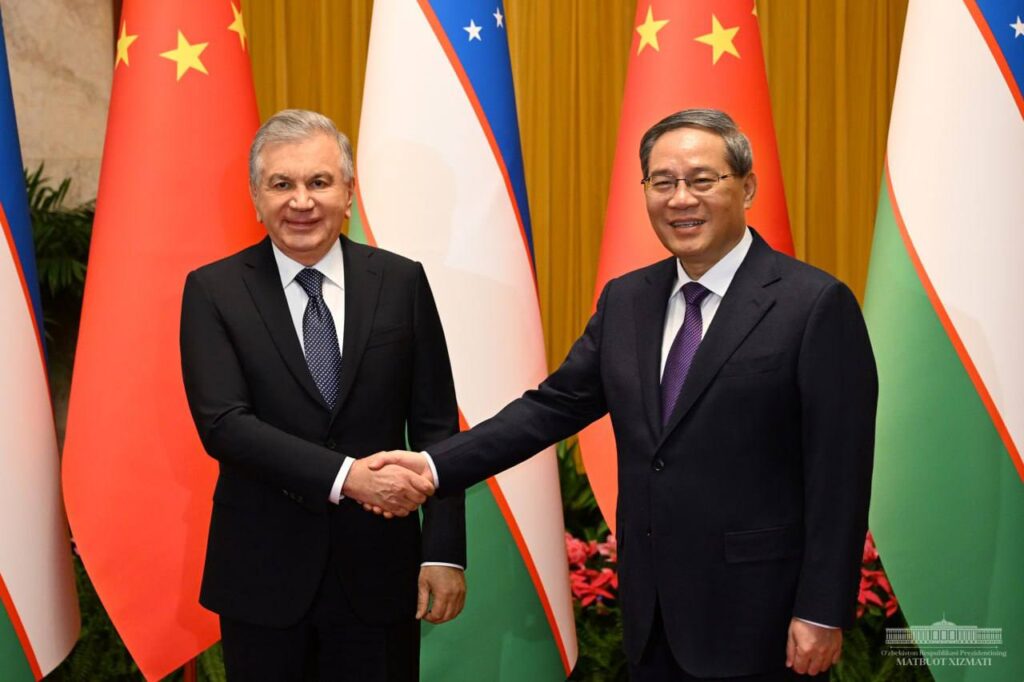
Uzbekistan’s president Shavkat Mirziyoyev arrived in Beijing on January 23rd to begin a three-day state visit to China at the invitation of Chinese president Xi Jinping.  On January 24th Mr Mirziyoyev had a meeting with the premier of the State Council of China, Li Qiang. The two parties discussed the trade and economic spheres, and both noted that Uzbek-Chinese relations have reached an unprecedented level in all areas, Mirziyoyev’s press service reported. Last year bilateral trade turnover grew by 50%, reaching $14 billion. The sides pointed out the potential for increasing this figure to $20 billion, including by increasing mutual supplies of high-quality agricultural and industrial goods. The total volume of Chinese investments in the economy of Uzbekistan currently exceeds $14 billion. The parties considered joint programs in the fields of infrastructure modernization, technology transfer in agriculture, and the development of green energy. They also discussed the potential for companies in Uzbekistan to cooperate more closely with leading Chinese banks and financial institutions, as well as the participation of Chinese companies in privatization processes in Uzbekistan. The parties also spoke for further expansion of air traffic and tourism initiatives between the two countries. Mr Mirziyoyev also met with the chairman of China National Petroleum Corporation (CNPC), Dai Houliang, to discuss new projects to construct underground natural-gas storage facilities in Uzbekistan and to modernize its gas transportation systems. The introduction of modern drilling technologies and the training of oil and gas workers was also discussed.

USAID Delivers 131 Tons Of Food Aid To Uzbekistan

On January 23rd the United States Agency for International Development (USAID) delivered 131 tons of food aid to Uzbekistan. This will provide 6.5 million meals to citizens with tuberculosis and mental health problems, children with disabilities, and senior citizens, the U.S. Embassy in Uzbekistan said. Speaking at the handover ceremony, USAID's mission director in Uzbekistan David Hoffman said: “This program demonstrates the strong ongoing partnership between Uzbekistan and the United States of America to improve nutrition and ensure that the most vulnerable have adequate, safe and nutritious food to support a healthy and productive life.” Since 2010, USAID’s International Food Relief Partnership program has delivered over 1,500 tons of food aid to Uzbekistan, worth more than $4.4 million, through USAID’s partners, the U.S. non-profit organization Resource and Policy Exchange and a Tashkent-based non-profit organization, Sog’lom Avlod Uchun. This latest humanitarian delivery to Uzbekistan builds on more than $122 million in long-term U.S. investment in health and over $1 billion in total aid over the past 20 years, the embassy said.

Uzbekistan, AIIB Sign Three-Year Investment Program

As part of his state visit to China, on January 24th Uzbekistan president Shavkat Mirziyoyev visited the headquarters of the Asian Infrastructure Investment Bank (AIIB) in Beijing and held talks with the bank's president, Jin Liqun. The sides announced that cooperation between Uzbekistan and AIIB has reached unprecedented levels in recent years, with the portfolio of joint projects exceeding $3 billion. In 2023 alone the bank’s investments in Uzbek projects reached $1 billion, financing energy, water supply, reconstruction of roads and railway, and business development. Mr Mirziyoyev advocated increasing financing for projects involving strategic raw materials, and the implementation of socially important programs on the principles of public-private partnership, his press service reported. During the meeting, Mr Liqun reaffirmed his bank’s strategic commitment to supporting Uzbekistan's sustainable growth. The two leaders signed a three-year investment program, with the goal of further supporting Uzbekistan’s development in multiple sectors across the country, AIIB said.  In 2023, AIIB announced that it would hold its 2024 Annual Meeting in Samarkand, Uzbekistan, on September 25th-26th, marking the first time AIIB would hold its flagship event in Central Asia.  AIIB is a multilateral development bank which began operations in Beijing in January 2016 and has since grown to 109 approved members worldwide.

Violence Against Migrants: Uzbekistan and Kyrgyzstan Appeal to Russia

Regarding the mistreatment of labor migrants who were made to walk like ducks in Yekaterinburg, the ombudsman of Uzbekistan filed an appeal with the ombudsman of Russia. The number of them who were Uzbek citizens was not stated. A case was started “at the level of Russian federal authorities” by Kyrgyzstan’s Ministry of Foreign Affairs. On January 17, workers at a construction site in Yekaterinburg, Russia, were forced to walk like ducks during a raid by representatives of the Federal Security Service, the Ministry of Internal Affairs, the Rosguard, and the Prosecutor’s Office. Approximately 150 people’s documents were examined during the raid. Which country or countries they are citizens of is unclear. Ombudsman Feruza Eshmatova of Uzbekistan appealed to Ombudsman Tatyana Moskalkova of Russia about the unfair treatment of labor migrants in Yekaterinburg. The press office of the parliamentarian’s human rights representative released this information on January 22. In the petition, it was asked that the rights of Uzbek nationals employed in Russia be upheld. Online images and videos depict security personnel compelling migrant laborers to hide as they navigate a snow-covered construction site. The number of migrants who were Uzbek citizens was not stated. There were reportedly also citizens from other nations, including Kyrgyzstan. According to the Kyrgyz Ministry of Foreign Affairs, the republic’s general consulate in Yekaterinburg paid a visit to the police, the center for temporary detention of foreign nationals, and construction sites on January 20. “It was discovered that three construction sites in Yekaterinburg had 150 foreigners’ documents examined, among them were 40 Kyrgyz citizens. There are no known instances of Kyrgyzstani citizens breaking the immigration laws, according to the report. According to the information provided by Ministry of Foreign Affairs of Kyrgyzstan, three of the migrants who were forced to walk like ducks were Kyrgyz. According to the message from the neighboring country’s MFA, the Consulate General of Kyrgyzstan is taking action to “organize the verification of the legality of the use of methods that degrade the dignity of citizens engaged in labor by law enforcement officers”. The statement from the Kyrgyz Ministry of Foreign Affairs states, “In light of this, the Ministry of Foreign Affairs of the Kyrgyz Republic is initiating a case at the level of the federal authorities of the Russian Federation in order to prevent such actions against citizens working from Kyrgyzstan”.

“At a Crossroads” – Atlantic Council Addresses Rare Earth Elements in Central Asia

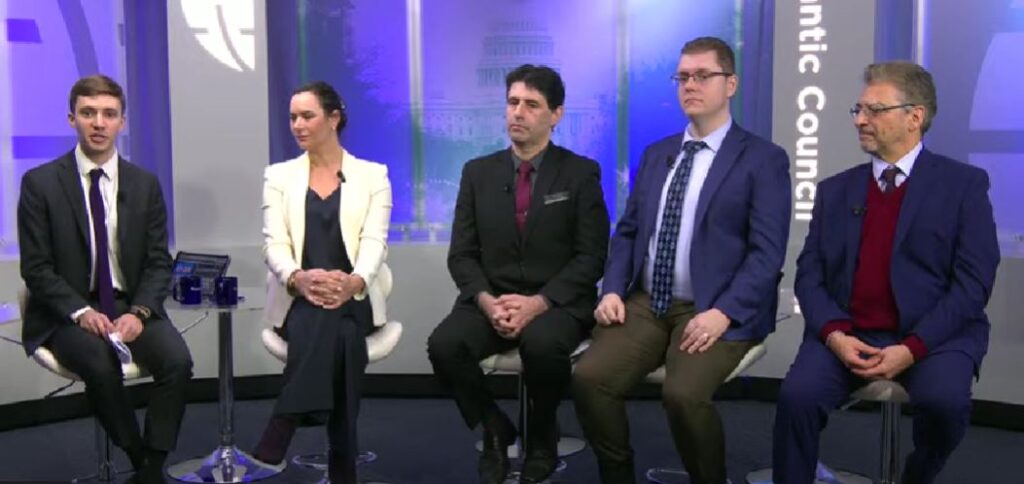
On January 23rd, the Atlantic Council’s Eurasia Center and the International Tax and Investment Center gathered together the authors of the report, “Leveraging Central Asia’s Rare Earth Elements for Economic Growth.” The report highlights the potential of Central Asia, which has remained underappreciated in terms of its rare earth elements (REE) resources, despite its increasing geopolitical significance. China currently dominates the global mining and refining of REEs, giving it a near-monopoly status. The report argues that this scenario calls for an urgent need to diversify global supply chains and suggests that Western investment could play a pivotal role in exploring and mining Central Asia's REEs, thereby contributing to the diversification of supply chains. Furthermore, such investment could have far-reaching implications for the region itself, bolstering regional integration and sovereignty, spurring economic growth, and enhancing economic freedom throughout Central Asia. Opening the discussion, Ariel Cohen, a Nonresident Senior Fellow at the Eurasia Center of the Atlantic Council, highlighted the critical geopolitical location of Central Asia, stating that REEs “may be the next big thing in Central Asia at the engine of economic growth.” Cohen praised the “visionary multi-vector policy pioneered” in Kazakhstan by President Tokayev, and characterized Kazakhstan’s relationship with Russia as “very fraught,” and defined by “multi-generational trauma. Nuclear energy is zero emission energy,” he said, but for the U.S. to capitalize on opportunities for mining REEs in Kazakhstan, “we need to do more and better.” The President of Second Floor Strategies, a public policy consulting company, Wilder Alejandro Sánchez emphasized that Kazakhstan and Uzbekistan are the most “forward-looking” nations in Central Asia in regard to REEs, whilst mining in Kyrgyzstan remains stuck in a “legal limbo,” and Tajikistan currently lacks the necessary critical infrastructure. Nether the less, he stated, REEs could become a driving factor behind regional “cooperation and integration.” Wesley Hill, an International Program Manager at the Energy, Growth, and Security Program of the International Tax and Investment Center, spoke about the international relations components of REEs. “In the same way we competed and continued to compete for other energy resources, most especially crude oil, we will be competing for REEs,” he stated. “It's happening already, this geopolitical clash [which is] primarily driven by competition between the United States and China. After the publication of this report, Beijing cut off all exports of rare earth element refining technologies to the United States. Central Asia is very much at a crossroads,” he stated. Addressing this geopolitical conflict with China over REEs, Ambassador John Herbst, a Senior Director at the Eurasia Center of the Atlantic Council, stated that Central Asia is a “critical region… rich in rare earth minerals [whilst] China is our principal adversary. They are not a friend of the United States.” Finally, Suriya Evans-Pritchard Jayanti, a Nonresident Senior Fellow at the Eurasia Center of the Atlantic Council, characterized REEs as an “extremely important development opportunity” for Central Asia, particularly given “geostrategic energy realignment after the Russian invasion of Ukraine. I think it's a geostrategic realignment opportunity for...

Excise tax increase provokes a rise in alcohol prices

Alcohol prices in Turkmenistan have changed twice this month: at the beginning of the year they doubled, and by the end of the month they almost returned to the previous level. The order to reduce prices, as reported in the Chronicles of Turkmenistan, came from the Ministry of Trade and Foreign Economic Relations. Thus, Turkmen wines went up in price from $2-2.86 per bottle to $2.86 - $4.29. Cognac went up from $8.59-14.31 to $10-17.17, vodka - from $8.59-10 to $17.17, expensive brands of vodka in liter bottles - from $28.62 to $42.94, beer - from $4.29-5.72 to $8.59-11.45. At the same time, the quality of alcoholic beverages produced in the country leaves much to be desired - consumers note that most of the wines are produced not from grapes, but from Chinese powder. The increase in alcohol prices was due to another increase in excise taxes from January 1, 2024. Excise tax on beer increased from 30% to 34.5%, on wines and spirits, depending on the degree - from 39%, 61% and 77% to 44.85%, 70.15% and 88.55% respectively, the publication notes. New excise tax rates are also introduced in neighboring Uzbekistan. Thus, the excise tax on domestically produced ethyl alcohol will double to $1.21 per liter. At the beginning of 2023, it increased fivefold. Excise on some types of alcoholic beverages will increase by 5% later - from July 1. However, tariffs for imported alcohol are again reduced by about 5%. Now the minimum wholesale and retail prices for alcoholic beverages in Uzbekistan vary within the following limits: wines - $1.17 -1.33 per 1 liter of finished product, cognac, $4.65 - 5.35, vodka and other alcoholic products (except beer) $3.48. For comparison, in Kazakhstan from October 1, 2023, the minimum retail price of vodka, strong liquor and vodka products was $4.69 per liter, cognac and brandy $6.95 per liter. This Central Asian country, according to WHO, has the highest alcohol consumption compared to its neighbors. Kyrgyzstan ranks second, Turkmenistan third, followed by Tajikistan and Uzbekistan. Nevertheless, all countries in the region, except Tajikistan, have seen a decline in per capita alcohol consumption. For example, in Kazakhstan in 2010 it was 9.3 liters, and in 2016 this figure decreased to 7.7 liters. In Kyrgyzstan, during this time, total alcohol consumption decreased from 10.2 liters to 6.2 liters per capita. Similarly, in Uzbekistan, alcohol consumption fell from 3.2 liters to 2.7 liters. The same situation in Turkmenistan - alcohol consumption fell from 6 liters to 5.4 liters per capita. Only in Tajikistan is the opposite situation observed. People there began to consume more alcohol - 3.3 liters against 2.4 liters. Recall that all Central Asian countries have a ban on advertising of alcoholic beverages, and a number of measures are taken to reduce the consumption of alcohol by the population. For example, in Kazakhstan, Uzbekistan, Tajikistan and Turkmenistan the minimum legal age to buy alcohol is 21; only in Kyrgyzstan can it be bought from the age of 18.