• KGS/USD = 0.01144 0%
  • KZT/USD = 0.00212 0%
  • TJS/USD = 0.10456 0.19%
  • UZS/USD = 0.00008 0%
  • TMT/USD = 0.28490 0%
  • KGS/USD = 0.01144 0%
  • KZT/USD = 0.00212 0%
  • TJS/USD = 0.10456 0.19%
  • UZS/USD = 0.00008 0%
  • TMT/USD = 0.28490 0%
  • KGS/USD = 0.01144 0%
  • KZT/USD = 0.00212 0%
  • TJS/USD = 0.10456 0.19%
  • UZS/USD = 0.00008 0%
  • TMT/USD = 0.28490 0%
  • KGS/USD = 0.01144 0%
  • KZT/USD = 0.00212 0%
  • TJS/USD = 0.10456 0.19%
  • UZS/USD = 0.00008 0%
  • TMT/USD = 0.28490 0%
  • KGS/USD = 0.01144 0%
  • KZT/USD = 0.00212 0%
  • TJS/USD = 0.10456 0.19%
  • UZS/USD = 0.00008 0%
  • TMT/USD = 0.28490 0%
  • KGS/USD = 0.01144 0%
  • KZT/USD = 0.00212 0%
  • TJS/USD = 0.10456 0.19%
  • UZS/USD = 0.00008 0%
  • TMT/USD = 0.28490 0%
  • KGS/USD = 0.01144 0%
  • KZT/USD = 0.00212 0%
  • TJS/USD = 0.10456 0.19%
  • UZS/USD = 0.00008 0%
  • TMT/USD = 0.28490 0%
  • KGS/USD = 0.01144 0%
  • KZT/USD = 0.00212 0%
  • TJS/USD = 0.10456 0.19%
  • UZS/USD = 0.00008 0%
  • TMT/USD = 0.28490 0%

Viewing results 1915 - 1920 of 2871

USAID Launches New Project to Empower Communities in Uzbekistan

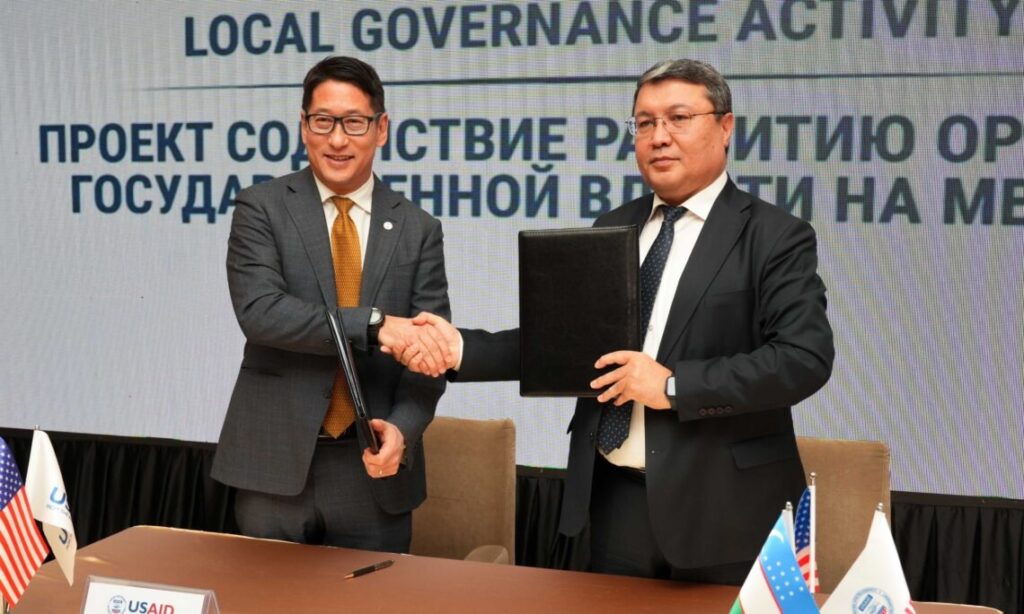
The United States Agency for International Development (USAID) has launched the Local Governance Activity in Uzbekistan, the U.S. Embassy in Uzbekistan has stated. Implemented by Chemonics International, the project will work closely with national government counterparts to improve the responsiveness and accountability of local governments, enhance citizen engagement, and promote a more inclusive and equitable decision-making processes. As a significant step towards strengthening collaboration and advancing local governance goals, the Ministry of Justice of Uzbekistan and USAID signed a Memorandum of Understanding (MOU) during the project launch ceremony on December 14th. The MOU outlines the framework for collaboration between the two parties, focusing on enhancing the legal and regulatory environment for effective local governance, promoting citizen participation, and strengthening the capacity of local government institutions. “Empowering local communities to participate actively in governance is essential for building a more responsive and accountable government,” said USAID Mission Director in Uzbekistan, David Hoffman. “This activity will work to strengthen the voices of citizens, particularly women, youth, people with disabilities, and minority groups, ensuring that their needs are heard and addressed at a local level.” The Local Governance Activity will identify and address the diverse needs of various stakeholders, including citizens, entrepreneurs, marginalized populations, activists, influencers, media, and other government entities. Through this inclusive approach, the activity will ensure local governance reforms are tailored to the specific needs and realities of Uzbek communities. Additionally, it aims to strengthen collaboration with national counterparts, ensure that the project’s activities are aligned with the Uzbekistan Strategy 2030, and that outcomes are sustainable beyond the project’s lifespan. Through collaboration, innovation, technical expertise, and a focus on user-centered approaches, the Local Governance Activity will work to address the diverse needs of Uzbek communities and contribute to a more inclusive, responsive, and accountable government.

Uzbekistan Plans to Manufacture One Million Cars a Year by 2030

Uzbekistan Plans to Manufacture One Million Cars a Year by 2030 The number of cars manufactured in Uzbekistan has grown threefold in recent years, with total annual production expected to reach 415,000 by the end of this year. This was said at a government meeting chaired by President Shavkat Mirziyoyev on December 14th. In order to end the state monopoly and develop competition in the Uzbek automotive industry, three new private automakers and prestigious foreign brands have been attracted to Uzbekistan. Today, eight plants in the country manufacture dozens of types of cars, freight and passenger transport, and agricultural machinery. In addition, more than 2,000 enterprises in the industry closely cooperate with each other, and a 50% localization of component production is ensured. It was said at the meeting that by 2030, Uzbekistan plans to increase the annual production of passenger cars to a million. Today, the world's leading automakers are switching to the production of electric vehicles. If domestic enterprises are slow to develop in this direction, in the future they will face difficulties in occupying a worthy place in the market. Uzbekistan has already started the first projects in this direction. It is planned that next year a car plant capable of producing 10,000 electric vehicles a year will be launched in the country. The President pointed out the importance of special attention being paid to the production of electric vehicles, and ordered the production of components for them.

Australian Company to Help Digitalize Gold Mining in Uzbekistan

Australian Company to Help Digitalize Gold Mining in Uzbekistan A meeting of the plant's management with a delegation from the Australian company, Micromine took place at the representative office of JSC NMMC in Tashkent. During the meeting, strategic aspects of the digital transformation of NMMC JSC aimed at improving the efficiency and competitiveness of the plant were discussed. Representatives of both sides noted the importance of integrating modern technologies into the company's current projects in order to optimize processes and increase productivity. During the meeting, the parties also discussed the prospects for further cooperation, especially in the context of the digital transformation of the enterprise. It is noted that the use of modern technologies and tools can significantly improve the efficiency of mining operations and reduce the cost of mining. Micromine is known for its digital solutions for mining, engineering, and the optimization of production processes. It has a wide range of products and services covering almost all mining processes, the report states.  

Central Asia’s Growing Economic and Strategic Importance Comes to Fore

The Central Asian region has experienced a tremendous economic transformation since the beginning of the century. Its aggregate gross domestic product (GDP) now totals $397 billion, growing 8.6-fold since the year 2000. Its share in global GDP in purchasing power parity (PPP) has also increased 1.8 times. The GDP per capita has tripled as the labor pool has grown to almost 80 million, representing a 1.4-fold increase since 2000. The region’s strategic importance, particularly thanks to its geographic position bridging major economies of Europe and Asia, makes it a key player in geopolitical dynamics. Central Asia’s dependence on commodity exports and remittances has so far limited its integration into global value-chains. The Central Asia Regional Economic Co-operation (CAREC) Program, established by the Asian Development Bank (ADB), plays an important role in fostering regional development and co-operation. CAREC includes the five Central Asia countries (namely Kazakhstan, Kyrgyzstan, Uzbekistan, Tajikistan and Turkmenistan) plus Afghanistan, Azerbaijan, China, Georgia, Mongolia and Pakistan. CAREC also partners with five multilateral international institutions in addition to the ADB (which serves as its Secretariat). These are the European Bank for Reconstruction and Development (EBRD), International Monetary Fund (IMF), Islamic Development Bank (IsDB), United Nations Development Program (UNDP) and the World Bank (a.k.a. International Bank for Reconstruction and Development or IBRD). The Program has constructively helped the countries of Central Asia to address challenges in trade governance. Nevertheless, inefficiencies in cross-border transport and customs procedures continue to hinder their commercial exchanges with one another as well as with external partners. CAREC’s current policy-implementation priorities are integration of regional trade, digitization, climate change, regional co-operation, development of financial technologies and financing in the water sector. There is still significant potential for further development given that the region’s trade within itself has been growing faster than its foreign trade. Enhancing Central Asia’s role in the global economy will require the implementation of co-operative initiatives already identified, especially in infrastructure. Such construction of new physical plants, as well as the renovation and building-out of those that already exist, is crucial for enhancing economic growth and sustainability. This strategy will leverage the region’s strengths such as its strategic location and resource endowments. In 2023, Central Asia’s economic growth is projected to remain relatively steady at 3.9 percent, but this may still be affected by the global challenges of weak external demand, rising inflation and supply-chain disruptions. These global economic conditions, along with the uncertainties that they engender, reflect continuing burdens of the ongoing post-COVID recovery as well as the effects of the war in Ukraine, which significantly impacts the region. In addition to the ADB, the IBRD also focuses on various development initiatives in Central Asia that aim to support regional infrastructure development and the strengthening of cross-border co-operation. These are implemented through relatively low-profile initiatives such as the Central Asia Water and Energy Program (CAWEP) to enhance energy and water security and the Central Asia Hydrometeorology Modernization Project (CAHMP) to improve weather, climate and hydrological services. The IBRD thus aims to increase...

Uzbek Blogger Jailed for 7 1/2 Years

The Tashkent regional court has dismissed an appeal by blogger Lemara Mirzaahmedova on December 13, upholding her 7 1/2-year prison term issued in October, as reported by RFE/RL's Uzbek Service. Her conviction, based on defamation, slander, and extortion charges linked to critical social-media posts about the government, faced staunch opposition from supporters who view it as retribution by authorities. Mirzaahmedova, detained in March, is seen by human rights watchdogs as part of a concerning trend in Tashkent, marked by an uptick in criminal cases targeting independent bloggers.

Consulate General of Uzbekistan Officially Inaugurated in Osh

The Consulate General of Uzbekistan celebrated its official inauguration in Osh city, fostering economic, cultural, and humanitarian ties and offering support to Uzbek citizens in the region. The ceremony drew notable figures like Vice Mayor Nurbek Kadyrov, Presidential Representative Elchibek Zhantaev, and Ambassador Khurshid Mirzakhidov, emphasizing the consulate's role in advancing cooperation. Zafarbek Akhmedov, a seasoned diplomat previously overseeing the Consular and Legal Department at Uzbekistan's Ministry of Foreign Affairs, heads this mission at 54 years old. Established in 2022, the consulate, led by Akhmedov, serves Batken, Jalal-Abad, and Osh regions in Kyrgyzstan.