• KGS/USD = 0.01144 0%
  • KZT/USD = 0.00208 0%
  • TJS/USD = 0.10414 -0.29%
  • UZS/USD = 0.00008 0%
  • TMT/USD = 0.28571 0%
  • KGS/USD = 0.01144 0%
  • KZT/USD = 0.00208 0%
  • TJS/USD = 0.10414 -0.29%
  • UZS/USD = 0.00008 0%
  • TMT/USD = 0.28571 0%
  • KGS/USD = 0.01144 0%
  • KZT/USD = 0.00208 0%
  • TJS/USD = 0.10414 -0.29%
  • UZS/USD = 0.00008 0%
  • TMT/USD = 0.28571 0%
  • KGS/USD = 0.01144 0%
  • KZT/USD = 0.00208 0%
  • TJS/USD = 0.10414 -0.29%
  • UZS/USD = 0.00008 0%
  • TMT/USD = 0.28571 0%
  • KGS/USD = 0.01144 0%
  • KZT/USD = 0.00208 0%
  • TJS/USD = 0.10414 -0.29%
  • UZS/USD = 0.00008 0%
  • TMT/USD = 0.28571 0%
  • KGS/USD = 0.01144 0%
  • KZT/USD = 0.00208 0%
  • TJS/USD = 0.10414 -0.29%
  • UZS/USD = 0.00008 0%
  • TMT/USD = 0.28571 0%
  • KGS/USD = 0.01144 0%
  • KZT/USD = 0.00208 0%
  • TJS/USD = 0.10414 -0.29%
  • UZS/USD = 0.00008 0%
  • TMT/USD = 0.28571 0%
  • KGS/USD = 0.01144 0%
  • KZT/USD = 0.00208 0%
  • TJS/USD = 0.10414 -0.29%
  • UZS/USD = 0.00008 0%
  • TMT/USD = 0.28571 0%

Viewing results 361 - 366 of 807

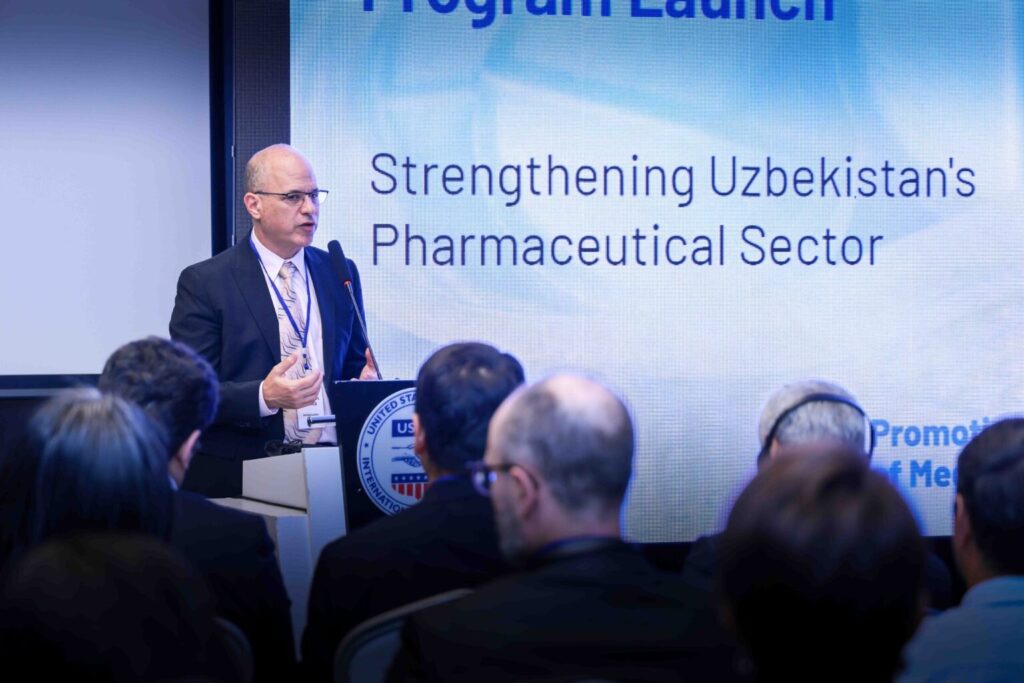
U.S. Support for Uzbekistan’s Pharmaceutical Industry

The launch of USAID’s Diversifying Asia’s Pharmaceutical Supply Chain project was attended by U.S. Ambassador to Uzbekistan Jonathan Henick and representatives of the country’s Ministry of Health and Agency for Development of the Pharmaceutical Industry. Running for two years and costing US $2.5 million, the project aims to strengthen local pharmaceutical regulation, enhance local technology and workforce skills, and attract investment in the industry. It will also ensure that medicines produced in Uzbekistan meet both national and international quality standards. Speaking at the launch, Henick stated, “Through our partnership, we will improve the health of the people of Uzbekistan while also improving the strength and responsiveness of the public and private pharmaceutical sectors. By aligning with global standards, we not only protect patients but also boost trust in local medicines, pharmaceutical companies, pharmacists, and the healthcare system as a whole.” A key objective of the project is promoting domestic production of medicines to boost the sector's contribution to the nation’s economic growth. Despite being Central Asia’s largest pharmaceutical supplier, with over 220 private manufacturers, Uzbekistan still relies heavily on imported medicines and raw materials. To address this issue, the Government of Uzbekistan offers various means of support and incentives for local manufacturers including import substitution and robust quality control regulations. Uzbekistan currently produces around 45% of the country’s medicines, a figure which the government aims to increase to 80% by 2026.

World Bank Helps Improve Social Services for Vulnerable People in Uzbekistan

On 24 May, the World Bank’s Board of Executive Directors approved a $100 million concessional loan for an Innovative Social Protection System for Inclusion of Vulnerable People Project to improve access to, and the quality of social services for vulnerable people in Uzbekistan. The project is co-financed by a $2 million grant from the Early Learning Partnership; a multi-donor trust fund managed by the World Bank to support vulnerable children’s development and learning. The grant will be used to evaluate and improve social services’ provision for the well-being of vulnerable children in Uzbekistan’s local communities or ‘mahallas.’ Welcoming the government’s commitment to broadening the nation’s social protection system and provide more inclusive and effective support to vulnerable people, Marco Mantovanelli, World Bank Country Manager for Uzbekistan, commented: “This project will help build the legal and institutional foundations of the care economy. It will also expand access to quality on-demand social services that are currently underprovided to thousands of vulnerable people across the country, including older people, persons with disabilities, survivors of gender-based violence, and vulnerable children.” The project will be implemented by the National Social Protection Agency through the Office of the President of Uzbekistan, in close collaboration with various government agencies, non-governmental organizations, and Uzbekistan’s international development partners. Over 50 community-based territorial social service centers (TSSCs) will be established across the country to improve access to enhanced social care and rehabilitation facilities for over 50,000 vulnerable citizens, including the elderly, people with disabilities, and vulnerable children. The project will also create a platform for a regulated and accredited provision of social services from the private sector and by encouraging external investment, reduce the strain on the state’s institutional-based care and welfare system. Once in operation, the project will equip 1,200 people with disabilities, at least half whom are aged 15-24, with professional skills and employment opportunities. Women will also benefit from legal, health and psychological services offered by the establishment of 29 Women Adaptation and Rehabilitation Centers. Last but not least, the initiative will lay the foundations for shock-responsive social protection in Uzbekistan, including the development of policies, emergency procedures and the piloting of a new climate adaptation program. Serving 100,000 impoverished people living in rural communities, the program is designed to increase awareness of climate-related risks and improve communities’ resilience through the provision of seeds for climate-resistant crops, tools, and training in climate-smart agriculture and climate adaptation practices.  

Uzbekistan to Increase Production and Export of Medicines

Uzbekistan President Shavkat Mirziyoyev called a government meeting  on 23 May to review plans for the country’s pharmaceutical industry. On 10 January, a road map for 2024–2025 was approved for the development of the pharmaceutical industry and the acceleration of related investment projects. This was followed by a presidential decree of 23 January which identified additional measures required to regulate the pharmaceutical sector. To date, a budget of $100 million has been allocated for the realization of new projects in the industry, boosted by an injection of $200 million from Asakabank. As a result, two projects worth $30.5 million have been launched over the past four months, with exports totalling $51 million. However, a lot of potential remains untapped. To redress the balance, plans are now underway to produce pharmaceutical products worth $400 million and increase the exports to $200 million.  A total of 147 projects worth $2 billion will be launched this year alongside the commission of a further 28. The head of state emphasized the need to increase the level of domestically produced medicines available in Uzbekistan and to ensure a balance between price and quality. The meeting also reviewed measures to intensify the work of the innovative pharmaceutical cluster, Tashkent Pharma Park, by launching 12 projects worth $470 million.  

Coca-Cola Opens New Production Plant in Uzbekistan

On 15 May, Laziz Kudratov, Minister of Investment, Industry and Trade of Uzbekistan, James Quincey, Chairman and CEO of The Coca-Cola Company, and Tuncay Özilhan, Chairman of the Board of Anadolu Group attended the launch of a new Coca-Cola non-alcoholic beverage production plant in the Samarkand region. The company’s exclusive partner in Uzbekistan is Coca-Cola İçecek, part of the Turkish Anadolu Group. According to the Uzbek Ministry of Investment, Industry and Trade, the new plant built at a cost of  $80 million, will produce 280 million liters of beverages per year and create 200 jobs. The company has now invested $500 million and created over 1,500 new jobs in three plants in Tashkent and Urgench, and in the Namangan region. The combined annual production exceeds 900 million liters of beverages. Plans were also announced for the construction of a new production line in the city of Namangan, costing $50 million and scheduled to open next year. The heads of The Coca-Cola Company and Anadolu Group commended Uzbekistan’s investment climate which nurtures confidence amongst foreign investors to implement long-term projects. Following the launch, James Quincey and Tuncay Özilhan attended a meeting with Uzbekistan’s president Shavkat Mirziyoyev during which agreements were reached on the further expansion of the Coca-Cola Company’s investment program in Uzbekistan. In response to the company's readiness to increase their presence in Uzbekistan,  the president advised that the state was set to adopt a separate roadmap for the accelerated implementation of this and other promising projects.    

Uzbekistan to Launch New International Bus Routes

Uzbekistan’s Transport Ministry has announced plans to launch ten new international bus routes during this year. The new routes will connect Samarkand and Bukhara with Kyrgyzstan’s capital Bishkek; Bukhara with Kazakhstan’s capital Astana; Samarkand, Bukhara and Shakhrisabz with Turkestan in Kazakhstan; Samarkand and Bukhara with in Tajikistan’s capital Dushanbe, and Tashkent with Ufa and Krasnodar in Russia. Uzbekistan currently runs 196 buses operated by 32 domestic and foreign companies,on 37 routes to Russia, Kazakhstan, Kyrgyzstan, and Tajikistan. From January-April 2024, 173 thousand passengers travelled on international bus routes, 15% more than during the same period in 2023.    

Launch of Flights Between Almaty and Nukus

From 1 June, Uzbekistan Airways will begin operating regular flights between Almaty in Kazakhstan and Nukus, the main city of Uzbekistan’s north-western Karakalpak Autonomous Region. Flights on a 174-seat A320 aircraft, will operate twice a week, on Wednesdays and Saturdays. In welcoming the move, the Ministry of Transport of Kazakhstan said that the new air route would greatly enhance the development of trade, economic and business cooperation between Kazakhstan and Uzbekistan. The introduction of the flights will also benefit tourism, making it easier and quicker to visit the region’s renowned Savitsky Museum, home to one of the world’s best collections of Soviet art; the Muynak Ship Cemetery on the fast-disappearing Aral Sea, and the ancient city of Mizdakhan. The total number of international flights from Kazakhstan now stands at 567 per week on 121 air routes, including direct flights to 28 countries.