• KGS/USD = 0.01144 0%
  • KZT/USD = 0.00210 0%
  • TJS/USD = 0.10431 0.1%
  • UZS/USD = 0.00008 0%
  • TMT/USD = 0.28571 0%
  • KGS/USD = 0.01144 0%
  • KZT/USD = 0.00210 0%
  • TJS/USD = 0.10431 0.1%
  • UZS/USD = 0.00008 0%
  • TMT/USD = 0.28571 0%
  • KGS/USD = 0.01144 0%
  • KZT/USD = 0.00210 0%
  • TJS/USD = 0.10431 0.1%
  • UZS/USD = 0.00008 0%
  • TMT/USD = 0.28571 0%
  • KGS/USD = 0.01144 0%
  • KZT/USD = 0.00210 0%
  • TJS/USD = 0.10431 0.1%
  • UZS/USD = 0.00008 0%
  • TMT/USD = 0.28571 0%
  • KGS/USD = 0.01144 0%
  • KZT/USD = 0.00210 0%
  • TJS/USD = 0.10431 0.1%
  • UZS/USD = 0.00008 0%
  • TMT/USD = 0.28571 0%
  • KGS/USD = 0.01144 0%
  • KZT/USD = 0.00210 0%
  • TJS/USD = 0.10431 0.1%
  • UZS/USD = 0.00008 0%
  • TMT/USD = 0.28571 0%
  • KGS/USD = 0.01144 0%
  • KZT/USD = 0.00210 0%
  • TJS/USD = 0.10431 0.1%
  • UZS/USD = 0.00008 0%
  • TMT/USD = 0.28571 0%
  • KGS/USD = 0.01144 0%
  • KZT/USD = 0.00210 0%
  • TJS/USD = 0.10431 0.1%
  • UZS/USD = 0.00008 0%
  • TMT/USD = 0.28571 0%

Viewing results 733 - 738 of 1133

Uzbekistan Taking Steps Towards Cleaner Water

In December 2023, a United Nations Development Program (UNDP) delegation participated in the opening of a refurbished water treatment plant in the village of Shuyt in Uzbekistan's autonomous republic of Karakalpakstan. It will provide clean drinking water to 1,500 residents of the surrounding area. This is a joint UNDP, UN International Children's Emergency Fund (UNICEF) and Food & Agriculture Organization (FAO) program called Empowering Youth Towards a Bright Future through Green and Innovative Development in the Aral Sea Region, funded by the UN Multi-Partner Trust Fund for Human Security for the Aral Sea Region in Uzbekistan. The project has the support of the governments of Uzbekistan, Norway, the European Union (EU), Finland, South Korea, Germany, and Alwaleed Philanthropies. UNDP, in cooperation with partner organizations, systematically assists remote regions of Uzbekistan to establish access to drinking water. Under a small-grants program implemented by the joint UNDP/GEF and the Uzbek State Committee of Ecology project for sustainable use of natural resources and forest management in key mountainous regions important for globally significant biodiversity, a 6.5-km pipeline was laid in the village of Chukur in the Kashkadarya region of Uzbekistan. It has provided about 1,500 people with clean drinking water for which the villagers used to walk long distances with buckets to the nearest spring. According to the World Health Organization (WHO), 70% of all diseases globally are associated with poor-quality drinking water that does not meet sanitary and hygienic standards. The region of Priaralie demonstrates the large-scale problems which can arise in the absence of potable water. In the most remote areas of this region, groundwater is the main source of fresh water - but such water cannot be used directly for drinking due to the presence of a large number of harmful and poisonous substances such as pesticides, mineral salts in large quantities, and heavy metals. That's caused by the systematic pollution of underground aquifers and the lack of modern drinking water treatment systems. All this has led to a massive deterioration in the health of the population of the Aral Sea region. According to the Pravda Vostoka newspaper, as of June 2023, the drinking water availability rate in Priaralie was 71%, and at the beginning of 2019, only 52.4%. By the end of 2023, 5,473 households were connected to water-supply networks, and water meters were installed for households free of charge. Construction of treatment facilities using modern standards is underway in the region. Since December 2021, construction has been underway in several districts of the country on 10.73 kilometers of drinking-water supply and wastewater networks, and three wastewater treatment plants, with a projected cost of $3 million. Construction of a wastewater treatment plant with a capacity of 30,000 cubic meters of water per day is ongoing in the city of Nukus, along with 16 pumping stations and wastewater disposal networks with a length of 88 kilometers. The projects are expected to increase the local population's drinking water supply by more than 74% this year.
CIPE’s Inaugural B5+1 Forum Opens in Almaty

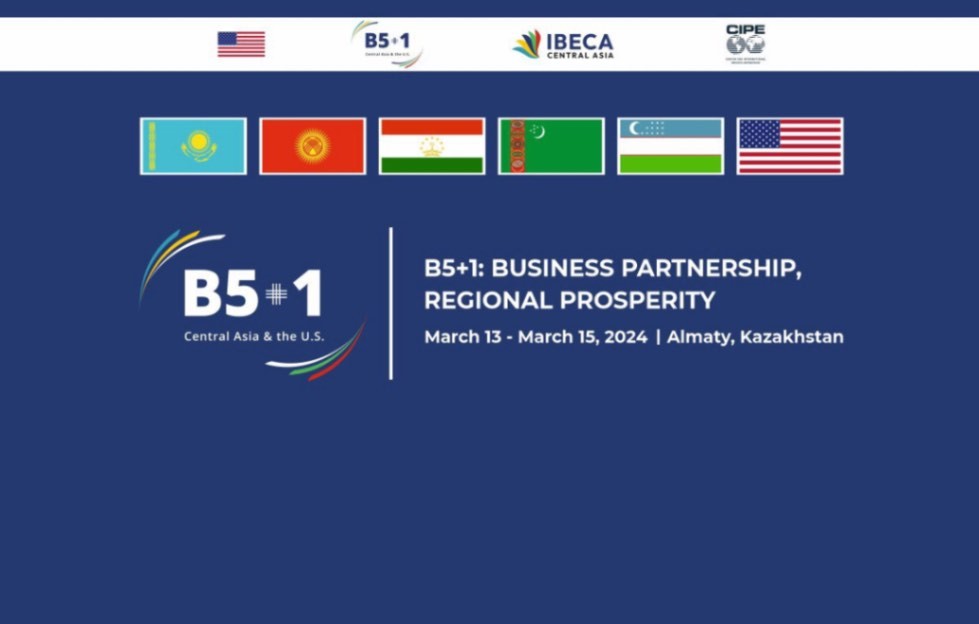
In recent years the countries of Central Asia have taken more confident steps towards working with the United States and Europe, so that both local and international companies and agencies can capitalize on the region’s potential.  Instrumental in this process has been the Center for International Private Enterprise (CIPE), which last year created the diplomatic ‘C5+1’ platform – a group comprising the governments of the five Central Asian republics – Kazakhstan, Uzbekistan, Kyrgyzstan, Tajikistan and Turkmenistan – plus the United States, whose State Department has been integral to the development of the platform. Following the first C5+1 Summit in New York in September 2023, led by the presidents of all six countries, CIPE has now created a dedicated business platform for these nations: ‘B5+1’. The inaugural B5+1 Forum will be held in Kazakhstan’s business capital of Almaty this week, and will bring together policy makers from Central Asia, America and other countries, as well as high-profile private companies working in the region.  At the C5+1 Summit, presidents Biden, Tokayev, Mirziyoyev, Japarov, Rahmon and Berdimuhamedov had committed to the establishment of B5+1 in order to “accelerate regional cooperation and connectivity [and]… advance efforts to create a more favorable business environment for U.S. private sector trade and investment in Central Asia.” The B5+1 event will be divided into two thematic days: “Looking within Central Asia” on Thursday 14 March, where representatives of the US Department of State, Kazakhstan’s Ministry of National Economy, the Caspian Policy Center and others will present their visions for improving Central Asia’s investment climate and economic integration; and “Central Asia’s place in the world economy” on Friday 15 March, where leaders from the US-Kazakhstan Business Council, the American-Uzbekistan Chamber of Commerce, the European Bank for Reconstruction and Development (EBRD) and others will look outwards, to give an international perspective on how the region can grow its trade and investment volumes. At a time of geopolitical upheaval and disruption of existing supply chains, the Almaty forum will also continue the conversation on enhancing regional connectivity via the Trans-Caspian International Transport Route, also known as the Trans-Caspian Corridor. The B5+1 Forum forms part of CIPE’s program called “Improving the Business Environment in Central Asia” (IBECA). CIPE themselves are affiliated to the US Chamber of Commerce – the catalyst behind the B7 and B20 platforms – and receive funding from the US Department of State.  The establishment of B5+1 is closely aligned with commitments made during the September C5+1 Presidential Summit and outlined in a document called the New York Declaration to strengthen their economic relations, and improve the business environment for regional economic integration and investments. The upcoming Forum aims to deliver on two key commitments in the declaration. The Times of Central Asia will be in attendance at the B5+1 Forum on 14-15 March, and will be publishing insight and analysis from the event.

Uzbekistan Ranks Fifth Among Tajikistan’s Bilateral Trade Partners

In a report issued by the Tajik state news outlet Khovar, Tajikistan's and Uzbekistan's intergovernmental commission on trade and economic cooperation met in Dushanbe on March 12th. The Tajik side stated its interest in collaborating with the Uzbek industrial sector to develop sizable industrial parks in Tajikistan. Proposals currently under consideration include production in the fields of building materials, pharmaceuticals, electronics, information technology, food, mining and metallurgy, textiles and clothing, and agricultural machinery and equipment. In addition, representatives from both countries shared perspectives on the the manufacture of tyres in cooperation with OJSC Talko, as well as the joint production of automobiles in Tajikistan. In 2023, bilateral trade between the two countries reached $500 million. With a share of 6.1 percent of Tajikistan's foreign trade total, Uzbekistan ranks fifth among its bilateral trade partners.

The C5+1 Concept: The Idea Behind This Week’s B5+1 Forum in Almaty

Recognizing that the Central Asia region could benefit more from initiatives in global security, business and trade if its countries strengthened their cooperation in key areas, the Center for International Private Enterprise (CIPE) created the ‘C5+1’ platform last year for just this purpose. The Center’s 5+1 group features the governments of the five Central Asian republics – Kazakhstan, Uzbekistan, Kyrgyzstan, Tajikistan and Turkmenistan – plus the United States, whose State Department and international chambers of commerce are central to the platform’s work. An inaugural C5+1 Summit was held in September 2023, on the sidelines of the 78th session of the UN General Assembly in New York. At this high-level meeting, the presidents of each of the Central Asian nations joined US president Joe Biden in dialog on enhancing the region’s stability and prosperity through economic, energy, and security partnerships within the C5+1 framework.  Building on this start made by C5+1, CIPE is now launching the ‘B5+1’ format, focused on cooperation in the global business context. The inaugural B5+1 Forum will take place this week in Kazakhstan’s business capital of Almaty, and will include presentations and panel discussions with policy makers from the United States, Central Asia and several other countries. On 14 and 15 March leaders from the public sector will discuss Central Asia’s economic integration, international trade and investment alongside dozens of influential private companies.  The B5+1 Forum will pick up where the C5+1 Summit left off in exploring opportunities for American companies in Central Asia. This potential lies in key sectors such as critical minerals, renewable energy and manufacturing. The Almaty event will also continue the conversation on enhancing regional connectivity via the Trans-Caspian International Transport Route, also known as the Trans-Caspian Corridor. At a time of geopolitical upheaval and disruption of existing supply chains, international investment in this trade route is being sought through the Partnership for Global Infrastructure and Investment. The B5+1 Forum forms part of CIPE’s program called “Improving the Business Environment in Central Asia” (IBECA). CIPE themselves are affiliated to the US Chamber of Commerce – the catalyst behind the B7 and B20 platforms – and receive funding from the US Department of State.  The establishment of B5+1 is closely aligned with commitments made during the C5+1 Summit last September, and outlined in a document called the New York Declaration. The upcoming Forum aims to deliver on two key commitments in the declaration.   The Times of Central Asia will be in attendance at the B5+1 Forum on 14-15 March, and will be publishing insight and analysis from the event.

Uzbekistan to Get Two More Wind Farms to Support Domestic Energy Sector

Saudi company ACWA Power will build two more wind farms in Uzbekistan with a total capacity of 800 MW. One of them will be located in the Kungrad district of Karakalpakstan, and the second in the Gijduvan district of Bukhara region. The agreement, signed back in November 2023, envisages an investment of almost $1.1 billion. Under the agreement, ACWA Power will sell electricity generated by these power plants to JSC National Electric Networks of Uzbekistan for 25 years. The Saudi company considers Uzbekistan promising in terms of energy investments. According to the republic's national strategy, it plans to increase its share of green energy up to 25% nationally by 2030. ACWA has already invested $7.5 billion in the republic's energy sector. The largest of its projects are the construction of a combined cycle heat-power plant (CCHP) with a capacity of 1.5 GW in the Syrdarya region, a wind farm with a capacity of 1.5 GW in Karakalpakstan, and two CCHPs with a total capacity of 1 GW in Bukhara region. The company also plans to produce green hydrogen in Uzbekistan. This project, which was finalized and launched in November of last year, will be realized in two stages. To start, a 2.4 GW power plant will produce 500 thousand tons/year of green hydrogen, which will then be used for the production of nitrogen fertilizers. According to experts' calculations, this will save 33 million tons of natural gas. The company has launched the first such project in its home country, and the second oneis scheduled for the end of this year. In recent years, the republic has embraced green energy, which now accounts for only 10% of the country's total electricity output. By comparison, in Germany in 2023, renewable energy sources provided up to 60% of the total electricity generated in the country. The President of Uzbekistan has repeatedly emphasized in his speeches that the country's green energy capacity exceeds its needs by 10-12 times. For Uzbekistan, decarbonization of the energy sector is becoming a priority not only from an economic point of view. It's also required by pressing environmental conditions in hot, dry Central Asia - conditions which are deteriorating by the day. According to a World Bank report titled Country Report on Climate and Development, by 2030 at least eight million people across the country will live in areas threatened by very high climate risks. According to the authors of the report, abandoning traditional energy sources will enable Uzbekistan not only to strengthen the country's energy security, but also to rid itself of one of the main causes of high mortality - air pollution.

US Policymakers and Central Asian Business Leaders Gather in Almaty for the CIPE B5+1 Forum

Cooperation and trade with Central Asia still holds much unrealized potential. The region is developing fast and offers opportunities for companies and agencies, both international and local. As the global geopolitical landscape changes and supply chains are disrupted, the importance of Central Asia as a business and transit hub, through initiatives such as the Trans-Caspian Corridor, is growing.  There are therefore great incentives for the five countries of the region – Kazakhstan, Uzbekistan, Kyrgyzstan, Tajikistan and Turkmenistan – to find ways to function as a single integrated market, in order to capitalize on opportunities for foreign and local companies, and attract more international investment and business.  For this reason the Center for International Private Enterprise (CIPE) is inviting policymakers from Central Asia, the United States and other countries to its B5+1 Forum this week. On 14 and 15 March in Kazakhstan’s business capital of Almaty, leading minds from the public sector will discuss Central Asia’s economic integration, international trade and investment, alongside dozens of high-profile private companies.  An event on 14 March entitled “Looking within Central Asia” will introduce the objectives and expected outcomes of the B5+1 format. Presentations by representatives of Kazakhstan’s Ministry of National Economy, the Caspian Policy Center, the US Department of State and Kyrgyzstan’s Ministry of Economy and Commerce will give business-focused perspectives on improving economic integration and the investment climate.  The discussion on 15 March will center on the theme of “Central Asia’s place in the world economy”. Talks from representatives of the US-Kazakhstan Business Council, the American-Uzbekistan Chamber of Commerce and the European Bank for Reconstruction and Development (EBRD) will give an international perspective on promoting trade and investment flows in Central Asia. The B5+1 Forum forms part of CIPE’s program “Improving the Business Environment in Central Asia” (IBECA). CIPE themselves are affiliated to the US Chamber of Commerce – the catalyst behind the B7 and B20 platforms – and receive funding from the US Department of State.  The establishment of B5+1 is closely aligned with commitments outlined in a document called the New York Declaration to strengthen the republics' economic relations, and improve the business environment for regional economic integration and investments. The upcoming Forum aims to deliver on two key commitments in the declaration.   The Times of Central Asia will be in attendance at the B5+1 Forum on 14-15 March, and will be publishing insight and analysis from the event.