• KGS/USD = 0.01144 0%
  • KZT/USD = 0.00207 0%
  • TJS/USD = 0.10437 0.19%
  • UZS/USD = 0.00008 0%
  • TMT/USD = 0.28571 0.28%
  • KGS/USD = 0.01144 0%
  • KZT/USD = 0.00207 0%
  • TJS/USD = 0.10437 0.19%
  • UZS/USD = 0.00008 0%
  • TMT/USD = 0.28571 0.28%
  • KGS/USD = 0.01144 0%
  • KZT/USD = 0.00207 0%
  • TJS/USD = 0.10437 0.19%
  • UZS/USD = 0.00008 0%
  • TMT/USD = 0.28571 0.28%
  • KGS/USD = 0.01144 0%
  • KZT/USD = 0.00207 0%
  • TJS/USD = 0.10437 0.19%
  • UZS/USD = 0.00008 0%
  • TMT/USD = 0.28571 0.28%
  • KGS/USD = 0.01144 0%
  • KZT/USD = 0.00207 0%
  • TJS/USD = 0.10437 0.19%
  • UZS/USD = 0.00008 0%
  • TMT/USD = 0.28571 0.28%
  • KGS/USD = 0.01144 0%
  • KZT/USD = 0.00207 0%
  • TJS/USD = 0.10437 0.19%
  • UZS/USD = 0.00008 0%
  • TMT/USD = 0.28571 0.28%
  • KGS/USD = 0.01144 0%
  • KZT/USD = 0.00207 0%
  • TJS/USD = 0.10437 0.19%
  • UZS/USD = 0.00008 0%
  • TMT/USD = 0.28571 0.28%
  • KGS/USD = 0.01144 0%
  • KZT/USD = 0.00207 0%
  • TJS/USD = 0.10437 0.19%
  • UZS/USD = 0.00008 0%
  • TMT/USD = 0.28571 0.28%

Viewing results 745 - 750 of 1127

Uzbekistan, Azerbaijan Move to Simplify Travel Rules for Each Other’s Citizens

Citizens of Uzbekistan will now be able to stay in Azerbaijan without registration for up to 15 days, according to Uzbekistan's Ministry of Internal Affairs. The same rules apply to citizens of Azerbaijan in Uzbekistan, due to a protocol entering into force that amends an agreement between the government of Azerbaijan and Uzbekistan on visa-free travel. Previously, the period of stay without registration in Uzbekistan was five days, and in Azerbaijan for Uzbeks -- 10 days. The visa-free regime between Uzbekistan and Azerbaijan is already in force: Uzbeks can stay in Azerbaijan for no more than 90 days, and Azeris in Uzbekistan for no more than 30 days. In August of last year, Uzbek president Shavkat Mirziyoyev visited Azerbaijan following his re-election and signed a document on the establishment of the Supreme Interstate Council between the two countries with his counterpart, Azeri President Ilham Aliyev A key component of bilateral cooperation is logistics. Currently the countries are discussing the creation of a logistics company within the Trans-Caspian corridor -- and building warehouse infrastructure and logistics centers in the ports of Baku and those located in third countries. The two countries actively cooperate in many spheres, as evidenced by the sharply increasing trade turnover between the two republics: it has grown by 40% since the beginning of 2023. The two countries plan to increase bilateral trade to $1bn annually. This will be facilitated in part by the Uzbek-Azerbaijani investment fund,  which now has authorized capital of $500m. Three-quarters of that capital is slated to go to Azerbaijan, with a quarter for Uzbekistan. Today, over 200 companies operate in Uzbekistan with Azerbaijani investments.
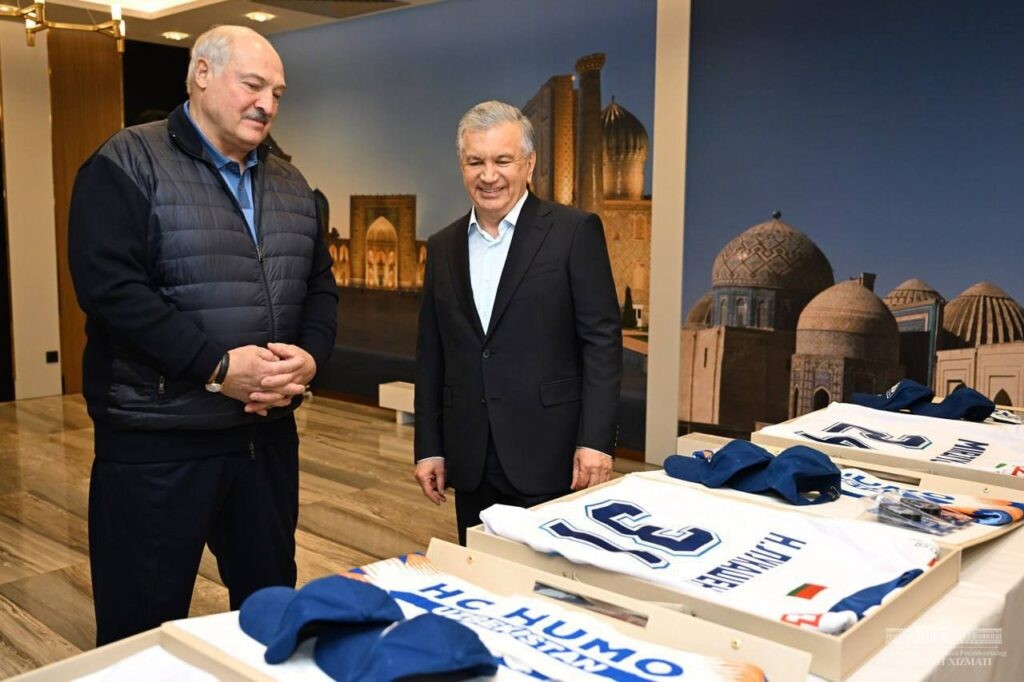

Lukashenko In Uzbekistan To Talk Trade

The president of Belarus Alexander Lukashenko arrived in Uzbekistan on February 7th for a two-day visit, holding official talks with president Shavkat Mirziyoyev in Tashkent. The two leaders discussed their countries' trade, economic and cultural ties. Mr Lukashenko's visit coincided with a meeting of the Business Council in Tashkent, which featured high-ranking officials and important businesspeople from the two countries. Last week a delegation of more than 100 Uzbek businessmen paid a working visit to Belarus, during which a trade house was opened at the Uzbek Chamber of Commerce & Industry in Minsk. Over the past seven years Belarus and Uzbekistan have increased bilateral trade by more than four times; turnover was $565m in 2023. The nations intend to increase this figure to $1bn within two years, expanding cooperation in sectors including agriculture, education, tourism, forestry and housing. At present Uzbekistan's exports to Belarus comprise industrial goods, food products, beverages and tobacco products. In monetary terms, Belarus' s investments in Uzbekistan's economy have increased threefold over the past three years and amount to $45.6m. Uzbekistan in turn buys foodstuffs, machinery and transportation equipment from Belarus.

Uzbekistan Gains Ground Against Corruption in Annual Perception Ranking

International non-governmental organization Transparency International has published its 2023 global ranking of corruption perception. For the last six years, Denmark has held first position, followed by Finland and New Zealand. It's no coincidence that these countries hold the lead in the rule of law index, what with their well-established government and societal institutions and transparent justice systems. Somalia, Venezuela, Syria, South Sudan, and Yemen, which suffer from wars and/or social crises, close out the list. According to the rating, Uzbekistan held 121st place out of 180 - rising five spots on the list in just one year. Over the past decade, the republic has improved its position by 16 spots, becoming the leader in terms of the rate of improvement across the entire index. Among Uzbekistan's neighbors in Central Asia, only Kazakhstan, which ranks 93rd, is higher. In the region, Turkmenistan (170) has the worst record with corruption; Tajikistan is 162nd on the list, and Kyrgyzstan ranked 141st - tied with Russia. According to Transparency International experts, the index revealed that many countries have made little progress in the fight against corruption. Francois Valerian, chairman of Transparency International, said "corruption will continue to thrive as long as justice systems fail to punish wrongdoing and keep governments in check. When justice is bought or interfered with by political forces, people suffer. Leaders must fully invest in and guarantee the independence of institutions that uphold the law and fight corruption. It is time to end impunity for corruption." Transparency International began assessing and compiling the 180-country index in 1995. It's calculated based on perceptions of public sector corruption. The company uses data from 13 external sources, including non-governmental consulting companies and think tanks, the World Bank, the World Economic Forum and others.

President Mirziyoyev Meets Xi Jinping on State Visit to China

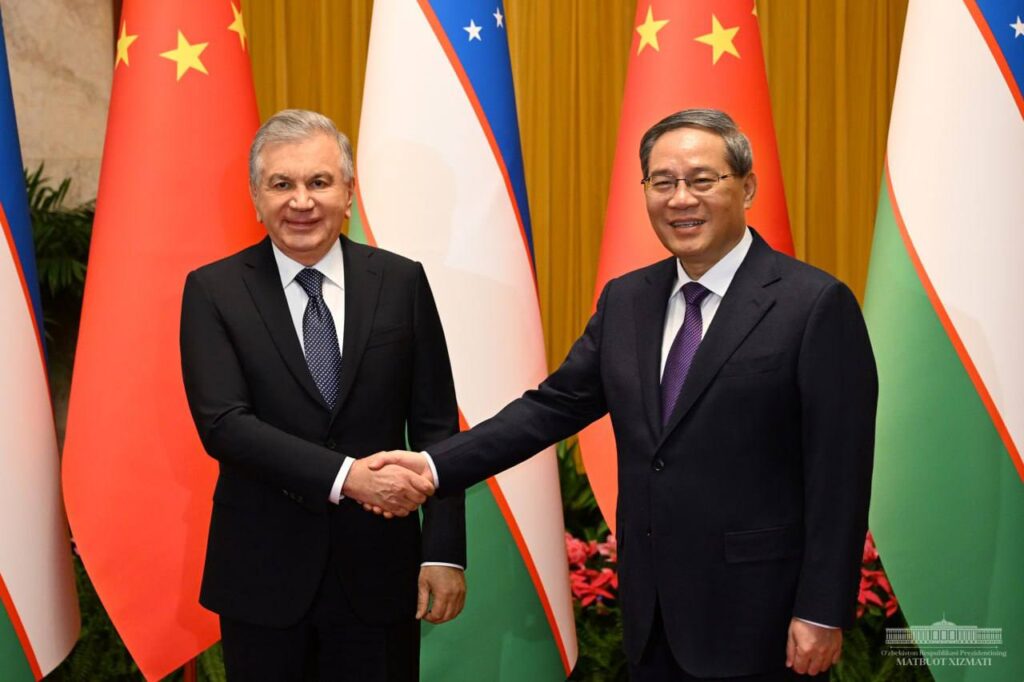
Late on Tuesday night, the President of Uzbekistan’s press service reported that the head of state's plane had landed at Shoudou International Airport, where he was greeted by China's Minister of Culture and Tourism, Sun Yeli and other officials. The president's state visit started on Wednesday with a meeting with the Premier of the State Council, Li Qiang, wherein they discussed the expansion of economic interaction, participation of Chinese companies in privatization in Uzbekistan, increasing the number of flights, and other issues. Many important points were raised at the meeting, such as the 50% increase in trade turnover between China and Uzbekistan over the past year, reaching $14 billion, and the volume of Chinese investment in the Uzbek economy exceeding this same figure. The two parties set their sights on making this figure reach $20 billion. As planned within the framework of the state visit, Mirziyoyev also held meetings with a number of major Chinese corporations important for Uzbekistan. Jin Liqun, President of the Asian Infrastructure Investment Bank (AIIB), discussed the expansion of strategic partnership, Dai Houliang, Chairman of the CNPC oil and gas corporation, talked about the implementation of promising projects in Uzbekistan on the construction of underground gas storage facilities and modernization of gas transportation systems, drilling technologies and the training of specialists, and Xi Guohua, head of the Chinese corporation CITIC, discussed the expansion of the portfolio of joint projects. Mirziyoyev also received Wu Fulin, Chairman of the Export-Import Bank of China, to discuss the bank's plan to open a regional office in Tashkent and prepare new promising projects for the development of transport and social infrastructure, industry, and in the private sector. At the main event of the visit, Mirziyoyev and Chinese President Xi Jinping signed a document which was described on President Mirziyoyev’s website as made possible by a "powerful breakthrough in bilateral relations" in recent years. The agreement includes cooperation in the field of environmental protection; technical and economic cooperation; cooperation in the development of human resources; cooperation between state scientific research institutions; cooperation in the field of teaching the Chinese language; a protocol on deepening cooperation on China-Central Asia-Europe railway and the development of cooperation in the field of new electric vehicles; cooperation in the field of poverty reduction; a protocol on further strengthening of scientific and technical cooperation; on cooperation in the field of standardization, etc. The two sides agreed to continue to comprehensively strengthen mutually beneficial cooperation in various fields and further enrich their strategic partnership.  

Mirziyoyev, Chinese Premier Discuss Economic Cooperation

Uzbekistan’s president Shavkat Mirziyoyev arrived in Beijing on January 23rd to begin a three-day state visit to China at the invitation of Chinese president Xi Jinping.  On January 24th Mr Mirziyoyev had a meeting with the premier of the State Council of China, Li Qiang. The two parties discussed the trade and economic spheres, and both noted that Uzbek-Chinese relations have reached an unprecedented level in all areas, Mirziyoyev’s press service reported. Last year bilateral trade turnover grew by 50%, reaching $14 billion. The sides pointed out the potential for increasing this figure to $20 billion, including by increasing mutual supplies of high-quality agricultural and industrial goods. The total volume of Chinese investments in the economy of Uzbekistan currently exceeds $14 billion. The parties considered joint programs in the fields of infrastructure modernization, technology transfer in agriculture, and the development of green energy. They also discussed the potential for companies in Uzbekistan to cooperate more closely with leading Chinese banks and financial institutions, as well as the participation of Chinese companies in privatization processes in Uzbekistan. The parties also spoke for further expansion of air traffic and tourism initiatives between the two countries. Mr Mirziyoyev also met with the chairman of China National Petroleum Corporation (CNPC), Dai Houliang, to discuss new projects to construct underground natural-gas storage facilities in Uzbekistan and to modernize its gas transportation systems. The introduction of modern drilling technologies and the training of oil and gas workers was also discussed.

Forum Of Uzbek Regions And Chinese Provinces Held In Xinjiang

On January 22nd the first Uzbek-Chinese interregional forum was held in the city of Urumqi, in China’s Xinjiang Uyghur Autonomous Region. The forum was attended by heads of key ministries, industry associations, chambers of commerce and industry, companies and more than 1,200 representatives of the business communities of the two countries. The Uzbek delegation at the forum was headed by deputy prime minister Jamshid Khojaev. The Chinese delegation was led by Ma Xingrui, secretary of the Party Committee of the Xinjiang Uygur Autonomous Region. In their welcoming speeches, the heads of both delegations stated that Uzbek-Chinese relations have entered a qualitatively new stage, which became possible thanks to the far-sighted policies of the heads of the two states, the Uzbek Ministry of Investment, Industry and Trade reported. The officials emphasized the positive dynamics of trade and investment partnership, with bilateral trade turnover having doubled and exceeding $14 billion over the past six years. It was noted that all the necessary capabilities are available to increase this indicator up to $20 billion in the coming years. The volume of utilized Chinese investments in Uzbekistan amounted to almost $15 billion. More than 2,000 enterprises with the participation of Chinese capital operate in Uzbekistan. In 2023 more than 60 projects worth almost $2 billion were successfully launched with the participation of Chinese companies, which are becoming leading partners in modernizing the country's industrial sector. Mr Khojaev and Mr Xingrui outlined the further steps to increase cooperation between the two countries, including through direct interaction between regions, emphasizing the importance of regularly holding exhibitions of the industrial and agricultural potential of the regions of Uzbekistan and the provinces of China. The heads of delegations called on business leaders to step up efforts to create high-tech industries based on the competitive advantages of the economies of the two countries, develop industrial cooperation to produce in-demand products and jointly develop new markets, as well as increase the volume of mutual trade. As a result of the forum, 27 documents were signed on the establishment of economic, trade and cultural ties between the regions of Uzbekistan and the provinces of China. In addition, a solid package of 30 agreements and contracts was signed between the business communities of the two countries.